Table of Contents
1 Introduction
In traditional broadcast (baseband) systems, video and audio are transmitted directly over cables, and all devices share the same physical reference signal—typically a black burst reference—so that all video equipment (cameras, switchers, captioners, recorders, converters, etc.) locks to the same time base.
With the adoption of IP, especially SMPTE-2110, video, audio, and ancillary data (metadata) are separated into independent IP streams (packetized over IP), each transmitted independently over the network. Video, audio, and caption streams may take different paths to reach the receiver, and network latency and jitter can cause these streams to become unsynchronized. Without a unified time reference, the receiver cannot correctly align audio and video frames. Therefore, network transmission alone cannot guarantee timing alignment.
At this point, a different mechanism is required: Precision Time Protocol (PTP), also known as IEEE 1588 (PTP V2). Unlike traditional methods that synchronize devices across a facility, PTP is entirely network-based and can be transported over the same data network connections already used for media transmission or reception, or over parallel networks.
PTP provides a unified time reference for SMPTE-2110 networks, allowing all devices to share the same clock across a distributed IP network. Even if video, audio, or ancillary data streams travel via different paths with varying latency and jitter, they can still be precisely aligned at the receiver. With PTP, devices such as cameras, encoders, decoders, switchers, and audio processors can achieve frame-level and sample-level synchronization, ensuring consistent audio-video playback, switching, and processing in IP-based broadcast systems.
This article is intended to provide a detailed discussion of PTP configuration methods and recommended practices for media networks.
2 PTP Design Options
A typical broadcast station or production center PTP timing network deploys dual Grandmasters (primary + backup). All PTP-aware switches operate in Boundary Clock (BC) mode, and the Priority 1 (P1) value of GM-A should be lower than that of GM-B so that the BMCA can correctly elect the active Grandmaster, master ports, slave ports, and passive ports. All interfaces that connect only to slave devices should be configured as master-only.
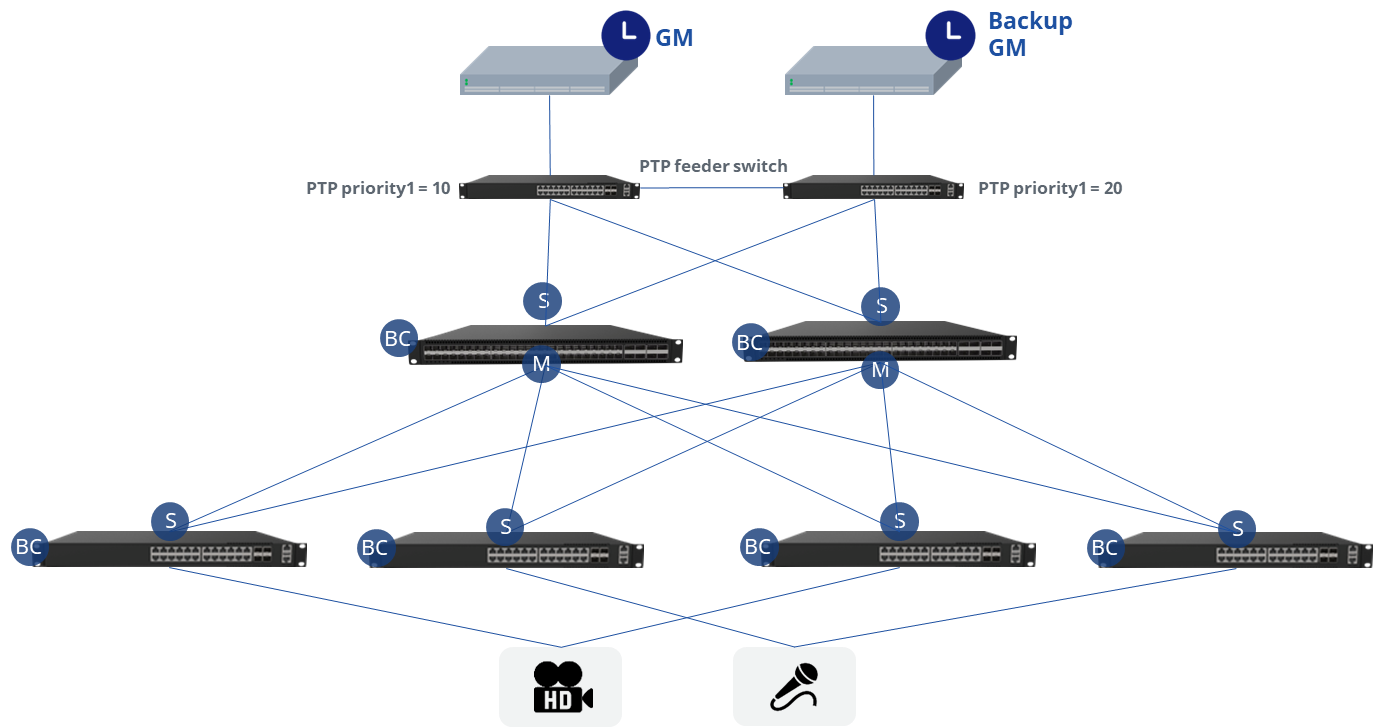
A correctly designed PTP network not only achieves sub-microsecond timing accuracy, but also ensures stability, scalability, and high availability for large-scale ST 2110 environments.
High Availability
A dual-Grandmaster architecture with full-mesh connectivity provides primary and backup timing sources. The BMCA automatically performs switchover in the event of a failure, ensuring uninterrupted synchronization even if one Grandmaster becomes unavailable.
Boundary Clock Deployment
Large broadcast centers or OB vans may host hundreds or even thousands of ST 2110 devices. If every slave were to synchronize directly with the Grandmaster, the resulting surge of Delay_Req messages would impose significant CPU and network load on the GM. Deploying Boundary Clocks creates a hierarchical PTP structure:
- Each BC serves only the devices within its local access domain.
- The GM no longer needs to process every slave device directly.
- BCs absorb jitter, compensate for drift, and distribute timing information locally.
This reduces Grandmaster load, increases scalability, and provides a more robust timing distribution architecture.
Security
On switch interfaces connected to slave devices, configuring ptp role master ensures that the connected device can never become the Grandmaster for the entire network. Even if a misconfigured or rogue device advertises a lower P1 value than the legitimate GM, it will not take over the timing domain, preventing potentially severe system disruptions.
Low Network Jitter and Reduced Timing Error
In large facilities or scenarios involving multi-switch paths, direct GM-to-slave synchronization can introduce significant delay variation. Boundary Clocks provide localized timing adjustment and buffering, distributing stable timing to downstream devices.
This is essential for maintaining the strict synchronisation accuracy required across SMPTE ST 2110 media networks.
Recommended PTP Parameters
Parameters | Value |
Sync Interval | 8/s(-3) |
Announce Interval | 1/s(0) |
Delay Request/ Response Interval | 8/s(-3) |
Priority1 | GM=10/20 |
Priority2 | 128 |
Delay Mechanism | P2P |
Multicast Address | 224.0.1.129 |
3 Network Deployment in a Broadcast Facility
3.1 Single Switch
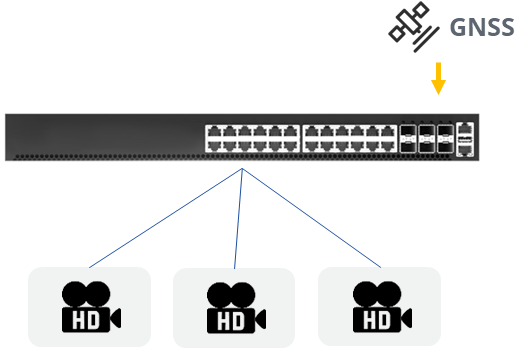
In this deployment scenario, all endpoint devices are directly connected to a single core switch. The switch is equipped with a GNSS interface and uses an external antenna to receive global navigation satellite time, serving as the PTP Grandmaster (GM) to provide a unified clock reference and achieve high-precision time synchronization across the network.
This type of deployment is typically used in small studios or mobile production units where the number of endpoints is limited, and the simplicity of the setup is a priority.
3.2 PTP and multi-site Deployments
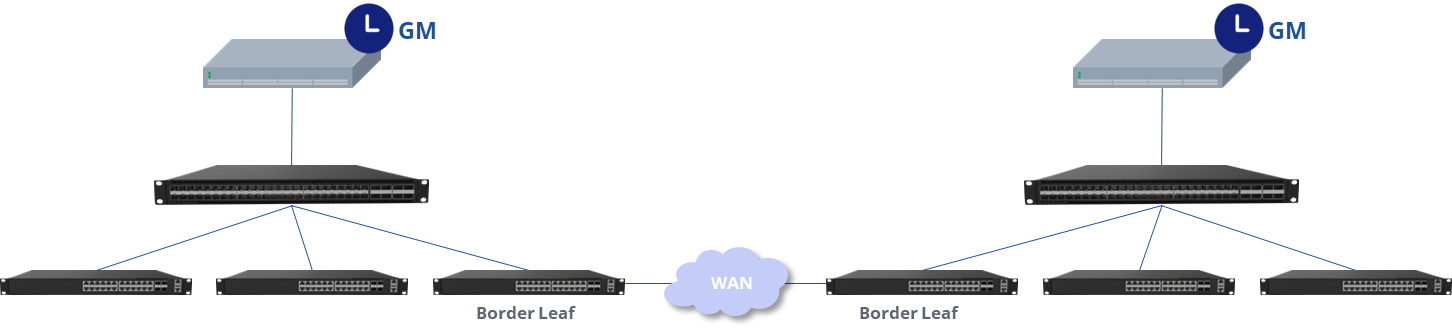
In broadcast networks spanning multiple geographic locations connected via Wide Area Networks (WAN), extending PTP across sites requires careful planning. The variable latency inherent in WAN links can compromise PTP accuracy, as the mean path delay continually fluctuates. To maintain precise time synchronization, it is often recommended to deploy independent PTP Grandmasters at each site rather than extending a single Grandmaster across multiple locations. This approach ensures each site maintains high-accuracy timing while avoiding the instability that WAN-induced delay variations can introduce.
3.3 PTP with a non-PTP-aware Network Switch
In some network deployments, PTP traffic may traverse switches that are not PTP-aware. These switches treat PTP messages as regular data, which can affect timing accuracy if no additional configuration is applied. To reliably transport PTP across non-PTP-aware networks, the following measures are recommended:

1. Ensure QoS Priority
PTP messages should be prioritized over other traffic to avoid delays or packet loss due to congestion. On BC switches, PTP traffic is automatically placed in the control queue (highest priority), requiring no additional QoS configuration.
2. Configure Secondaries in Mixed Mode
In mixed mode, Delay Request messages from secondaries are sent as unicast and are not broadcast to all secondaries on the segment, reducing unnecessary network load. If secondaries are configured in multicast mode, Delay Request/Response messages would be sent to all secondaries in the segment, increasing traffic.
3. Enable Static IGMP Snooping or IGMP Entries
For multicast or mixed mode, static IGMP snooping or IGMP entries may be needed on non-PTP-aware switches to ensure proper forwarding of PTP messages and maintain end-to-end time synchronization.
4. PIM + RP Configuration for Cross-Subnet Deployments
When the GM and endpoints reside in different subnets or on different switches, PIM with a Rendezvous Point (RP) is required to route PTP multicast traffic. Endpoints cannot pre-know the GM’s IP, so the RP is essential. On non-PTP-aware switches, PTP is treated as standard multicast with a destination address of 224.0.1.129.
4 Device Selection
Deployment Location | Product List |
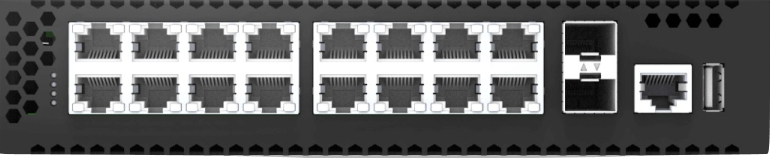
GrandMaster (GNSS antenna input) |  CX206Y-24GT-M-H |
Spine/Core | |
Leaf/Access | |





5 Conclusion
There are multiple ways to implement a functional PTP distribution network. However, when designing such networks—especially in the Media & Entertainment (M&E) space, where a facility may have hundreds of distributed slave devices—it is strongly recommended to select devices that support Boundary Clock (BC) functionality and enable this feature. Deploying BC across the entire IP fabric ensures robust and reliable PTP time synchronization, providing a solid timing reference for high-precision applications such as SMPTE-2110.
Other PTP Blogs You Should Read
- What is PTP and How does it Work?
- All PTP Clock Types and How to Configure in Asterfusion
- PTP Profiles for Network Engineers: How to Pick the Best Profile
- AV over IP Switches Enable Cost-Effective Live Streaming Networks
- Why 10ns PTP Switches for Broadcast Are the Industry Gold Standard
- How to Deploy PTP Synchronization in 5G Open RAN Small Cell Networks with a GNSS-Enabled Switch
- Why PTP Network Switches are Used in Financial Trading?
- How to Maintain PTP Time Synchronization During Configuration Changes
- AES67 vs. ST 2110-30: How to Choose the Right Audio over IP Standard
Real Case Study:
- SMPTE 2110 in IP-Based Broadcast Studio Design: A Transforming with Asterfusion
- Asterfusion PTP Switch Powers Live Streaming of Australia’s Premier Sporting Events
Author:

Miko Zhou
Senior Director
Campus Network Solutions Asterfusion | 10+ Years of Expertise in Campus Network R&D & Innovation


