Table of Contents
Introduction
The Asterfusion Asteria OpenWiFi Controller is a controller product based on the TIP OpenWiFi specification and ecosystem. It is designed to manage both wireless and wired devices, ranging from APs and access switches to OpenLAN gateways and routers (OLG). The controller supports management from Asterfusion’s own platform as well as third-party APs. Recently, its management capabilities have been extended to PON networks, allowing centralized management of OLT Stick and ONU Stick modules, thus achieving unified management of Ethernet and PON networks. OpenWiFi Controller Performance is significantly enhanced through its multi-dimensional capabilities and efficient management of diverse network devices.
To further support heterogeneous network environments, Asteria OpenWiFi Controller integrates LibreNMS, an open-source network monitoring engine, to provide unified monitoring capabilities for third-party network devices now !

This article will introduce the performance of the OpenWiFi Controller from four aspects, providing an overall understanding of how the OpenWiFi Controller helps manage devices across the entire network.
Ⅰ. Zero-Touch Deployment & Rapid Service Provisioning
For the Asteria OpenWiFi Controller itself, it can be deployed either locally or in the cloud. However, the real advantage of its rapid deployment lies more in the planning of the business network topology, which directly impacts OpenWiFi Controller Performance.
Zero-Touch Provisioning (ZTP)
With ZTP, devices automatically register to the controller and pull configurations upon plug-in. This plug-and-play capability eliminates the need for on-site manual configuration of network parameters and device settings, greatly reducing human intervention in deployment. It effectively shortens the device go-live cycle and avoids configuration errors caused by manual operation, ensuring consistent setup across all network devices. ZTP is ideal for large-scale network deployments, helping to boost deployment efficiency and lower overall operational costs. OpenWiFi Controller Performance benefits greatly from this automation, making large-scale deployments faster and more reliable.
Pre-design Topology
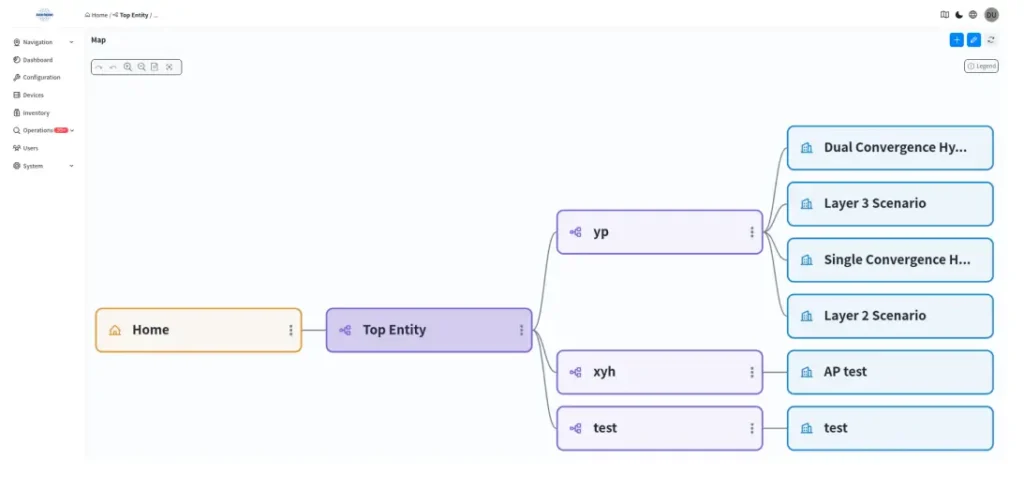
To simplify the configuration of common network setups, the Asteria OpenWiFi Controller includes four built-in scenarios: Small/Mid-Scale Campus, Traditional L2 Network, Large/Mid-Scale Campus, and Open Cloud Connect.
Once the devices in these predefined topologies are online and connected to the controller, the Asteria OpenWiFi Controller will automatically discover and identify the connection status between devices, generating an accurate network topology. Through topology consistency verification, once confirmed, the pre-planned device configurations are pushed to the devices, completing the network configuration and deployment.
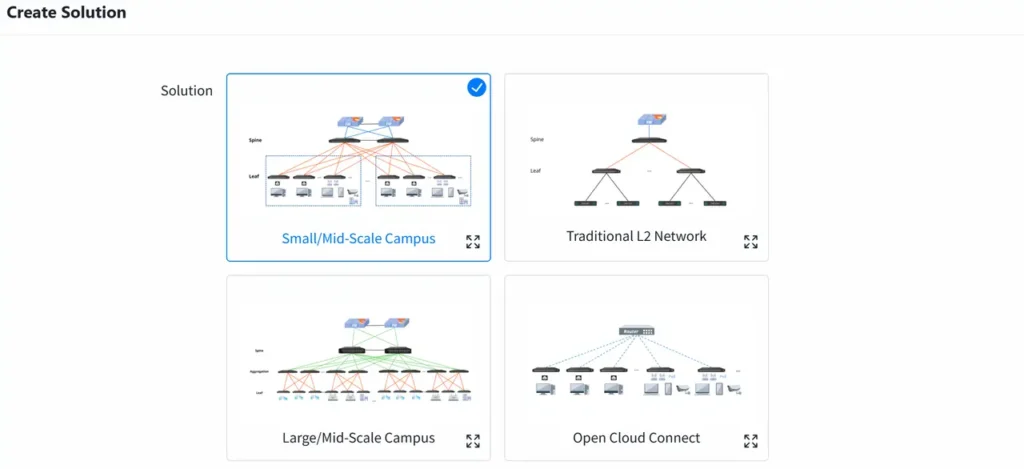
In addition to quickly completing topology planning, the configuration and deployment process can also be centrally managed through the controller. Based on the four aforementioned topology scenarios, we can categorize the related configurations into three main modules:
Basic Network Configuration
In terms of basic network configuration, the primary focus is on routing. With one-click BGP activation and proper route aggregation, the outbound connectivity is quickly established. To ensure device reliability, the controller also supports one-click configuration of MC-LAG for high availability, ensuring network stability. Additionally, in device management, the controller supports Syslog for log collection, TACACS+ for access control, and management ACLs, among other features. In the Traditional L2 Network and Large/Mid-Scale Campus scenarios, in-band management configurations for relevant devices can also be performed.
Wired Service Configuration
Wired service configuration includes related service settings and DHCP services.
- Service Configuration: This includes DHCP relay, service VLAN, IP addresses, DAI/IPSG, MAC detection, and other network parameter configurations. It also supports PoE enabling, wired terminal information collection, user authentication, and security protection deployment.
- DHCP Services: Focused on DHCP server configuration, covering DHCP address pools, DHCP options, and other core settings. No additional licenses are required; the controller can directly complete the entire configuration process.
Wireless Service Configuration
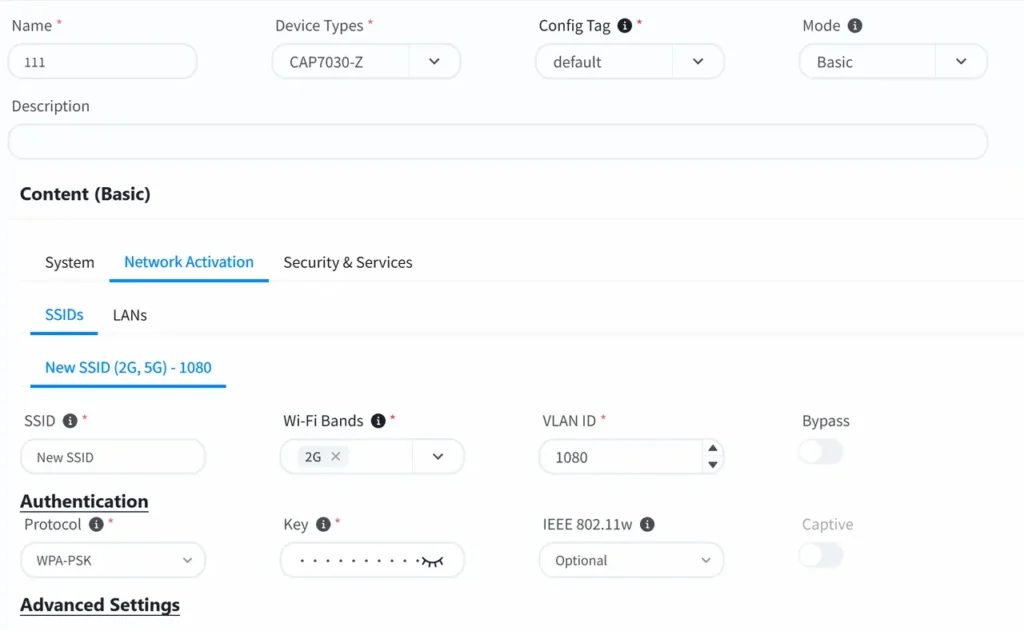
In wireless service configuration, the controller supports AP configurations for SSID, LAN settings, as well as security and service configurations such as NPT and portal authentication. It also allows RF configuration for wireless devices, such as settings for 2.4G/5G/5.2G/5.8G channels, channel modes, channel width, and more.
Ⅱ. Unified Multi-Dimensional Monitoring Dashboard
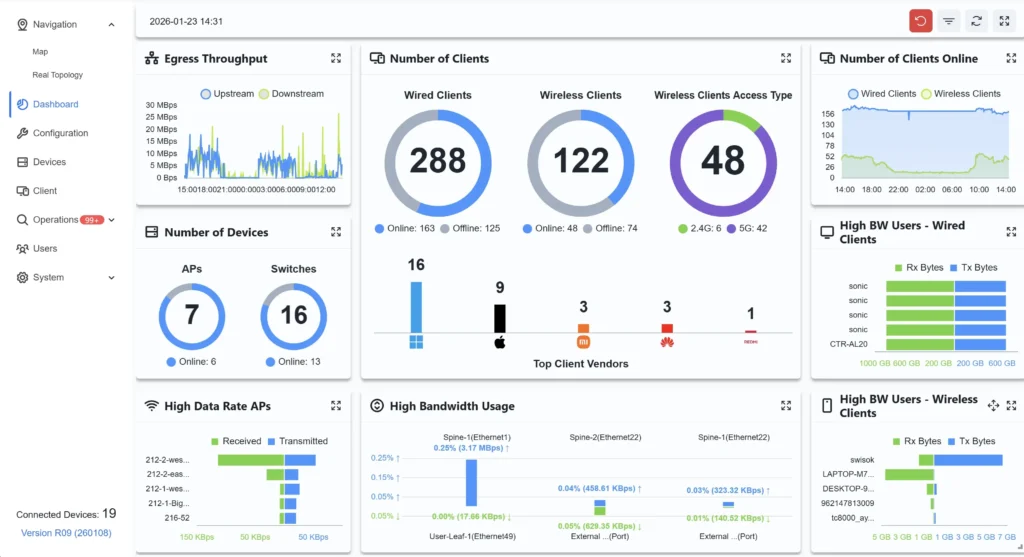
The Asteria OpenWiFi Controller enables unified monitoring of Ethernet and PON networks, wired and wireless networks, as well as APs, switches, and routers.
In the dashboard, four dimensions of data can be viewed:Real-time statistics for the entire network perspective, single device perspective, client perspective, and data statistics for devices in the PON network. You can drag and drop the modules you prioritize to make them more visible and easily accessible.
Entire Network Perspective
The Entire Network Perspective aggregates core metrics to monitor network throughput in real time, automatically tracking high-bandwidth consumers. It clearly displays top users and APs, and analyzes the SNR (Signal-to-Noise Ratio) distribution of terminals, helping you quickly assess overall network quality and make more optimized decisions. This greatly enhances OpenWiFi Controller Performance, ensuring smooth operations.
Granular Node Diagnostics
The controller provides real-time health scoring for devices, tracks CPU and memory load, monitors physical link and port telemetry data, and analyzes the RF (Radio Frequency) performance of APs. This ensures that each node operates efficiently, with any potential issues clearly visible on the dashboard.
Comprehensive Client Intelligence
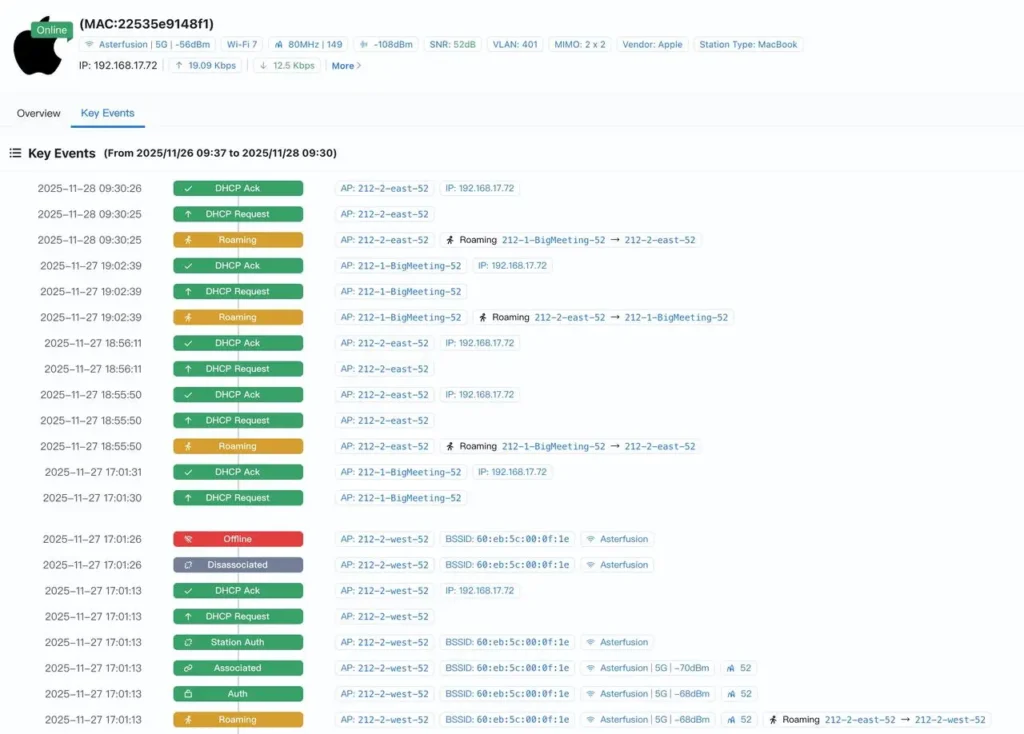
The controller monitors connectivity status, signal quality (SNR), and vendor characteristics for all terminals, along with historical traffic consumption trends and association patterns.
For terminal devices, the entire lifecycle from online to offline can be tracked, including key events such as access, authentication, DHCP, reachability, roaming, and offline status. These events are visually displayed on a timeline, with the duration of each event used for root cause analysis.
PON Network Integration
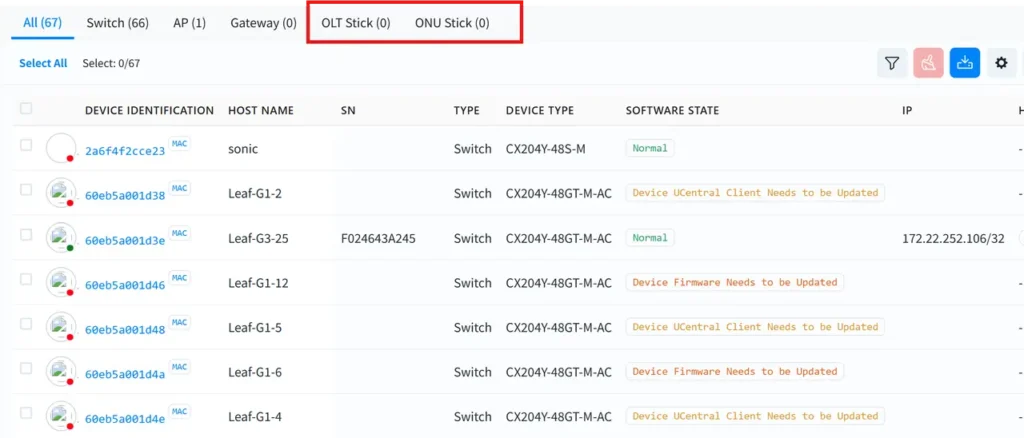
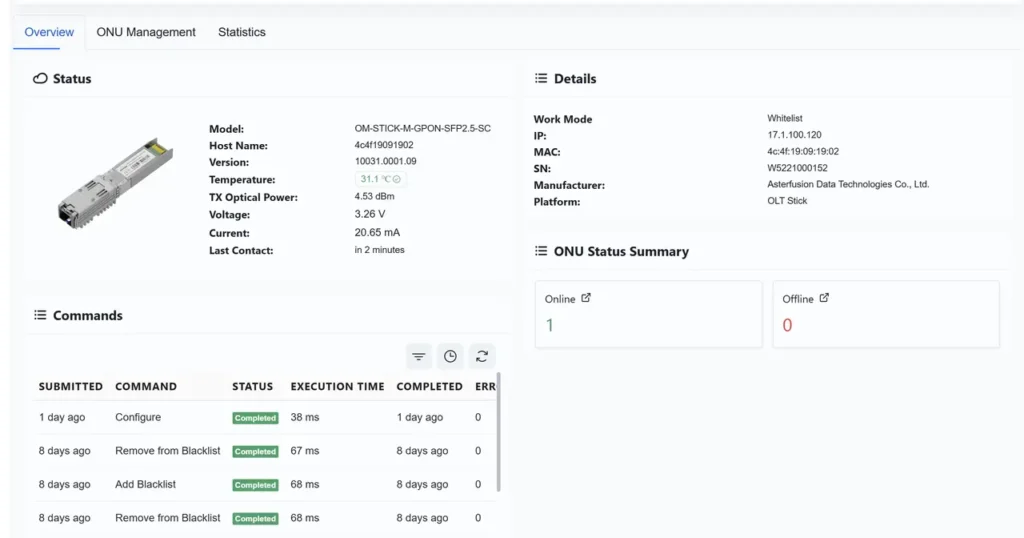
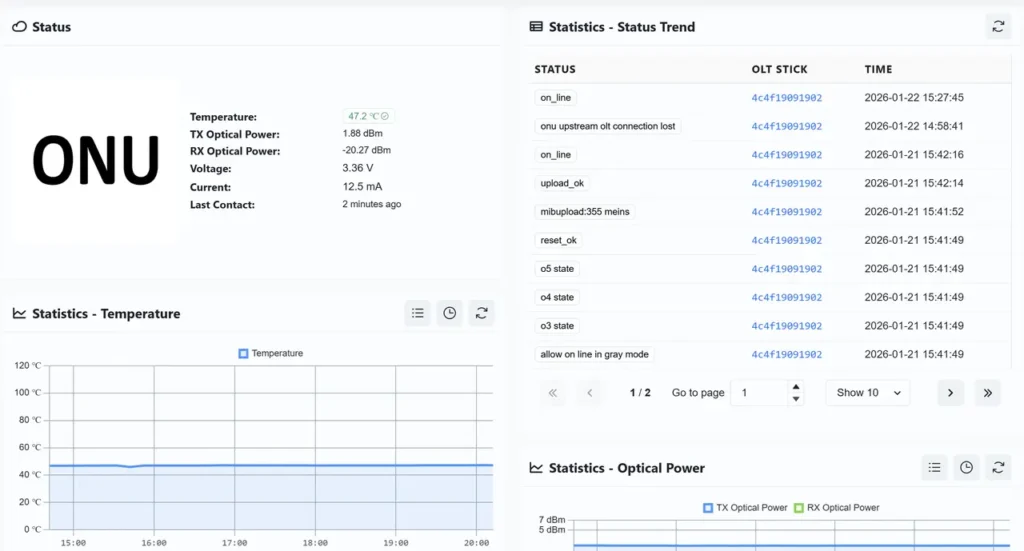
The controller also supports monitoring of OLT/ONU Stick devices in the PON network.
For the OLT Stick, it includes basic information such as temperature and TX optical power.
For the ONU Stick, the controller supports statistics for online/offline status, online trend statistics, historical temperature data, and more.
Ⅲ. Integrated Alarm System & Advanced Operations
The Asteria OpenWiFi Controller supports log alerts and advanced operations such as inspection, firmware upgrades, and scripting. These functionalities play a key role in maintaining OpenWiFi Controller Performance, ensuring that issues are promptly detected and resolved.
Comprehensive Alarm Sources
The alarm sources cover three core dimensions: device alarms, business alarms and service alarms.
- Device-level alarms include power supply, cooling fans, link status, and high CPU/memory/disk usage.
- Business-level alarms include device offline status and protocol abnormalities.
- Service-level alarms monitor the operational status of detected RADIUS servers and Portal servers.
The system also supports custom alarm thresholds to precisely capture potential risks.
Flexible Alarm Notification
Alarm notification methods are flexible and diverse. In addition to traditional email notifications, Webhooks are integrated, enabling easy connection with third-party management platforms for multi-channel real-time alert notifications.
Automated Device Inspection
Manual inspections are time-consuming and prone to errors. The system supports one-click health checks, covering both system and service inspections. You can also customize inspection intervals, automatically collect logs, and analyze key processes, significantly reducing manual maintenance costs and ensuring rapid fault detection and recovery.
Firmware and Scripts
Centralized management makes maintenance simpler.
The controller supports firmware creation via remote URLs, unified management of patch distribution and upgrades, and the ability to push custom operation scripts, such as executing AP reboot commands. This increases flexibility in device management.
Ⅳ. Built-in 3A & Multi-Tenant Subscriber Management
The Asteria OpenWiFi Controller creates an integrated network management platform, deeply combining multi-tenant architecture with core network services to enable secure and efficient authentication management without relying on external dependencies. The seamless integration of these services contributes directly to OpenWiFi Controller Performance.
NAC & Built-in AAA
By supporting the NAC (Network Access Control) system management and built-in 3A servers, the controller eliminates the need for licenses from external vendors, third-party service providers, or potentially insecure sources (such as open-source projects or unverified licenses), enhancing the system’s security and reliability.
High-performance DHCP
The controller includes a high-performance DHCP service capable of handling a large number of concurrent connections. Importantly, this service is completely free. Enterprises do not need to purchase commercial software licenses, eliminating costly license fees while ensuring efficient IP address distribution. This guarantees that core network services are both robust and cost-effective.
Diverse Authentication
The controller supports a wide range of authentication methods, including 802.1X (EAP-TLS/PEAP), MAC, Portal (Username/Password, OAuth 2.0, or One-Time Password), with the option to fully customize the portal. Asteria OpenWiFi Controller offers highly secure 802.1X authentication, as well as convenient MAC-based seamless authentication.
The portal authentication feature is also very powerful, supporting various login methods such as username/password, OAuth 2.0, or one-time passwords. You can even fully customize the portal, making it suitable for both enterprise intranets and guest networks, offering the most appropriate access method for each use case.
Feature-Based Control
The controller can accurately identify terminal operating systems and analyze specific user attributes to dynamically assign IP addresses or VLANs. This enables fine-grained resource isolation, placing different devices into the appropriate groups, making management more flexible and enhancing network security.
Subscriber Management
For complex operational environments, Asteria OpenWiFi Controller has built a robust multi-tenant subscriber management system.
The system supports logical isolation on a single 3A server with a shared physical network, ensuring strict data separation. Through a hierarchical administrator mechanism, different organizations can share infrastructure while keeping their data completely isolated from each other. Whether importing in bulk or allowing self-registration by users, all subscriber data is strictly confined within the respective tenants or organizations, ensuring an optimal balance of efficient resource sharing and data privacy isolation.
Ⅴ. Asteria OpenWiFi Controller’s Self-Management
In addition to supporting various management functions for controlled devices, the management of the controller itself is more convenient, contributing to the overall OpenWiFi Controller Performance.
Upgrades and patching can be performed not only through backend methods but also via the UI. The system also supports system logs and NTP services.
Furthermore, the system supports multiple microservice modules on the OW platform, including OWAnalytics, OWFMS, OWGW, OWProv, and OWSub, which provide different management and functional services.
2025 Q4 Update for Enhanced Asteria OpenWiFi Controller Performance
In the 2025 Q4 update for Asteria OpenWiFi Controller performance, the focus is primarily on the management of OLT Stick and ONU Stick devices within the PON network, as well as the management of OpenLAN Gateway (OLG) devices. This update aims to further enhance OpenWiFi Controller Performance by improving device lifecycle management and operational alerts.
For OLT Stick and ONU Stick devices, the new update includes support for status management, configuration deployment, and operational alerts.
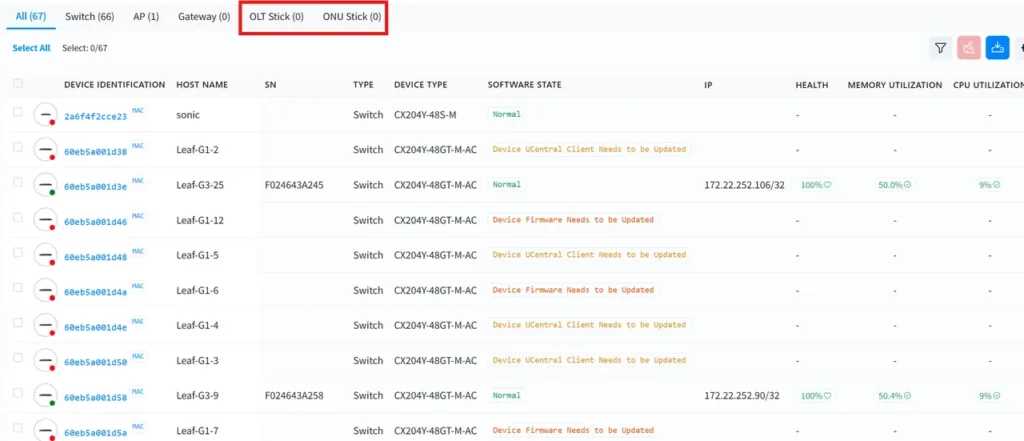
For OLG/router support, the new update focuses on status management, operation command deployment, and operational alerts.
Additionally, in terms of maintenance and visualization, several refined features have been introduced. These include support for Dashboard monitoring metrics at both the terminal and operation dimensions, as well as AP alerts, inspection, and patch management.
Regarding terminal management, the Asteria OpenWiFi Controller now supports full lifecycle management for wireless terminals. From when they come online to when they go offline, you can easily monitor their status at a glance.
OpenWiFi Controller Setup and Installation
You can refer to the Asteria OpenWiFi Controller Configuration Guide for detailed instructions. Alternatively, the PDF version of the document is available at the bottom of this article.
Conclusion
The Asterfusion Asteria OpenWiFi Controller is built based on the TIP OpenWiFi specification, serving as the intelligent network management core that unifies the management of Ethernet and PON networks, as well as wired and wireless devices. It supports a wide range of devices, including APs, access switches, OLG routers, and OLT/ONU Sticks.
Leveraging five core capabilities—zero-touch deployment, multi-dimensional unified monitoring, integrated alarm and operation management, built-in 3A and multi-tenant management, and convenient self-management—the product enables full-process automation and centralization of network deployment, monitoring, authentication, and operation. This significantly reduces manual intervention, minimizes configuration errors, and lowers operational costs, while ensuring standardized network configuration, refined management, and data security.
The 2025 Q4 update further strengthens the full lifecycle management of PON network devices and OLG routers. It also enhances the visual monitoring of terminal and operational dimensions and improves the AP’s full-process operation management capabilities, continuously enriching device compatibility and refining functionality.
Overall, the controller provides a one-stop management architecture that balances network management efficiency, security, and scalability. It is adaptable to various scenarios, including campus networks, branch networks, and Ethernet-PON hybrid networks, providing reliable core support for the intelligent network construction, efficient operation, and flexible business expansion of enterprises and operators.

Contact US !
- To request a proposal, send an E-Mail to bd@cloudswit.ch
- To receive timely and relevant information from Asterfusion, sign up at AsterNOS Community Portal
- To submit a case, visit Support Portal
- To find user manuals for a specific command or scenario, access AsterNOS Documentation
- To find a product or product family, visit Asterfusion-cloudswit.ch


