Table of Contents
Introduction
In a PON network, there are two key devices: the OLT and the ONU. This article explains the difference between the OLT and ONU and addresses the operational challenges in managing these devices.
What is a PON
We start with the Optical Access Network (OAN).
The higher-level concept of a PON network is the Optical Access Network (OAN), which refers to all solutions that use optical fiber for access to connect users to an operator or enterprise network. OAN includes several technical forms:
- PON (Passive Optical Network)
- AON (Active Optical Network)
- Point-to-Point Fiber (P2P Fiber)
PON is a specific implementation of OAN and the mainstream approach. Its key feature is passive splitting, supporting point-to-multipoint connections, with no powered equipment within the PON network.
Common PON technologies include EPON (defined by IEEE 802.3ah), GPON, XG-PON, and XGS-PON (all defined by ITU-T). Detailed explanations of these technologies can be found in How to Choose From EPON, GPON, XG-PON & XGS-PON,Ultimate Guide to PON Technologies
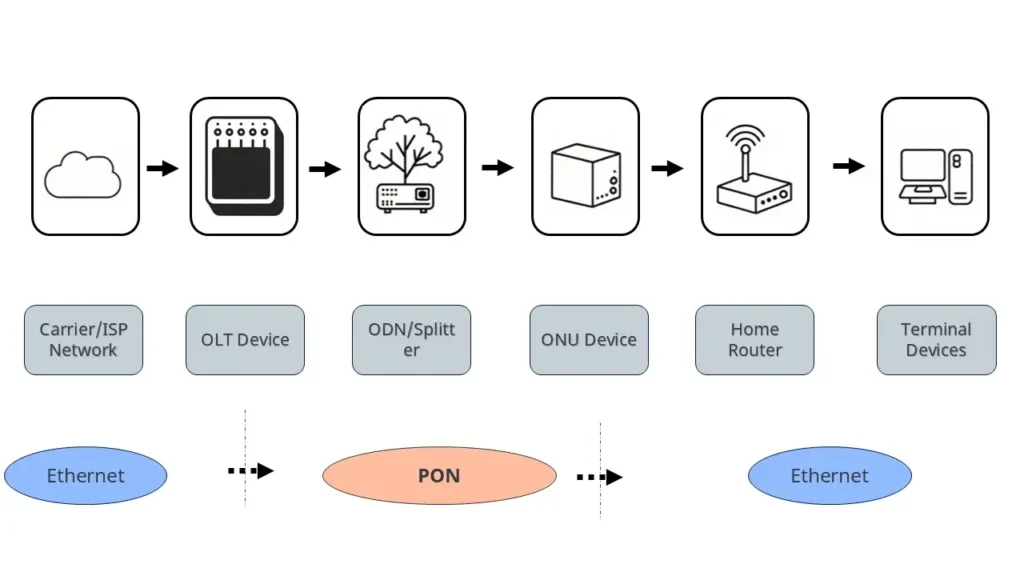
A PON network has three core components:
- OLT (Optical Line Terminal): Deployed at the central office or data center, serving as the “core switching device” responsible for controlling and managing the entire PON network.
- ODN (Optical Distribution Network): A fully passive optical distribution network, requiring no power, composed of fibers and splitters.
- ONU (Optical Network Unit): Deployed at the user’s side.
What is OLT
The OLT serves as the central brain of a PON network. It functions like a core switch combined with a controller.
Why is an OLT needed? The principle is straightforward. A single fiber serves multiple users, so bandwidth allocation must be managed. The OLT controls when and which ONU can transmit data, preventing collisions, and manages all ONUs. This critical role is the OLT.
OLTs are commonly deployed in any central office or data center. They are essential for fiber-to-the-home (FTTH) access and play a key role in all-optical campus networks, replacing traditional access switch networks. They convert Ethernet signals into PON protocol optical signals.
The OLT operates in two directions:
- Downstream (OLT → ONU): Broadcast to all connected ONUs.
- Upstream (ONU → OLT): Uses TDMA, dividing time slots so that ONU1 transmits during slot A, ONU2 during slot B, and so on. This ensures no ONU occupies the channel simultaneously.
Beyond bandwidth allocation, the OLT handles ONU registration and authentication, as well as the deployment of QoS policies.
Currently, traditional OLT chassis are increasingly replaced by OLT stick, which save space and simplify network operations.
What is ODN ?
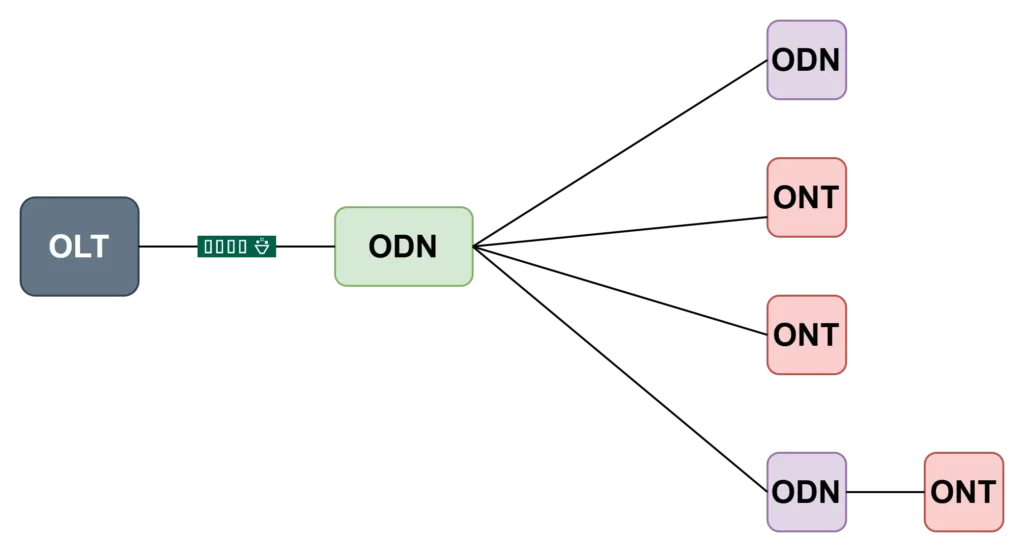
The ODN is straightforward. It is the segment of the network consisting purely of fiber and splitters, with no power or switches. This is a core advantage of PON networks. Its key component is the splitter, forming the physical infrastructure of the PON.
The operation is simple, with pure optical signal transmission in both directions:
- Downstream: The signal is split according to a predefined ratio (e.g., 1:8 or 1:32), distributing one optical signal to multiple ONUs.
- Upstream: Signals from multiple ONUs are combined onto a single fiber.
This segment is completely passive. It does not amplify, control, or process optical signals. While the fixed split ratio lacks flexibility, its low cost and minimal failure rate are major advantages.
What is ONU?
The ONU is the user-side device (optical modem or access box). Since user devices (PCs, APs) cannot directly use optical signals, the ONU performs optical-to-electrical conversion. It is typically installed in homes, hotel rooms, offices, or near APs.
Its operation follows the same upstream and downstream logic as the OLT:
- Upstream (ONU → OLT): Transmits data during the time slot assigned by the OLT.
- Downstream (OLT → ONU): Receives broadcast data from the OLT and extracts only the data intended for itself.
Note: In a PON network, the concepts of upstream and downstream are consistent for both ONU and OLT, always centered on the OLT: downstream is from OLT to ONU, and upstream is from ONU to OLT.
Current trends in enterprise networks include connecting GPON Wi-Fi 6 APs or XGSPON Wi-Fi 7 APs directly via fiber, eliminating the intermediate ONU device. Alternatively, ONU sticks in SFP form can be plugged directly into switch ports. These approaches save rack space, simplify operations, reduce potential points of failure, and ease fiber management during installation.

The Difference Between GPON OLT and ONU
Functionally, the OLT and ONU operate in opposite roles along the same network direction:
- OLT: Located at the ISP central office, the OLT is the core device of the PON access network. It converts electrical signals from upstream switches or routers into optical signals. Downstream, it sends these signals through fiber and splitters to the user-side ONU/ONT. Upstream, it receives data from ONUs, manages bandwidth allocation, schedules traffic, and performs overall network management.
- ONU/ONT: Located at the user side, its core function is to convert optical signals from the OLT into electrical signals (e.g., Ethernet) and provide multiple interfaces (Ethernet ports, phone ports, Wi‑Fi) to home routers or enterprise terminals. Upstream, it aggregates user data, converts it into optical signals, and sends it back to the OLT.
Deployment location:
- OLT: Always in the ISP or operator central office, procured, deployed, and maintained by the operator. Users do not have direct access.
- ONU/ONT: Location depends on the access type:
- FTTH: Installed inside homes or offices (commonly called an optical modem).
- FTTB/FTTC: May be installed in building corridors, telecom rooms, or neighborhood cabinets, with Ethernet cables distributed to individual users.
Impact of failure:
- OLT failure can cause widespread service disruption across the entire PON segment.
- ONU failure affects only the individual user or room.
Processing capacity:
- OLT can manage hundreds or thousands of ONUs simultaneously.
- ONU only handles the traffic of a single user.
Protocol and standards support:
- OLT supports the full PON protocol stack (GPON, EPON, XGS-PON) and is compatible with multiple ONU vendors (interoperability required).
- ONU follows specific standards (e.g., BPON, GPON Class B+/C+) and must match the OLT’s protocol and wavelength to register and operate.
| Dimension | OLT | ONU |
| Role | Control Center | Access Terminal |
| Function | Scheduling, management, bandwidth allocation | Execution, access, forwarding |
| Upstream | Timeslot allocation | Transmit according to assigned timeslot |
| Downstream | Broadcast data | Selectively receive data |
| Deployment | Central Office / ISP Facility | Customer Premises |
| Quantity | Few (1:N) | Many |
| Impact of Failure | Large-scale | Single user / endpoint |
| Processing Capacity | Hundreds to thousands of concurrent ONUs | Single user |
| Protocol Support | Full PON protocol stack | Must match OLT protocol |
The Management of GPON OLT and ONU
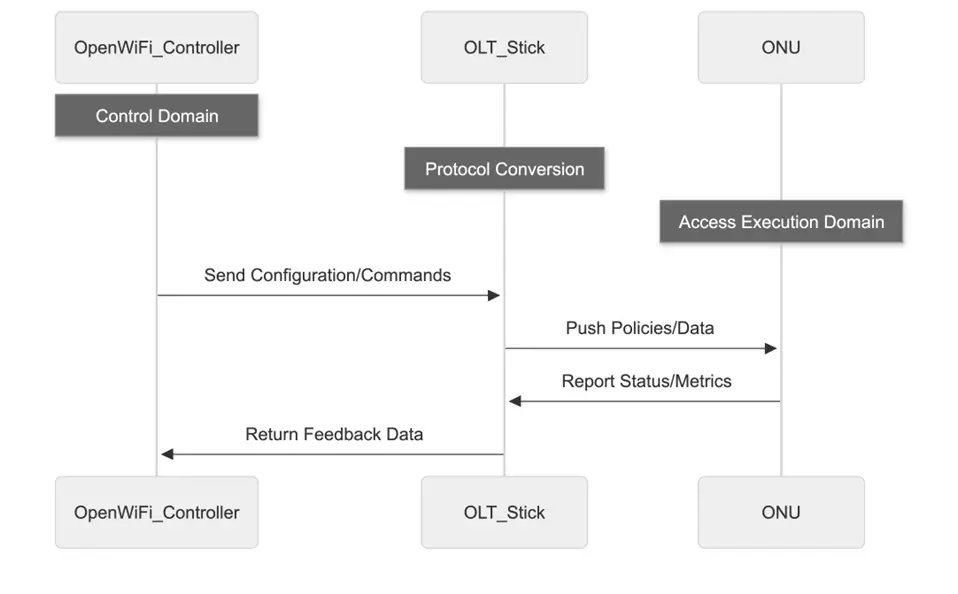
The most critical aspect is the management of OLTs and ONUs, which directly affects troubleshooting efficiency for network operators.
If you are looking for companies that support open WiFi controller–based OLT and ONU management, the solution is Asteria OpenWiFi Controller, which provides unified management for both OLTs and ONUs.
Traditionally, ONU registration and management are handled by the OLT, making ONU management effectively a black box. With Asteria OpenWiFi Controller, operators gain a unified, visualized operational view of OLTs and ONUs. Through the controller, they can directly monitor:
- Online status of all OLTs
- ONU topology under each OLT
- Optical power and online/offline history for each ONU
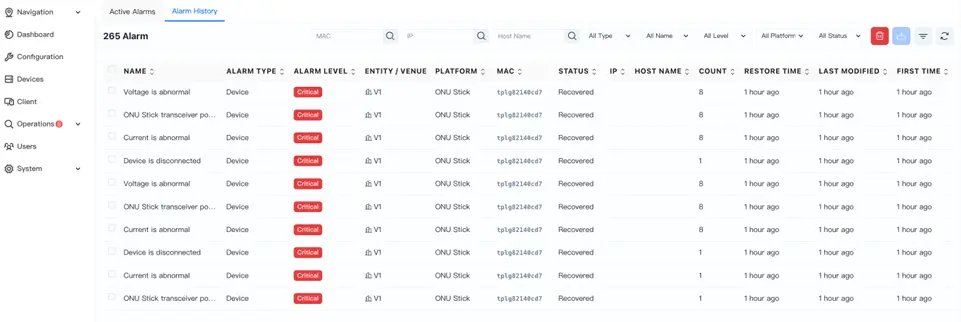
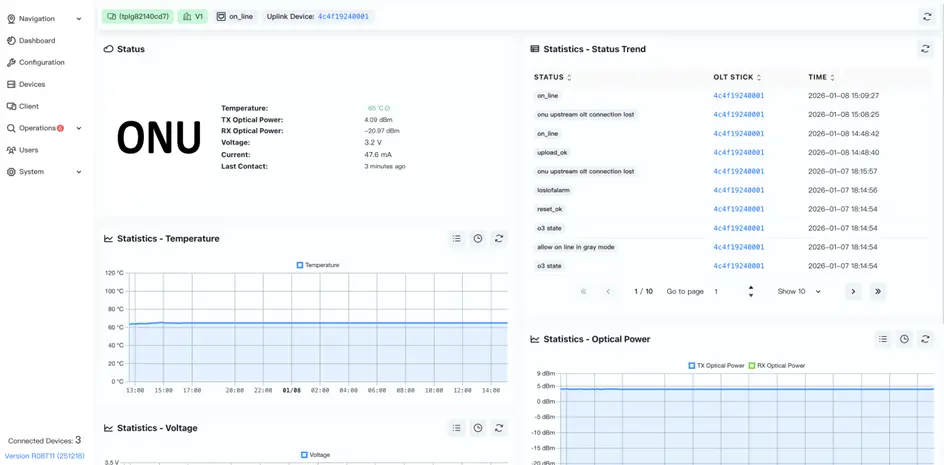
For details on how the Asteria OpenWiFi Controller manages PON networks, see: Unified PON and Wireless Management Solution via Asteria OpenWiFi Controller
Conclusion
In summary, clearly understanding the difference between GPON OLT and ONU is essential for building a stable optical network. The OLT resides at the central office, responsible for global scheduling and bandwidth allocation. The ONU is located at the user edge, focusing on optical-to-electrical conversion and service access. Although they differ in deployment, functional logic, and impact scope, they operate in close coordination.
Grasping the difference between OLT and ONU not only aids network design but is also key to solving operational challenges. To overcome the traditional black-box management issue, adopting a unified visual solution like the Asteria OpenWiFi Controller enables integrated management of both OLTs and ONUs. This approach clarifies the boundary between core devices and user terminals while providing full-path visibility from central office to user edge, making optical network operations smarter and more efficient.
Have a project in mind?
Fill out the form, and we’ll reach out to you today !
Contact US !
- To request a proposal, send an E-Mail to bd@cloudswit.ch
- To receive timely and relevant information from Asterfusion, sign up at AsterNOS Community Portal
- To submit a case, visit Support Portal
- To find user manuals for a specific command or scenario, access AsterNOS Documentation
- To find a product or product family, visit Asterfusion-cloudswit.ch


