Table of Contents
Introduction
As enterprise networks evolve, high-definition cross-border video conferencing, real-time financial data feeds, and large-scale IoT firmware upgrades have become core business scenarios. However, traditional routing models face severe architectural scalability bottlenecks when handling “one-to-many” high-concurrency traffic.
This article delves into the limitations of unicast in handling large-scale concurrency and analyzes how AsterNOS, through its IP Multicast on SONiC with VPP heterogeneous decoupled architecture, ensures smooth business scaling. By combining a SONiC control plane and VPP data plane with underlying Zero-Copy mechanisms, the solution drastically reduces system CPU and memory loads, delivering a highly available and resource-efficient distribution solution for modern enterprise egress gateways.
Why Traditional Unicast Fails at Scale: The O(N) Complexity Trap
Traditionally, most concurrent network traffic relies on Unicast sessions, requiring the source to replicate and send an independent data stream to each receiving node.
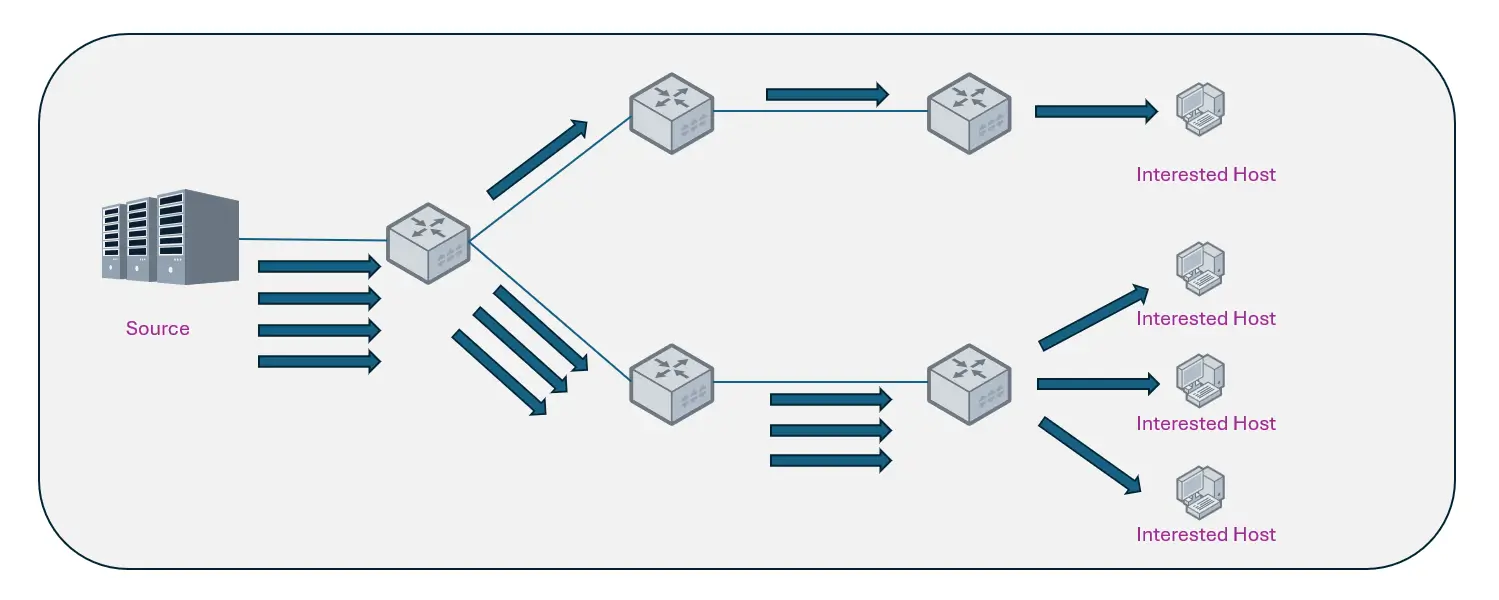
When coping with large-scale concurrent business, network infrastructure faces an O(N) linear scaling pressure:
- Business Scenario Example: A multinational enterprise data center pushes identical high-definition video streams to numerous endpoints across global branch offices.
- hroughput Challenge: Under unicast mode, the core egress must carry redundant traffic proportional to the number of endpoints.
- Engineering Impact:
- Network Congestion: Available bandwidth for mission-critical applications (e.g., ERP, SIP voice) is squeezed by massive amounts of duplicated packets.
- Resource Exhaustion: The CPU I/O overhead of the source server NIC and intermediary gateway devices surges with the number of concurrent sessions, facing severe overload risks.
How IP Multicast Reduces Forwarding Complexity ?
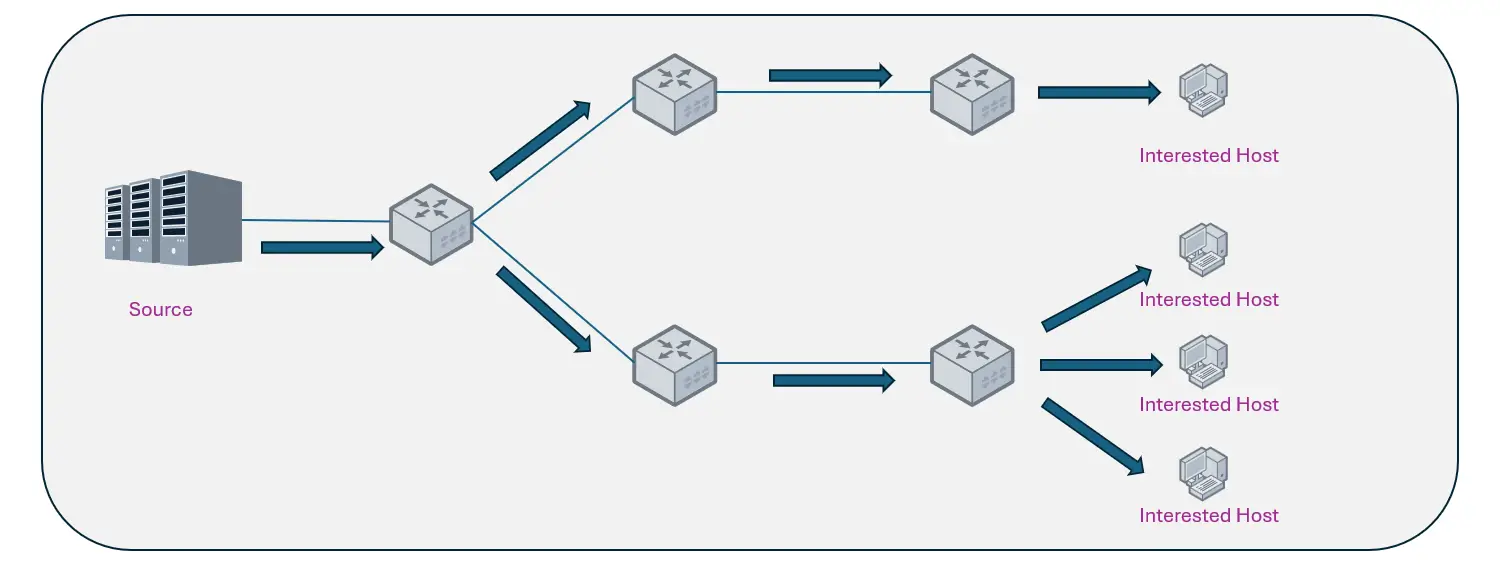
IP Multicast resolves the above issues by shifting the location of traffic replication. It offloads the replication burden from the source server to the underlying network infrastructure (routers and switches).
Under this mechanism, the source only needs to send a single copy of the data stream to a specific multicast address (Class D IP address). Through multicast routing protocols, network devices perform packet replication only at network forking points leading to valid subscribers. This mechanism reduces the bandwidth overhead of the source and backbone links from O(N) to O(1), significantly optimizing the overall utilization of WAN links.
How AsterNOS Improves Multicast Efficiency by Building Distribution Trees
AsterNOS fully supports industry-standard multicast protocol stacks, achieving efficient path establishment and state maintenance through the synergy of IGMP on the endpoint side and PIM protocols on the network side.
Endpoint Subscription and IGMPv3 Source Filtering
AsterNOS recommends deploying IGMPv3 at the access layer. Compared to the (*, G) any-source receiving mode of earlier versions, IGMPv3 introduces precise source filtering capabilities (S, G). Endpoints can not only subscribe to specific channels but also explicitly specify trusted sender sources. This enhances security by preventing unauthorized traffic injection and lays the foundation for building highly efficient PIM-SSM architectures.
Path Optimization: From RPT to SPT
Under standard PIM-SM (Sparse Mode), the network initially lacks source location information. AsterNOS adopts the industry-standard two-stage tree building mechanism:
Phase 1: Building the Shared Tree (RPT)
The receiver gateway establishes a downstream receiving path toward a pre-configured Rendezvous Point (RP) in the network by sending a (*, G) Join message; meanwhile, the source registers and sends data to the RP.
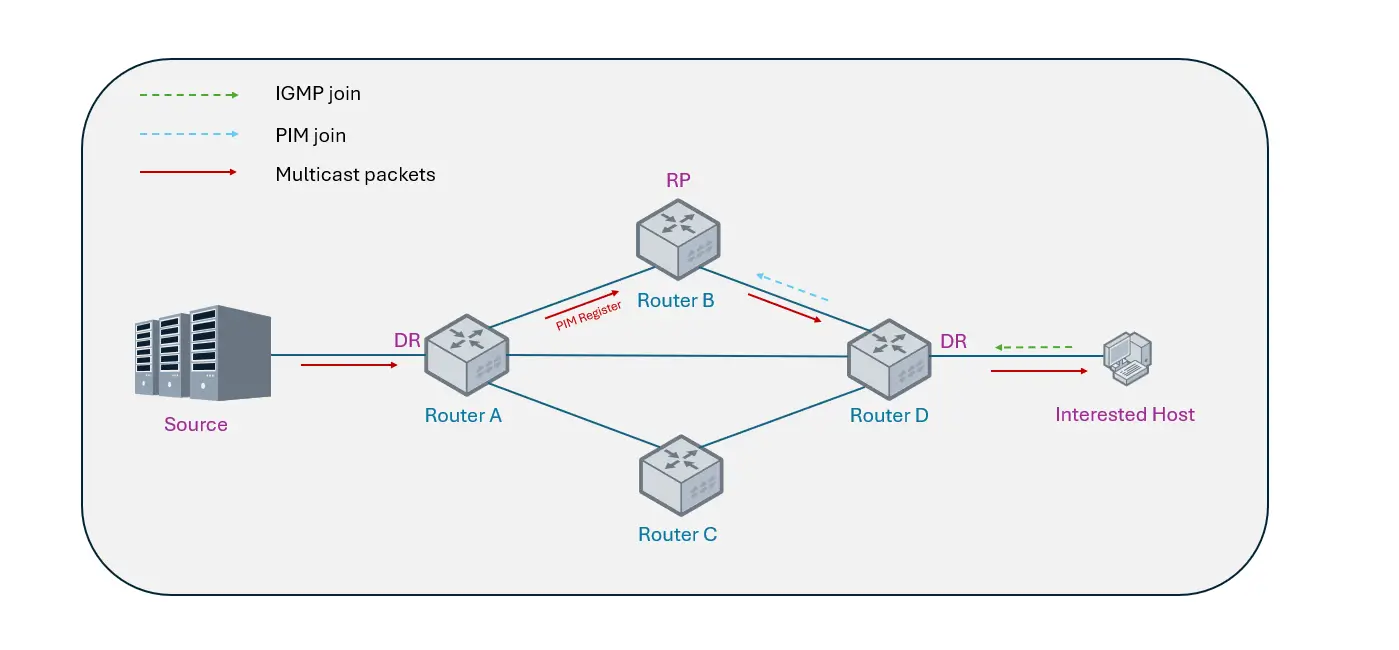
Phase 2: Triggering SPT Switchover and State Pruning
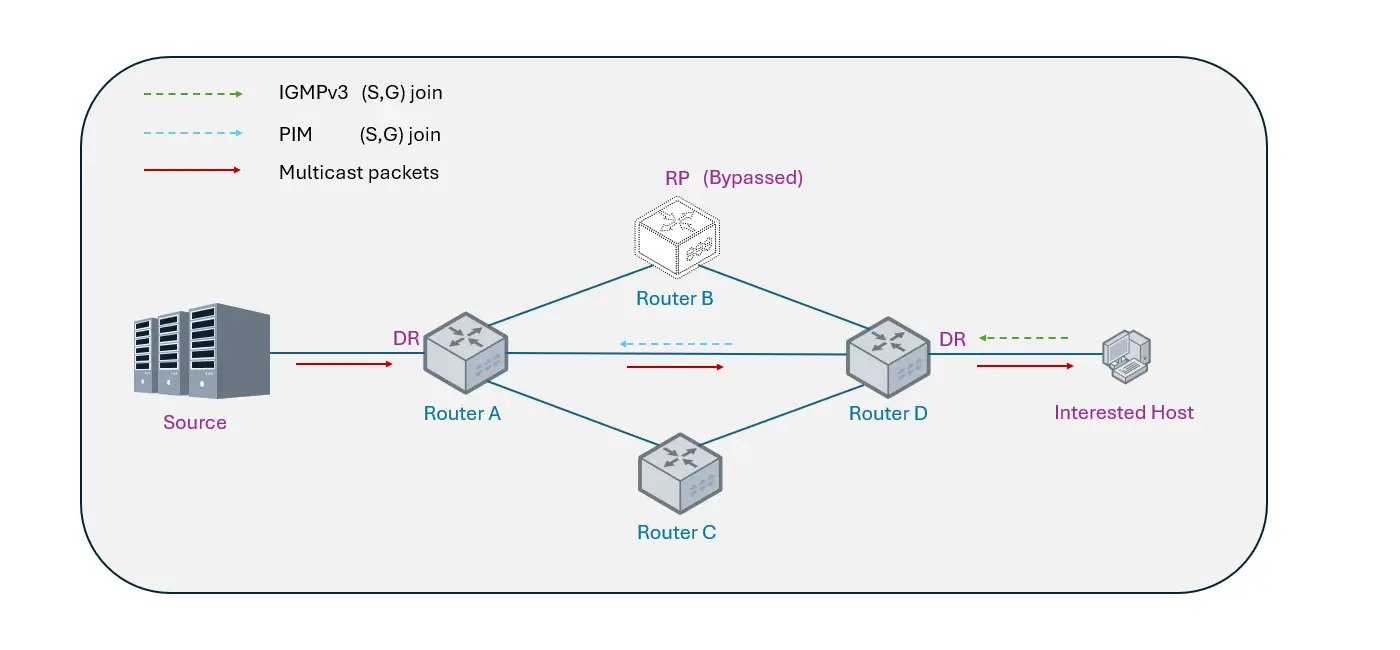
To avoid suboptimal routing and RP bottlenecks, AsterNOS triggers an immediate switchover upon receiving the first multicast packet. Once the true source IP is resolved, it initiates an (S, G) Join request directly toward the source based on the unicast routing table, establishing the Shortest Path Tree (SPT). After the SPT is established, AsterNOS automatically sends Prune messages to cut off the redundant path via the RP, thereby optimizing data distribution efficiency across the core backbone.
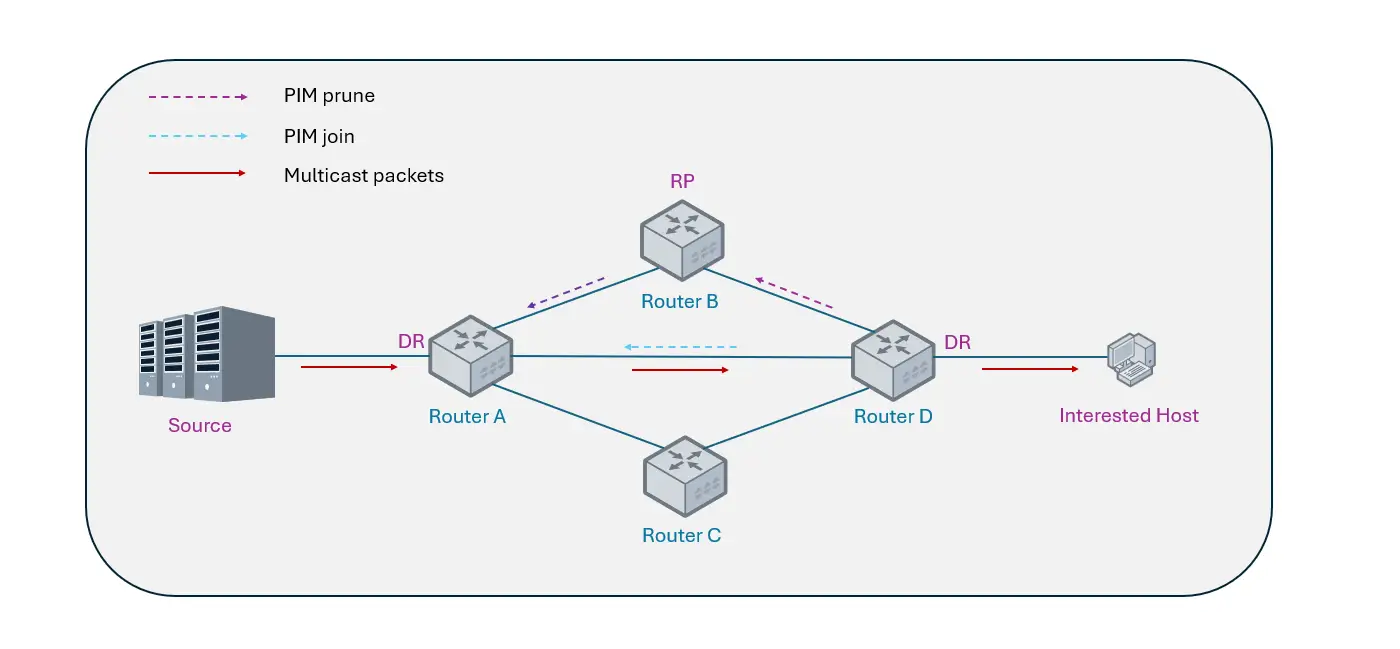
Advanced Evolution: PIM-SSM for Specific-Source Multicast
For businesses with fixed source addresses (e.g., internal streaming media from fixed sources, financial market data distribution), AsterNOS supports the streamlined PIM-SSM mode. Paired with IGMPv3, the network eliminates the need to configure and maintain complex RP nodes. The receiver directly initiates an (S, G) Join, bypassing the state negotiation phase to directly establish the shortest path tree, realizing ultimate simplicity and efficiency in the network structure.
Core Advantages in IP Multicast on SONiC with VPP
While standard protocol implementations are largely uniform across the market, the core competitiveness of IP Multicast on SONiC with VPP in AsterNOS lies in its deep software-hardware decoupling. This design fundamentally optimizes the system’s compute and memory overhead.
Control Plane: Agile Routing via Containerized SONiC
AsterNOS leverages the open nature of the SONiC operating system to deploy complex multicast control protocols (such as PIM and IGMP daemons in FRRouting) in a containerized manner.
The control plane focuses on processing PIM state machines and loop-prevention calculations. Upon generating optimal (S, G) forwarding entries, it efficiently programs them into the data plane via internal APIs. This deep isolation between the control and data planes ensures that under complex network flapping, protocol calculations do not interfere with underlying data forwarding processes.
Data Plane: How VPP Zero-Copy Drastically Reduces CPU Load
When performing multicast distribution, traditional software routers based on kernel protocol stacks must execute N physical copies of the entire packet payload in memory (corresponding to N egress interfaces). This is often the primary culprit behind CPU overloads and memory bandwidth depletion.
AsterNOS relies on the VPP (Vector Packet Processing) architecture to completely reconstruct this resource consumption model:
- Zero-Copy Design: When identical multicast streams need to be dispatched concurrently to numerous interfaces, VPP avoids repetitive copying of the bulky data payload area. The system only clones minimal packet metadata (containing the required L2 header information for rewrites) for different egress interfaces and increments the Reference Count of the shared memory area where the packet resides.
- Memory I/O Offloading: In the final transmission phase, the NICs of various egress ports read the exact same physical memory block based on different metadata to complete packet dispatch. This mechanism drastically reduces system memory bandwidth utilization and CPU copy overhead, enabling generic compute platforms to effortlessly handle the concurrency challenges of massive multicast sessions.
BGP and ECMP Integration Ensures Multicast High Availability
- High-Availability RPF Integration: The AsterNOS multicast engine is deeply integrated with the underlying BGP routing table. When topology changes occur in cross-domain WAN links, the RPF (Reverse Path Forwarding) validation mechanism responds instantly, triggering dynamic reconstruction of the multicast tree and enhancing disaster recovery capabilities for core businesses.
- ECMP Traffic Load Balancing: Breaking through the single-path limitations of traditional multicast, AsterNOS supports ECMP (Equal-Cost Multi-Path) hashing based on (S, G) session states. This effectively schedules different multicast streams across multiple available backbone links, preventing single-point link congestion.
The Benefits of Deploying Multicast on SONiC and VPP
By adopting the AsterNOS SONiC+VPP heterogeneous architecture, enterprises achieve an optimal balance of scalability, resource efficiency, and deployment agility.
Technical Comparison Summary:
| Comparison Dimension | Traditional Multicast Architecture | AsterNOS Multicast (SONiC+VPP) |
| Architecture | Monolithic OS or Hardware-coupled. | Decoupled. Containerized SONiC + VPP. |
| Replication Overhead | Scales linearly ( memory copies). memory copies). |  efficiency. VPP Zero-Copy reference counting. efficiency. VPP Zero-Copy reference counting. |
| Routing & Convergence | Standard convergence times. | Millisecond RPF updates via deep BGP integration. |
| Traffic Engineering | Often pinned to single network paths. | ECMP load balancing based on  session states. session states. |
| SSM Deployment | Can require complex legacy protocol support. | Streamlined natively via IGMPv3 edge enforcement. |
Use Cases
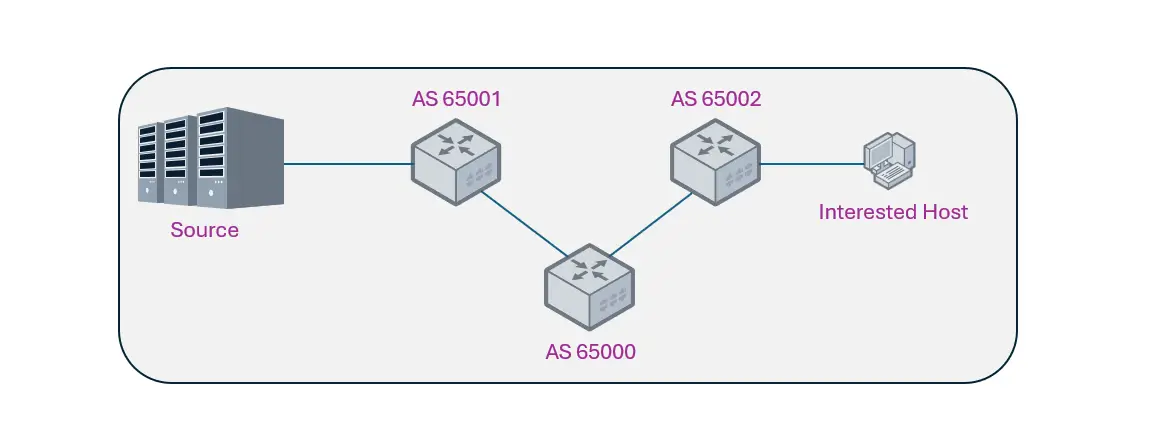
1. Cross-Domain High Availability
- Benefit: Establish highly available global multicast trees across different BGP Autonomous Systems.
- Example: Designate a Spine node as the core Rendezvous Point (RP) and inject physical links via BGP to ensure network-wide RPF validation, guaranteeing millisecond recovery during WAN link flaps.
- Config Code:
#Spine (RP Layer): BGP Underlay & RP Designation
  sonic(config)# router bgp 65000
  sonic(config-router-af)# network  <Underlay_Subnet>
  sonic(config-router-af)# exit
  sonic(config)# ip pim rp  <RP_IP_Address> <Multicast_Group_Range>

 # Source Leaf Node: Trigger initial registration
   sonic(config)# unknown-multicast trap
2. Streamlined PIM-SSM Distribution (Topology Optimization)
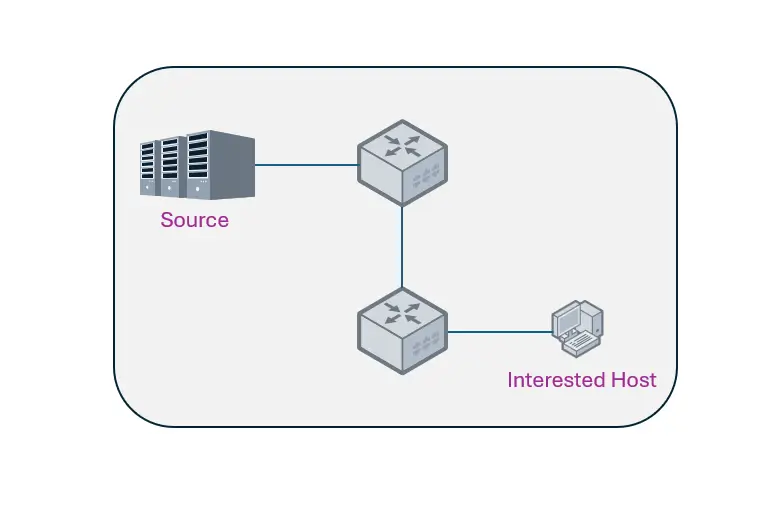
- Benefit: Eliminate transit bottlenecks and simplify network architecture by bypassing Rendezvous Points (RP) for known fixed-source traffic.
- Example: For financial market data feeds or dedicated IPTV networks, rely on IGMPv3 to build a Shortest Path Tree (SPT) directly from the receiver to the fixed data source.
- Config Code:
# Network-wide: Remove forced RP transit paths to streamline topology
  sonic(config)# no ip pim rp

# Receiver Leaf: Enforce Source Filtering to enable PIM-SSM
  sonic(config)# interface ethernet X
  sonic(config-if)# ip igmp version 3
Conclusion
When building modern enterprise backbone networks, simply stacking physical bandwidth is no longer sufficient to cope with complex concurrent business requirements. By implementing IP Multicast on SONiC with VPP, AsterNOS integrates an agile protocol stack brain with high-efficiency data plane muscle, equipping modern enterprise backbones with unprecedented scalability.
Whether designing a highly resilient BGP multicast architecture or implementing a streamlined and highly efficient SSM solution, AsterNOS, with its superior underlying resource optimization mechanisms, empowers enterprises to ensure concurrency scalability while achieving cost reduction and efficiency enhancement for network infrastructure.
(For comprehensive topology designs, advanced interface configurations, and disaster recovery best practices, please refer to the official [Multicast PIM-ASM/SSM Configuration Guide].)
Contact US !
- To request a proposal, send an E-Mail to bd@cloudswit.ch
- To receive timely and relevant information from Asterfusion, sign up at AsterNOS Community Portal
- To submit a case, visit Support Portal
- To find user manuals for a specific command or scenario, access AsterNOS Documentation
- To find a product or product family, visit Asterfusion-cloudswit.ch


