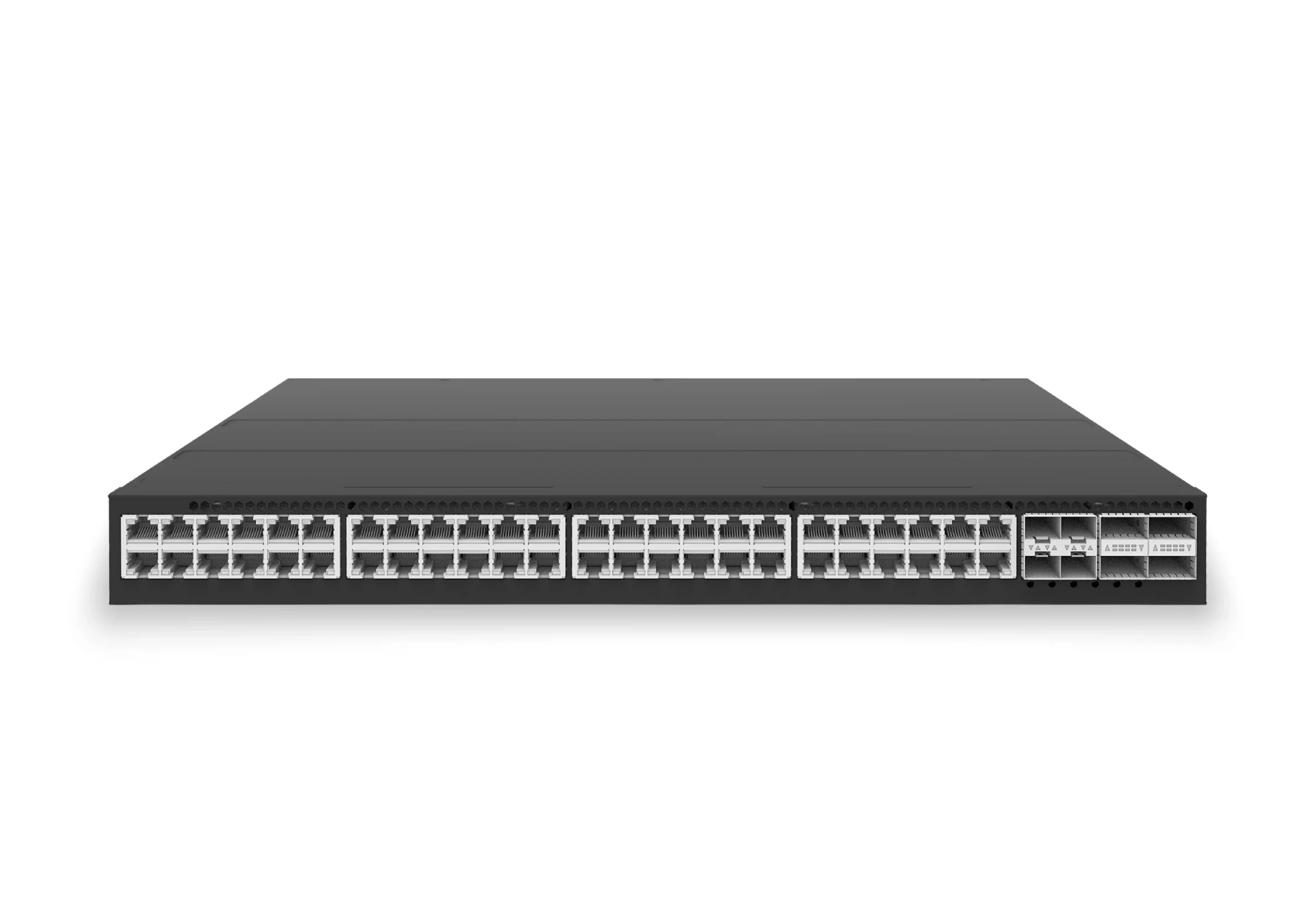
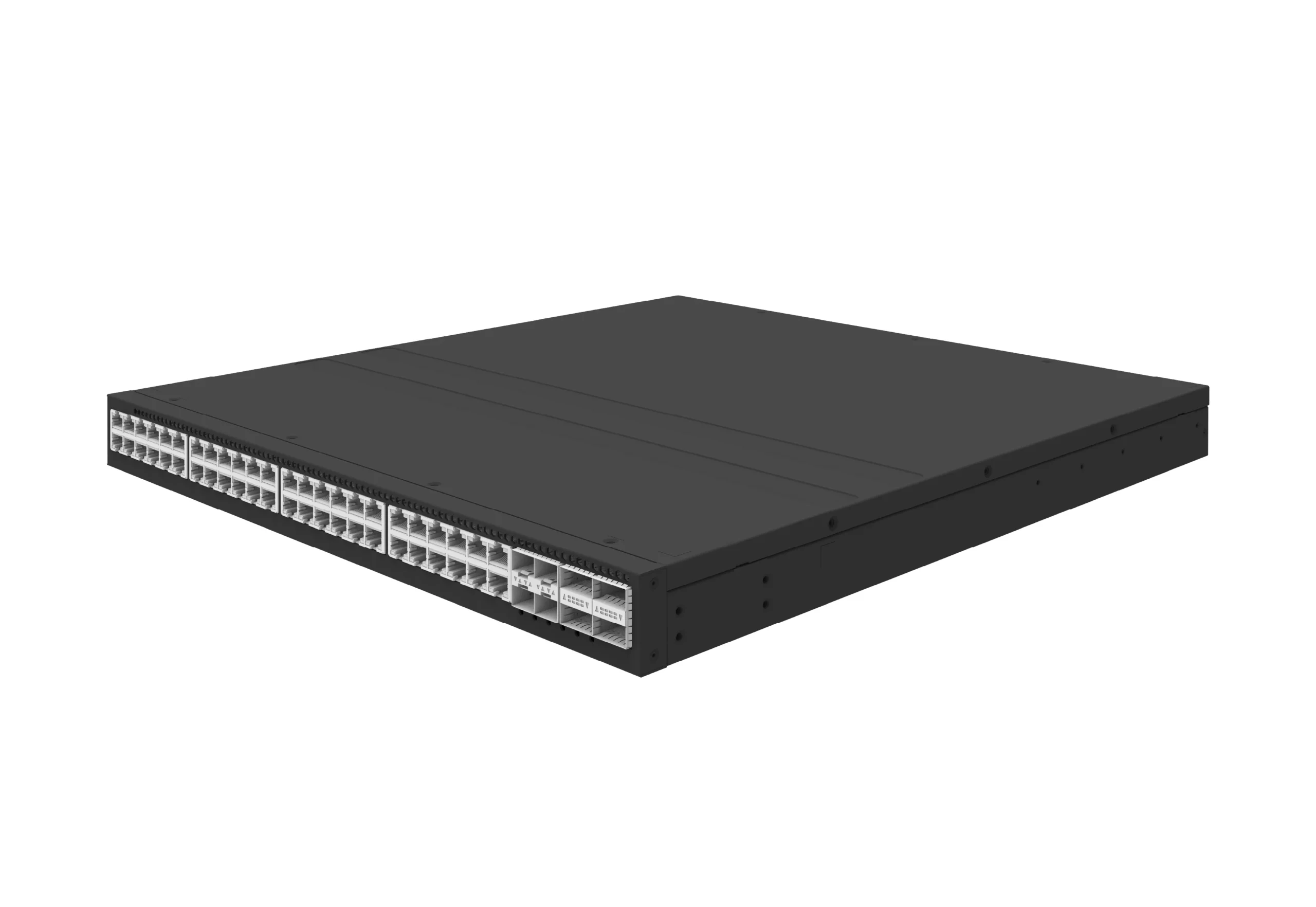
CX206Y-4Y48MT-M-HWP8

4x25Gb/10Gb SFP28 , 48×2.5G RJ45 PoE++ Enterprise Access Switch, 4x100Gb/40Gb QSFP28 Uplinks, Enterprise SONiC Ready

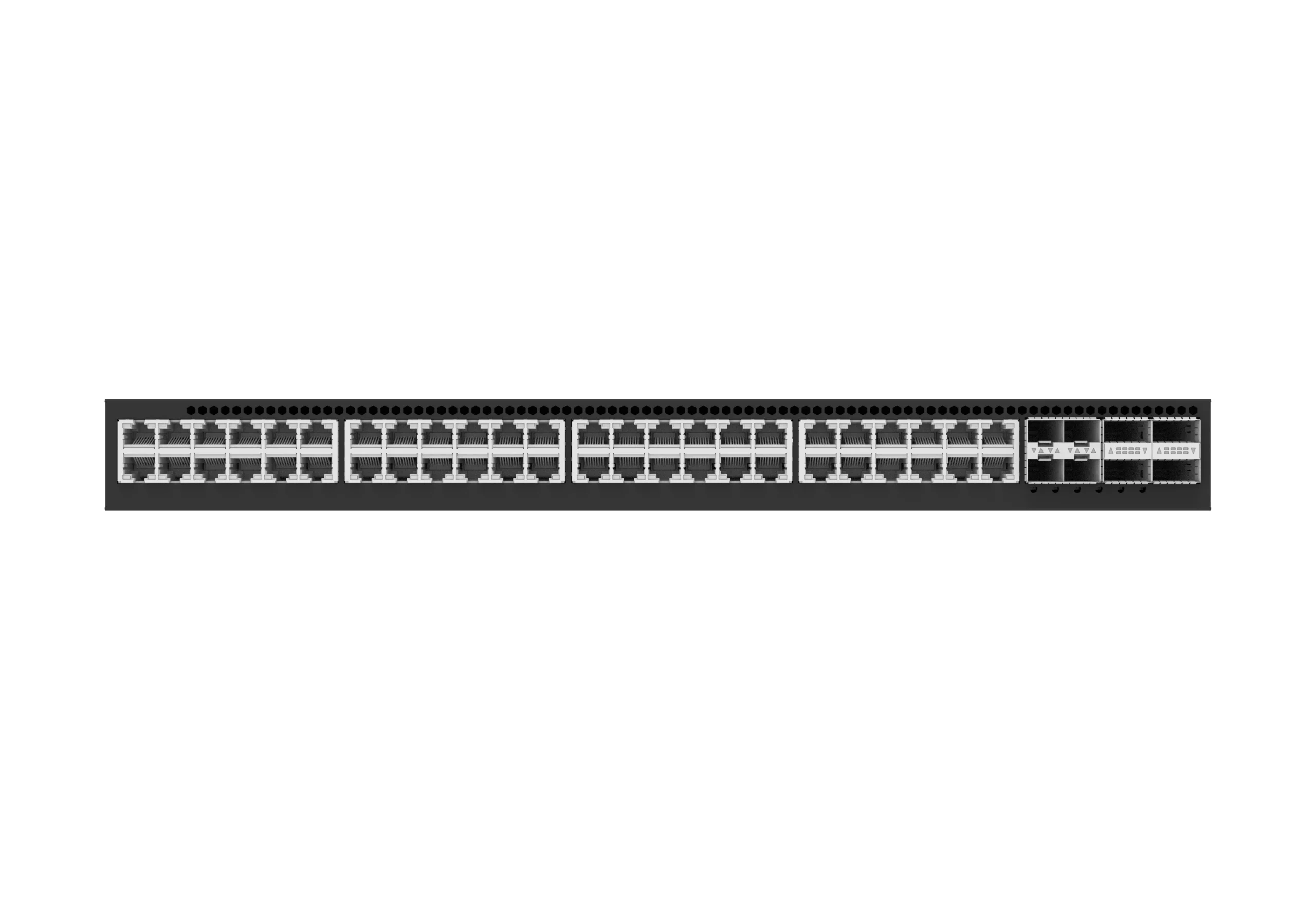
  • 48 Ports 2.5G RJ45 and 4 ports 25G/10G SFP28 downlinks
  • 4 Ports 100G/40G QSFP28 uplinks
  • 800Gbps high switching capacity engineered for campus access deployments
  • Rich Layer 2/3 features
  • Enterprise SONiC Distribution preload
Please login to request a quote

48 x 2.5G RJ45 and 4 x 25G/10G SFP28 downlinks, Copper & Fiber Hybrid Access Switch, 4 x 100G/40G QSFP28 uplinks,  Enterprise SONiC Ready, Marvell AlleyCat 5P

As the highest-performance switch in enterprise access scenario, the CX206Y-4Y48MT-M-H is powered by the Marvell Alleycat 5P chip and a high-performance Octeon CN9130 CPU, delivering a massive 800Gbps switching capacity.

Featuring 48 x 2.5G BASE-T and 4 x 25G/10G SFP28 downlinks and 4 x 100G/40G SFP28 uplinks, its versatile port options effortlessly adapt to diverse high-bandwidth scenarios, from next-gen Wi-Fi 7 APs to core workstation clusters. Built for massive-scale enterprise routing, it supports an impressive 360K IPv4 Prefix Routes and 180K IPv6 Prefix Routes.

As the market pioneer running commercial SONiC (AsterNOS) on campus networks, it delivers robust L2/L3 routing (OSPF, BGP), enterprise virtualization (VXLAN, BGP-EVPN), and high availability (MLAG). Combined with our 3-5 SKU leaf-spine architecture, this switch offers an ultra-scalable, cost-effective, and future-proof solution for modern SMBs and large enterprise networks.

800Gbps

Switching Capacity

320K/160K

IPv4/IPv6 Prefix

8MB

Packet Buffer

1440W

PoE Budget

Specifications

Ports4 x 100G/40G QSFP28
4 x 25G/10G SFP28
48 x 2.5G RJ45
Switch ASICMarvell AlleyCat5P
PoE Port8 x PoE++
40 x PoE+
Switching Capacity800Gbps
PoE Budget1440WCPUOCTEON CN9130
Forwarding Rate834 MppsMac Address Entries32K
RAM4GBIPv4 Prefix Routes360K
Flash Memory32GB eMMCIPv6 Prefix Routes180K
Max. Power Consumption246W (Without PoE) ARP Entries64K
Packet Buffer8MBInput Range100-240V AC / 36-72V DC
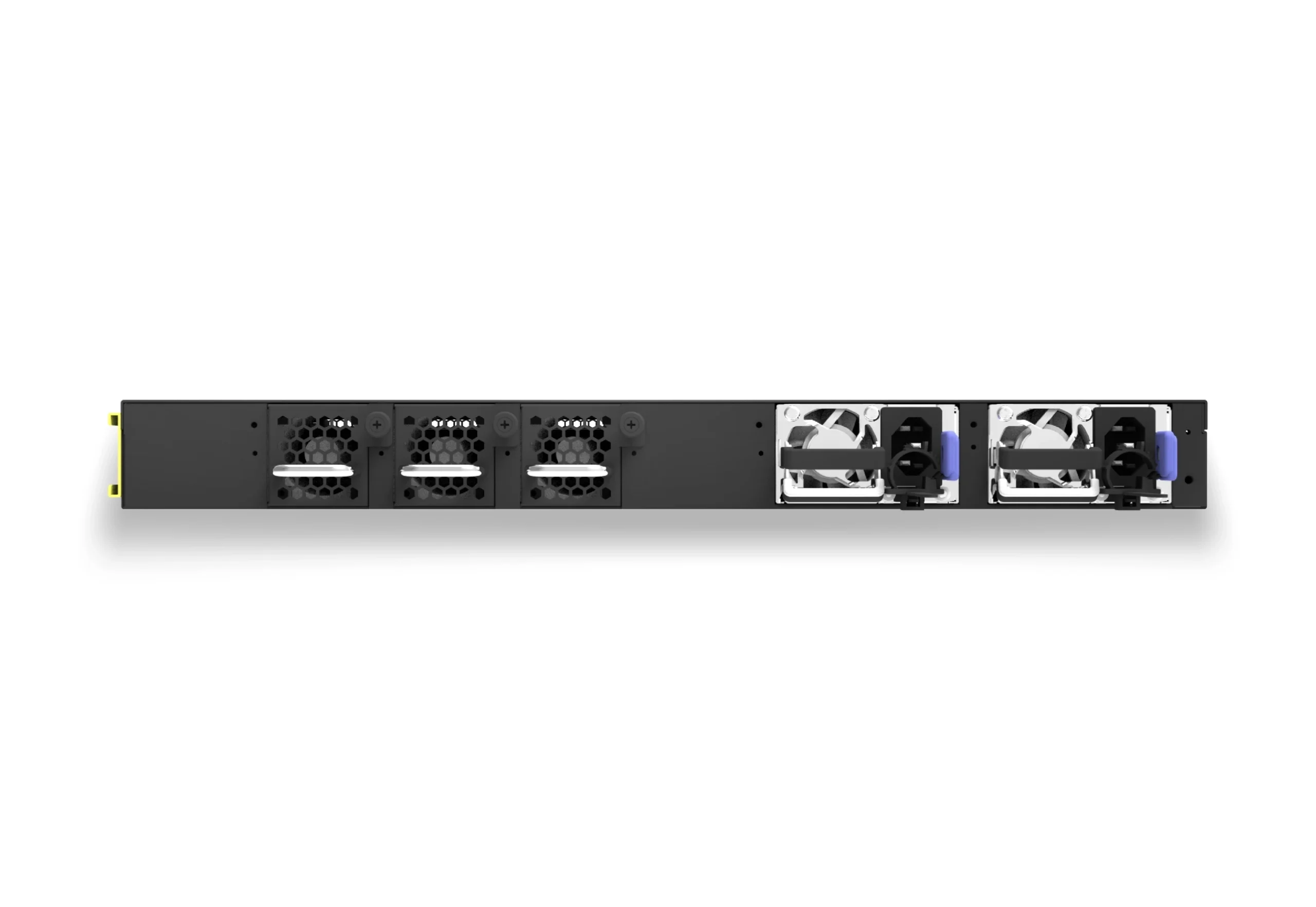
Rack Space1RUPower Module1+1 Hot-pluggable
Dimensions (HxWxD)44 x 440 x 470mmFan Modules2+1 Hot-pluggable
Weight9 KGAirflowFront to Rear
Relative HumidityTemperature5%-90% (non-condensing)Operating Temperature0 – 45℃ (32 – 113℉)
Optional
PTP Class C Accuracy

Optimized Software for Advanced Workloads-AsterNOS

AsterNOS is the pre-installed network operating system on Asterfusion’s CX-M Series campus switches. Built on SONiC, but enhanced far beyond the open-source version, AsterNOS delivers a rich set of enterprise-grade features tailored for modern campus and enterprise office environments. It supports comprehensive Layer 2 and Layer 3 protocols, advanced routing, and virtualization capabilities such as VXLAN and BGP-EVPN—along with powerful extensions like MPLS and MacSec for more specialized use cases. Smart, secure, and simple to manage, AsterNOS is purpose-built to power high-performance, always-on campus networks with ease and confidence.

Optimized Software for Advanced Workloads – AsterNOS

AsterNOS is the pre-installed network operating system on Asterfusion’s CX-M Series campus switches. Built on SONiC, but enhanced far beyond the open-source version, AsterNOS delivers a rich set of enterprise-grade features tailored for modern campus and enterprise office environments. It supports comprehensive Layer 2 and Layer 3 protocols, advanced routing, and virtualization capabilities such as VXLAN and BGP-EVPN—along with powerful extensions like MPLS and MacSec for more specialized use cases. Smart, secure, and simple to manage, AsterNOS is purpose-built to power high-performance, always-on campus networks with ease and confidence.

Software Features

layer-2-features-icon

Virtualization Features

  • VXLAN Centralized/Distributed Gateway
  • EVPN Type 2/3/5

    Quality of Service (QoS)

  • 8 Queues per Port
  • 802.1p Based Classification
  • DSCP Based Classification
  • Strict priority queueing
  • DWRR Scheduling
  • Policing/Shaping
  • Rate Limiting

layer-3-features-icon

Layer 3 Features

  • IPv4/v6 Dual Stack
  • Policy Based Routing
  • Resilient ECMP
  • ARP-to-Host
  • VRF
  • Bi-Directional Forwarding Detection (BFD)
  • IGMP v2/v3
  • Route Map
  • VRRP
  • GRE
  • Routing Protocols: OSPF v2/v3, BGP, MP-BGP

security-features-icon

Management and Monitoring

  • Asteria Campus Controller
  • Industry Standard CLI
  • Zero Touch Provisioning (ZTP)
  • SNMP v1/v2/v3
  • sFlow
  • Port Mirroring
  • Syslog
  • Log Management
  • PTP IEEE 1588v2 (TC and BC)
  • Containerized Custom Tools
  • BGP/BFD Operational Status

Quality Certifications

ISO-9001-SGS
ISO-14001-SGS
ISO-45001-SGS
ISO-IEC-27001-SGS
fcc-icon
ce-icon

Features

Advanced Routing Capabilities

Equipped with powerful routing capabilities, including static routing, VRF, OSPFv2/v3, BGP, and MP-BGP, this model ensures flexible network segmentation and dynamic route management for demanding enterprise and campus environments.
ai-ml-hpc

Comprehensive Virtualization Feature Set

This model supports full network virtualization features:
GRE/static GRE tunnels for point-to-point overlays, plus VXLAN with BGP-EVPN for scalable L2/L3 virtualization across distributed environments.
Perfect for flexible, multi-tenant campus/enterprise networks.
ai-ml-hpc

Advanced Network Protection Features

This model provides strong L2/L3 security for network edge and core, including storm control, DHCPv4/v6 Snooping, ND Snooping, RA Guard, and SAVI (source IP validation). It adds DAI, IP Source Guard (IPv4/IPv6), and CoPP to block spoofing, man-in-the-middle attacks, and control plane overload—ensuring a secure, resilient network.attacks, and control plane overload—ensuring a secure and resilient network environment.
ai-ml-hpc
BFD-Based Link Fault Detection & Re-routing in Sub-50ms

BFD-based link fault detection and sub-50ms re-routing capabilities ensure rapid, reliable failover across critical routing protocols including OSPF, BGP, and IS-IS, minimizing network downtime and maintaining uninterrupted traffic flow even during unexpected link failures.

Achieve seamless redundancy and active-active reliability with MC-LAG support.

MC-LAG support enables networks to maintain uninterrupted connectivity through seamless redundancy and active-active reliability,
ensuring zero downtime and optimal performance during link or device failures.

ai-ml-hpc

Harness MPLS Capabilities for Seamless Redundancy and Resilient Path Engineering

This switch model supports robust MPLS functionality, enabling efficient label-switched path management and seamless traffic forwarding across complex networks. It delivers active-active-like reliability through MPLS-based redundancy mechanisms, ensuring uninterrupted connectivity for mission-critical applications.

ai-ml-hpc

48-Port 2.5GbE PoE++ Access Switches with PTP Support (Optional)

IEEE 1588v2 PTP timing diagram for data center switches with sub-microsecond precision

The CX204P-4Y48MT-M-HWP8 access switches fully support IEEE1588 PTPv2 and SMPTE 2059-2 standards through hardware and software. The hardware port supports PTP as a Boundary Clock (BC) or Ordinary Clock (OC), with customizable modules to fit customer needs. On the software side, Asterfusion leads the way in implementing and optimizing PTP in SONiC, delivering top performance on our AsterNOS Enterprise Distribution. Currently, it supports PTP Class C with a maximum time error of ≤10 ns. →For More←

Unified Visualization, Management & O&M with OpenWiFi Network Controller

Our campus switches, powered by enterprise SONiC, integrate with a TIP OpenWiFi – based controller. This integration enables unified monitoring, automated deployment, and streamlined operations.
Key features include intelligent topology planning, ZTP, real – time network visualization, and script – based automation. With centralized remote management and flexible deployment options (cloud or on – premise), this solution offers full control over the entire campus network, from APs to switches. It helps IT teams optimize performance, speed up troubleshooting, and scale easily. For more←
the-software-architecture-of-the-sonic-based-packet-broker
Our campus switches, powered by enterprise SONiC, integrate with a TIP OpenWiFi – based controller. This integration enables unified monitoring, automated deployment, and streamlined operations.
Key features include intelligent topology planning, ZTP, real – time network visualization, and script – based automation. With centralized remote management and flexible deployment options (cloud or on – premise), this solution offers full control over the entire campus network, from APs to switches. It helps IT teams optimize performance, speed up troubleshooting, and scale easily. For more←

Network Packet Broker Functionality (Optional)

the-software-architecture-of-the-sonic-based-packet-broker

The SONiC-based campus switches CX-M series take full advantage of SONiC’s open and containerized architecture, and fully leverage its capabilities by installing the new APP-PB container and deploying packet broker docker functionality on SONiC.

This integration unlocks a range of advanced features, including traffic mirroring, raw data tagging, filtering, aggregation, preprocessing, load balancing, and output replication. For more←

Panel

Front Panel Ports Indicator Image for 2.5G enterprise access switch CX204P-4Y48MT-M-H
Rear Panel Ports Indicator Image for copper & fiber hybrid access switch CX204P-4Y48MT-M-H

Warranty

This model is backed by a 2 year limited hardware warranty.
Multiple extended support options, including advanced replacement and 24×7 support services, are available.
Contact us for complete details.

Warranty

This model is backed by a 2 year limited hardware warranty.
Multiple extended support options, including advanced replacement and 24×7 support services, are available.
Contact us for complete details.

FAQ

What is this 48×2.5G + 4×25G + 4×100G switch designed for?

This copper & fiber hybrid access switch is designed for complex enterprise and edge environments where you need:

  • 48×2.5G RJ45 ports for high‑density Multi‑Gig access (Wi‑Fi 7 APs, IP cameras, IoT, and office PCs)
  • 4×25G/10G SFP28 downlinks for local servers, storage, and high‑end workstations (3D rendering, video editing)
  • 4×100G/40G QSFP28/40G uplinks to aggregate traffic to the core or data center without becoming a bottleneck
Why 2.5G ports instead of 1G or 10G?

2.5G is the sweet spot for Wi‑Fi 7 and Multi‑Gig endpoints:

  • Wi‑Fi 7 APs typically need 2.5G/5G/10G uplinks to fully utilize their throughput
  • 2.5G works over existing Cat5e/Cat6 cabling, so you don’t have to rewire everything to Cat6A for 10G
  • Many modern laptops, desktops, and NAS devices now include 2.5G Base‑T ports
How does this switch help reduce TCO (Total Cost of Ownership)?
  • Uses existing Cat5e/Cat6 cabling for 2.5G, avoiding expensive re‑cabling to Cat6A/Cat7 for 10G
  • Consolidates access + partial aggregation into one switch, reducing the number of devices and management overhead
  • 25G ports are cheaper per Gbps than 10G Base‑T for high‑performance workloads
  • 100G uplinks provide long‑term scalability, delaying the need for a full spine upgrade
  • Open network / SONiC support reduces software licensing costs and vendor lock‑in
Why does an access switch need a massive 4 x 100G uplink? Isn’t 40G enough?

If you look at the math behind a fully loaded access layer, 40G creates a severe bottleneck.

If you saturate 48 x 2.5G ports (120Gbps) and 4 x 25G ports (100Gbps), your total potential downlink bandwidth is 220Gbps. Utilizing a standard 40G uplink results in an oversubscription ratio of over 5.5:1, causing packet drops during peak hours (e.g., scheduled enterprise backups or heavy Wi-Fi utilization). By providing 4 x 100G uplinks (up to 400G backhaul via MLAG/LAG), this switch slashes the oversubscription ratio down to a near-line-rate level. It guarantees a seamless, non-blocking data highway from the campus edge straight to your Leaf-Spine core.