With the rapid adoption of cloud computing and AI, enterprise networks are quietly undergoing a fundamental shift: their boundaries are becoming increasingly blurred. Campus networks, once relatively “quiet” and stable, are now carrying workloads traditionally associated with data centers—video conferencing, large-scale data processing, and AI applications are steadily moving into office and production environments. As a result, the campus network is no longer just an “access network,” but is evolving into a continuous service delivery platform.
Along with this shift, traffic patterns are also changing. Campus networks, which were once dominated by north-south traffic, are now seeing a significant increase in east-west traffic. At the same time, design principles originally developed for data centers—such as high bandwidth, low latency, and strong scalability—are beginning to flow back into campus environments.
This naturally raises a question: if campus networks are already carrying data center-like workloads, can they still rely on traditional three-tier tree architectures, VLANs, and STP? Or is there a need for a new architecture that preserves simplicity and operational controllability while also delivering data center-grade scalability?
A Spine-Leaf architecture based on BGP EVPN and VXLAN is emerging as the mainstream answer to this question. It brings mature data center networking principles into the campus environment, delivering high scalability and reliability while avoiding excessive operational complexity.
In this context, Asterfusion’s campus solution can be understood as an effort to rebuild traditional campus networks using data center networking methodologies. Built on the enterprise SONiC system (AsterNOS), it adopts a BGP EVPN + VXLAN Spine-Leaf architecture and deeply integrates the OpenWiFi open wireless framework. This results in a unified network model that combines wired and wireless networking, multi-tenancy at the protocol level, and cloud-native operational capabilities.
The Problem with Traditional Campus Networks
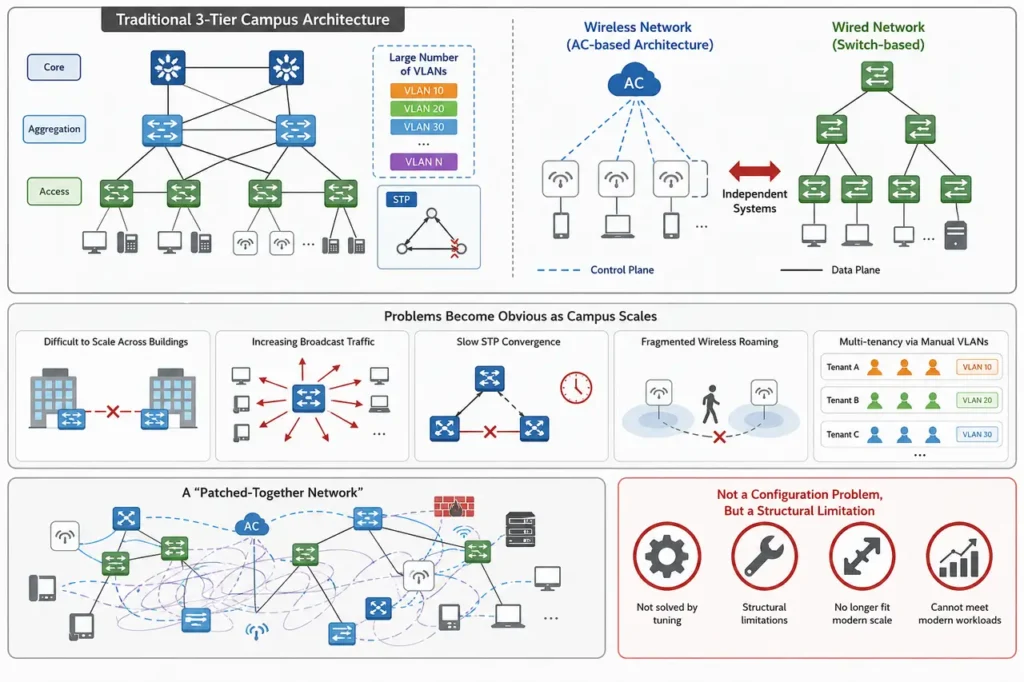
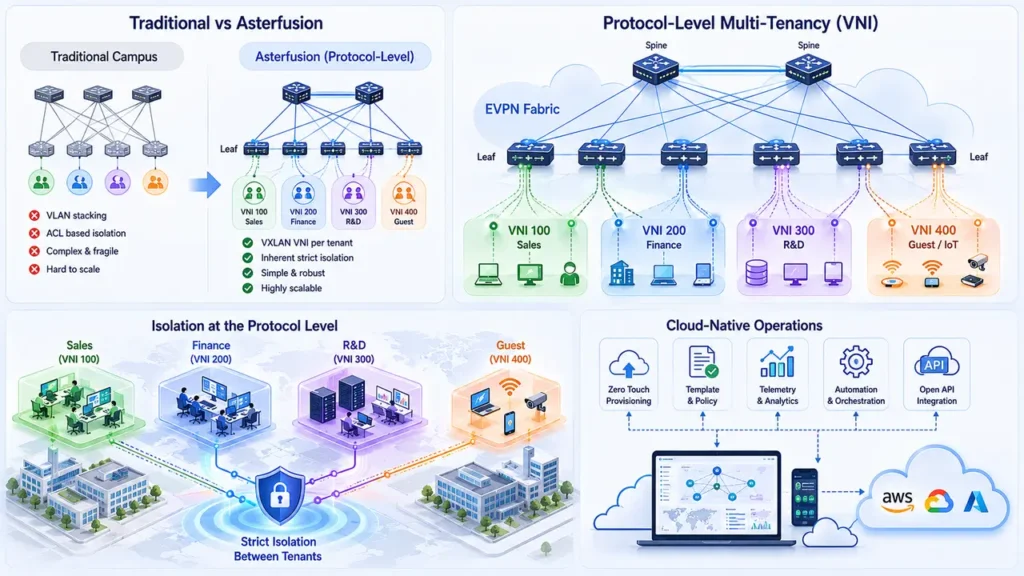
Traditional campus networks are well known: a three-tier architecture (access, aggregation, core), a large number of VLANs for segmentation, and STP used to prevent loops. Wireless networks rely on AC-based architectures, while wired networks are handled separately by switches—two independent systems with their own control planes. This setup works at small scale, but as campuses grow, the limitations become obvious: difficulty in scaling across buildings, increasing broadcast traffic, slow STP convergence, fragmented wireless roaming experiences, and multi-tenancy implemented through manual VLAN design. The overall system increasingly resembles a “patched-together network.”
These issues are not something that can be solved through configuration tuning. They are structural limitations that no longer fit modern campus scale and workload requirements.
Architecture Shift: From Switch-Centric Design to Routing-Driven Networks
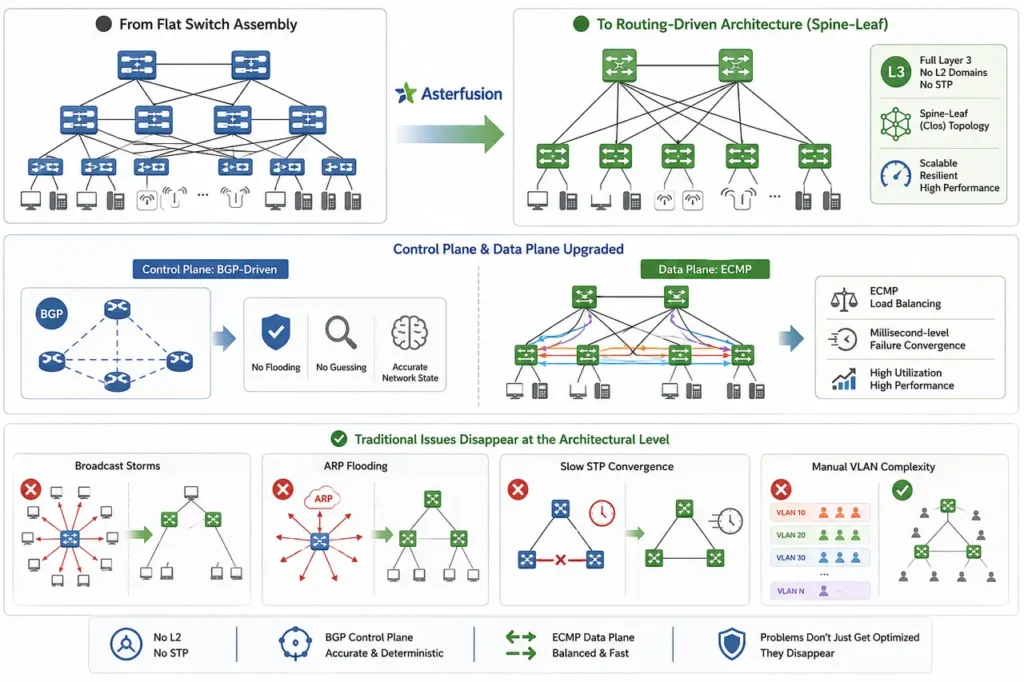
Due to historical constraints, traditional campus networks have long relied on a “switch-centric patchwork mindset”—layered three-tier hierarchies, VLAN-based segmentation, and STP-based loop prevention, resulting in increasingly complex and fragile architectures.
Asterfusion fundamentally changes this approach by transforming the network from a “flat switch assembly” into a routing-driven system:
The entire network becomes fully Layer 3 routed, eliminating Layer 2 domains and STP entirely. The topology is redesigned as a Spine-Leaf (Clos) architecture.
Both the control plane and data plane are upgraded.
- The control plane is fully driven by BGP, eliminating legacy mechanisms that rely on flooding to “guess” network state.
- The data plane uses ECMP (Equal-Cost Multi-Path) to achieve load balancing and millisecond-level failure convergence.
As a result, traditional issues such as broadcast storms, ARP flooding, and slow STP convergence are not optimized—they disappear at the architectural level.
Core Mechanism: The VXLAN + EVPN Duo
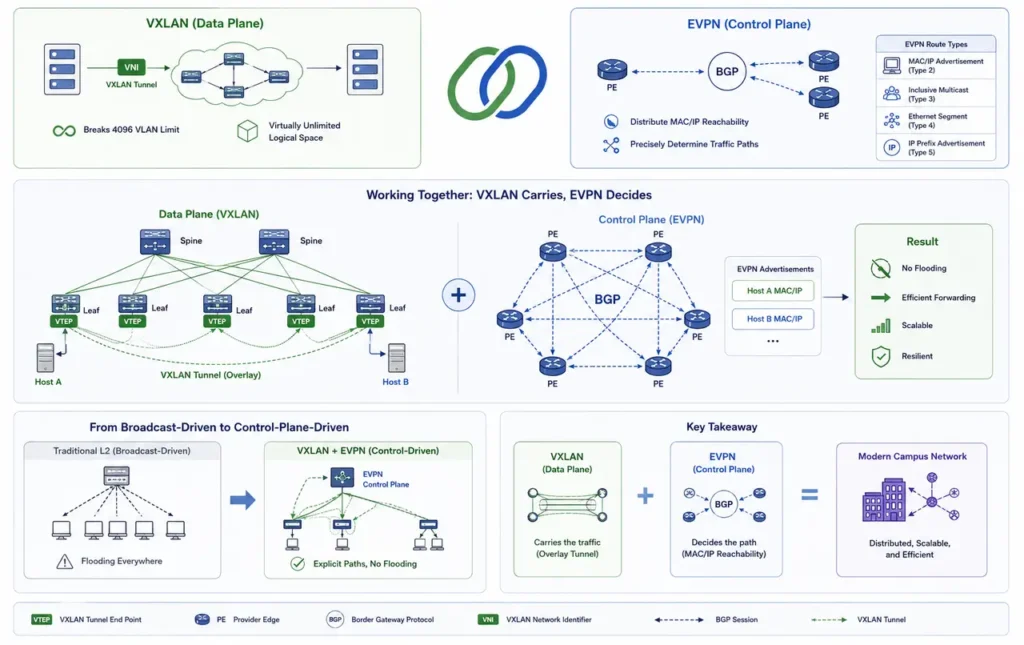
Within a routing-driven architecture, VXLAN and EVPN work together as a tightly coupled system:
- Vxlan( Data plane): Responsible for delivering traffic across the network -breaking the 4096 VLAN limit and enabling a virtually unlimited, overlay-based logical space
- EVPN (Control Plane): Responsible for precisely determining where traffic should be sent (leveraging BGP to distribute MAC and IP reachability information across the entire network)
Together, they transform the campus network from a broadcast-driven Layer 2 system into a distributed network with explicit control logic.
For more: BGP EVPN VXLAN: Unified Spine-Leaf Network Topology for Campus and Data Center Based on SONiC
Experience Redefined: True Wired-Wireless Unification
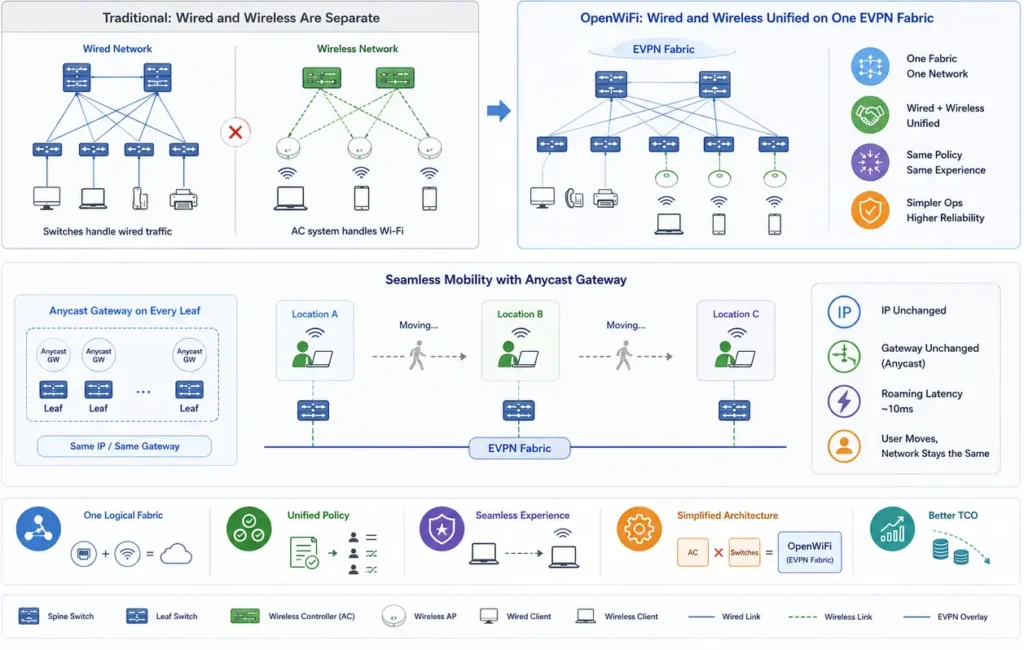
Asterfusion breaks the traditional separation between wired and wireless networks, where AC systems handle Wi-Fi and switches handle wired traffic independently. By introducing the OpenWiFi model, both are unified into a single EVPN fabric.
Wireless access is no longer an isolated domain but becomes part of the same network system. As a result, wired and wireless traffic are no longer two separate networks, but two entry points into a single logical fabric.
This also enables seamless mobility. When users move within the campus, their IP address and gateway remain unchanged, since every Leaf switch functions as an Anycast Gateway. From the user’s perspective, they appear to “move locations,” but from the network’s perspective, they remain at the same logical point. This is why roaming latency can be reduced to around 10ms—not because Wi-Fi is optimized, but because mobility is absorbed into the network architecture itself.
For more :
- Ensuring Uninterrupted Wi-Fi Roaming Connectivity-Asterfusion’s Anycast Gateway
- https://cloudswit.ch/product-category/sonic-access-aggregation-switch/
- https://cloudswit.ch/product/tip-campus-openwifi-network-controller/
Enterprise-Grade Capabilities: Protocol-Level Multi-Tenancy and Cloud-Native Operation
Asterfusion transforms what used to be manually engineered, configuration-heavy enterprise requirements into built-in protocol-level capabilities.
Protocol-Level Multi-Tenancy Isolation
Traditional campus networks rely on complex VLAN stacking or ACL policies to achieve segmentation, which is fragile and difficult to scale. In Asterfusion’s architecture, each tenant (or business unit) is essentially represented by a VXLAN Network Identifier (VNI). VNIs provide inherent and strict isolation, turning the campus into a collection of logical networks rather than a collection of physical devices. This enables true multi-campus, multi-building, and multi-tenant deployments.
Cloud-Native Operations
Built on a unified SONiC-based architecture and standard APIs, the entire campus network—including switching, routing, and OpenWiFi wireless—is fully programmable and centrally abstracted. The solution enables both wired and wireless networks to be managed through a unified cloud control plane, delivering Network-as-a-Service (NaaS). IT teams can provision multi-tenant services at scale, perform full-network visibility monitoring, and enable automated operations—bringing a public-cloud-like operational experience to campus networking.
Summary
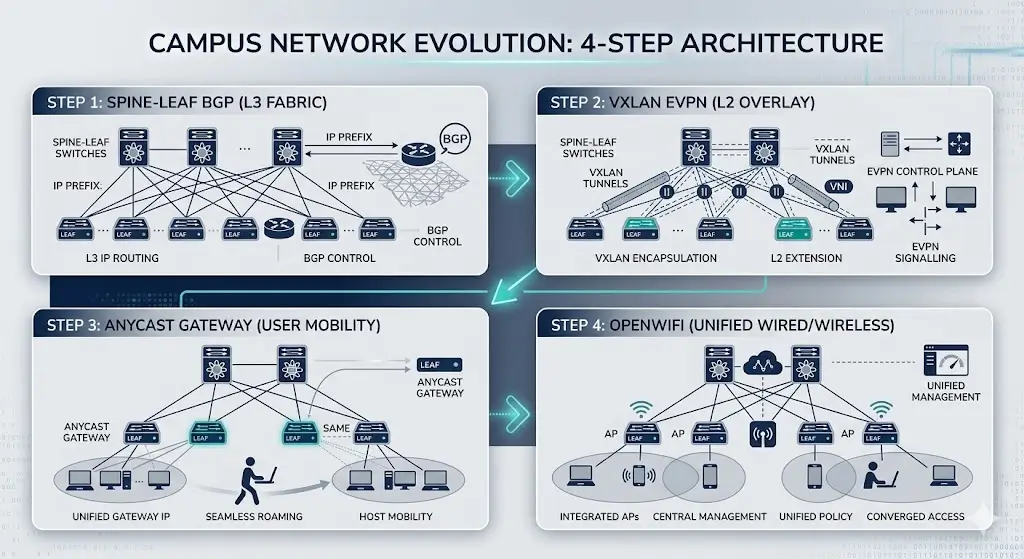
First, Spine-Leaf + BGP transforms the campus into a pure L3 fabric.
Then, VXLAN + EVPN brings Layer 2 services onto this fabric.
Next, Anycast Gateway and EVPN host routing enable seamless mobility.
Finally, OpenWiFi unifies wireless and wired networks into a single system.
When viewed as a whole, this is not an incremental technical upgrade—it is a fundamental paradigm shift. The network is no longer organized around “how switches are connected,” but around how business traffic flows within a unified logical system.
From this perspective, the role of the campus network itself is changing. It is no longer just an access infrastructure, but a distributed platform that supports multi-service, multi-tenant, and multi-application environments. Whether it is AI-driven traffic variability or high-bandwidth, low-latency application demands, everything is ultimately mapped onto a single EVPN VXLAN fabric.
What Asterfusion is doing is essentially bringing this unified networking model into the campus environment, converging previously fragmented wired, wireless, multi-tenant, and operational systems into a single architectural framework for the first time.
As a result, campus networking is no longer a problem that requires continuous patching and optimization. It is becoming a systematically designed and continuously evolving infrastructure capability. For enterprises, this means networking is no longer just a cost center, but increasingly a foundation for business agility and innovation.
If traditional campus networking was about “how to connect things together,” the next generation based on EVPN VXLAN is about a deeper question: once everything is connected, how should the network evolve to support the business itself?


