Table of Contents
Packet Broker Market is Growing
According to research from Kings Research , the global Network Packet Broker market is projected to grow from USD 1.0126 billion in 2024 to USD 1.5729 billion by 2031. The increasing demand for network visibility and security continues to drive market expansion.
Beyond the rapid growth of cyber threats and the increasing complexity of IT infrastructure, several other factors are accelerating market adoption. These include the integration of AI and ML for advanced analytics, along with the broad adoption of virtualization and cloud-native architectures for better scalability and operational flexibility.
At the technology level, Packet Broker platforms are also moving in a new direction. NPBs are evolving from traditional hardware appliances into software-defined and scalable visibility platforms. Open and disaggregated architectures, especially SONiC-based ecosystems, are becoming an important industry trend.
For enterprise buyers, selecting the right Open Packet Broker vendor has become a critical decision. Whether the goal is improving network security, enabling AI/ML-driven analytics, or aligning with next-generation open networking architectures, the Packet Broker platform now plays a key role in modern infrastructure design.
Based on these market trends and current industry adoption, the following section provides an overview of 11 leading Packet Broker vendors shaping the market in 2026 for reference.
Asterfusion
Founded in 2017, Asterfusion became an active contributor during the era when P4-programmable chips dominated the Network Packet Broker (NPB) market. Following the EOL of Intel Tofino, Asterfusion began developing an alternative architecture. The company eventually introduced an NPB 2.0 solution based on the open networking operating system SONiC. By integrating NPB capabilities into white-box switching platforms, Asterfusion has become one of the vendors driving the next direction of the NPB market.
Asterfusion provides full-stack SONiC-based Packet Broker and high-performance switching platforms. The solution combines 1G–800G Ethernet switching with advanced traffic visibility capabilities.
Hardware Platform
The platform uses SONiC-based white-box switches with interface speeds ranging from 1G to 800G. Available platforms include 24-port, 48-port, and 64-port models. With breakout capability, a single system can scale up to 256 ports. Nearly 30 platform options are available for 1G and 10G deployments alone. The hardware is built on Marvell Falcon and Teralynx chipsets, providing ultra-large packet buffers ranging from 3MB to more than 100MB. Combined with the visibility platform, the solution delivers full traffic feeds and data sources for operations analytics, security compliance, and monitoring systems. It supports deployment across both traditional data centers and cloud environments.

Software Capabilities
On the software side, Asterfusion delivers NPB functionality through PB-APP. Running as a containerized application on SONiC, PB-APP supports traffic aggregation, filtering, replication, and distribution, along with multiple advanced traffic processing functions. Benefiting from SONiC’s container-based architecture, new feature development and service expansion can be implemented quickly and flexibly.
For more advanced use cases, Asterfusion’s FusionNOS also supports DPU acceleration for deeper packet processing. Advanced capabilities include application-layer protocol matching, signature-based filtering, SSL encryption and decryption, packet deduplication, and packet masking. Some key advanced features are listed below:
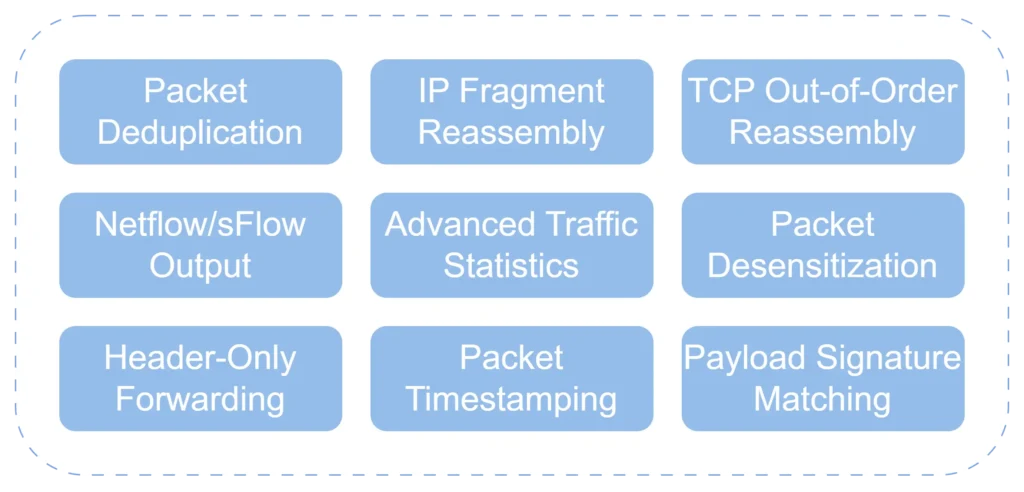
Key Advantages
- Future-ready architecture: Built on SONiC and white-box hardware, aligned with the mainstream direction of open networking.
- Broad platform coverage: Supports platforms from 1G to 800G. With breakout capability, the solution provides high-density port scalability for AI traffic environments and enterprises of different sizes.
- Investment protection: Reuses existing switching infrastructure without requiring large-scale network redesign or proprietary NPB appliances and closed software ecosystems.
- Decoupled software and hardware: Avoids vendor lock-in between hardware and software while providing a user-friendly Web UI management platform.
- Integrated switching capabilities: Functions as both a high-performance NPB and a fully featured Ethernet switch.
- High cost efficiency: Simplifies feature expansion and reduces overall deployment cost.
For customized requirements, mail to bd@cloudswit.ch
Gigamon
Founded in 2004, Gigamon is one of the global leaders in the Network Packet Broker market. More than 80% of Fortune 100 companies use its solutions. Gigamon represents the traditional purpose-built NPB vendor model and has focused on network visibility long before the P4-programmable chip era. As of 2025, the company serves more than 4,000 organizations worldwide.
Gigamon’s platforms are built on the proprietary GigaVUE-OS software and dedicated hardware appliances.

Hardware Platform
Its product portfolio is divided into three major series for different deployment scenarios:
- GigaVUE HC Series, designed for data centers and service providers
- GigaVUE TA Series, focused on edge NPB deployments
- GigaVUE V Series, providing virtualized NPB capabilities
The product lineup ranges from compact half-width 1U platforms to high-density 3U systems, with interface scalability ranging from dozens to hundreds of ports.
Software Capabilities
GigaSMART is Gigamon’s proprietary intelligent traffic processing engine and a core component of the GigaVUE-OS platform. It provides the following advanced traffic processing capabilities:
| Feature Category | Functions |
| Traffic Intelligence | Adaptive Packet Filtering, Advanced Load Balancing, De-Duplication, Header Stripping, Masking, NetFlow Generation, Packet Slicing, SSL/TLS Decryption, and Tunneling |
| Application Intelligence | Application Filtering, Application Metadata with more than 5,000 identifiable attributes, and Application Visualization |
| Security Intelligence | TLS/SSL Decryption, Encrypted Traffic Threat Detection, and Inline Bypass Architecture |
| Subscriber Intelligence | Advanced traffic intelligence for 5G networks |
Based on its integrated hardware and software architecture, Gigamon introduced the concept of the Deep Observability Pipeline. It refers to a complete framework that extracts intelligence from network traffic and delivers enriched telemetry to monitoring and security tools in real time.
Key Advantages
Built around the GigaSMART intelligent traffic processing engine and the Deep Observability Pipeline architecture, the platform delivers advanced capabilities for security operations teams, including encrypted traffic analysis, packet deduplication, SSL/TLS decryption, and application identification. The solution supports full-rate traffic visibility from 1G to 100G and is widely adopted by 83 Fortune 100 companies. Gigamon remains one of the most established purpose-built visibility platform vendors in the market.
Garland Technology
Garland Technology was founded in 2011 and is recognized as a global provider of network and OT visibility solutions. In the NPB market, the company is best known for its expertise in network TAP technology. In 2019, Garland expanded its portfolio with the PacketMAX series to enter the Network Packet Broker market. As of 2025, its solutions are widely deployed across enterprises, service providers, and government organizations.
The platform is built on proprietary hardware combined with a user-friendly GUI management system. Instead of relying on a dedicated proprietary network operating system, Garland uses a proprietary embedded OS architecture. Devices can be managed directly through an embedded Web interface or CLI, without requiring an external centralized management platform.

Hardware Platform
On the hardware side, Garland Technology provides three product series designed for different deployment scenarios:
- Portable Packet Broker: Entry-level hardware platforms for standard NPB deployments
- PacketMAX: Advanced Aggregators: Designed for high-density aggregation, filtering, and load balancing
- PacketMAX: Advanced Features: Focused on advanced service expansion such as timestamping, packet slicing, and enhanced load balancing
The product architecture follows a progressive feature model aligned with the “Deconstructed Packet Broker” concept. Advanced functions are delivered as independent service nodes instead of being tightly integrated into the primary appliance. This design allows users to add advanced capabilities based on deployment requirements, providing greater flexibility and scalability.
Software Capabilities
On the software side, the platform supports the following capabilities:
| Feature Category | Functions |
| Core Functions | Filtering, Aggregation, Load Balancing, and Replication |
| Advanced Functions | Packet Slicing, Time Stamping, De-Duplication, and GRE/VXLAN Tunnel Termination |
| Tunnel Support | GRE, L2GRE, ERSPAN, and VXLAN Tunneling, all included without additional port license costs |
| Specialized Features | NTP Time Stamping, sFlow Support, Physical Layer Error Pass-through, and Hash-based Round-robin Load Balancing |
Key Advantages
Garland Technology is one of the early innovators in the TAP market. Its platforms are recognized for eliminating port-based licensing costs and adopting the Deconstructed Packet Broker architecture. The solution also provides a user-friendly GUI management platform for simplified operations.
Keysight (Ixia)
Keysight Technologies was formed in 2014 as a spin-off from Agilent Technologies, inheriting the network test and visibility business originally developed by Ixia. Its Network Packet Broker product line originates from the Ixia Vision series. Keysight is widely recognized in the NPB market for FPGA-accelerated hardware design and zero-loss, wire-speed packet processing. It is a key player in carrier-grade network testing and visibility solutions.
The platform is built on proprietary hardware with FPGA acceleration, combined with Keysight’s in-house PacketStack software architecture. In 2025, Keysight introduced AI Insight Broker, enabling integration with the Keysight AI Stack and support for third-party AI applications running directly on the platform.

Hardware Platform
On the hardware side, Keysight organizes its portfolio into four core product families designed for different deployment scenarios:
| Product Series | Use Cases | Port Configuration | Speed Support | Key Features |
| Vision X Series | Telecom operators, financial institutions, and government networks (flagship line) | 60+ ports | 1/10/25/40/100/400G | Up to 2 Tbps throughput, FPGA acceleration, and support for AI applications |
| Vision 400 Series (E400S) | Production networks and high-density data centers | 24×QSFP56 + 16×QSFP-DD | 400 Gbps | 1RU compact design, based on Intel P4 programmable architecture |
| Vision E1S | Small enterprises and edge deployments | 12×10G + 2×40G | 10/40G | Compact chassis with cost-efficient design |
| V400 | Edge and branch offices | 16×10G + 2×40G | 10/40G | Portable form factor with AI application support |
Form factor: ranges from 1U to 3U chassis-based platforms. Port density varies from 12 to 60+ ports, with support for customizable rack configurations and modular, on-demand expansion.
Software Capabilities
Core features is shown in below tables:
| Feature Category | Functions |
| Basic Functions | Filtering, Aggregation, Load Balancing, Replication, and De-Duplication |
| Advanced Functions | Packet Slicing, Time Stamping, Header Stripping, Dynamic Filter Compiler, and Metadata Extraction |
| Tunnel Support | ERSPAN, GRE, L2GRE, VXLAN, and GTP tunnel termination |
| Specialized Functions | FPGA hardware acceleration (zero-packet-loss wire-speed processing) and AI application support (AI Stack / third-party AI integration), plus drag-and-drop GUI |
| AI Capabilities | Baseline learning, anomaly detection, dynamic application signatures, predictive quality/threat analysis, and automated configuration optimization |
Key Advantages
Built around FPGA-based hardware acceleration and zero-packet-loss wire-speed processing, the platform delivers high-performance packet handling for carrier-grade environments. In 2025, Keysight introduced AI Insight Broker and the AI Stack, enabling AI applications to run directly on the NPB platform. With these AI-driven capabilities integrated into the visibility layer, Keysight is positioned as a leader in AI-enhanced Packet Broker solutions.
Cubro Network Visibility
Cubro Network Visibility was founded in 1999 in Vienna, Austria. The company focuses on network observability solutions. In the Network Packet Broker market, Cubro is known for high reliability, zero-packet-loss processing, and wire-speed performance. It is a key player in the network visibility space, positioned just below leading vendors such as Gigamon and Keysight.
The platform is built on proprietary hardware combined with proprietary intelligent software. It does not rely on any open-source operating system. Instead, Cubro develops its own fully proprietary software stack.
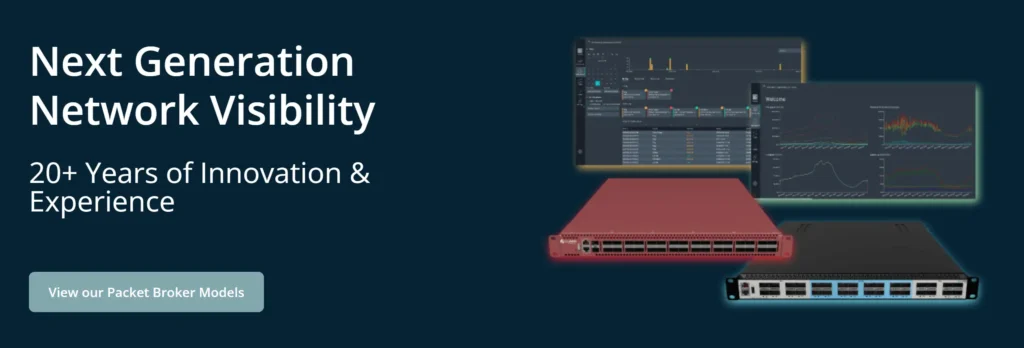
Hardware Platform
The product portfolio is organized into four core series, designed for different deployment scenarios:
| Product Series | Use Cases | Port Configuration | Speed Support | Key Features |
| Packetmaster EX Series | Data centers and enterprise DC environments (flagship line) | Tens to hundreds of ports | 1/10/25/40/100/400G | High-density aggregation, filtering, replication, load balancing, and de-duplication |
| EX2 Series | Portable deployment, field testing, and mobile networks | 2×1/10G SFP/SFP+ + 4×10/100/1000M | 10M–10G | Fully featured portable “field” Packet Broker with native 10G support |
| EX6-3 | Hybrid deployments (10/100/1000 copper + fiber) | High-density 10/100/1000 copper and fiber ports | 10M–1G | First hybrid NPB combining switch and packet broker functions, supports inline monitoring use cases |
| Vitrum | Centralized management platform | Software platform | N/A | Centralized management for all Cubro network visibility solutions |
Software Capabilities
| Feature Category | Functions |
| Basic Functions | Filtering, Aggregation, Load Balancing, Replication, and De-Duplication |
| Advanced Functions | Packet Slicing, Time Stamping, Header Modification, and HMAC/ERC checksum validation |
| Tunnel Support | CFP, ERSPAN, GRE, GTP, MPLS, MPLS over GRE, L2GRE, and VXLAN |
| Specialized Functions | L2/L3/L4 header modification (VLAN tag, MPLS label, MAC address, IP address, and port manipulation), supporting up to 4,500 rules |
| Advanced Capabilities | DPI (Deep Packet Inspection) and packet capture functionality (available on high-end NPB models) |
Key Advantages
Cubro emphasizes zero-packet-loss processing, ensuring accurate and real-time visibility even under high load conditions. Its wire-speed architecture ensures all ports operate at line rate without introducing processing latency.
The platform supports more than 4,500 rules, enabling complex filtering and load-balancing policies. It also provides a fully featured portable “field” Packet Broker, along with hybrid NPB devices that combine switching and packet broker capabilities.
Compared with leading vendors, Cubro focuses on a more cost-efficient and practical approach, delivering a balance between functionality and deployment economics
APCON
APCON was founded in 1993 and is a dedicated vendor focused on network observability and security visibility solutions. The company is positioned around high-performance, chassis-based, purpose-built hardware platforms. Its core emphasis is on real-time traffic processing, compliance, encrypted traffic visibility, and observability capabilities for AI and 400G environments.
Hardware Product Portfolio
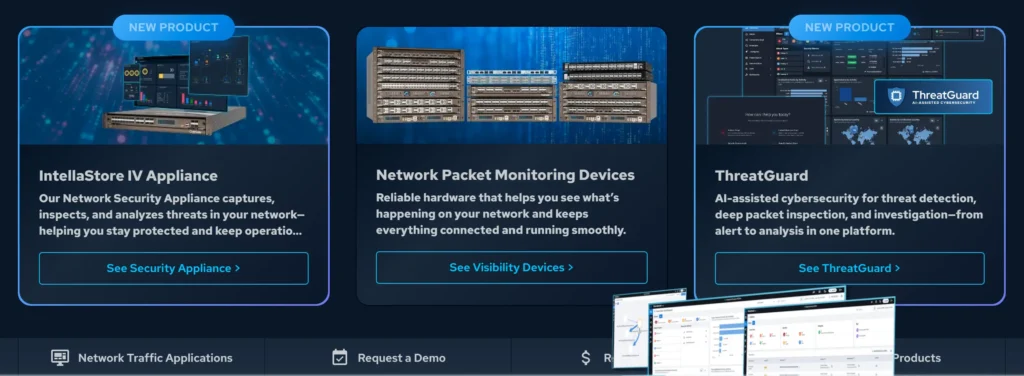
APCON primarily uses proprietary chassis-based hardware platforms. Its product ecosystem is built around three main product lines:
- IntellaView / IntellaFlex Series: Chassis-based NPB platforms designed for enterprise and data center environments. They support speeds from 1G to 400G, high-density optical interfaces, and modular expansion. These systems are commonly used for monitoring and compliance use cases.
- PacketMAX Series: Focused on advanced traffic processing, providing capabilities such as de-duplication, packet slicing, load balancing, and deep filtering for efficient tool optimization and traffic handling.
- Managed TAP / Bypass Series: Includes TAP and bypass appliances used for traffic mirroring and inline protection. These are widely deployed in testing environments and specialized network deployments.
In 400G and AI-driven environments, APCON positions NPB as a core visibility infrastructure layer. The platform emphasizes high-performance packet processing, traffic aggregation, filtering, de-duplication, load balancing, and packet slicing.
Software and Feature Capabilities
The software layer is based on APCON’s proprietary IntellaFlex visibility software. The design focuses on integrating visibility and advanced packet processing directly into the platform rather than adopting an open operating system ecosystem.
Key capabilities include traffic aggregation and filtering, de-duplication, load balancing, packet slicing, compliance-driven visibility, and real-time traffic processing for 400G AI workloads.
The overall value proposition is centered on a combination of high-performance hardware, traditional NPB functionality, and strong compliance/security-oriented use cases, rather than an open software ecosystem.
Key Advantages
- Full-featured traditional NPB capabilities: Strong support for traffic aggregation, filtering, de-duplication, load balancing, and packet slicing at scale.
- Strong compliance and security focus: Mature capabilities in encrypted traffic visibility and compliance-driven monitoring, suitable for financial institutions and government environments.
- High-performance hardware architecture: Purpose-built platforms designed to handle 1G–400G traffic and AI-scale workloads with stable performance.
Arista Networks
Founded in 2004, Arista Networks is a globally recognized vendor in cloud networking switches and the EOS operating system. Arista is not a dedicated visibility appliance vendor. Instead, it extends advanced packet brokering capabilities as a core function of its general-purpose switching platforms. With its DANZ (Data ANalyZer) monitoring architecture, Arista has become a key participant in data center observability.
Arista’s solution is built on its proprietary DANZ EOS software along with the standard Arista EOS operating system.

Hardware Platform
It covers multiple deployment scenarios through three main product lines:
- DANZ Monitoring Fabric (DMF): A controller-based NPB architecture designed for large enterprises and data centers. It provides integrated advanced services and multi-tenant “monitoring-as-a-service” capabilities.
- DANZ EOS: A TAP aggregation solution built on standard Arista EOS switches, supporting 1G–400G speeds. It is optimized for cloud data center deployments.
- CloudVision + DANZ: A unified cloud network observability platform that delivers end-to-end visibility across physical, virtual, and containerized environments.
Software Capabilities
At the functional level, Arista’s DANZ Monitoring Fabric adopts a controller-based NPB architecture. In addition to standard capabilities such as filtering, aggregation, de-duplication, and ECMP-based load balancing, it also supports packet slicing, sensitive data masking, payload stripping, and VXLAN encapsulation and decapsulation.
Beyond traditional packet processing, the platform integrates context-aware analytics, zero-trust security monitoring, predictive analytics, and scalable packet capture capabilities, enabling AI/ML-driven observability at the edge.
Key Advantages
- Next-generation controller architecture: Centralized management through DMF enables highly scalable multi-tenant monitoring-as-a-service.
- Cloud-native full-speed design: Built on mature Arista EOS and DANZ software, optimized for 1G–400G high-density cloud environments.
- Advanced intelligent analytics: Extends beyond traditional packet processing with predictive analytics and intelligent observability capabilities.
Cisco
Founded in 1984, Cisco Systems is positioned in the Network Packet Broker market primarily as a data switching vendor extending its platform capabilities, rather than a pure-play network visibility appliance provider. Cisco delivers packet brokering functionality through its Nexus 9000/3000 series switches combined with a software-defined architecture.
Cisco is best known in the NPB space for its Nexus Dashboard Data Broker (NDB) solution. The platform is built on a combination of proprietary Cisco Nexus Dashboard Data Broker software and Nexus switching hardware.

Hardware Platform
Cisco’s approach can be summarized into two main product forms:
- Nexus Dashboard Data Broker (NDB): The flagship controller-based platform designed for large enterprises and data centers. It provides centralized policy control for traffic replication, filtering, aggregation, and distribution.
- Nexus 9000 / 3000 Series as NDB execution plane: Existing Nexus switches act as the data plane for packet brokering functions. This model supports 1G–400G environments and is optimized for deployments with minimal disruption to existing infrastructure.
Software Capabilities
At the functional level, Cisco NDB extends beyond traditional SPAN-based traffic mirroring. The basic feature set includes filtering, aggregation, replication, timestamping, and SPAN/TAP traffic ingestion. Advanced capabilities include packet slicing, header modification, de-duplication, NetFlow generation, and event-driven northbound APIs for integration with external orchestration and analytics systems.
In terms of tunnel support, Cisco also provides VXLAN encapsulation and decapsulation, fabric tunneling support, and integration with modern overlay network environments.
Key Advantages
- Software-defined and infrastructure reuse: NDB virtualizes packet brokering functions on Nexus 9000/3000 switches, reducing dependence on dedicated NPB hardware.
- Full-rate scalability: Supports 1G–400G environments, suitable for high-density enterprise, data center, and cloud deployments.
- Deep Cisco ecosystem integration: Tight integration with Nexus, control plane systems, NetFlow, and northbound APIs enables seamless alignment with existing Cisco networking and operations platforms.
Datacom Systems
Founded in 1992, Datacom Systems is a U.S.-based vendor specializing in network TAP, NPB, and data aggregation solutions. The company is positioned as a pure-play network visibility vendor, focused on Network Access Solutions rather than general-purpose switching platforms.
Datacom Systems is well known in the NPB market for its VERSAstream series and over 28 years of experience in dedicated network access technologies. It remains a key participant in enterprise network visibility and monitoring infrastructure.
The solution is built on proprietary hardware platforms combined with in-house developed software.
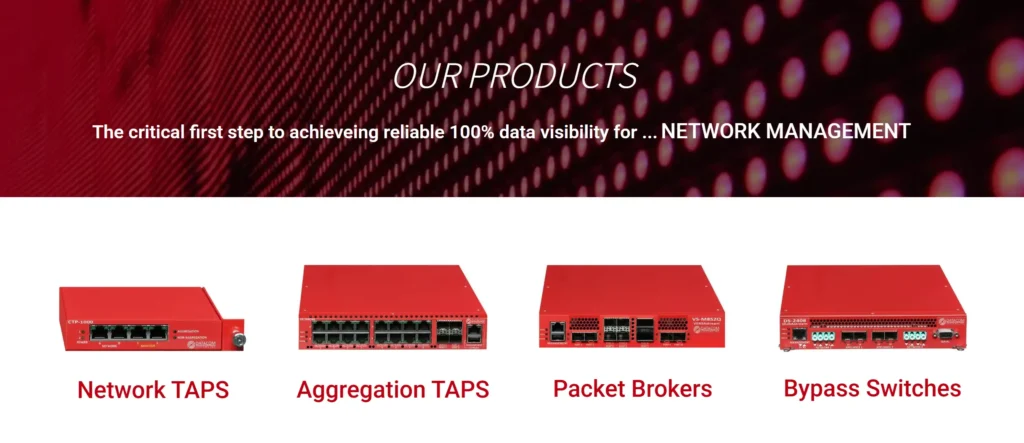
Product Portfolio
The platform is organized into two core product families:
| Product Series | Use Cases | Form Factor | Port / Speed Characteristics |
| VERSAstream G M Series | Enterprise security, data center, and monitoring (flagship line) | Dedicated NPB appliances | 1G/10G/25G/40G/100G, supporting aggregation, replication, filtering, and load balancing |
| VERSAstream Data Access Switch | Enterprise network segmentation and monitoring | Aggregators and regenerators | Multi-port aggregation with VLAN and TAP inputs, supporting single or multiple stream outputs; 1U–2U chassis with tens of ports, supporting SFP+ and QSFP28 interfaces |
Core Functional Capabilities
| Feature Category | Functions |
| Basic Functions | L2/L3/L4 filtering, aggregation, replication, load balancing, and regeneration |
| Advanced Functions | Multi-port aggregation (combining multiple network ports, VLANs, or TAP inputs into single or multiple streams), data regeneration to multiple devices, and port-level traffic control |
| Specialized Functions | Purpose-built monitoring infrastructure design, cross-segment traffic collection, and improved utilization of monitoring tools |
| Design Philosophy | NPB deployed between infrastructure and security/management tools, enabling broad access to enterprise traffic for monitoring and analytics |
Datacom Systems follows a “Purpose-Built Monitoring Infrastructure” approach. The architecture is designed to aggregate and reuse traffic across network segments, reducing the number of required monitoring tools and improving infrastructure efficiency.
Key Advantages
Datacom Systems is a long-established U.S. NPB vendor with deep expertise in network access solutions. Its VERSAstream G M Series reflects decades of specialization in TAP and visibility infrastructure. The platform emphasizes traffic consolidation and reuse across network segments,
Niagara Networks
Founded in 2006 as a spin-off from Interface Masters, Niagara Networks focuses on network visibility and its Open Visibility Platform (OVP) architecture.
Niagara Networks is known in the NPB market for its award-winning OVP framework and the PacketMaster N2 modular NPB series. The company specializes in 1/10/40/100 Gbps environments, including network TAPs, bypass switches, and packet brokers. It is recognized for high port density and strong cost efficiency, and its solutions are widely validated by major security vendors.
urpose data switching, but for purpose-built monitoring infrastructure. Similar to Datacom Systems, it follows a monitoring-centric design model, while placing stronger emphasis on open platforms and microservices-based architecture.
Product Portfolio
| Product Series | Use Cases | Form Factor | Port / Speed Characteristics |
| PacketMaster N2 Series | Large enterprises, data centers, and service providers (flagship line) | Modular NPB (2nd-generation platform) | 1U/2U chassis, supports 10/40/100G, with FabricFlow technology and processing acceleration modules |
| vNPB (Virtual NPB) | Mobile networks, virtualized environments, and 5G deployments | Virtual NPB (microservices-based platform) | Elastic scaling, supports real-time GTP-C/GTP-U correlation and 4G/5G/IoT traffic processing |
| Niagara 4540 | SOC/NOC optimization environments | Next-generation NPB (NGNPB) | Packetron-accelerated L4–L7 processing, de-duplication, packet slicing, application-aware filtering, and tunnel termination |
Core Functional Capabilities
| Feature Category | Functions |
| Basic Functions | Filtering, aggregation, replication, load balancing, and de-duplication |
| Advanced Functions | Packet slicing, header/payload slicing, data masking, NetFlow/IPFIX metadata generation, and tunnel termination |
| Tunnel Support | ERSPAN, GRE, NVGRE, VXLAN, and GENEVE tunnel termination |
| Specialized Functions | FabricFlow modular platform, Packetron-accelerated L4–L7 processing, subscriber/cell-aware correlation, and application-aware filtering |
| Mobile Network Features | Subscriber-aware intelligence, real-time GTP-C/GTP-U correlation, and support for roaming, VoLTE, and mobility events |
| Security Features | Selective TLS decryption, regex-based filtering, and deep packet inspection (DPI) |
- OVP Concept
- Microservices-based architecture and agility: The vNPB platform adopts a microservices design, enabling scalability and flexible deployment of advanced packet manipulation and network intelligence applications.
- Real-time GTP correlation: Designed for mobile networks, it correlates control plane (GTP-C) and user plane (GTP-U) traffic in real time to ensure accurate per-cell session tracking.
Key Advantages
Niagara Networks’ key differentiation lies in its Open Visibility Platform (OVP). In virtualized NPB environments, it is among the first vendors to integrate cell-level correlation into vNPB architecture. The platform supports 1G–100G scalability and delivers real-time GTP-C/GTP-U correlation and mobile-native visibility capabilities, making it highly suited for modern 4G/5G environments.
Profitap
Founded in the early 1990s, Profitap has more than 30 years of experience in TAP and Network Packet Broker technologies. The company operates its own manufacturing facility in France and provides network TAPs, field service troubleshooting tools, and NPB solutions. It delivers end-to-end network visibility and access capabilities for enterprise and SOC/NOC teams.
Profitap is recognized in the NPB market for its X2-Series advanced NPB and XX-Series high-density platforms. The company focuses on high-performance, high-density, and cost-efficient visibility solutions. In 2025, it introduced its next-generation X3-Series NPB platform.

The solution is built on proprietary hardware combined with proprietary software, managed through Profitap Supervisor.
Product Portfolio
| Product Series | Positioning | Key Features | Use Cases |
| XX-Series | Standard NPB (entry-level) | Aggregation, filtering, replication, and load balancing | SMB data centers, basic traffic monitoring, budget-sensitive deployments |
| X2-Series | Next-generation NPB (NGNPB) | Packet slicing, GTP filtering, ERSPAN support, de-duplication, and time-stamping | Enterprise data center monitoring, mobile networks/5G, security tool environments |
| X3-Series | Latest-generation NPB | SSL/TLS decryption, data masking, NetFlow export, DPI, and L2–L7 filtering | Encrypted traffic inspection, compliance workloads, enterprise security, SOC/NOC environments |
Core Functional Capabilities
| Feature Category | Functions |
| Basic Functions | Filtering, aggregation, replication, load balancing, and de-duplication |
| Advanced Functions | Packet slicing, GTP IP filtering, ERSPAN tunnel termination (encapsulation/decapsulation), packet de-duplication, and time-stamping |
| Tunnel Support | ERSPAN and GTP tunnel termination |
| Specialized Functions | True layer-2 visibility, microburst buffering, high availability and resiliency, protocol-aware filtering, and advanced data manipulation |
| Management | NPB CM (Centralized Management) and Profitap Supervisor for unified control of XX-Series and X2-Series platforms |
Profitap follows a “Centralized Observability Platform” architecture. Profitap Supervisor provides unified management across all product lines, while NPB CM supports large-scale deployment operations for XX-Series and X2-Series. The platform delivers continuous 24/7/365 network visibility across TAP and SPAN-based environments.
Key Advantages
Profitap leverages more than 30 years of experience in network visibility. With Profitap Supervisor and NPB CM, it provides centralized management across 1G–100G environments and ensures continuous 24/7/365 observability. With in-house manufacturing in France, the company delivers a cost-efficient, high-density visibility solution for both SMBs and large enterprises.
Executive Summary
The NPB market in 2026 is shifting from traditional purpose-built appliances toward software-defined, disaggregated, and AI-driven visibility platforms, driven by 1G–400G+ traffic growth, cloud-native adoption, and AI/ML-based security analytics. NPBs are increasingly evolving into real-time data intelligence pipelines rather than simple traffic aggregation systems.
Vendors now mainly differentiate across three architectural directions:
- Open / disaggregated and SONiC-based platforms (flexible, cloud-native, cost-efficient): Emerging leader Asterfusion.
- Purpose-built hardware platforms (high performance, FPGA/ASIC acceleration): Represented by Gigamon, Keysight Technologies, APCON, Cubro Network Visibility, Profitap, Datacom Systems, and Garland Technology.
- Switch-based / controller-driven visibility (infrastructure reuse, software-defined): Led by Cisco Systems and Arista Networks.
From a procurement perspective, selection depends on priorities: choose SONiC/open platforms for flexibility, cost efficiency, and cloud-native transformation paths, switch-based models for infrastructure reuse and ecosystem integration, and FPGA-based purpose-built platforms for


