Table of Contents
The Open Networking Wave Is Expanding from Data Centerto Network Packet Broker
Over the past decade, closed black-box architectures have dominated network infrastructure. From underlying silicon (ASICs) and network operating systems (NOS) to protocol stacks and management software, the entire networking stack has traditionally been tightly integrated and controlled by a single vendor.
The data center switching industry was the first to challenge this model. With the maturation of open network operating systems such as SONiC and the rise of white-box hardware, network infrastructure underwent a fundamental transformation — moving from the traditional “integrated proprietary platforms from vendors like Cisco and Juniper” toward a new architecture based on disaggregated white-box hardware combined with open or commercial NOS solutions. This separation of hardware and software gives enterprises greater freedom to select their preferred platforms, significantly improving network flexibility while reducing TCO (Total Cost of Ownership).
Today, this wave of openness and disaggregation is expanding into another domain that has long been dominated by proprietary appliances — Network Packet Broker (NPB).
Traditional NPB appliances are now evolving rapidly toward Open Packet Broker architectures, bringing the principles of open networking, software-hardware disaggregation, and flexible deployment models into the network visibility infrastructure market.
Traditional NPB’s Proprietary Black-Box Architecture
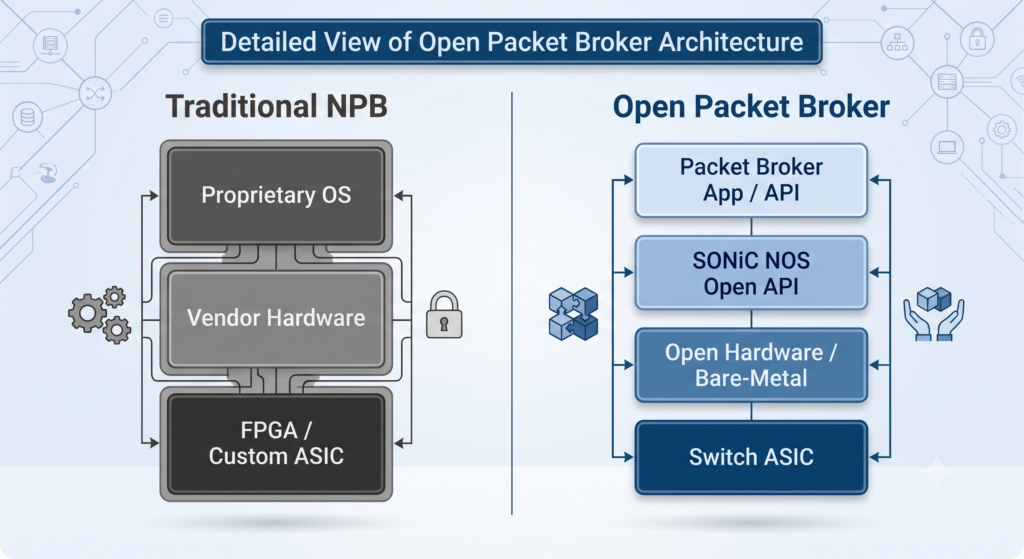
In the 10G/40G era, limited by the basic functions and table capacities of commodity switching ASICs, complex traffic processing tasks—such as deep packet filtering, header stripping, precise timestamping, and deduplication—had to rely on specialized FPGAs or custom ASICs. This formed the classic commercial model of traditional NPB: Proprietary Hardware + FPGA/ASIC + Closed OS + Tiered License = Traditional NPB Appliance
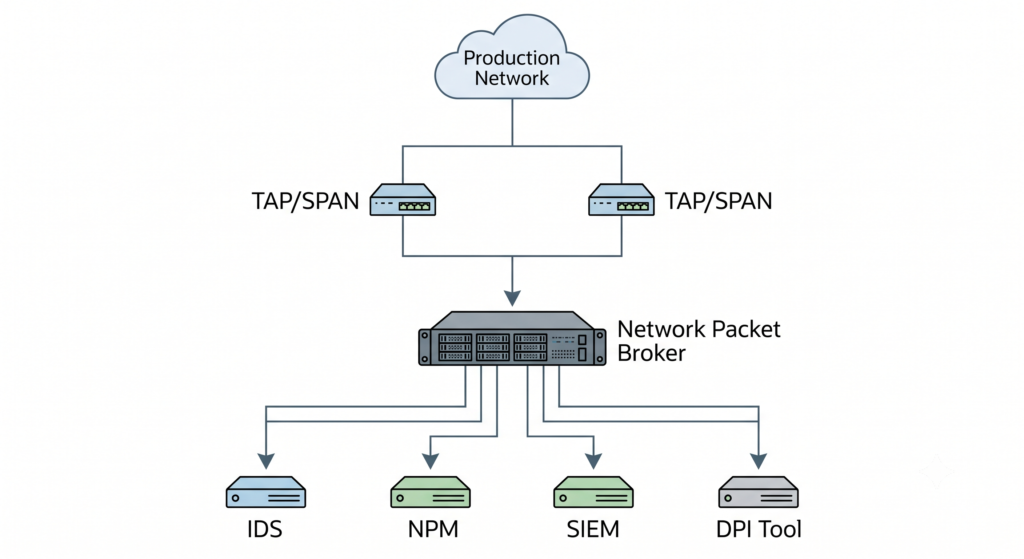
Three Core Pain Points of Traditional NPB
As network scale grows exponentially, this proprietary hardware model reveals major limitations:
Exorbitant Hardware Costs: The per-port cost of a high-end NPB appliance can far exceed that of a data center core switch.
- Exorbitant Hardware Costs: The per-port cost of a high-end NPB appliance can far exceed that of a data center core switch.
- Scale-Up Expansion Bottlenecks: Facing traffic surges from 100G to 400G/800G, enterprises can only scale up vertically by stacking or replacing increasingly expensive black-box appliances.
- Severe Technical and Vendor Lock-in: Software features are tightly coupled with specific hardware, making feature updates entirely dependent on the vendor’s product roadmap, alongside highly complex licensing models.
Three Core Drivers Pushing NPB Toward Openness
A Quantum Leap in Switching ASIC Performance and Programmability
In the past, switching chips were only responsible for basic Layer 2/3 high-speed forwarding. Today, modern commercial switching ASICs (such as Marvell Prestera®/Teralynx, Broadcom Tomahawk/Trident series, etc.) possess highly powerful programmable pipelines and massive TCAM resources. Now, most traffic processing tasks that previously required dedicated FPGAs—such as traffic filtering, packet slicing, header encapsulation/decapsulation (VXLAN/NVGRE), and parsing—can be executed directly at line rate on commercial switching ASICs. The democratization of hardware capabilities has completely dismantled the hardware moat of proprietary NPB.
AI Data Centers and Hyperscale Networks Drive Scale-Out Demands
In AI compute clusters (AI Fabric), cloud data centers, and 5G carrier networks, traffic volume has surged to 400G/800G and even 1.6Tbps levels.
- Traditional Model (Scale-Up): Buying larger, more expensive proprietary appliances can no longer keep pace with explosive bandwidth growth.
- Open Model (Scale-Out): Built on white-box switches and open software, traffic visibility capacity can be scaled horizontally just like building a compute cluster, enabling elastic expansion.
The Business Trend of Infrastructure Decoupling
Enterprise IT architects no longer accept being locked into a single vendor’s hardware and software stack. Just as the server domain achieved “Generic X86/ARM + Linux” and switching networks achieved “Whitebox + SONiC”, the NPB domain is bound to evolve toward “Open Switch Hardware + Open Packet Broker Software”.
Hardware-Software Decoupled Architecture Comparison
Traditional closed NPB and Open NPB differ fundamentally in architecture: Currently, global technical forces—including the OCP (Open Compute Project) community—are driving a SONiC-based Open Packet Broker architecture that runs traffic capture and processing capabilities as standard applications on top of an open NOS.
DPU + Open Architecture: Completely Breaking Through Advanced Feature Bottlenecks of Open NPB
In the past, many believed Open NPB could only replace low-end NPBs for simple L2–L4 traffic filtering, aggregation, and distribution. Whenever advanced NPB features were required—such as packet deduplication, IP defragmentation, SSL/TLS decryption, or GTP/VXLAN tunnel stripping—enterprises had no choice but to purchase expensive black boxes from traditional vendors.
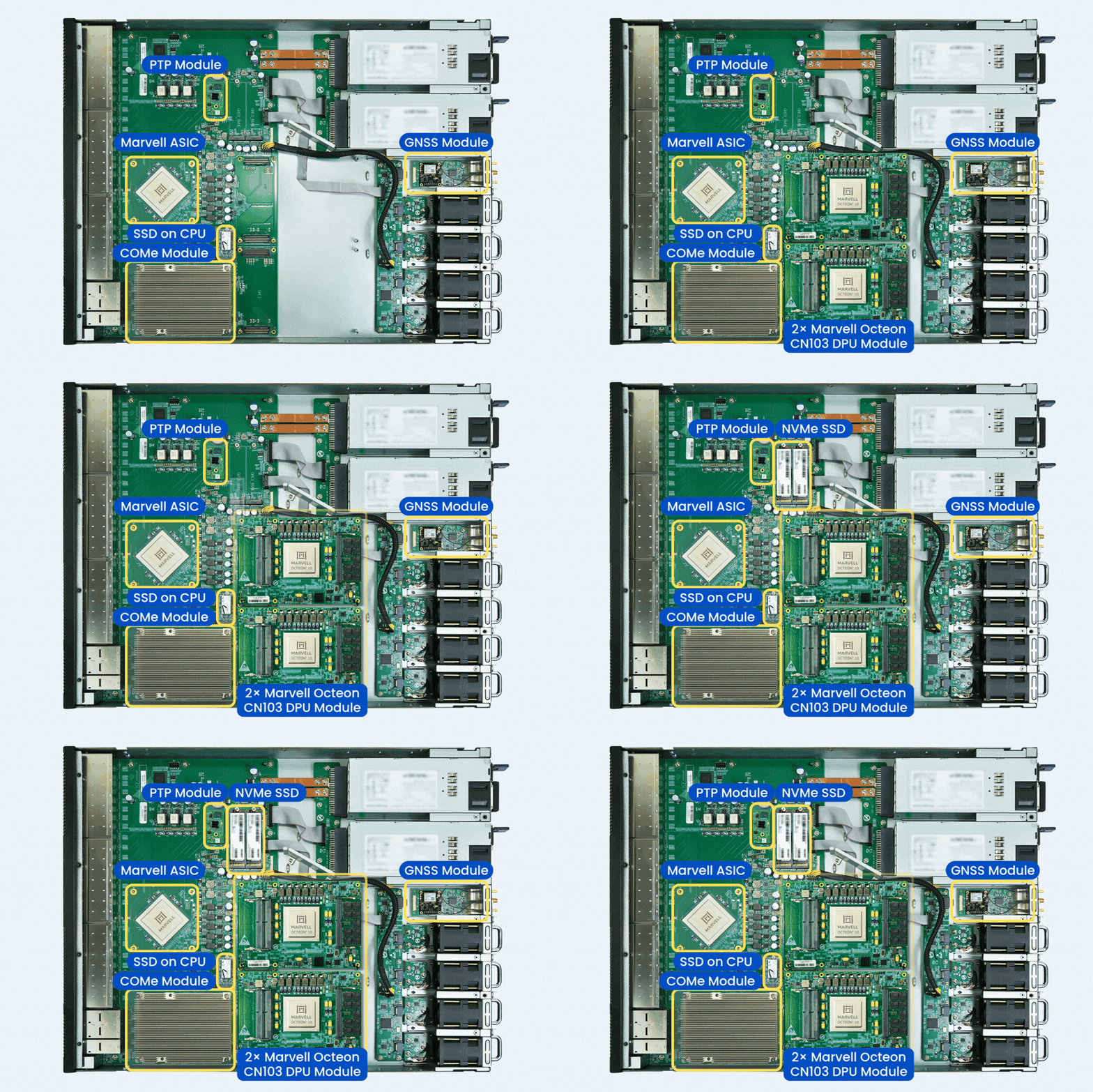
Today, through the deep integration of DPUs (such as the Marvell OCTEON series) with the open SONiC ecosystem, Open NPB has thoroughly shattered this limitation. It achieves a layered architecture that delivers “Open White-box Hardware + Enterprise-Grade Advanced NPB Features”:
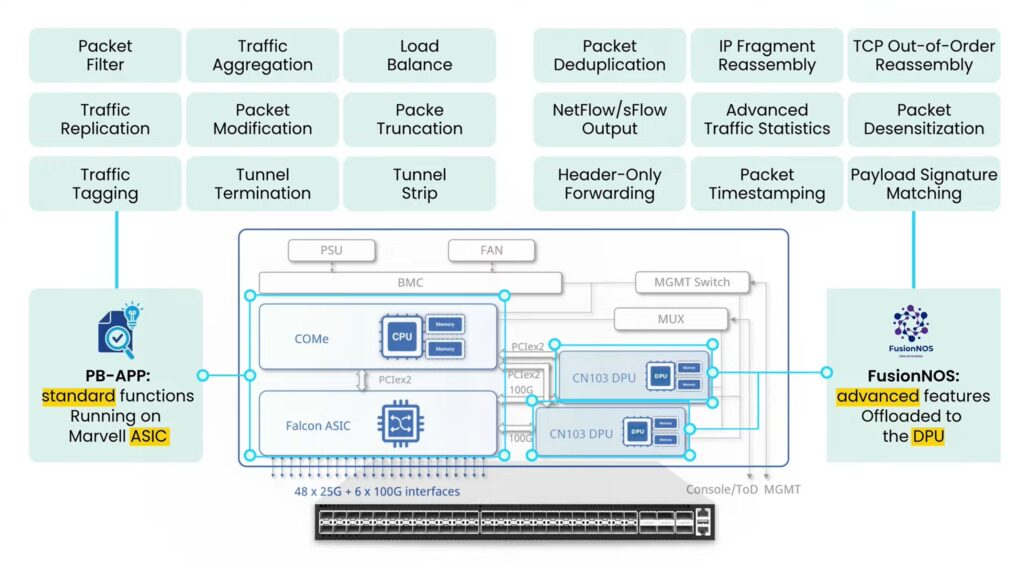
- Switch ASIC: Responsible for massive-scale, line-rate traffic acquisition from 1G to 800G, along with basic packet filtering and load-balancing distribution.
- DPU (such as Marvell OCTEON): Serves as a general-purpose Advanced NPB Offload Engine, handling compute-intensive processing tasks including deduplication, packet fragmentation and reassembly, SSL/TLS decryption, GTP decapsulation, and other advanced traffic processing functions.
- Backend Analysis Tools (IDS / SIEM / NPM): Receive clean, pre-processed traffic from the Open NPB platform for security monitoring, network analysis, and operational intelligence.
This layered architecture enables Open NPB to combine the extremely high throughput and cost efficiency of white-box switches with advanced processing capabilities that go beyond traditional proprietary NPB appliances.
Will OPB Replace Traditional NPB?
Conclusion: OPB (Open Packet Broker) will not completely “kill” or replace traditional NPBs in the short term. However, over the medium-to-long term, OPB will steadily erode traditional NPB market share across the vast majority of mid-to-large-scale deployment scenarios, ultimately becoming the mainstream standard.
The relationship between the two closely mirrors how “White-box Switches + SONiC” disrupted “Traditional Proprietary Switches from Cisco/Juniper”—it is not an overnight replacement, but rather an evolutionary process penetrating layer by layer across different use cases.
Why Will OPB Rapidly Disrupt Traditional NPB’s Market Share?
The rise of OPB is not driven by fancy features, but rather by a structural shift in business models and cost economics:
1.TCO Collapse Driven by Traffic Surges: Entering the 400G/800G era, data center and carrier traffic is growing exponentially. Under traditional proprietary NPB pricing models (charged per port or per license), buying NPB hardware can cost even more than the core switching network itself. Enterprises urgently need to purchase NPB hardware with the same cost efficiency as standard white-box switches.
2.Commodity ASIC and DPU Capability Surplus: Basic filtering, aggregation, and slicing—which previously required proprietary ASICs/FPGAs from traditional NPB vendors—can now be executed at line rate using commodity switching chips like Marvell Teralynx and Broadcom Tomahawk. Meanwhile, advanced functions such as deduplication, IP defragmentation, and SSL decryption are now handled by standard DPUs like Marvell OCTEON. The hardware moat no longer exists.
3.Architectural Decoupling and Automation Ecosystem: Built on open architectures like Enterprise SONiC, OPBs natively integrate with modern Data Center CI/CD pipelines, Prometheus monitoring, and automated O&M frameworks. This eliminates the operational pain point of managing traditional NPBs as isolated, closed silos.
Which Scenarios Will OPB Replace First?
First Wave : Hyperscalers/Cloud Data Centers & AI Compute Clusters
Traffic volumes here are massive (400G/800G), with requirements focused on L2–L4 traffic capture, basic filtering, aggregation, and load-balanced distribution (Scale-out). These demands can be fully satisfied at line rate using standard switching ASICs and open operating systems. OPB offers a 50%–70% cost advantage here, rendering traditional NPBs completely non-competitive on price performance.
Second Wave : Carriers (Telecom/5G), Financial Institutions & Large Enterprise Networks
These sectors demand not only high throughput, but also advanced NPB capabilities such as GTP stripping, IP defragmentation, deduplication, and SSL decryption. As the “White-box Switch + Generic DPU” architecture matures, OPB bridges the advanced preprocessing feature gap, paving the way for bulk migrations from traditional black boxes to OPB across these industries.
Where Will Traditional NPB Retreat? (Niche Areas Resistant to OPB in the Short Term)
Traditional NPBs (such as Keysight/Ixia, Gigamon, NetScout, etc.) will not vanish overnight. They will retreat into high-barrier or niche scenarios:
1.SMEs Heavily Dependent on Out-of-the-Box Simplicity and Lacking IT/Network Development Capability: Although commercialized OPB OS options exist, the paradigm remains inherently software-defined. Some mid-to-small enterprise clients still prefer a plug-and-play experience—buying a turnkey black box with a simple GUI setup.
2.Highly Peripheral and Complex Legacy Networks: Traditional NPB vendors have accumulated two decades of hardware decoding capabilities for obscure industrial protocols and legacy telecom standards. The OPB ecosystem currently lacks the commercial incentive to adapt to these edge scenarios one by one.
3.Full-Service End-to-End Packaging Requirements: Certain enterprise customers buy not just hardware, but comprehensive risk coverage—demanding full vendor liability and round-the-clock, on-site TAC support when outages occur. Traditional NPB vendors retain long-standing commercial inertia among these specific enterprise accounts.
Long-Term Outlook
- Short-to-Medium Term (5–8 Years): Dual-Track Coexistence. OPB captures the Incremental Market (new high-speed data centers, AI clusters, and high-bandwidth networks), while traditional NPBs hold onto the Stock Market (legacy replacements, old protocol networks, and traditional mid-to-small enterprises).
- Long Term (8–10+ Years): OPB Becomes the Infrastructure Standard. Just as SONiC and open networking have become mainstream in modern data centers, the Packet Broker market will ultimately shift entirely toward a software-defined, open, and disaggregated model. Traditional NPB vendors that fail to pivot toward software and open ecosystems risk being relegated to niche, marginal players.
Why is SONiC the Ideal Foundation for Open Packet broker?
Core Technical Synergies
Docker-Based Containerized Microservices Architecture
SONiC adopts a highly modular container architecture (with components like swss, syncd, and telemetry running independently in containers). Meanwhile, NPB demands rich and extensible traffic processing capabilities (such as traffic filtering, redirection, slicing, and tunnel encapsulation). On top of SONiC, various NPB functionalities can be mounted and flexibly deployed as independent application or service containers without refactoring the underlying OS kernel, significantly lowering development and customization barriers.
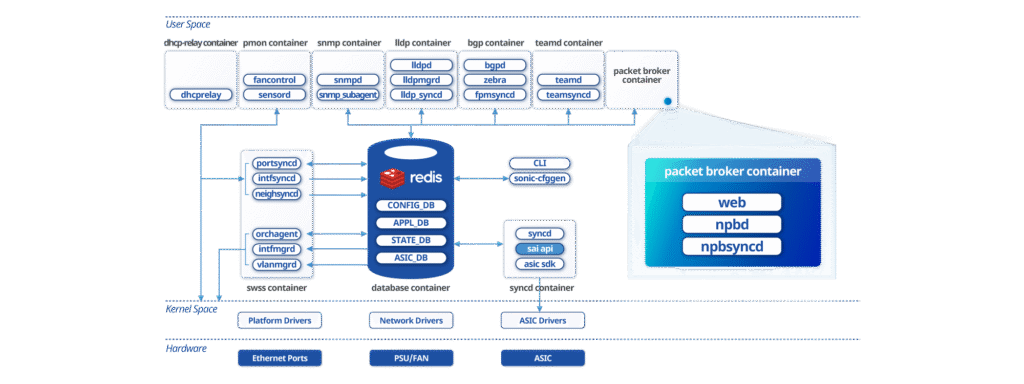
SAI (Switch Abstraction Interface) Decoupling Layer
SAI is the soul of SONiC. It defines a unified C-language API that abstracts away hardware differences across various chip vendors (Broadcom, Marvell, etc.). Traditional NPBs rely heavily on proprietary FPGAs/ASICs, locking software tightly to specific hardware bI, Open NPB software can be developed once and seamlessly adapted to various commodity switching ASICs, completely eliminating vendor lock-in.
Native Support for High Concurrency and Chip Pipeline Control
Modern SONiC features highly mature control interfaces for managing ASIC pipelines, TCAM tables, and large-capacity buffer scheduling. NPB is deeply dependent on ACL (Access Control List) matching, 5-tuple filtering, and line-rate forwarding. SONiC directly maps and pushes upper-layer NPB traffic policies down to hardware tables in switching ASICs, achieving full-rate, zero-performance-loss line-speed processing.
Business and Operational Synergies: Dimensional Strike on Traditional NPB
Unified Cloud-Native Automation and Telemetry Ecosystem
Traditional NPBs act as “information silos” in data centers—they rely on isolated CLIs/GUIs, and their monitoring and automated O&M frameworks are disconnected from the primary network. SONiC natively supports cloud-native Telemetry tools such as gNMI, gRPC, REST APIs, and Prometheus/Grafana. Building Open NPB on SONiC enables operations teams to manage the traffic visibility network using the exact same CI/CD pipelines and automated Ansible/Terraform scripts used for core data center switches.
Supply Chain Resilience and Superior TCO
SONiC-based Open NPB runs directly on standard white-box switches. Hardware costs can be reduced by 50%–70% compared to traditional NPB vendors. Furthermore, in the event of a hardware failure, faulty units can be immediately swapped out with standard switch hardware, drastically minimizing procurement and spare-parts overhead.
Massive Global Community and Commercial Ecosystem (OCP / Linux Foundation)
SONiC is backed by major hyperscalers—such as Microsoft, Google, and Alibaba—alongside leading silicon and white-box vendors. Choosing SONiC as the underlying foundation ensures that Open NPB reaps the long-term dividends of the open-source community’s security patches, protocol stack optimizations, and next-gen chip adaptations, preventing it from ever devolving into an unmaintained, isolated open-source project.
Asterfusion: Building Next-Generation Open Packet Broker Solutions
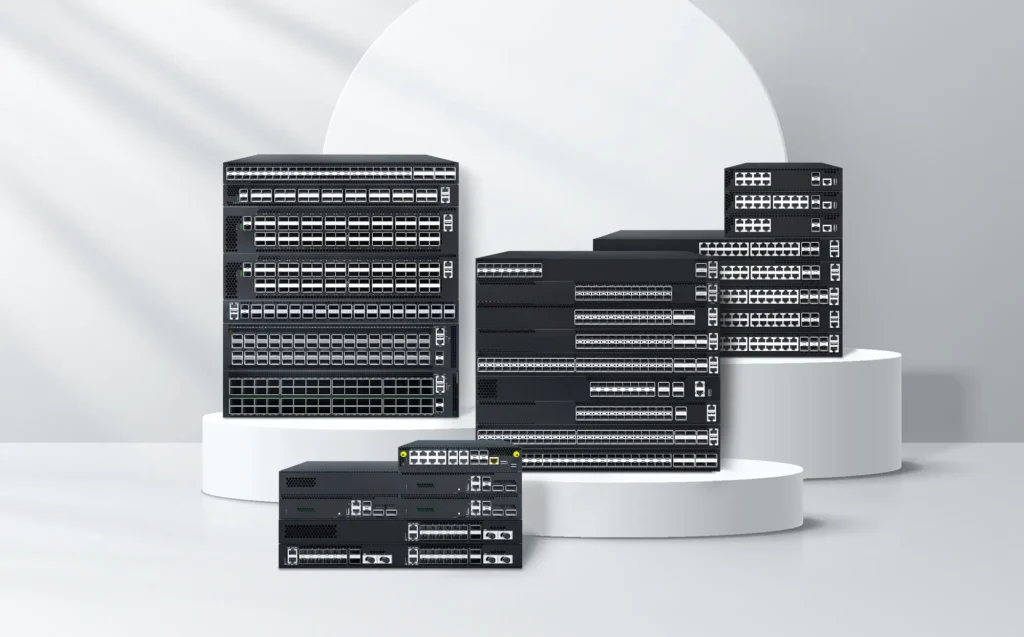
As a pioneer in open networking and an advocate for Enterprise SONiC, Asterfusion possesses an in-depth understanding of the evolutionary trends in network observability architectures. Leveraging high-performance commodity switching ASICs, DPU hardware platforms, and a deeply optimized Enterprise SONiC ecosystem, Asterfusion delivers a disaggregated, highly cost-effective Open Packet Broker solution:
- Full-Rate Line-Speed Coverage: Supports massive-bandwidth traffic aggregation, replication, and distribution from 1GbE up to 800GbE, effortlessly handling hyperscale AI data centers and carrier networks.
- Rich Enterprise-Grade NPB Features: Equipped with robust capabilities including packet filtering, deduplication, slicing, timestamping, and flexible load-balancing algorithms.
- Software-Hardware Decoupling with Turnkey Usability: Built upon the SONiC software architecture and open hardware to eliminate vendor lock-in, significantly driving down enterprise hardware procurement and future expansion costs (TCO).
- Flexible Heterogeneous Expansion Capabilities: Combines DPU hardware acceleration to deliver advanced capabilities such as deduplication and SSL decryption.
Asterfusion is committed to helping enterprises and carriers break free from expensive proprietary hardware lock-in, building an open, programmable, and software-defined modern network observability infrastructure.
For more:
Network Packet Broker Powered by SONiC: PB-APP Solution
Open Packet Broker powered by SONiC: Next Genaration NPB Solution-NPB2.0
SONiC-based Network Packet Broker 2.0: Transforming Network Visibility and Efficiency


