Table of Contents
Customer Background
The S Company team was founded in 2016. It is a National High-Tech Enterprise and a “Specialized, Refined, Distinctive, and Innovative” enterprise focused on GPU video cloud computing, edge computing, and computing acceleration services. The company combines heterogeneous computing with 5G networks to provide end-to-end computing infrastructure for real-time interactive applications, including cloud gaming, ultra-high-definition video, the metaverse, and AI agents.
Its core business includes:
GPU Video Cloud Computing: Based on a Cloud 2.0 architecture, it delivers low-latency, high-performance 3D rendering and video encoding and decoding.
Cloud-Network-Edge Integration: It provides edge cloud deployment and computing network solutions for the three major telecom operators in China, including China Mobile and China Telecom, as well as large Internet and cloud service providers.
Diverse Application Scenarios: Its solutions are widely used for cloud gaming, VR ultra-high-definition video, virtual digital human livestreaming, cloud workstations, and AI large language model inference deployments.
As its cloud esports business grew rapidly and requirements for game graphics and real-time interactive experiences continued to increase, S Company placed higher demands on the network supporting its core PC Farm (GPU computing cluster). Large-scale concurrent and burst traffic generated by high-density gaming endpoints increased requirements for access bandwidth, backbone forwarding capacity, and low-latency performance.
To support the continued expansion of its cloud esports business, S Company selected Asterfusion to jointly build a network architecture for high-density 2.5G gaming endpoints. The infrastructure provides its PC Farm with high bandwidth, low latency, and scalability.
Why Choose Asterfusion
1. High-Density 2.5G Architecture for Esports
As the esports business has grown, traditional Gigabit Ethernet (1G) access can no longer meet the high-throughput requirements of computing nodes. Network traffic in esports environments is characterized by high concurrency and multiple traffic types. Game real-time traffic, download traffic, rendering return traffic, and backend node status synchronization and log traffic can occur concurrently. As a result, access bandwidth requirements have expanded from 1G to 2.5G.
Asterfusion’s high-density 2.5G switch solution aligns with the customer’s upgrade path from 1G to 2.5G access. It meets the requirements for non-blocking forwarding in large-scale, highly concurrent environments.
2. High Flexibility and Customization Powered by Enterprise SONiC
Based on the open architecture and unique capabilities of Asterfusion AsterNOS (Enterprise SONiC), S Company can flexibly adjust and configure customized network parameters and architectural features when participating in tenders and developing customized solutions for telecom operators and large enterprise and government projects. This helps create differentiated competitive advantages for its solutions.
3. Easy Maintenance and Rapid Delivery
AsterNOS provides high maintainability and agility, along with extensive API management interfaces. Combined with Asterfusion’s supply chain support and rapid delivery capabilities, it overcomes the limitations of traditional vendors in delivery lead times and hardware and software flexibility. This supports rapid project deployment and continued node expansion.
Network Deployment Architecture
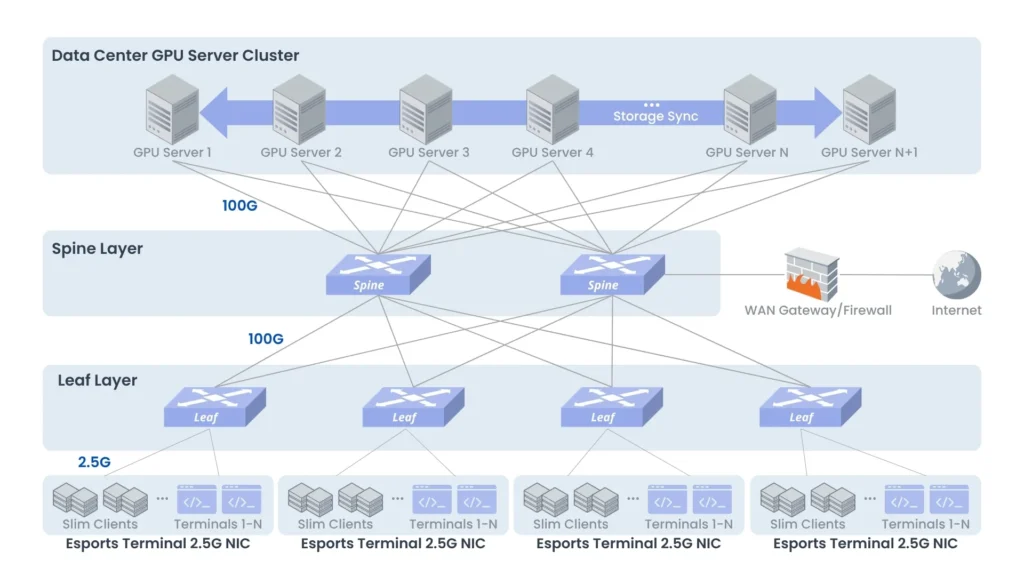
For S Company’s esports project, the deployment includes more than 500 Asterfusion switches and uses a standard Layer 2 Spine-Leaf network architecture.
Spine Layer
The Spine layer uses Asterfusion CX532P-M-H switches to build a high-bandwidth, low-latency core switching network. The Spine switches connect upstream to the GPU rendering server cluster (PC Farm) and storage servers through 100G interfaces. High-speed links carry large volumes of east-west traffic between GPU compute nodes and between compute nodes and storage. Downstream, multiple 100G links connect to the Leaf access switches, providing high-bandwidth aggregation for high-density 2.5G esports endpoints.
The architecture uses multiple links between Spine switches and between the Spine layer and various service nodes. LAG, M-LAG, ECMP, and other mechanisms improve link utilization and network reliability. The Spine layer provides sufficient bandwidth headroom for burst traffic generated by GPU computing and storage workloads. This reduces congestion and queuing latency and provides stable network capacity for traffic forwarding between the PC Farm and esports endpoints.
Leaf Access Layer
The Leaf access layer uses Asterfusion CX204P-4Y48MT-M-H switches to provide high-density 2.5G access for esports endpoints. Each Leaf switch connects directly to the 2.5G NICs of esports endpoints through 2.5G copper ports, meeting the demand for higher access bandwidth on gaming PCs. Each switch also connects to the Spine layer through 100G uplinks to aggregate 2.5G access traffic with high bandwidth.
This 2.5G access + 100G uplink design increases access bandwidth for each endpoint while providing sufficient uplink bandwidth for concurrent and burst traffic generated by high-density esports endpoints. It prevents a new aggregation bottleneck from emerging after the access layer is upgraded.
Challenges and Technical Solutions
During the PoC testing and deployment preparation stages, the Asterfusion R&D team carried out targeted development and technical optimizations based on AsterNOS (Enterprise SONiC) to address S Company’s requirements for rapid compute node deployment, network security integration, and agile operations and maintenance.
1. Rapid Field Deployment via Batch 4K VLAN Provisioning
Challenge: The project involved multi-site deployment of more than 500 devices under a tight deployment schedule. Configuring VLANs and planning Trunk ports on each device individually would require extensive onsite configuration work and increase the risk of errors.
Solution: The solution supports batch creation of the full VLAN range from 1 to 4094 (4K VLANs). STP/RSTP loop protection is enabled by default across all 4K VLANs to eliminate potential large Layer 2 broadcast storm risks. Uplink and interconnection ports are preconfigured as Trunk ports that allow the full VLAN range. After arriving onsite, operations personnel only need to use a single command to change the Access VLAN of each access port based on the deployment location of the device. This significantly simplifies onsite configuration and reduces the risk of manual errors.
2. SNMP Performance Optimization under Large-Scale VLAN Scenarios
Challenge: In a large-scale network with all 4K VLANs enabled, periodic device polling by the network management system (NMS) over SNMP can cause excessive CPU utilization, increased response latency, and even polling timeouts. This cannot meet the requirements for second-level monitoring in cloud esports networks.
Solution: By leveraging the high-concurrency processing capabilities of the underlying Redis in-memory database in Enterprise SONiC, the MIB adaptation layer was redesigned to optimize the retrieval of large volumes of VLAN data.
3. User Experience and Thermal Performance Optimization
Challenge: During initial testing, the customer provided several operational feedback items. These included high CPU temperatures under heavy load and CLI interaction issues, such as command response speed, special character support, and configuration display formatting.
Solution: The optimizations eliminated high CPU temperature alerts during extended periods of heavy load, helping ensure stable 24×7 operation. CLI command response speed was significantly improved, and support for English and special characters in account passwords was expanded. The VLAN display layout under show running-config was also redesigned to remove redundant blank lines. This makes Trunk VLAN allowance checks and VLAN planning easier to review and improves daily troubleshooting efficiency.
Deployment Results & Customer Value
1. Deployment Value
- 2.5× Higher Access Bandwidth: The esports network access layer was smoothly upgraded to 2.5G, removing network bottlenecks during ultra-high-definition game streaming and concurrent large-file downloads.
- Significantly Improved Deployment Efficiency: Zero-Touch Provisioning (ZTP) enables batch configuration deployment, improving deployment efficiency by more than 50%.
- Stronger Competitiveness in Tenders: The technical advantages of open SONiC helped S Company build differentiated capabilities for tenders and solution projects with downstream telecom operators.
- Strong Cost Efficiency and Delivery Assurance: A competitive total cost and responsive supply capabilities supported the rapid expansion of S Company’s business.
2. Customer Feedback and Future Outlook
Following extensive testing and software optimization during the PoC phase, S Company’s technical and procurement teams highly recognized Asterfusion’s product performance, software development responsiveness, and technical support services.
As testing was successfully completed, S Company plans to add Asterfusion switches to its approved supplier list. As its cloud esports and GPU computing businesses expand nationwide, the company plans to continue deploying hundreds of Asterfusion switches each year for network expansion and upgrades.
Summary
To address rapidly growing demand for cloud gaming and cloud esports, S Company worked with Asterfusion to build high-throughput network connectivity for its GPU PC Farm computing cluster. The deployment is based on a SONiC architecture and high-density 2.5G/100G switching platforms.
With strong customization and engineering response capabilities, cost-effective standard product delivery, and an open ecosystem based on Enterprise SONiC, Asterfusion addressed network transport challenges in highly concurrent esports environments. The solution also helped S Company strengthen its position in cloud computing projects and collaborations with telecom operators.


