Table of Contents
Building private AI infrastructure does not necessarily require a massive GPU cluster. As open-weight models and inference frameworks continue to mature, more enterprises are deploying existing models on-premises to support internal knowledge assistants, AI-powered customer service, and AI agents. Depending on model size, concurrency, and response-time requirements, a cluster of just 2–4 GPU servers can provide a practical starting point for enterprise private AI inference. Private deployment not only gives enterprises greater control over sensitive data and computing resources but also enables more flexible integration of AI services with internal business systems.
However, getting a model to run successfully does not mean the AI infrastructure is ready for production-level management. When a second business department starts sharing the same GPU cluster, new challenges quickly emerge:
- Resource contention: An AI agent repeatedly sends requests due to an unexpected retry loop, causing inference queues to grow and slowing down other business applications.
- Access control: An internal knowledge assistant and a financial analysis system share GPU resources but require different levels of model access and data security.
- Service management: When a model is migrated to another server or a new inference instance is added, multiple applications may need to update their API endpoint configurations individually.
- Resource visibility: GPU utilization continues to rise, but administrators struggle to identify which applications consume the most inference resources.
Even with only a few GPU servers, enterprises must address three fundamental questions: Who can access AI services, how much can each application consume, and where should requests be routed? This is where an AI Gateway comes in. It provides a unified entry point for multiple business applications, centralizing authentication, access control, token quotas, and request routing to make even small private GPU clusters easier to manage and control. For enterprises already planning to deploy a network gateway or switch, Asterfusion provides a more compact deployment option: running AI Gateway software on compatible ET series gateways or integrated switches. This brings network connectivity and AI service management onto one platform, potentially reducing the need for a separate server.
1. Beyond Getting the Model Running: Why Do You Need a Unified Entry Point?
Suppose an enterprise deploys three GPU servers. Two run separate replicas of the same general-purpose large language model, while the third runs a specialized model for financial or legal tasks. A knowledge assistant, a document processing system, and AI agents all need access to these services.If each application connects directly to individual servers, application teams must maintain backend addresses, access credentials, and model configurations separately. As model replicas increase, services move, and permissions change, this approach creates a growing operational burden.
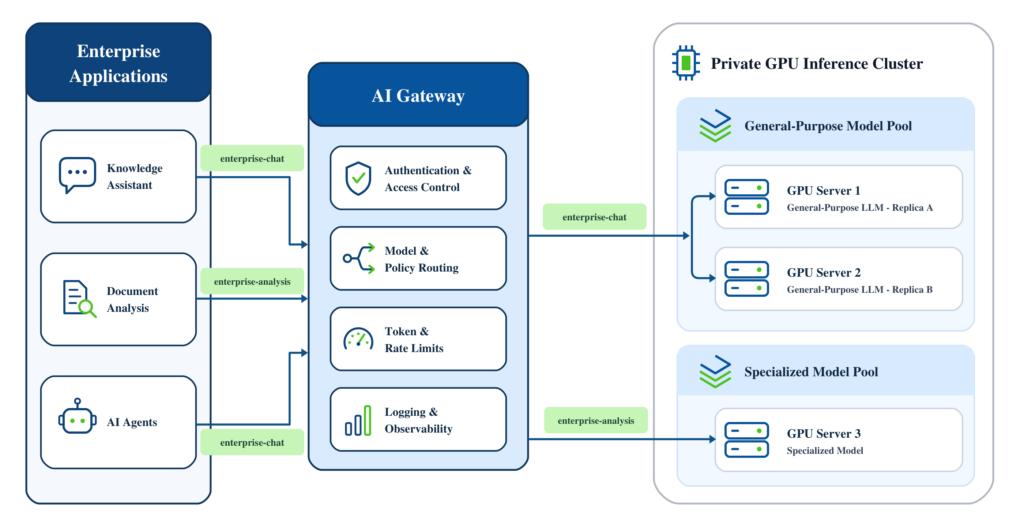
An AI Gateway acts as a central switchboard between business applications and model services. Applications connect to a unified API endpoint and request logical services such as enterprise-chat or enterprise-analysis. The gateway authenticates the caller, checks permissions and usage limits, and forwards the request to the appropriate model instance. Applications focus on which service to call, while the infrastructure team manages where that service runs. When backend instances change, administrators can update the gateway configuration. As long as interfaces, model versions, and agreed behavior remain compatible, this reduces the changes required across upstream applications.
2. How Does an AI Gateway Manage Shared Inference Resources?
AI requests can vary significantly in resource consumption. Saying “hello” and analyzing a lengthy financial report each count as one request, but their input lengths, generation times, and resource requirements can differ substantially. Counting requests alone is therefore often insufficient for managing shared inference services. Depending on the selected software, an AI Gateway can apply controls across several dimensions:
| Control | Purpose |
|---|---|
| Request rate (RPM) | Limits the number of requests submitted per minute |
| Token rate (TPM) | Controls usage rates based on input and output token counts |
| Application or department quotas | Sets usage budgets for different callers |
| Concurrent request limits | Controls the number of requests processed simultaneously |
| Model access permissions | Restricts which model services each caller can use |
These mechanisms help prevent a single application from suddenly consuming an excessive share of shared resources. However, token usage is not a precise measure of GPU compute consumption. Actual resource costs also depend on the model, context length, caching, and inference implementation. Gateways differ in how they estimate input tokens, account for output tokens, and enforce limits on streaming requests. These details should be checked during software selection. The gateway manages request admission, usage policies, and forwarding. GPU scheduling, continuous batching, and GPU memory management remain the responsibility of the backend inference engine.
3. How Does a Request Pass Through an AI Gateway?
Consider a request from an enterprise knowledge assistant:
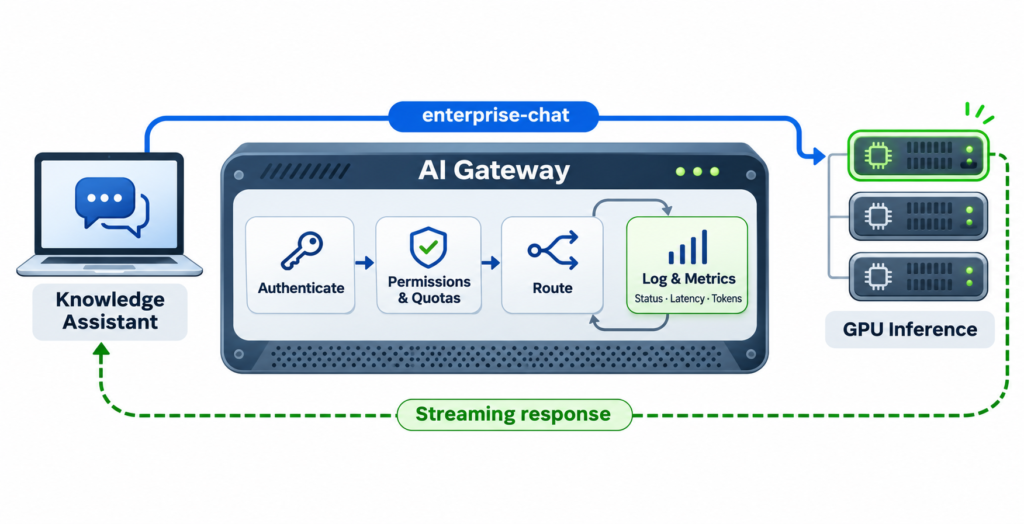
- Request a logical service. The application sends a request to the gateway, specifying
enterprise-chat. - Authenticate the caller. The gateway checks an API key, JWT, or another authentication credential.
- Check permissions and quotas. It verifies that the application can access the model and complies with the applicable usage limits.
- Select a model instance. The gateway forwards the request to an available backend according to the configured routing and load-balancing policies.
- Run inference and return the result. The GPU server generates the content, and the gateway passes the response back to the application.
- Record operational information. Depending on software capabilities and configuration, the gateway records request status, latency, and token usage.
For streaming responses, the gateway must continuously pass generated content back to the application. Deployment testing should therefore consider long-lived connections, concurrency, and response duration—not just requests per second.
4. Where Should an AI Gateway Run? Network Hardware Offers Another Option
An AI Gateway is software. Deploying one does not necessarily require purchasing a dedicated appliance. Enterprises can run it on an existing compute node, a virtual machine, a standalone server, or a network platform with a compatible computing environment.
| Deployment option | Benefits and considerations |
|---|---|
| Existing GPU server | Convenient for getting started, but shares resources and maintenance cycles with the compute node |
| Standalone server or virtual machine | Easier to manage and scale independently, but requires allocated computing resources |
| Network device with a compute module | Offers an opportunity to consolidate hardware, but compatibility, capacity, and reliability must be validated |
For example, if the only gateway instance runs on a GPU server, maintenance on that server may also disrupt the unified entry point. Deploying the gateway separately can reduce this dependency. For sites already planning to deploy a network gateway or switch, using the network device’s computing resources to host an AI Gateway is a consolidation option worth evaluating. The potential benefit is to separate access governance from GPU compute nodes while reducing the need for an additional server. Whether this lowers total costs depends on the device’s available resources, software requirements, and high-availability design.
5. Asterfusion’s Approach: Turn Network Hardware into an AI Service Entry Point
As discussed earlier, an AI Gateway can run on a GPU server, a standalone server, or a virtual machine. For enterprises already planning to deploy a network gateway or switch, another option is worth considering: Could the network device’s computing resources also run the AI Gateway? Asterfusion’s approach is to deploy compatible AI Gateway software on network hardware connected to the private GPU cluster. This allows network connectivity and AI service management to share the same hardware platform.
Each component has a clear role:
| Component | Main Responsibilities |
|---|---|
| Network platform | Connects the enterprise network to the GPU cluster and provides packet forwarding and network access control |
| AI Gateway software | Authenticates callers, manages model permissions and usage limits, and forwards requests |
| GPU servers | Run the models, perform inference, and generate responses |
In simple terms, the network platform connects and controls access to the AI environment, while the GPU servers generate the answers. The AI Gateway software runs on the network platform’s computing resources. It does not need to consume GPU server resources or perform model inference itself. If the deployment already requires a network device, and that device has sufficient resources to run the gateway software, the enterprise can evaluate whether a separate AI Gateway server is necessary.
6. What Hardware Options Does Asterfusion Offer?
Depending on the network topology, enterprises can consider an ET series white-box gateway or a COMe102-based integrated switch.These are independent hardware options. They do not need to be deployed together.
Option 1: ET Series White-Box Gateway at the Cluster Boundary
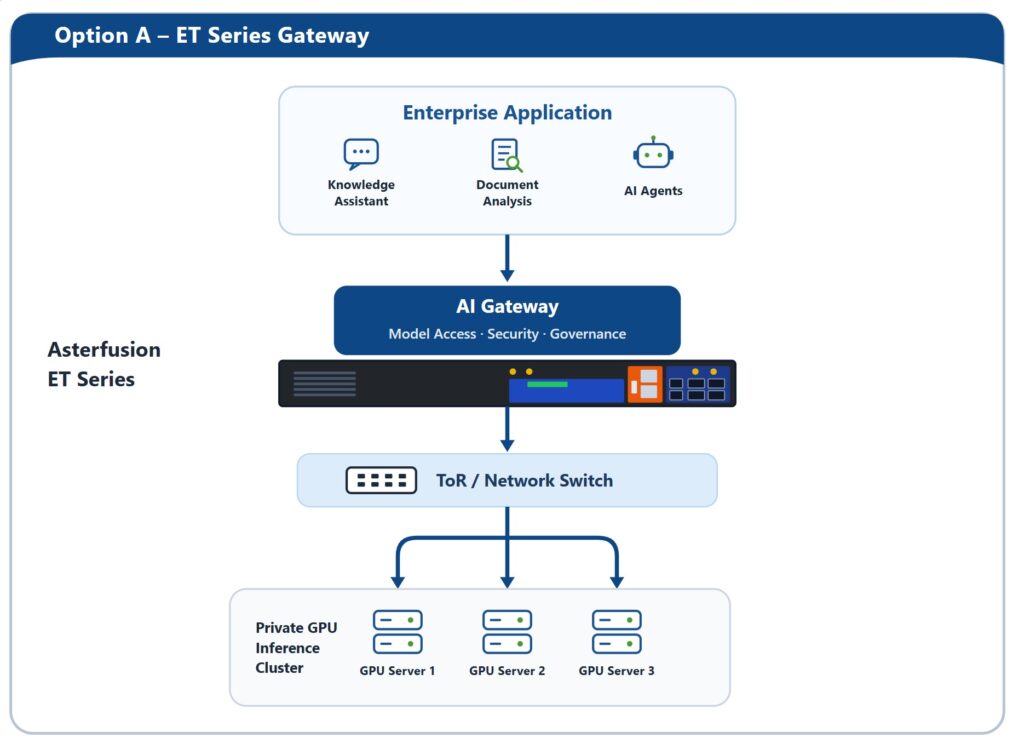
An ET series device can be deployed between the enterprise business network and the private GPU cluster, serving as a network entry point between them. When the selected device model, computing resources, and software environment meet the requirements, compatible AI Gateway software can run on the same platform. The device can then support:
- Connectivity between the enterprise network and the GPU cluster.
- Network-layer access control.
- A unified entry point for AI services.
For example, AI requests from customer service and finance applications can reach a common entry point, where the gateway checks their identities and permissions before forwarding them to the appropriate models. If the enterprise already plans to deploy an ET gateway at the cluster boundary, this approach may reduce the need for a separate server dedicated to the AI Gateway.
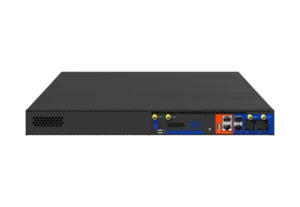
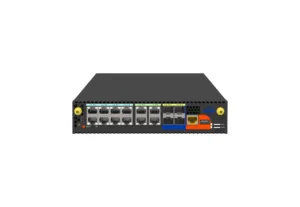
Option 2: COMe102-Based Integrated Switch for GPU Connectivity and Gateway Hosting
Another option is Asterfusion’s upcoming integrated switch based on a COMe102 compute module. According to the current product plan, the platform features 8 × 200G interfaces for connecting backend GPU servers. Its integrated COMe102 compute module can also be used to run compatible AI Gateway software. A single platform can therefore combine two types of functions:
- Switching: connecting GPU servers and forwarding network traffic.
- Application hosting: running AI Gateway and other compatible software on the compute module.
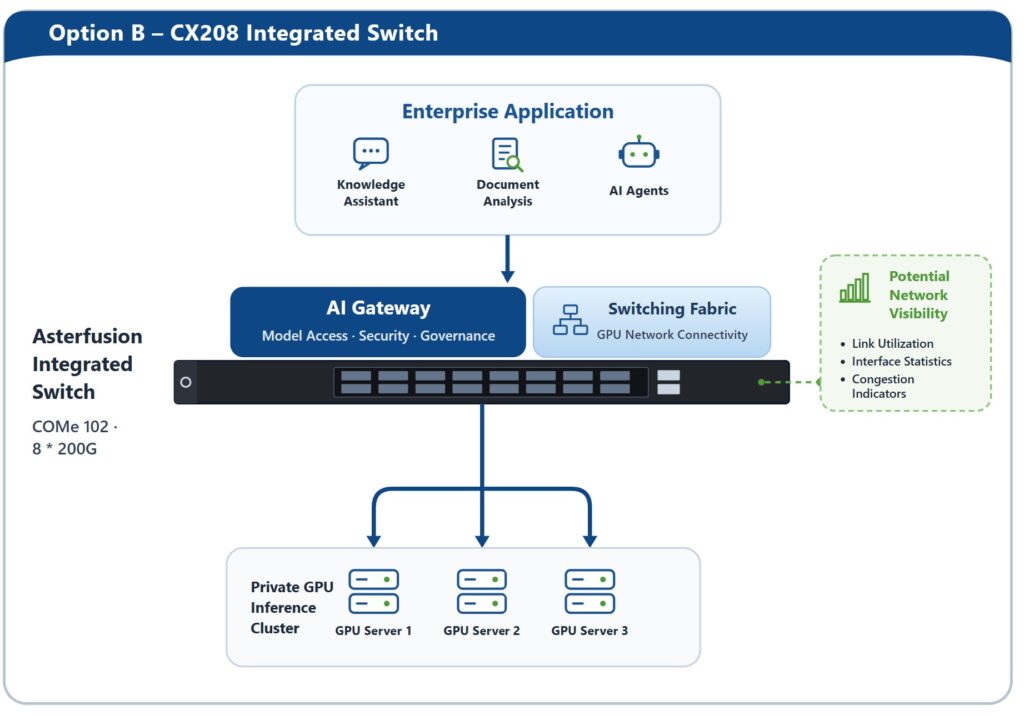
Final interface specifications, product availability, and AI Gateway software compatibility should be confirmed against the final product documentation and validation results. Depending on hardware and software support, the switch can also provide information such as link utilization, interface error counters, and congestion indicators. These metrics can help administrators understand network conditions between connected GPU servers.
| ET Series White-Box Gateway | COMe102-Based Integrated Switch | |
|---|---|---|
| Typical location | Between the enterprise network and the GPU cluster | At the GPU cluster’s switching layer |
| Main role | Provides boundary connectivity and a controlled entry point | Connects GPU servers and provides resources for application hosting |
| Where the AI Gateway runs | On a compatible compute environment available on the device | On the integrated COMe102 compute module |
| When to consider it | The site already needs a gateway at the cluster boundary | The enterprise is building a high-speed network between GPU servers |
7. How Can the Software Be Deployed?
After selecting the hardware, enterprises need to decide which AI Gateway software to use and how to deploy it.Different software projects address different requirements. Some focus on unified APIs, authentication, and quotas; others primarily select backend inference instances. Enterprises may need to combine components to meet their requirements.
Option 1: Deploy in a Compatible Linux or Container Environment
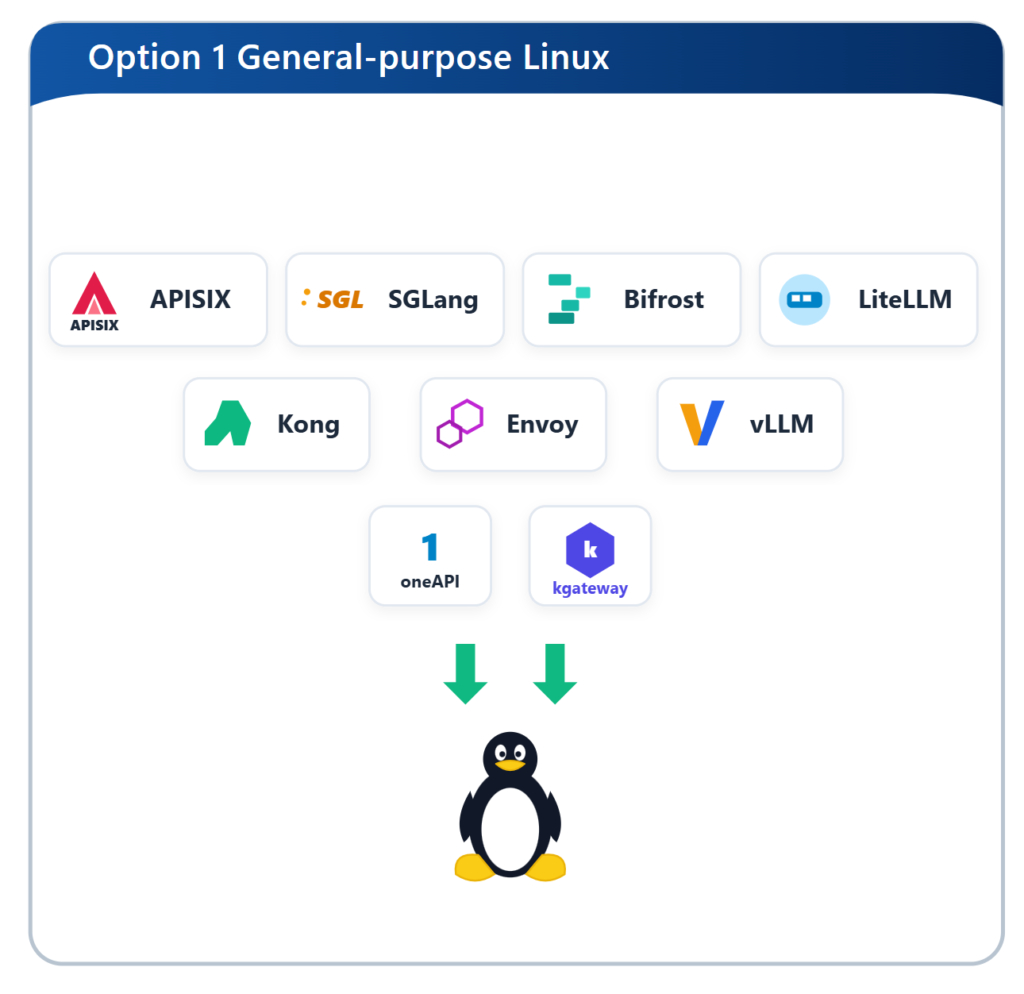
Teams that already use an AI Gateway or API gateway can evaluate deployment in a compatible Linux, Docker, or Kubernetes environment. Examples include:
| Software Category | Main Purpose | Examples |
|---|---|---|
| AI Gateways and API gateways | Provide a unified entry point and manage authentication, permissions, and access policies | Envoy AI Gateway, Higress, Apache APISIX |
| Multi-model API adapters | Provide a consistent way to call different models or model services | LiteLLM, New API |
| Inference routing and scheduling | Help select backend inference instances; some solutions consider load or KV cache information | SGLang Router, llm-d, AIBrix |
These projects have different areas of focus. Not all provide a complete set of authentication, quota, and scheduling functions, so multiple components may be needed. This approach allows enterprises to reuse existing software ecosystems while keeping the hardware platform and application software relatively independent. Before deployment, teams should verify processor architecture, operating environment, software dependencies, and available resources.
Option 2: Integrate with AsterNOS-VPP
Another approach is to integrate AI Gateway capabilities into the AsterNOS-VPP platform. In this proposed architecture, the AI Gateway is packaged as a containerized service running alongside existing network services:
- AsterNOS-VPP provides network connectivity, packet forwarding, and network-layer access control.
- The AI Gateway container processes model API requests, including authentication, authorization, usage limits, and model routing.
- Backend GPU servers run the models and generate responses.
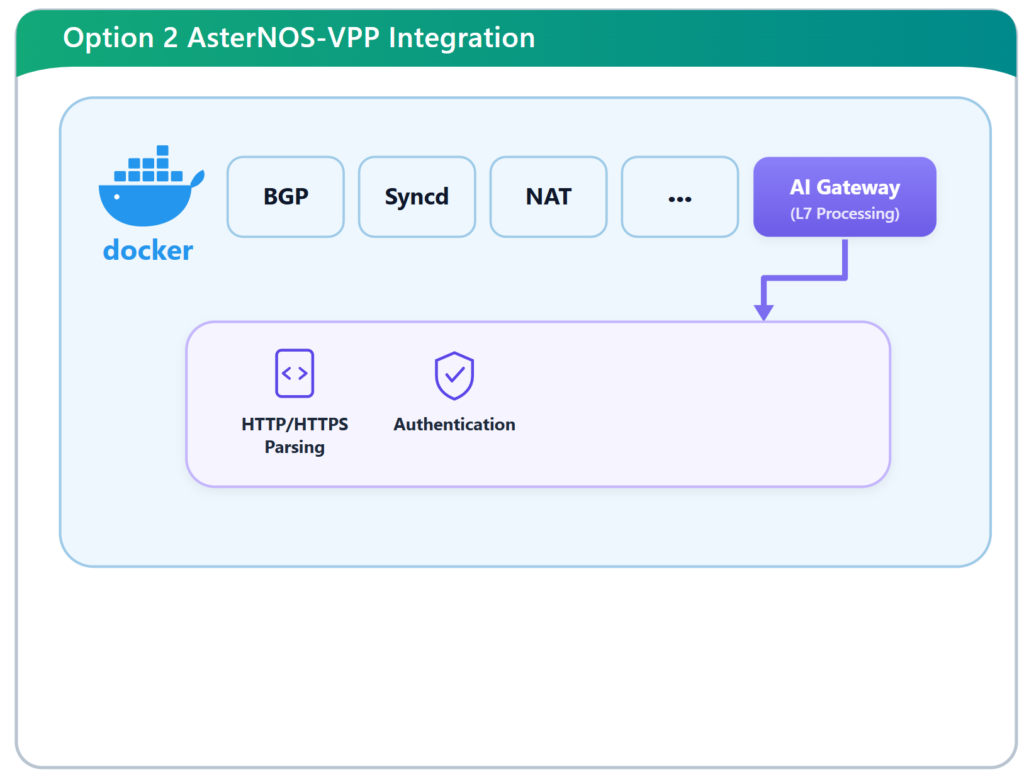
Authorized requests are forwarded to the appropriate model service, and the generated content is returned to the business application through the gateway. For HTTPS traffic, the deployment also needs to address TLS termination, certificate management, and the traffic path. Traffic steering and feature support require integration and validation. Both software routes can be evaluated according to the site’s requirements, hardware platform, software compatibility, and operational practices.
8. What Can an AI Gateway and Network Controls Manage Together?
When multiple departments share a GPU cluster, enterprises generally need to answer three questions:
- Who can use each model?
- How much can each application use?
- Which devices can connect to GPU servers or external services?
The AI Gateway and network functions can each play a role in answering these questions.
8.1 Model Access: Who Can Use Which Model?
Suppose an enterprise provides two AI services:
enterprise-chatfor general-purpose questions.enterprise-financefor financial tasks.
Depending on its capabilities, the AI Gateway can identify callers using API keys, JWTs, or other methods and apply different model access policies. For example:
| Caller | General Chat Model | Finance Model |
|---|---|---|
| Knowledge assistant | Allowed | Not allowed |
| Customer service system | Allowed | Not allowed |
| Financial analysis system | Authorized as needed | Allowed |
Requests outside the caller’s permissions can be rejected before they reach the backend inference service. TLS can also protect traffic in transit when configured for the relevant connections.
8.2 Usage Management: Prevent One Application from Consuming Too Much
Different departments can use AI in very different ways. A customer service system may generate many short requests, while a finance system may occasionally submit longer report analysis jobs. Depending on the selected software, an enterprise can combine:
- Requests per minute (RPM): Limits how many requests are submitted per minute.
- Tokens per minute (TPM): Sets a rate limit based on token usage.
- Application or department quotas: Assigns usage budgets to different callers.
- Concurrency limits: Controls how many requests can be processed at the same time.
These controls help reduce the risk of one application continuously submitting requests and consuming an excessive share of resources. Token usage is a useful metric, but it is not a precise measure of GPU compute consumption. Model size, context length, caching, and inference implementation all affect actual resource costs.
8.3 Network Access: Prevent Direct Connections That Bypass the Gateway
Even if the AI Gateway has access policies in place, users may still bypass it if GPU inference ports remain open to the entire enterprise network. The network must therefore control access paths as well as authenticate callers at the application layer. For example, ACLs and VRFs can be used to segment the inference network and restrict which hosts can connect to model services. Administrative access can follow separately defined rules. The AI Gateway manages who may use a model; network controls manage who can reach the backend.
8.4 Outbound Connections: Where Can the GPU Cluster Connect?
A private AI cluster is not necessarily disconnected from the internet. It may need to download models, access model repositories, call external APIs, or connect to third-party tools. Outbound connections therefore need policies as well. Depending on supported capabilities and configuration, AsterNOS-VPP’s GeoSite and GeoIP traffic classification can contribute to those policies:
- GeoSite: Classifies destinations using domain names or website categories.
- GeoIP: Classifies traffic based on IP addresses and associated geographic information.
- ACL and policy-based routing (PBR): Apply access rules or direct selected traffic through a specified network exit.
For example, an enterprise can create an outbound policy that permits access to approved model repositories and external AI services, while directing selected traffic through a designated exit. Depending on the protocol and device configuration, domain identification may use information such as the HTTP Host header, TLS SNI, DNS queries, or destination addresses carried by proxy protocols. Actual visibility depends on the protocol, encryption, and configuration. Controlling destinations does not determine whether the transmitted content contains sensitive data. That requires additional security capabilities.
8.5 Operational Visibility: Who Is Using the Service?
A unified entry point can also help administrators understand how model services are used. Depending on the gateway software, administrators may be able to see:
- Which application submitted a request.
- Which model service it accessed.
- Whether the request succeeded.
- How long the response took.
- Available token usage records.
- Whether repeated authentication failures occurred.
This information can help teams troubleshoot problems, assess capacity, and decide whether to add model instances or adjust policies. Logs also need protection. API credentials and prompts containing business information should not be recorded indiscriminately. Masking, access permissions, and retention periods should be configured according to enterprise requirements. Prompt-injection detection, sensitive-data scanning, and input/output guardrails can be explored as additional integrations, but require specialized detection engines or policy services.
9. Example: How Can One Network Platform Serve Three GPU Servers?
Suppose an enterprise deploys three GPU servers:
- GPU servers 1 and 2: Run two replicas of the same general-purpose model.
- GPU server 3: Runs a financial analysis model.
The enterprise has two main applications: an internal knowledge assistant and a financial document processing system. Both need AI services, but they require different models and permissions. The enterprise can deploy an ET gateway at the cluster network boundary and run AI Gateway software in a compatible environment, provided the selected platform meets the requirements.
A Request from the Knowledge Assistant
An employee asks: “What is the company’s procurement process?”
- The knowledge assistant requests
enterprise-chatthrough the unified entry point. - The AI Gateway authenticates the application and checks its permission to use the general-purpose model.
- The gateway checks the request against the configured usage limits.
- It selects an available instance from the general-purpose model pool and forwards the request to GPU server 1 or 2.
- The GPU server generates an answer, and the gateway returns it to the assistant.
The knowledge assistant only needs to know the enterprise-chat service. It does not need to know which server handled the request.
A Request from the Finance System
When the finance system needs to analyze an internal report, it can request another logical service, such as enterprise-finance. The gateway applies the finance system’s model permissions and usage policies, then forwards the request to the financial model. In this way, both applications can share one AI service entry point while following different access and usage policies.
At the same time, network policies can restrict unauthorized endpoints from connecting directly to backend inference ports. If an administrator later adds a general-purpose model replica, the model pool can be updated at the gateway. As long as the interface and model behavior remain compatible, upstream applications generally do not need to update individual server addresses. Depending on the network topology, the same scenario can also be evaluated using a COMe102-based integrated switching platform: the switching system connects the GPU servers, while the integrated compute module runs compatible AI Gateway software.
10. What Should Be Considered Before Deployment?
Hosting an AI Gateway on network hardware can simplify the equipment layout, but production readiness must be validated against actual workloads.
First, is there enough compute capacity? Testing should consider input and output lengths, streaming connections, concurrency, TLS processing, and logging—not just request counts.
Second, could network forwarding be affected? If the AI Gateway and network system share CPU, memory, or I/O resources, those resources need appropriate allocation and testing under realistic load.
Third, what happens if the gateway fails? If one device handles both network connectivity and the AI service entry point, a device failure may affect both. Redundancy and failover should be planned according to availability requirements.
Fourth, is the software compatible? Verify that the selected gateway software runs on the target platform and supports the model APIs, streaming behavior, and access policies used by the enterprise.
11. What Comes Next? From a Unified Entry Point to Network and AI Coordination
Once an enterprise has established a unified AI entry point, it can explore closer coordination between network information and model services.
Network-Aware Routing
Depending on hardware and software support, an integrated switching platform can provide information such as link utilization, interface errors, and congestion indicators.
In the future, combining this information with inference instance load and service status may provide additional context for analyzing bottlenecks or assisting model instance selection.
This requires integration between telemetry, routing policies, and the inference system.
Policy-Based Hybrid Inference
Enterprises can also explore using local models alongside external AI services.
For example:
- Requests containing business-sensitive information remain with approved local models.
- Other requests that comply with enterprise data policies may use external AI services.
- When local resources are busy, eligible workloads may be considered for external capacity.
These capabilities require clear data classification, model access policies, external service rules, and the necessary software integration.
Conclusion
A private AI cluster does not need to be large to be useful. But once it begins serving multiple applications and departments, model access, usage limits, network isolation, and operational visibility become part of everyday management.
An AI Gateway provides a unified entry point for model services, while network functions control connectivity and access paths. Combining them on a suitable network hardware platform offers a compact deployment option for small private GPU clusters.
Asterfusion’s ET series gateways and COMe102-based integrated switching platforms address different locations in the network: the cluster boundary and the switching layer. Enterprises can evaluate the right approach based on their topology, software requirements, and expected workloads.
Frequently Asked Questions
Do Two or Three GPU Servers Really Need an AI Gateway?
Server count alone does not determine the need. A single-application test environment may work well with direct access. A gateway becomes more useful when multiple applications require different permissions, usage limits, centralized routing, or shared operational reporting.
Will Hosting an AI Gateway Affect Network Forwarding Performance?
It depends on the hardware architecture, resource allocation, and workload. Separate software services may still share hardware resources. The deployment should therefore be tested under representative network and AI API loads before making performance commitments.
Can We Keep Using Our Existing Open-Source AI Gateway?
Potentially, yes. The selected platform must support its processor architecture, dependencies, runtime, and resource requirements. Start by validating the software already used by your applications, including its authentication, streaming, routing, and quota behavior.
Does This Architecture Prevent All AI-Related Data Leakage?
No. Network policies restrict connectivity, and AI Gateway policies manage model API access.
Sensitive-data detection, prompt-injection defenses, and decisions about sending content to external services require additional controls. They should be designed and validated separately.


