Table of Contents
Our Customer Finds Us to Support
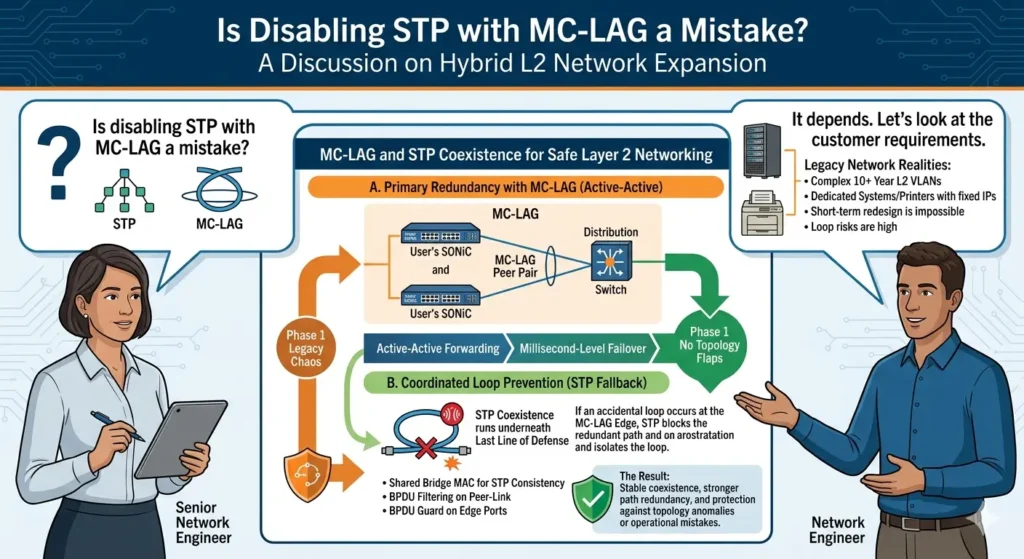
The customer told us: “Our network has been running for nearly ten years, with complex Layer 2 VLAN designs spread across multiple devices. For this expansion, we want to use your SONiC-based MC-LAG capability to provide dual-device redundancy at the core and aggregation layers.
However, we cannot redesign the existing Layer 2 network in the short term. The existing network still contains many legacy office systems, printers, and dedicated Layer 2 VLANs whose IP addresses cannot be changed. During this transition period, network loops could easily occur.
Can your MC-LAG work together with the existing STP network? If loops or cabling mistakes happen on the MC-LAG edge or legacy switch side, can STP still provide backup loop protection?”
Based on these requirements, we implemented MC-LAG and STP integration for campus networks. This avods MC-LAG and STP conflicts to work together, providing coordinated loop prevention in Layer 2 environments.
Full Layer 3 Networking in Campus Environments
To answer the question in the title, let’s first look at our vision for networking.
In Asterfusion’s architectural approach, a full Layer 3 network is considered the optimal design for modern cloud campus and data center deployments. Key advantages include:
- Simplicity: In a full Layer 3 environment, MC-LAG is mainly used for dual-homing servers or access switches. Since all forwarding is handled at Layer 3, loop risks are naturally eliminated through Layer 3 protocol calculations such as BGP or OSPF.
- Operational Transparency: This architecture no longer relies on STP. Without STP convergence fluctuations, the network becomes highly flat and transparent. Troubleshooting is simpler, and the design provides better scalability.
Current Reality: Layer 2 Networks Are Still Required
Although full Layer 3 networking is the long-term direction, many campus services still depend on large Layer 2 domains, such as printers, surveillance systems, and legacy office applications.
In many deployments, the requirement comes from network expansion, existing service continuity, or architectural limitations in production environments where large-scale redesign is not feasible. In these scenarios, customers still need to deploy MC-LAG in Layer 2 networks.
To address these compatibility requirements, AsterNOS provides support for STP, RSTP, and MSTP. This ensures interoperability with traditional Layer 2 campus architectures.
Therefore, the answer to the question in the title cannot be generalized. In our vision of a fully Layer 3 network, disabling STP when using MC-LAG is not a mistake. However, in a Layer 2 network, disabling STP would clearly create risks and lead to problems.
Why Is MC-LAG Required in Layer 2 Networks?
In Layer 2 network topologies, MC-LAG is introduced to solve the long-standing tradeoff between bandwidth utilization and redundancy.
- From Single-Active to Dual-Active: With a traditional single-device access design, a device failure directly causes service interruption. With dual-device access but without MC-LAG, half of the links must be blocked to prevent loops.
- The core value of MC-LAG is that it turns two physical switches into one logical system. This allows all access links to remain active for load balancing and increases bandwidth utilization by 100%.
- Millisecond-Level Failover: When a switch or link fails, traffic can automatically switch over within milliseconds. For services such as office applications and video conferencing, users can barely notice the network transition. This provides true device-level redundancy.
Why Is STP Still Required with MC-LAG?
Although MC-LAG can logically eliminate loops during normal operation, STP is still essential in complex Layer 2 environments.
- Compatibility with Existing Networks: Many production networks still contain legacy devices that only support STP, RSTP, or MSTP.
- Protection Against Unexpected Conditions: During network initialization, configuration changes, or accidental cabling errors, such as connecting the Peer-link to a third-party switch, the logical loop prevention mechanism may temporarily fail.
- The Last Line of Defense: In this architecture, STP is no longer the primary traffic control mechanism. Instead, it serves as the underlying loop prevention safeguard.
- It functions like an airbag in a vehicle. Under normal conditions, it does not participate in forwarding decisions. However, during topology anomalies or severe network events, it prevents the entire campus network from collapsing due to broadcast storms.
AsterNOS Modifications to STP for MC-LAG Compatibility
Standard STP cannot directly recognize MC-LAG architectures. Without additional optimization, protocol conflicts can occur.
Asterfusion AsterNOS modifies STP behavior to make traditional protocols work seamlessly with modern MC-LAG designs.
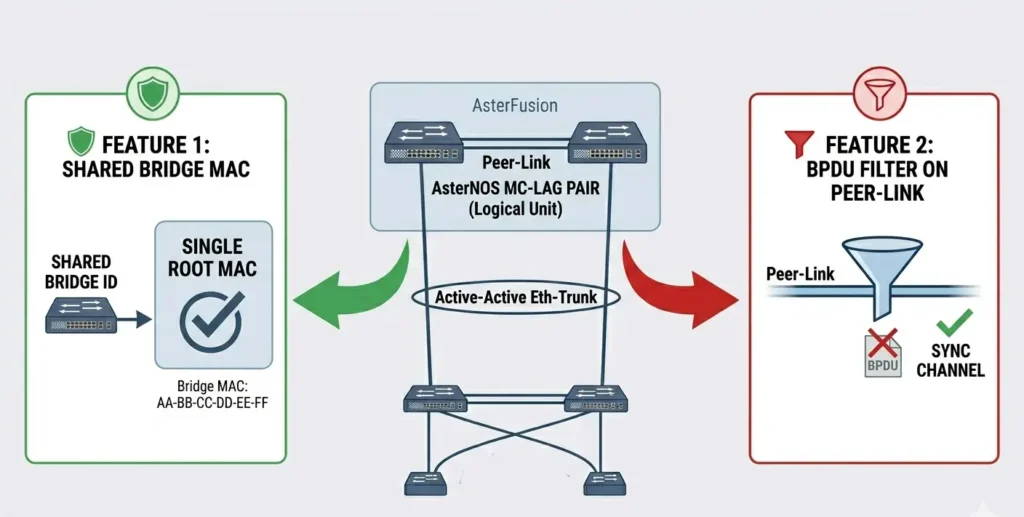
Shared Bridge MAC: Eliminating Identity Conflicts
- Issue: In standard STP operation, each switch has a unique MAC address. Without modification, downstream devices would detect two separate upstream switches, which could cause links to be incorrectly blocked.
- Design Purpose: AsterNOS allows both MC-LAG devices to share the same bridge MAC address. From the STP perspective, the two switches appear as a single logical bridge. This ensures that access links remain in the Forwarding state and maintains maximum bandwidth utilization.
BPDU Filter: Protecting the Lifeline Link
- Issue: The Peer-link is the critical channel used for state synchronization and traffic failover between MC-LAG peers.
- Design Purpose: AsterNOS forcibly filters STP BPDUs on the Peer-link. This prevents STP from mistakenly identifying the Peer-link as a loop path and blocking it.
- Once the Peer-link is blocked, MC-LAG synchronization and failover mechanisms can no longer operate correctly. This optimization ensures stability of the MC-LAG control plane.
Conclusion & Resources
In summary, the core design philosophy of AsterNOS is to balance architectural evolution with real-world deployment requirements.
Although full Layer 3 networking is the preferred architecture for modern cloud campus and data center environments due to its naturally loop-free design and operational simplicity, MC-LAG in Layer 2 environments still plays a critical role in scenarios such as legacy network expansion and existing service continuity.
By combining MC-LAG dual-active forwarding with the STP family protocols, including STP, RSTP, and MSTP, AsterNOS addresses both bandwidth utilization and redundancy requirements. Through optimizations such as shared bridge MAC addresses and BPDU filtering, AsterNOS also eliminates conflicts between cross-device link aggregation and traditional spanning tree protocols.

When deploying MC-LAG in Layer 2 networks using CX-M series switches, this architecture provides stronger path redundancy and more reliable protection against topology anomalies or operational mistakes. This ensures stable network operation even under unexpected conditions.
For more technical details and configuration procedures, refer to the full article:
MC-LAG and STP Interoperability Constructs Loop-Free Layer 2 Campus Networks


