Table of Contents
Introduction
With the rapid growth of AI in 2026, large models have reached trillion-parameter scale. Compute clusters have expanded from thousands to hundreds of thousands of GPUs. In this context, the network is no longer just a connectivity layer. It has become a key constraint on AI training and inference efficiency.
Why Remote AIDC Monitoring Is Required
In modern IT operations, about 80% of organizations report network complexity and visibility gaps. Network visibility remains a critical issue. For AI data centers (AIDC), remote monitoring is essential:
- Handling complex AI traffic patterns: AI workloads generate high fan-in traffic (incast), long-lived elephant flows, and strict requirements for low latency and lossless transport over RoCE/RDMA. Traditional device-centric and distributed management models cannot meet these demands.
- Proactive fault detection and reduced downtime: Downtime or performance bottlenecks can cost thousands of dollars per hour. Remote AIDC monitoring tools detect issues early and enable fast remediation before user impact.
- Improved operational efficiency and cost control: Clusters often include hundreds or thousands of switches. Per-device configuration is inefficient and error-prone. Remote AIDC monitoring provides real-time visibility and troubleshooting without on-site access.
- Enhanced security posture: Cybersecurity Ventures predicts global cybercrime costs will reach $10.5 trillion annually by 2025. Modern monitoring platforms integrate intrusion detection and firewall visibility. This is critical for protecting sensitive AI data.
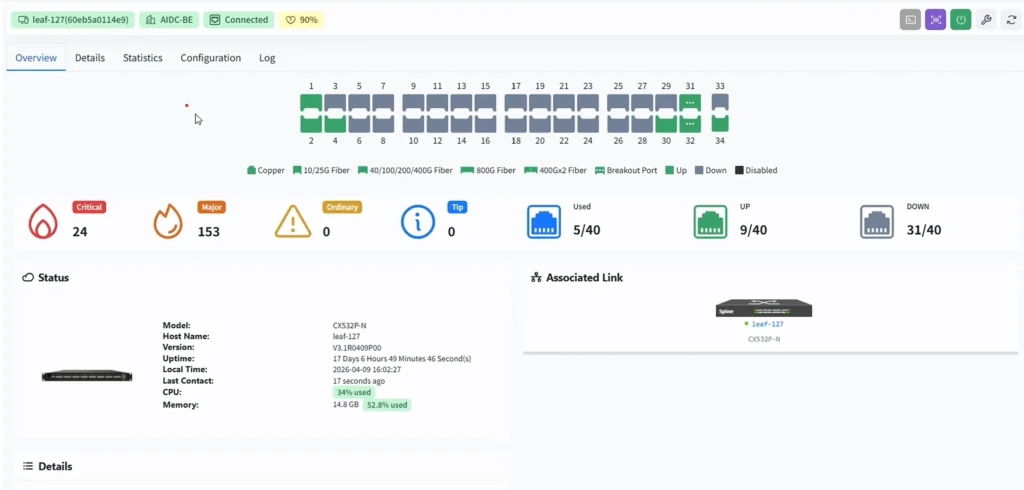
Overview of Mainstream Remote Network Monitoring Tools in 2026
In 2026, several platforms stand out. They address different scales and use cases:
- Asteria AIDC Controller: Purpose-built for AI data centers. Based on the OpenWiFi Cloud Controller architecture. Uses the uCentral protocol for device management. Provides full-stack centralized control, from zero-touch provisioning (ZTP) to scenario-based deployment and deep RoCE optimization.
- SolarWinds Network Performance Monitor: Designed for enterprise networks. Provides strong analytics and reporting. Excels in device discovery, topology visualization, AIOps-based alerting, reporting, and troubleshooting. Suitable for campus, data center, and hybrid cloud operations.
- Datadog: A cloud-native observability platform. Network monitoring is one component. It is typically used with host, container, application, log, and APM monitoring. Strong in cloud-native workloads and cloud infrastructure visibility.
- Zabbix: A general-purpose open-source monitoring platform. Collects metrics via SNMP, ICMP, HTTP, scripts, and Prometheus. Suitable for cost-sensitive teams that require high customization.
- LogicMonitor: A cloud-based IT infrastructure monitoring and observability platform. Covers networks, servers, cloud services, VMs, containers, and applications. Provides AI-assisted anomaly detection and alert analysis.
Positioning:
| Tool | Primary Positioning | AIDC-Specific |
| Asteria AIDC Controller | Network management and automation for AI data centers. Focuses on ZTP, topology presets, scenario-based deployment, RoCE optimization, and unified operations. | Yes |
| SolarWinds Network Performance Monitor | Enterprise network performance monitoring. Focuses on visibility, alerting, troubleshooting, and reporting across on-prem, hybrid, and cloud networks. | No |
| Datadog Network Monitoring | Cloud-native and hybrid observability. Covers network traffic, cloud infrastructure, and unified monitoring across applications, hosts, and GPUs. | No |
| Zabbix | Open-source monitoring platform. Suitable for infrastructure, servers, network devices, and custom metrics. | No |
| LogicMonitor | SaaS-based monitoring platform. Focuses on infrastructure, network, cloud, and alert automation. | No (not AIDC-specific) |
If the goal is network automation in AIDC, RoCE/lossless fabric optimization, scenario-based deployment, and unified control, a dedicated controller such as Asteria is the right fit.
If the goal is network health visibility, fault isolation, performance analysis, and unified monitoring across network, cloud, hosts, and applications, tools like SolarWinds, Datadog, and Zabbix are general-purpose platforms rather than AIDC-specific solutions.
Why Asteria AIDC Controller Is a Strong Choice for Remote AIDC Monitoring
Although many monitoring tools are available in the market, none are truly designed for AIDC environments. Asteria AIDC Controller is different. It was built from the ground up for AI data centers, giving it clear architectural and operational advantages:
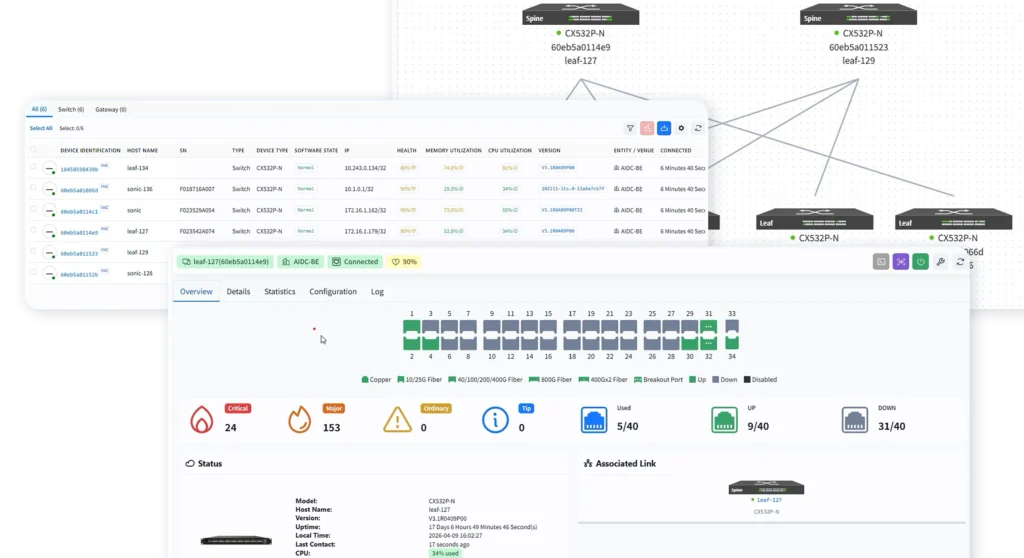
- Intent-based automation (ZTP): Traditional deployments rely on per-device configuration. Asteria enables one-click orchestration. Devices onboard automatically and are centrally managed through ZTP. This supports fast deployment at scale, including hundreds of nodes.
- Deep optimization for AI workloads: It includes built-in templates for GPU training, storage, front-end, and DC convergence networks. It integrates RoCE, intelligent path selection, and ARS (Adaptive Routing Switching). It also provides predefined PFC priorities and ECN marking policies, with fine-tuning support to optimize lossless performance.
- Advanced network observability: Unlike general-purpose tools, it provides detailed RoCE metrics, device buffer statistics, interface traffic history, and global health views. This level of visibility is critical for identifying congestion in AI training workloads.
- Secure multi-tenancy and access control: Designed for large-scale or managed environments. It supports multi-organization structures with hierarchical management by region, department, or service. With role-based control and owsec security services, each tenant operates within its authorized scope, ensuring logical isolation and fine-grained access control.
- Open and flexible architecture: Built on the OpenWiFi Cloud Controller architecture and the uCentral protocol. It avoids vendor lock-in and provides strong scalability and high concurrency capabilities.
- Comprehensive operations and maintenance: Supports one-click inspections, customizable alert thresholds, and multi-tenant management. This ensures stable operation of large-scale AIDC networks.
How to Deploy an AI Backend Network Step by Step with Monitoring Tool ?
Please refer to Deploy an AI Backend Network Step by Step with AIDC Network Operations Platform.
Experience Next-Generation AIDC Network Management
In 2026, as network architectures become increasingly complex, selecting the right monitoring platform is not only a technical decision but also a key factor for business continuity. Asteria AIDC Controller, with its deep understanding of AI workloads and automated operations capabilities, has become a foundational platform for building future-ready networks.
Want to learn how the AIDC Controller can improve the efficiency of your AI data center?
[Fill out the form below] to contact our experts and request a free trial. Keep your AIDC network ahead in 2026.
Conclusion
In 2026, as the competition for AI compute power intensifies, the data center network is no longer a background utility. It has become a core driver of AI training and inference performance. At the scale of ten-thousand-GPU clusters, high-concurrency communication and lossless transport requirements expose the limitations of traditional device-centric and fragmented management models.
Asteria AIDC Controller is designed to address these constraints. It provides intent-based automation with ZTP, along with deep visibility into RoCE traffic. It also introduces multi-tenant isolation to ensure secure operations in large-scale environments. By converting complex network configurations into standardized scenario templates, it reduces operational overhead and allows teams to focus on AI-driven innovation and business growth.
For a comprehensive introduction to the AIDC Controller, please refer to the AIDC Controller Whitepaper.


