Table of Contents
Introduction
In the previous article, we learned what a BNG network is and its evolution toward openBNG. However, you may have noticed that there is a term overlap between BRAS and BNG. So in this article, let’s clarify the concepts of these two technologies.
During the evolution of broadband access networks, BRAS (Broadband Remote Access Server) and BNG (Broadband Network Gateway) are often discussed together. As a result, the terms BRAS router and BNG router frequently appear in the same context. In short, BRAS and BNG provide similar functions. However, in terms of technical positioning, service scope, and deployment scenarios, BNG can be viewed as the natural evolution and upgrade of BRAS. The following sections provide a closer look at both.
BRAS: Early Broadband Remote Access Server Explained
A BRAS (Broadband Remote Access Server) was originally deployed in copper-based DSL/ADSL (Digital Subscriber Line / Asymmetric Digital Subscriber Line) access networks. Positioned between the aggregation network and the core network, it handled subscriber traffic and centralized broadband access control.
The core responsibilities of a BRAS were defined in TR-025 published by Broadband Forum. Its primary tasks included PPP termination and tunnel encapsulation. With the introduction of TR-059, its scope expanded to cover subscriber management, advanced IP processing (including IP QoS), and enhanced traffic management features such as five-layer hierarchical shaping.
Its main functions can be summarized as follows:
- PPPoE session termination
- RADIUS-based authentication, authorization, and accounting (AAA)
- IP address assignment
- Subscriber session management
- Basic QoS and rate limiting

As shown in the diagram, the traffic path is: User device → DSLAM → ATM aggregation network → BRAS
In this workflow, the DSLAM (Digital Subscriber Line Access Multiplexer) receives traffic from each subscriber line (DSL signals over copper), converts it into DSL data, encapsulates it into ATM cells, and aggregates it upstream toward the BRAS, which then forwards the traffic to the Internet.
In summary, a BRAS can be viewed as a remote access server centered around PPPoE/DSL, focusing on subscriber access, authentication, session management, and basic QoS control.
BNG: Modern Broadband Gateway for FTTH, IPoE, IPv6, and Multi-Service
In TR-101 published by Broadband Forum, the broadband access network was transitioning from an ATM-based architecture to an Ethernet-based aggregation model. At the same time, multiple access technologies emerged to replace DSL, such as GPON, Ethernet, and fiber-based access. The traditional BRAS concept could no longer represent these new architectures.
To avoid ambiguity and align with the updated network model, TR-101 introduced a more general term: BNG (Broadband Network Gateway).
The BNG inherits the typical BRAS functions defined in TR-092—such as PPPoE, IP address assignment, subscriber session management, and policy enforcement—but is designed for the new Ethernet-based broadband access architecture.
The BNG extends support for modern capabilities, including:
- IPoE / DHCPv4/v6
- Large-scale FTTH/PON deployments
- Full IPv6 support and multi-service integration (e.g., IPTV, VoIP)
- Advanced H-QoS and multicast control
- Cloud-native deployment, virtualization, and Control/User Plane Separation (CUPS), which is central to the openBNG model

As shown in the diagram, the traffic path is: User side → IP DSLAM / OLT → Ethernet aggregation network → BNG
- For DSL subscribers, the IP DSLAM converts the signal on each copper DSL line into Ethernet frames.
- For fiber subscribers, the OLT converts optical signals into Ethernet frames.
These frames are carried through the Ethernet aggregation network and eventually reach the BNG. The BNG then performs session management, policy enforcement, IP address assignment, and other subscriber-related functions before the traffic is forwarded to the Internet.
In short: The BNG is the evolution of the BRAS under modern technologies and architectures — an upgraded and generalized version of the traditional BRAS.
BNG Router vs BRAS Router: Key Differences and Evolution
From an evolutionary perspective, the BRAS and BNG have a clear inheritance relationship, and the terms are sometimes used loosely and interchangeably. Their functions are highly similar.
The comparison below illustrates this more clearly:
| Dimension | BRAS | BNG |
| Definition | Traditional broadband access device for dial-up, authentication, and accounting | Modern broadband gateway that includes BRAS functions and extends to IPoE, IPv6, QoS, and the CUPS architecture |
| Background / Standards | Introduced in the xDSL/PPPoE era; based on TR-025 / TR-059 | Developed for upgraded broadband networks supporting FTTH/PON, large-scale IPv6, and multi-service integration; based on TR-101 / TR-178 / TR-459 |
| Subscriber Authentication | PPPoE + RADIUS | PPPoE/IPoE + AAA (RADIUS/DIAMETER) |
| IP Address Assignment | DHCP | DHCP + DHCPv6 + IPv6 PD |
| QoS / Traffic Policy | Basic | Advanced, with hierarchical queues, scheduling, and shaping |
| Access Protocols | Mainly PPPoE | PPPoE + IPoE + VLAN/QinQ + FTTx/FWA |
| Architecture | Monolithic | Monolithic or CP/UP separation (CUPS) |
| Aggregation Network Technology | ATM | Ethernet aggregation |
| High Availability / Redundancy | Dual-chassis redundancy | Dual-chassis redundancy + distributed user-plane scaling |
| IPv6 Support | Limited or none | Full IPv6 support |
| Cloud / Virtualization | Minimal | Supports OpenBNG / vBNG / white-box hardware |
From this perspective, a BRAS router and a BNG router also share a high degree of functional overlap:
- Both act as the subscriber session management point in the access network
- Both handle IP address assignment, policy enforcement, QoS, and multi-service support
- Both serve as the upstream traffic aggregation point toward the Internet
The differences lie in their design focus:
- A BRAS router was designed for the early DSL/PPPoE access era. It relies on an ATM-based aggregation model and primarily serves DSL subscribers.
- A BNG router targets modern broadband networks. It supports IPoE, IPv6, FTTH/PON, cloud-native deployment, and the CUPS architecture, as well as integrated services such as IPTV and VoIP.
In short, the BNG router represents a full functional upgrade. It can fulfill all roles of a BRAS router while supporting the broader requirements of today’s multi-service broadband networks.
Asterfusion ET2508 as a High-Performance BNG Router
In summary, the BRAS and BNG share similar functions, while the BNG router is the fully upgraded version that supports IPoE, IPv6, FTTH/PON, and multi-service integration.
Based on this, the Asterfusion ET2508 Open Intelligent Gateway with Enterprise SONiC – AsterNOS-VPP, built on the Marvell OCTEON 10 CN102 platform, can fully serve as a BNG router for the following reasons:
The free version is here ! For any questions, please leave your comments in the AsterNOS-vpp Column.
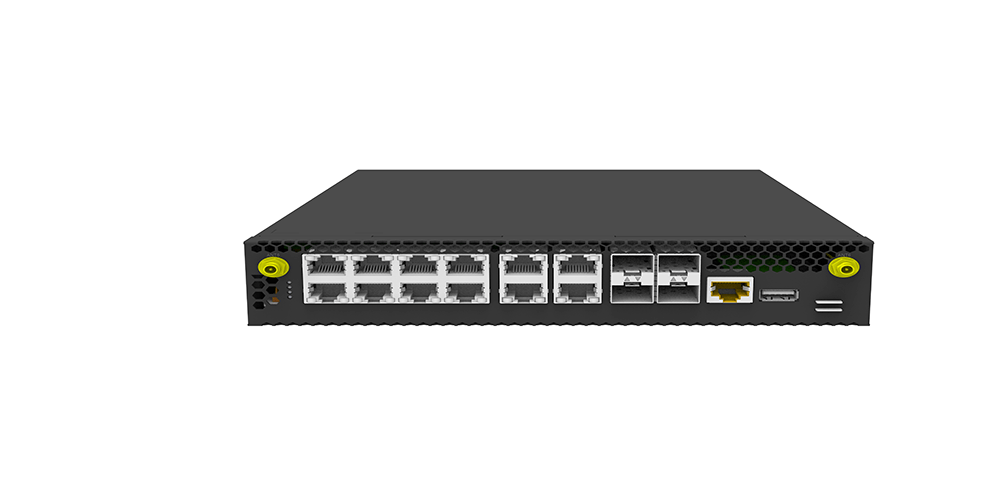
- High-performance hardware:
8-core ARM64 Neoverse N2 CPU, 16 GB DDR5 (expandable to 48 GB), and up to 60 Gbps routing and security processing capability.
- Flexible interfaces and deployment:
Equipped with 4×10GE, 4×2.5GE, 8×1GE, and optional PoE modules to support various FTTH/PON and enterprise deployment scenarios.
- Support for modern protocols and services:
Compatible with PPPoE, IPv6, QoS, VPN, NAT, and ACL, meeting service requirements such as IPTV and VoIP.
- Flexible software and architecture:
Preloaded with AsterNOS-VPP (SONiC + VPP) or customizable software, and supports Restful APIs and cloud-based management through the OpenWiFi controller.
Therefore, the ET2508 not only inherits the traditional BRAS feature set but also delivers the performance, multi-service capability, and cloud-ready architecture required by a modern BNG, making it a unified gateway for today’s broadband access networks.
FAQs
1. What is a BNG router?
A BNG router (Broadband Network Gateway Router) is the core gateway in a broadband access network. It manages subscriber sessions, assigns IP addresses, enforces policies, provides QoS, and aggregates subscriber traffic toward the Internet. A BNG router supports multiple access methods such as PPPoE and IPoE, as well as integrated services including IPTV and VoIP. It is used in modern FTTH/PON and Ethernet-based access networks.
2. What is a BNG in networking?
A BNG (Broadband Network Gateway) is a gateway device in the operator access network that centralizes subscriber session control and traffic handling. It can be seen as an evolved version of the traditional BRAS (Broadband Remote Access Server). It supports modern broadband technologies such as IPoE, IPv6, and FTTH/PON, provides multi-service integration, and enables Control/User Plane Separation (CUPS) for next-generation OpenBNG architectures.
3. What are the four types of broadband?
Common broadband access types include:
- DSL (Digital Subscriber Line): Uses telephone copper lines for DSL signals, such as ADSL/VDSL.
- Fiber (FTTH/PON): Uses fiber directly to homes or subscribers, offering high bandwidth and good stability.
- Cable Broadband: Provides high-speed Internet access through coaxial cable used in cable TV networks.
- Wireless Broadband: Includes 4G/5G, Wi-Fi, and Fixed Wireless Access (FWA). In this article, BRAS is associated with DSL-based access, while the BNG primarily supports modern fiber deployments.
4. BNG router vs. BRAS router
Functionally, a BNG router and a BRAS router are very similar:
- Both serve as the subscriber session management point
- Both handle IP address assignment, policy enforcement, QoS, and multi-service support
- Both aggregate subscriber traffic toward the Internet
5. What is the difference between BNG and BRAS?
Although the terms BNG and BRAS are sometimes used interchangeably, the differences are:
- BRAS: Designed for the early DSL/PPPoE era, based on ATM aggregation, mainly serving DSL subscribers. Its functions focus on PPPoE termination, AAA, and basic QoS.
- BNG: Built for modern broadband networks, supporting IPoE, IPv6, FTTH/PON, multi-service integration, cloud-native deployment, and the CUPS architecture. It provides a more comprehensive feature set and supports services such as IPTV and VoIP.

Contact US !
- To receive timely and relevant information from Asterfusion, sign up at AsterNOS Community Portal
- To submit a case, visit Support Portal.
- To find user manuals for a specific command or scenario, access AsterNOS Documentation
- To find a product or product family, visit Asterfusion-cloudswit.ch .
- To contact Sales, Send E-Mail to bd@cloudswit.ch


