Table of Contents
Broadcom SONiC on Trident and Tomahawk Breaks Black-Box Networking
In the process of breaking the traditional “black-box” networking, AsterNOS, as Broadcom SONiC on Trident and Tomahawk, has completely reshaped the boundaries of enterprise networks through hardware and software decoupling. Unlike the basic open-source version, AsterNOS integrates our in-house developed Switch Abstraction Interface (SAI) adaptation layer, ensuring that all complex software functions can be executed with hardware-level line-speed processing.
When AsterNOS runs on the Broadcom StrataXGS chip, the most widely adopted globally, it not only adds critical enterprise features like EVPN Multihoming but also provides enterprises with cost-effective, devops-ready management capabilities comparable to those of hyperscale cloud providers, along with observability based on Grafana and Prometheus.
Hardware Foundation: Positioning of Trident vs. Tomahawk
Broadcom’s StrataXGS series, through its Trident and Tomahawk product families, has achieved precise coverage of modern network scenarios. The Trident series focuses on functional flexibility and programmability, designed specifically for enterprise campus, edge computing, and leaf layers. On the other hand, the Tomahawk series is built for maximum throughput and low latency, serving as the core engine for hyperscale data centers, AI/ML clusters, and network backbones. Together, they define the network forwarding standards for the era from 100G to 1.6T.
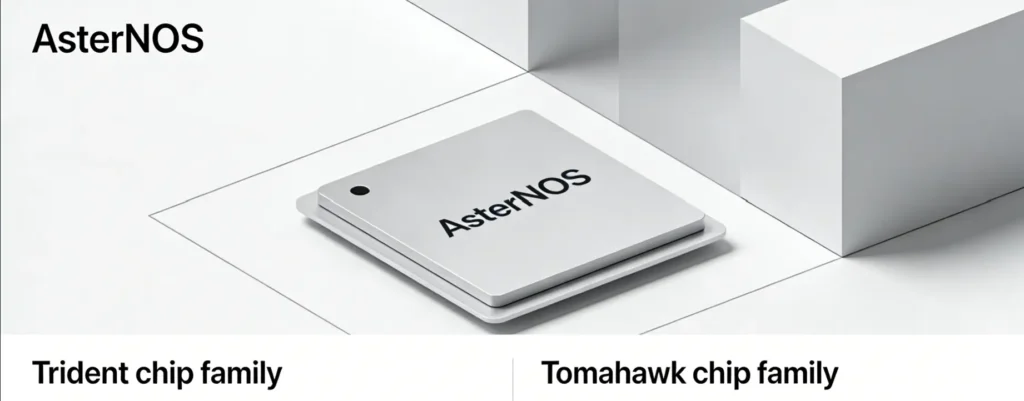
Trident Series
The Trident series emphasizes programmability and feature richness, primarily deployed in leaf/ToR switches and enterprise core networks. The bandwidth has evolved from the 3.2Tbps of TD3 to 12.8Tbps of TD4, supporting flexible 100G/400G ports, and further to the 16Tbps of TD5-X12. These are the hardware platforms supported by AsterNOS as Broadcom SONiC, laying a foundation for future high-bandwidth devices.
This series integrates a complete enterprise protocol stack, including VXLAN and EVPN, and supports runtime policy updates through the highly programmable P4/FlexFlow pipeline. Additionally, Trident features robust in-band telemetry (IFA 2.0) and micro-burst capture capabilities, ensuring a deep balance between cost, power consumption, and flexibility, while safeguarding large-scale routing and ACL resources.
Tomahawk Series
The Tomahawk series focuses on extreme bandwidth and low latency, positioning itself as the core network for data center spine nodes and AI training clusters. Evolving from the 12.8Tbps of TH3 to 102.4Tbps of TH6, this series continues to break single-chip bandwidth records, supporting ultra-high-density deployments with 400G, 800G, and 1.6T ports.
From a technical perspective, it integrates dynamic load balancing (DLB), congestion-aware, and cognitive routing mechanisms, effectively optimizing RoCEv2 traffic and reducing tail latency in AI training. With exceptional energy efficiency and flat topology construction capabilities, Tomahawk is the preferred choice for high-performance computing (HPC) and hyperscale cloud networks.
Through port density and energy efficiency, this series enables the construction of flat AI topologies with a single chip, significantly reducing power consumption each generation and making it ideal for large-scale deployments in the 400G/800G/1.6T era.
Broadcom SONiC on Trident and Tomahawk is an open networking operating system solution specifically developed and optimized based on the hardware features of the chips.
Enterprise SONiC AsterNOS: Unlocking Hardware Performance
AsterNOS, as an enterprise-grade network operating system based on SONiC, unlocks the hardware potential of Broadcom SONiC on Trident and Tomahawk chips through deep customization and optimization, translating this capability into performance advantages in real-world production environments.
In-house developed SAI : Traditional SONiC deployments rely on the SAI provided by chip vendors, which often leads to longer feature release cycles constrained by the vendor’s update schedule. AsterNOS addresses this challenge by utilizing a in-house developed SAI layer, directly interfacing with Broadcom’s chip SDK. This bypasses intermediate steps, enabling SONiC’s upper-layer software features (such as routing protocols and traffic engineering policies) to be precisely translated into the chip’s hardware instruction set.
Containerized Architecture: AsterNOS, built on SONiC’s microservices architecture, allows for the upgrading of specific protocol modules without interrupting service. This ensures extremely high stability in high-performance environments.
RoCE Support: AsterNOS supports RDMA (RoCE v2), enabling efficient communication between GPUs. Coupled with Tomahawk’s low-latency characteristics, it delivers maximum performance. At the same time, the comprehensive feature coverage of Trident enhances enterprise campus scenarios and other environments.
Broadcom SONiC on Trident and Tomahawk Equals High-Performance Networking
Broadcom’s chips provide the physical “muscle,” while Broadcom SONiC on Trident and Tomahawk by Asterfusion brings the flexible, open “brain.” For enterprises seeking AI compute efficiency and large-scale automated operations, this is the ideal solution.
Broadcom SONiC on Trident and Tomahawk builds high-performance networking through the following key aspects:
Proven and Unified Solution Across Scenarios
AsterNOS for Broadcom is not a new product built from scratch. It is based on mature multi-platform practices and uses a in-house developed SAI to achieve a unified network architecture across chips. It inherits core technologies that have been fully validated in real-world production environments from several mature commercial versions, including AsterNOS for Marvell, AsterNOS for VPP, and AsterNOS for P4. It covers the following full-scenario applications:
Full-Scenario Coverage:
- AI Data Centers: Tomahawk provides ultra-high-bandwidth backbones.
- Enterprise Campus Networks: Trident supports rich enterprise-grade features.
- Edge Computing: Hybrid deployment of Broadcom and Marvell chips for unified operations.

SAI Deep Optimization: Zero-Loss Performance Mapping
AsterNOS has deeply adapted and optimized Broadcom’s chip SDK to ensure that every configuration command at the software layer is executed with line-rate precision on the hardware. This “direct hardware-software connection” architecture allows upper-layer protocol stack policies to be directly applied to the hardware forwarding plane, enabling zero-latency configuration for ACL rules, routing table entries, and ensuring full-speed performance even under extreme bandwidth conditions.
This optimization ensures that the theoretical performance of the Trident and Tomahawk chips is fully translated into usable bandwidth in real-world production environments, providing upper-layer applications with predictable and deterministic networking.
AI Compute Acceleration Features
In AI/ML training scenarios, networking is often the hidden bottleneck that limits GPU cluster efficiency. AsterNOS integrates several key technologies to minimize the impact of networking on training performance:
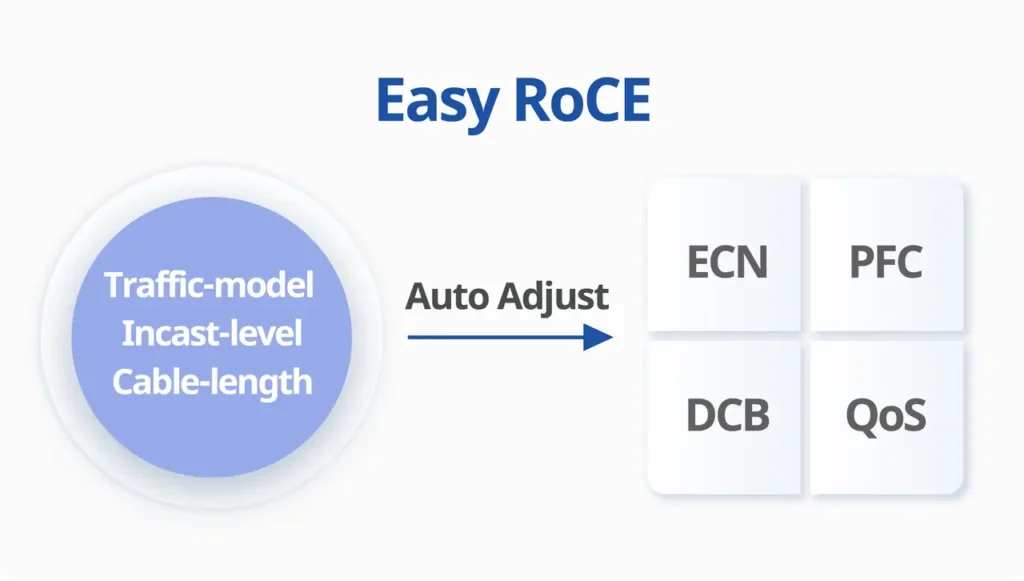
- PFC (Priority Flow Control): Implements hop-by-hop flow control for RoCEv2 traffic, ensuring zero packet loss in RDMA communication between GPUs.
- ECN (Explicit Congestion Notification): Actively marks packets before congestion occurs, triggering a slowdown on the sender to prevent buffer overflow.
- DCBX (Data Center Bridging Exchange): Automatically negotiates end-to-end QoS parameters, simplifying large-scale cluster deployments.
Combined with Easy RoCE, AsterNOS becomes the network foundation for building efficient AI training clusters, directly translating to faster model iteration and reduced compute costs.
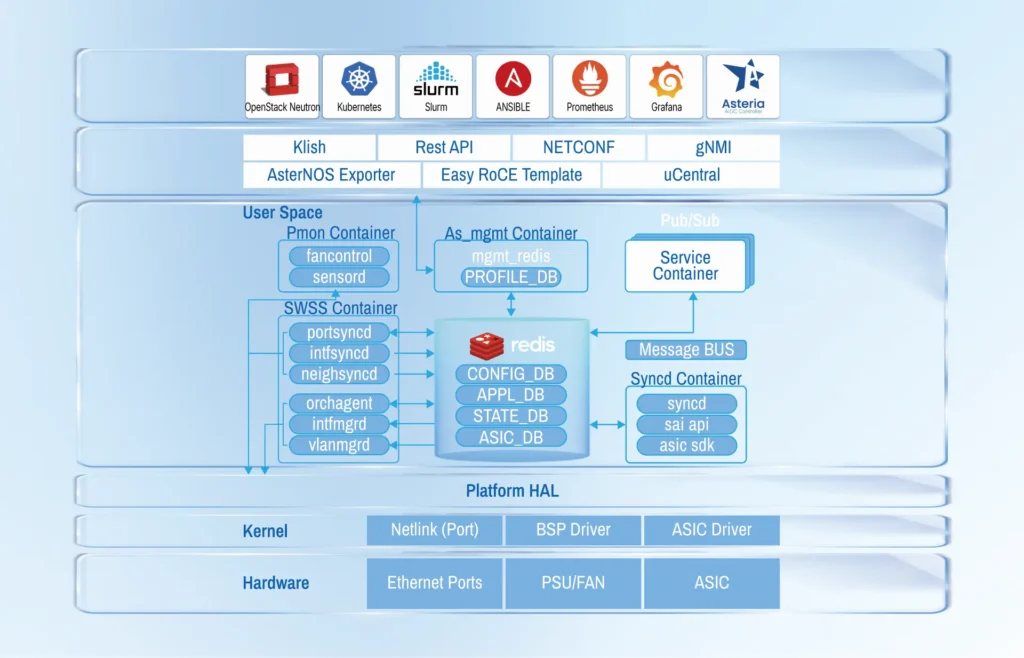
Containerized Microservices Architecture
AsterNOS, based on SONiC’s containerized architecture, splits network functions into independent microservice modules, enabling hot upgrades. This allows the upgrading of BGP protocols or management components without affecting other container modules, ensuring zero disruption to business traffic. Additionally, thanks to containerized isolation, when a service module encounters an issue, the core protocol remains unaffected, and only the faulty container needs to be taken offline for resolution.
This architecture ensures that network devices can be “always online,” making it suitable for 24/7 operations in environments such as cloud service providers, online trading platforms, and smart manufacturing workshops.
Full-Module Management: A Tool for Simplified Configuration
Traditional community SONiC requires management through Linux command lines and multiple configuration files (JSON, YAML), which is complex and error-prone. AsterNOS simplifies management in several ways:
- Unified CLI Management (Klish): Provides a Cisco-style CLI, allowing network engineers to operate with no learning curve. All functional modules (VLAN, routing, ACL, QoS, etc.) can be configured through a unified interface, eliminating the need to frequently switch between files or directories.
- In addition, it offers several southbound interfaces, such as RESTful API, to support automated orchestration and third-party system integration (e.g., Ansible, Terraform); NETCONF/YANG for bulk configuration, and gNMI/gRPC for high-performance configuration deployment and status subscription, making it ideal for large-scale networks.
Observability: Data-Driven Intelligent Operations
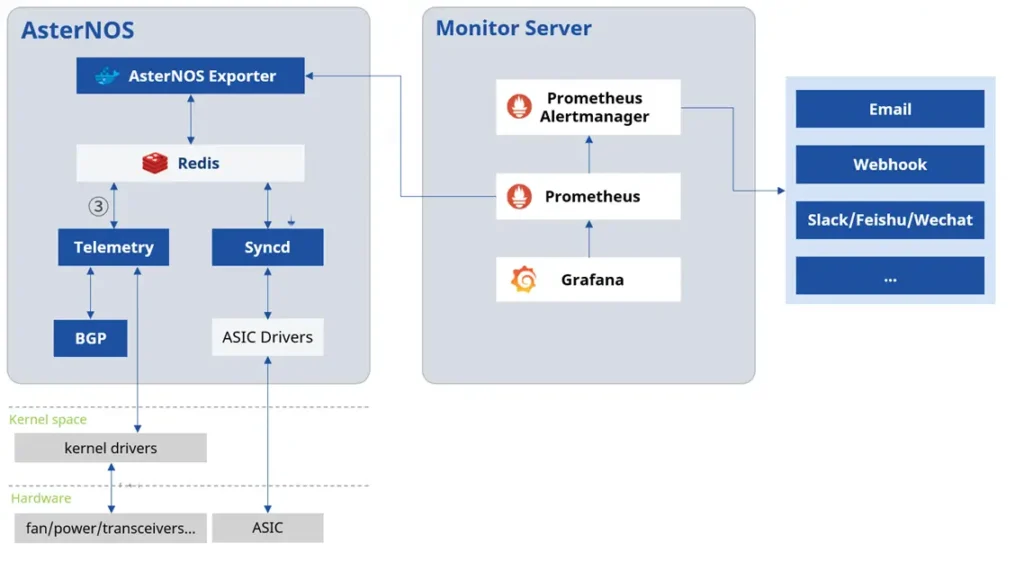
AsterNOS Exporter + Grafana + Prometheus build a comprehensive network visualization and monitoring system:
- Real-Time Metric Collection: The Exporter component exports telemetry data, protocol statuses, and system resource metrics in Prometheus format.
- Multi-Dimensional Visualization: Grafana dashboards display key KPIs, such as port traffic, latency heatmaps, error rate trends, and resource utilization.
- Alerting and Prediction: Machine learning models based on historical data predict traffic peaks and potential failures, triggering early capacity expansion or path adjustments.
Broadcom SONiC on Trident and Tomahawk is not just a simple enhancement of the open-source community version. It leverages Asterfusion’s years of cross-platform practical experience, applying deep technological innovations—in-house developed SAI, AI optimizations, enterprise-grade hardening, containerized architecture, simplified management, and full-stack observability—to fully unlock the hardware potential of Broadcom chips. This solution, which inherits the technological lineage of several mature commercial versions, including Marvell, VPP, and P4, and has been thoroughly validated in real-world production environments, is becoming the new standard for network infrastructure in the AI era and enterprise digital transformation.
Contact US !
- To request a proposal, send an E-Mail to bd@cloudswit.ch
- To receive timely and relevant information from Asterfusion, sign up at AsterNOS Community Portal
- To submit a case, visit Support Portal
- To find user manuals for a specific command or scenario, access AsterNOS Documentation
- To find a product or product family, visit Asterfusion-cloudswit.ch


