Table of Contents
As AI, cloud computing, high-performance computing (HPC), and financial services push the boundaries of modern networks, selecting the right switch has become more critical than ever. It’s no longer just about bandwidth—today’s networks demand low latency, high scalability, deep visibility, and operational efficiency. Asterfusion offers two powerful 32×100G switch platforms built on Marvell Prestera CX 8500 (Marvell Falcon) and Marvell Teralynx 7 ASICs. Both are powered by our Asterfusion Enterprise SONiC NOS, providing a unified, open, and production-ready software experience. However, each platform is optimized for distinct deployment needs.
This guide will help you choose the best fit—whether you’re building an ultra-low-latency fabric for AI inference or scaling a multi-tenant cloud network.
Why Choose Teralynx 7?
Outperforms Broadcom 3.2T-Class Chips in Latency, Throughput & Buffering

Marvell’s Teralynx 7 ASIC leads the pack when it comes to performance. Compared to Broadcom’s 3.2T-class chips, it delivers clear advantages in three areas that matter most to high-performance networks:
Ultra-Low Latency for Delay-Critical Applications
With latency as low as 500 nanoseconds, Teralynx 7 is engineered for workloads where even microseconds matter:
- AI training & inference clusters
- High-Frequency Trading (HFT) systems
- Financial backbones requiring real-time synchronization
In contrast, competitor chip in this class operate between 800ns to 1μs, which may fall short in latency-sensitive scenarios.Massive Packet Throughput
Teralynx 7 supports up to 6300 Mpps (million packets per second)—nearly double that of many competing 3.2T chips. This allows:
- Efficient handling of massive numbers of small packets
- Smoother operation in highly concurrent environments like inference farms, NVMe storage fabrics, or microservice architectures
Large Buffer Capacity for Congestion Tolerance
Armed with a 70MB packet buffer, nearly 2× that of equivalent chips, Teralynx 7 offers:
- Better burst absorption with fewer dropped packets
- Consistent performance under congestion, especially in lossless Ethernet (RoCEv2, ECN, PFC) scenarios
- Stable performance even during traffic spikes in HPC or distributed training clusters
In Summary:Teralynx 7 = Faster, Smoother, and Optimized for Next-Gen, Low Latency Networking
Ideal Use Cases for Teralynx 7:
- AI/ML training & inference clusters
- HPC environments using RDMA or RoCE
- Financial institutions and trading platforms
- Spine or core layers in latency-sensitive data center fabrics
| Metric | Teralynx 7 | Competitor’s 3.2T Class | Advantage |
| Latency | ~500ns | 800–1000ns | Best for AI, HFT, finance workloads |
| Forwarding Rate | ~6300 Mpps | ~3000 Mpps | Superior for small-packet processing |
| Buffer Size | ~70MB | ~32MB | Handles bursts with greater resilience |
Marvell Prestera CX 8500(Marvell Falcon): Built for Route Scale and Cloud-First Flexibility
While Teralynx 7 focuses on ultra-low latency and congestion handling, the Marvell Falcon-based 32×100G switch excels in scalability, control plane capacity, and cloud-ready features—making it an ideal fit for large-scale, multi-tenant, and virtualized data center environments.

Built for Scalable, Cloud-Driven Networks
With 288K IPv4 and 144K IPv6 routes, Falcon offers one of the highest routing table capacities in its class. This makes it a perfect match for:
- Large tenant networks
- VXLAN tunnel endpoints (VTEPs)
- East-west and north-south traffic routing at scale
It’s particularly well-suited for spine/leaf layers or edge routers in cloud-scale fabrics where route density and tenant isolation are critical.
128K MAC Address Entries-Powerful Support for Multi-Tenant & Overlay Networks
Modern data centers often host tens of thousands of VMs, containers, and tenant networks. Falcon’s high route and MAC table capacity makes it ready for:
- Multi-tenant cloud providers
- Container-heavy environments like Kubernetes clusters
- Overlay networks running VXLAN EVPN
From a traffic model perspective, Falcon is more aligned with the typical requirements of a “cloud-native data center”: high-volume east–west traffic, mixed north–south access patterns, and multi-tenant isolation. This is also why it fits naturally into EVPN/VXLAN-based networks, where it can effectively serve as a Leaf or Spine node, and in some designs even operate as a Top-of-Rack (ToR) switch.
10-nanosecond-level high-precision clock: Support for PTP (IEEE 1588v2) synchronization
Beyond raw performance, Falcon also has a critical but often overlooked capability: ultra-high-precision time synchronization support (PTP), reaching nanosecond-level accuracy (approximately ~10 ns). In scenarios such as broadcast ultra-HD live streaming, low-latency media distribution, and distributed financial database synchronization, this level of timing precision is essential. It ensures reliable cross-node event ordering and accurate latency measurement.
Falcon Recommended For:
- Hyperscale cloud and edge data centers
- Multi-tenant IaaS or hosting environments
- Overlay-heavy networks (VXLAN, EVPN)
- ToR or leaf switch roles in L3 spine-leaf architectures
- Ultra-high-definition broadcast TV live streaming, low-latency streaming media distribution
Contrast of 32×100G Switch of Marvell Falcon vs. Teralynx Platforms
| Feature / Spec | Teralynx 7 Platform | Falcon Platform |
| Positioning | Ultra-low-latency / High-performance | Large-scale routing / Cloud flexibility |
| Latency | 500ns (best-in-class) | Higher |
| Forwarding Rate | 6300 Mpps | 2800 Mpps |
| Buffer Size | 70MB | Smaller |
| Routing Table Scale | Moderate | 288K / 144K |
| Use Case Fit | AI, HPC, Financial Trading, Spine/Core | Cloud DC, Multi-Tenant, Leaf/ToR |
| Price | expensive than falcon | cheaper than Teralynx 7 |
Deep Dive into the Three Flagship Models: CX532P-N, CX532P-N-V2, and CX532P-M
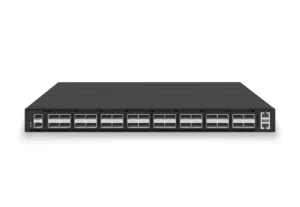


CX532P-N: The Lossless Champion for AI and High-Performance Computing
Built on the Marvell Teralynx 7 high-performance silicon platform, the CX532P-N is designed with one clear mission—ultimate performance for demanding compute environments.
Its most critical capability is its ultra-low end-to-end latency, reaching as low as 500 nanoseconds (ns) at the hardware forwarding level. On top of that, it provides native hardware support for RoCE v2 (RDMA over Converged Ethernet) and lossless Ethernet mechanisms.
In distributed AI training scenarios—such as large-scale model synchronization using All-Reduce—or in high-performance storage clusters like NVMe-oF, GPU and storage nodes exchange data at extremely high frequency and intensity.
For AI training fabrics, machine learning clusters, or large-scale high-performance cloud backends, the CX532P-N is the clear choice when a truly lossless and deterministic Ethernet fabric is required.
CX532P-N-V2: The Backbone of Efficient Data Centers with Precision Timing
The CX532P-N-V2 represents an evolution based on the Marvell Falcon architecture, shifting the focus from pure latency optimization to balanced performance, efficiency, and operational scalability.
Falcon-based design significantly improves power efficiency and thermal management, helping data centers reduce long-term operational PUE. Unlike the teralynx that prioritizes extreme low-latency AI workloads, the CX532P-N-V2 offers a more versatile feature set:
Massive routing scale: With up to 288K IPv4 / 144K IPv6 hardware routing entries, the Falcon silicon enables strong scalability for cloud data centers, multi-tenant virtualization environments, and standard Spine-Leaf deployments where it can serve as ToR or Leaf nodes.
High-precision timing (10 ns PTP accuracy): It fully supports IEEE 1588v2 Precision Time Protocol with nanosecond-level synchronization accuracy (up to ~10 ns). This makes it well-suited for applications such as broadcast-grade media distribution, low-latency streaming, 5G core transport, and financial distributed systems where strict time alignment is critical.
CX532P-M: A Practical Workhorse for Campus and Enterprise Networks
Compared to the previous two models, the CX532P-M-H plays a very different role. It is important to clearly position it as a campus and enterprise core switch, not a data center AI fabric device.
From a software perspective, CX532P-M does not support RoCE (RDMA) protocol stacks, meaning it is not intended for AI compute backend networks. However, this design choice is intentional—it avoids unnecessary complexity and cost associated with lossless data center networking.
Instead, it focuses on what enterprise and campus networks actually need: high-density 100G aggregation, high availability, and an Enterprise SONiC-based campus automation ecosystem.
At the hardware level, it still benefits from the Falcon silicon foundation, including 10 ns-class PTP time synchronization, making it suitable for campus-wide video systems, multimedia conferencing, and time-sensitive enterprise applications.
It also retains the same 288K IPv4 / 144K IPv6 routing scale, giving it the ability to evolve beyond traditional campus boundaries into large enterprise backbones, colocation environments, or even overlay-based L3 architectures.
By removing the premium cost of data center lossless networking features, CX532P-M focuses its value on high-capacity campus backbone switching—making it an efficient and practical choice for enterprise core aggregation.
| Attribute | CX532P-N | CX532P-N-V2 | CX532P-M-H |
| Chip Platform | Marvell Teralynx 7 | Marvell Falcon | Marvell Falcon |
| Positioning | AI / HPC Lossless Fabric | Cloud Data Center Backbone | Campus / Enterprise Core |
| Architecture Focus | Ultra-low latency, deterministic forwarding | Balanced performance, efficiency, scalability | Enterprise routing & aggregation focus |
| Latency | ≈500 ns | Higher (800ns – 1μs) | Higher (800ns – 1μs) |
| RoCE Support | Yes ( RoCE v2) | Yes (RoCE v2 supported) | No |
| PTP Accuracy | Not primary focus | Up to ~10 ns (IEEE 1588v2) | Up to ~10 ns (IEEE 1588v2) |
| Routing Table Capacity | High-performance DC scale (AI-oriented) | 288K IPv4 / 144K IPv6 | 288K IPv4 / 144K IPv6 |
| OS | Enterprise SONiC(Data Center Edition) | Enterprise SONiC(Data Center Edition) | Enterprise SONiC(for Campus Edition) |
| Key Use Cases | AI training, NVMe-oF, HPC clusters | Cloud DC, EVPN/VXLAN, multi-tenant networks | Campus core, enterprise backbone, aggregation |
Unified Software Experience Across Platforms –Powered by Asterfusion Enterprise SONiC
All three models are powered by Asterfusion Enterprise SONiC Distribution. However, the “-N” and “-V2” versions are based on the Enterprise SONiC for Data Center edition, while the “-M-H” version is based on the Campus edition. For detailed differences, please refer to the respective SONiC documentation pages.
For reference, I’ve also listed a couple of tables below:
Core Networking Capabilities
| Feature | Campus SONiC | AI / Data Center SONiC |
| VXLAN | Supported (basic overlay) | Deep support (large-scale EVPN-VXLAN fabric) |
| BGP-EVPN | Supported | Full-featured with large-scale control plane optimization |
| Anycast Gateway | Supported | Enhanced for distributed IRB architectures |
| Multi-homing | EVPN-MH supported | High-performance ECMP optimized for AI fabrics |
| VRF | Supported | Large-scale multi-tenant VRF design |
| DCI (Data Center Interconnect) | Basic support | Multi-site / AI cluster interconnect optimized |
RoCE / DCB / AI Network Capabilities (Key Differentiation Layer)
| Feature | Campus Network SONiC | AI / Data Center SONiC |
| RoCEv2 | ❌ Not supported / not a focus | ✅ Fully supported |
| PFC (Priority Flow Control) | ❌ | ✅ Required |
| ECN (Explicit Congestion Notification) | ❌ | ✅ Required |
| DCBX | ❌ | ✅ Supported |
| Adaptive Routing (ECMP optimization) | ❌ | ✅ Supported |
| Lossless Ethernet | ❌ | ✅ Core requirement for AI fabrics |
Telemetry & Observability
| Feature | Campus SONiC | AI / Data Center SONiC |
| SNMP | Standard support | Enhanced scale telemetry |
| sFlow | Supported | High-precision sampling + analytics |
| INT (In-band Telemetry) | ❌ / limited | ✅ Core capability |
| gRPC Streaming | Basic | Enhanced for AI fabric observability |
| Drop / Latency tracing | ❌ | ✅ Required for AI workloads |
The fundamental difference between the two SONiC distributions is not just about features—it is about network intent:
- Campus SONiC is designed to reliably connect users and enterprise services
- AI / Data Center SONiC is designed to move data at scale between compute, storage, and GPU clusters with deterministic performance
🧩 Final Thoughts
If you’re still torn at the end, just print the following three lines on your selection whiteboard:
Marvell Falcon (e.g., CX532P-N-V2): a balanced “all-rounder,” serving as a cost-effective foundation for standard public cloud environments, multi-tenant virtualization, and high-precision time synchronization networks.
Marvell Teralynx (e.g., CX532P-N): a performance-focused “beast,” purpose-built for AI/ML training workloads, ultra-low-latency HFT financial trading, and high-speed NVMe-oF storage.
Campus Enterprise (e.g., CX532P-M): a practical “backbone workhorse,” designed to leverage Falcon’s large routing tables and high bandwidth while specifically serving as the high-speed backbone for enterprise and campus networks.


