Table of Contents
Introduction
A data center network controller helps you deploy AIDC backend, frontend, storage, and DC convergence networks with zero-touch provisioning. It detects topology issues in advance. It enables one-click provisioning of advanced AIDC features such as RoCE and ARS.
It also provides end-to-end visibility, from the entire network down to individual modules. It supports one-click alarm handling and network inspection. These are essential for AIDC network operations. The answer is yes.
Next, we will examine why a data center network controller is required and what capabilities it provides.
The Pain Points in AIDC Network Monitoring
In an AIDC network, do you need to log in to each device and use the CLI to monitor traffic and maintain the network?
Without a centralized management platform, you typically rely on the following methods to obtain traffic and network state:
- Manual interface statistics collection: Operators run commands on switches to check per-interface or system-level metrics. These include byte rate (bytes per second), packet counters, drop counts, and error statistics.
- Fragmented AI workload metrics: For RoCE networks, key indicators such as ECN-marked packets, PFC frame Tx/Rx, and PFCWD (PFC deadlock detection) status must be collected and analyzed on each Spine and Leaf device individually.
- Manual buffer monitoring: Ingress and egress queue buffer utilization and peak values are checked per interface. This is required to identify congestion hotspots during AI training workloads.
- Local logs and alarms: Events such as alarms, IP/MAC moves, and BGP session status are stored on individual devices. They may be exported via Syslog, but lack aggregated views. There is no global health score or site-level visibility as provided by a controller.
- Service-level visibility: When application behavior deviates from expectations, operators must log in to devices and retrieve service state information one by one.
- No automated topology correlation: Without controller-based discovery, operators rely on manual wiring records to reconstruct traffic paths. There is no real-time topology view.
Overall, this approach is fragmented and labor-intensive. It does not scale for AI data centers, which require high bandwidth, large scale, and strict lossless transport monitoring.
Why Do You Need a Data Center Network Controller ?
In AIDC networks, a dedicated management platform is required to handle extreme complexity, scale, and strict performance requirements. Even under massive traffic loads, the controller maintains efficient monitoring. It collects statistics processed by the uCentral client, instead of inspecting raw service traffic.
This platform is the Data Center Network Controller. It is designed with reference to the OpenWiFi architecture. Devices communicate with the OpenWiFi gateway using the uCentral protocol, especially for containerized components and control messaging. It provides the following capabilities:
- Simplified large-scale fabric provisioning: AI workloads demand massive scale. Manual configuration is not practical. The controller includes predefined profiles for backend, frontend, and storage networks, as well as traditional data center scenarios. It supports automated topology planning and one-click configuration deployment.
- Support for key AI networking features: AI clusters rely on RoCE, intelligent routing policies, and ARS (Adaptive Routing and Switching). These ensure high bandwidth and low latency. The controller provides a clear interface and simplifies deployment of these features.
- High reliability assurance: The controller evaluates CPU and memory utilization, traffic load, and hardware status such as ASIC, fan, and PSU temperature. It calculates a health score per device and triggers alerts before resource exhaustion or hardware failure.
- Automated operations: It supports one-click or scheduled inspections. It detects issues such as abnormal optical power or packet loss. It generates reports for further analysis.
How Does A Controller Monitor Large-scale AIDC Traffic?
AIDC traffic often runs at 400G or higher. The controller does not participate in the data plane, so it does not become a bottleneck. The model is clear: traffic stays on switches, statistics go to the controller.
Implementation details:
Real-time data collection
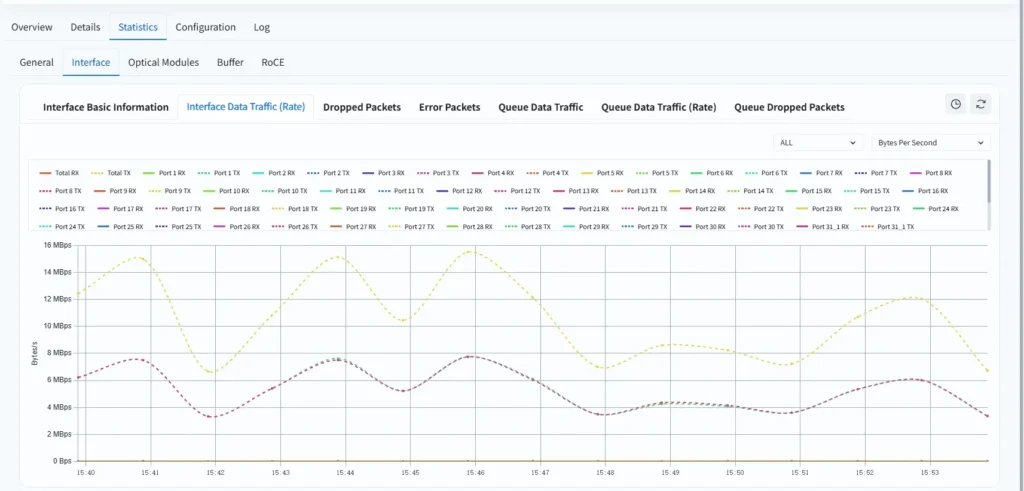
The controller connects to switches over the management network. The uCentral client on each device collects interface statistics in real time. Metrics include rx_Bps/tx_Bps, packet drops, and error counters.
Hierarchical visualization
- Venue level
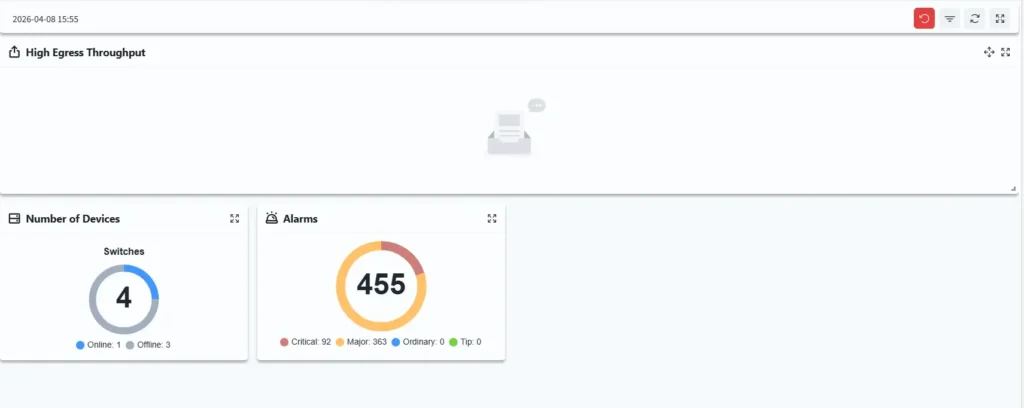
Displays historical throughput on Spine uplinks. Shows TOP5 utilization on Spine–Leaf links. This helps identify network-wide bottlenecks.
- Device level
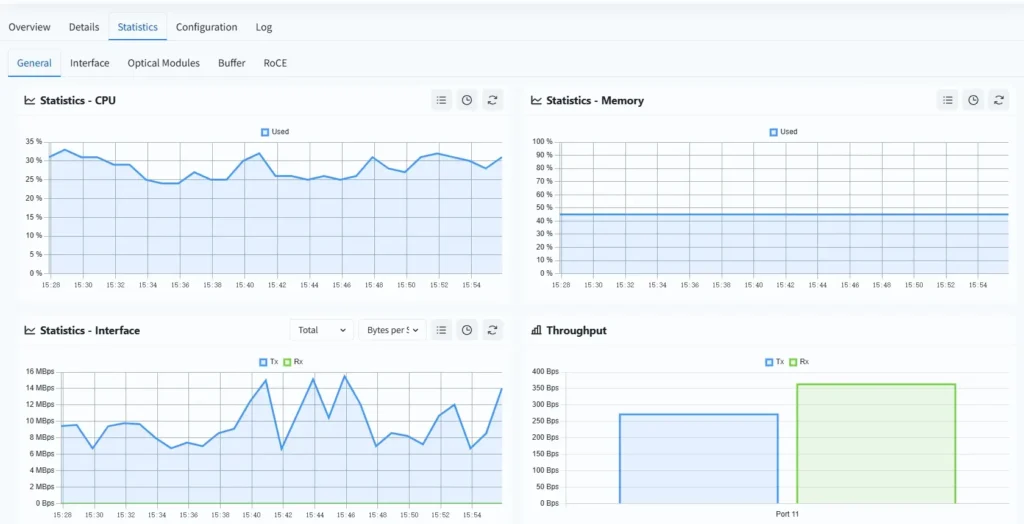
Provides per-switch CPU and memory trends. Shows real-time forwarding rates on each physical interface.
Deep visibility for AI traffic
- RoCE metrics
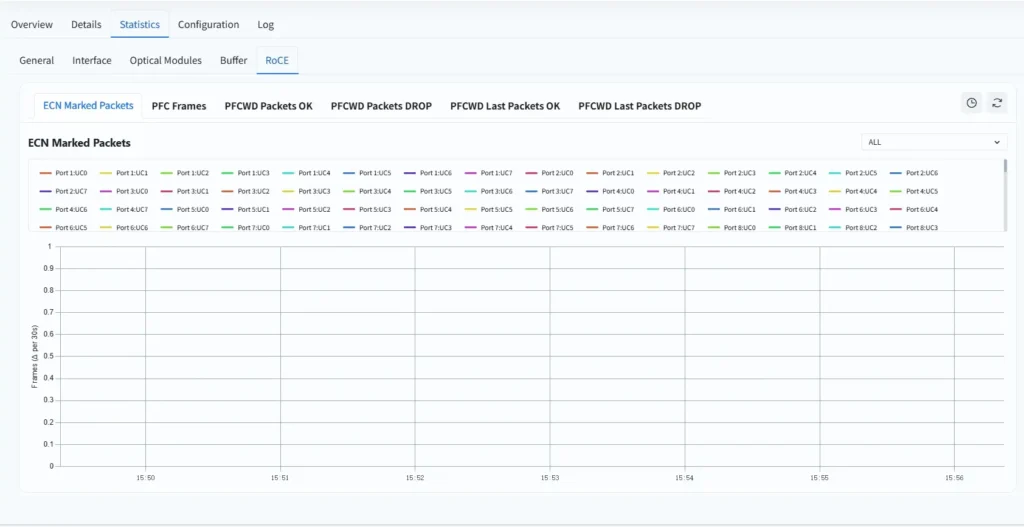
Tracks ECN-marked packets every 30 seconds. Monitors PFC Tx/Rx and PFC deadlock detection.
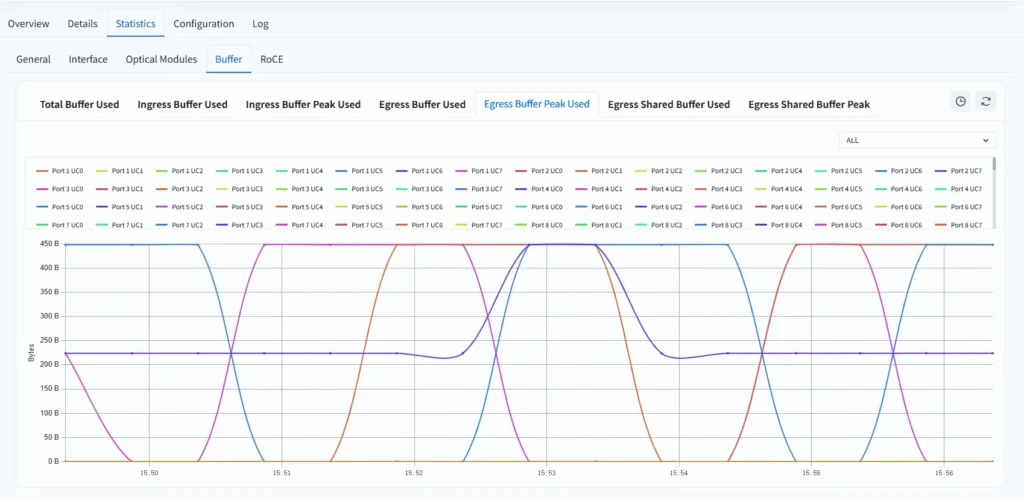
- Queue buffer monitoring:
Tracks ingress and egress buffer utilization and peak values. This is critical for identifying microbursts caused by elephant flows during AI training.
Service-level visibility
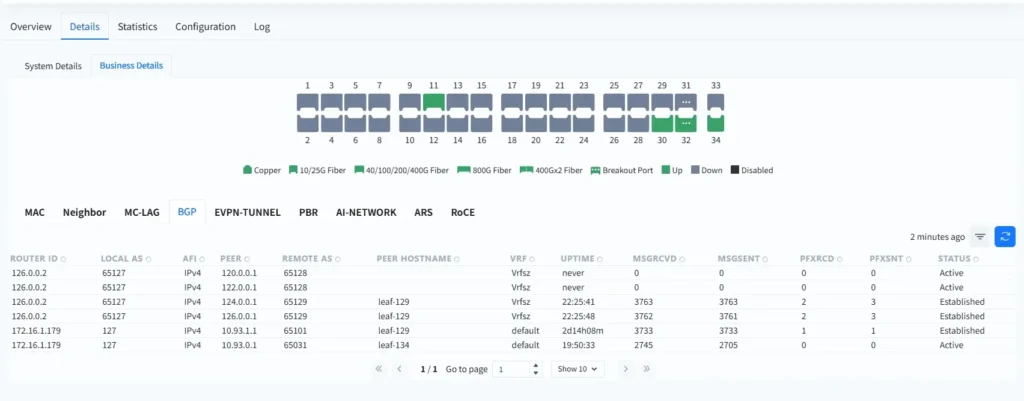
The data center network controller periodically retrieves detailed service state from devices. It helps operators quickly isolate faults.
uCentral communication architecture
Devices communicate with the controller through the uCentral client. This model supports scalable telemetry collection. The controller can receive heartbeats and statistics from hundreds or thousands of devices. It enables centralized visibility across the entire AI compute network.
Data Center Network Controller Feature Set
The Asteria AIDC Controller provides end-to-end capabilities across scenario-based deployment, configuration, visualization, and operations.
Typical AI workload deployment scenarios
The controller includes three predefined deployment models for AI data centers. It simplifies topology design and baseline configuration. It also supports traditional data center deployments:
- AIDC backend network: Built on a full Layer 3 Spine–Leaf fabric. It supports large-scale node access. It integrates RoCE, intelligent routing (AI-Network), and ARS (Adaptive Routing and Switching). These features ensure high bandwidth and low latency.
- AIDC frontend network: Uses EVPN MC-LAG for reliable service delivery and logical isolation.
- AIDC storage network: Combines distributed gateway, MC-LAG, and RoCE. It ensures high throughput and reliability for storage traffic.
- DC convergence network: Designed for traditional data center scenarios. It supports EVPN MC-LAG or EVPN multi-homing (MH) for service deployment.
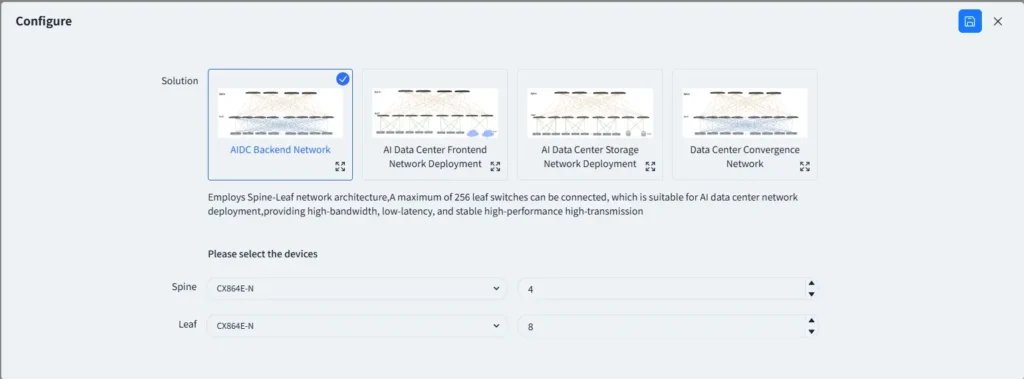
Its deployment logic follows a “template-driven auto-generation + interactive editing” model:
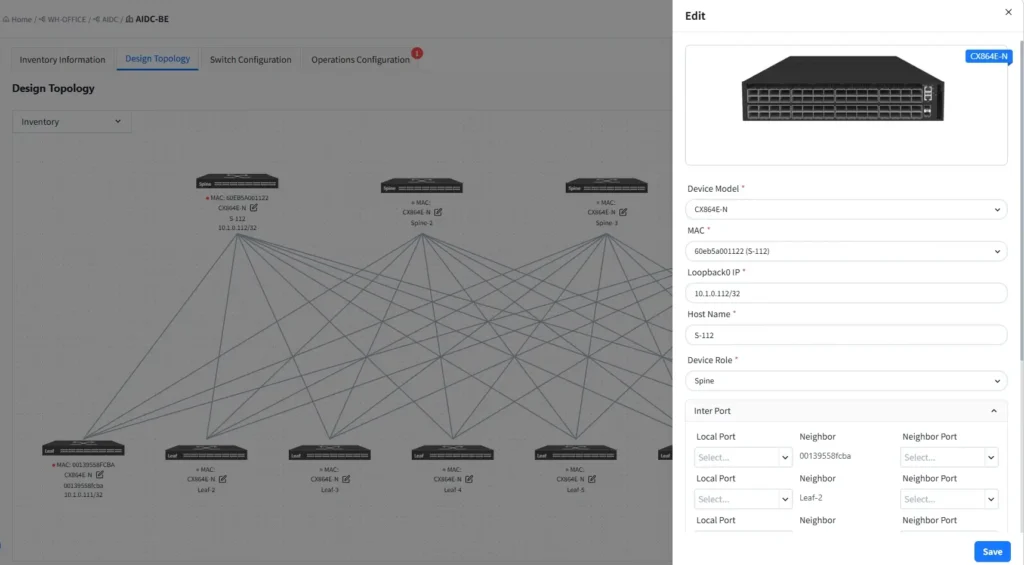
- Automated planning: Administrators only need to select a built-in scenario (backend, frontend, storage, or DC convergence network) and specify the model and quantity of Spine and Leaf switches. The controller then automatically generates a recommended network topology.
The backend network scenario is used as an example in the figure below:
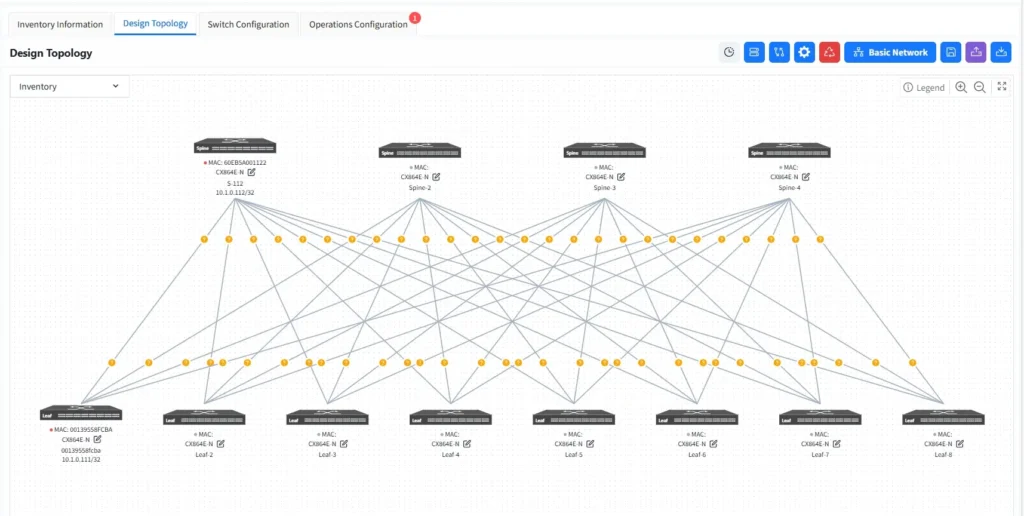
- Interactive editing: On the generated topology canvas, users can click device icons to enter edit mode. In the side panel, they can select specific devices from the inventory and bind them using their MAC addresses.
- Local drag-and-drop: On the status visualization dashboard, users can rearrange the layout by dragging and dropping cards (widgets) according to their preferences.
One-click deployment of core AI network configurations
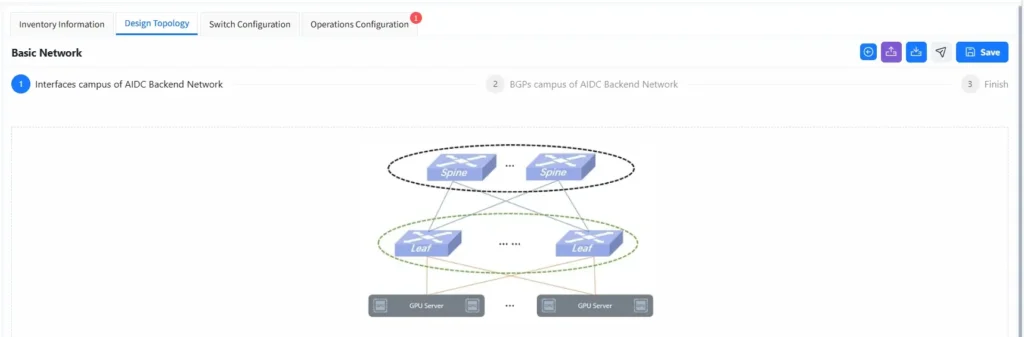
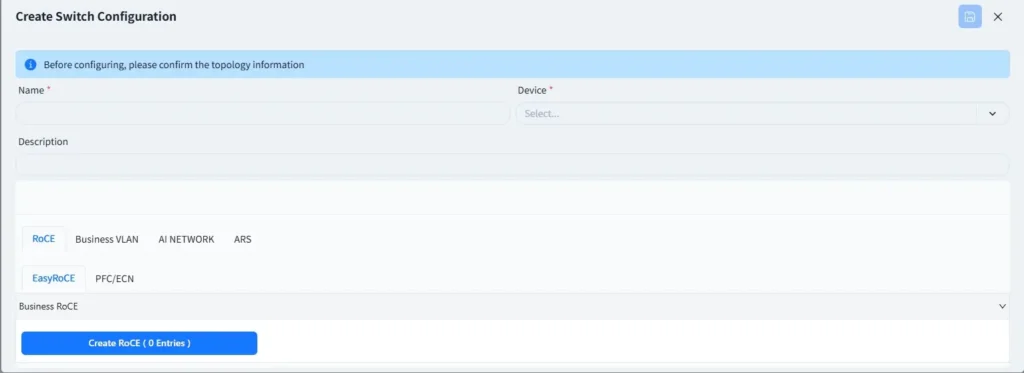
The controller supports one-click deployment of both underlay network and wired service configurations, significantly improving delivery efficiency.
It automates BGP routing protocol configuration and enables key technologies required for high-bandwidth and low-latency AI compute clusters, including RoCE lossless networking policies, ARS (Adaptive Routing and Switching), and intelligent routing policy capabilities.
Multi-dimensional network state visualization
The controller provides end-to-end visibility, from macro-level overview to device-level details.
- Organization Dashboard: Enables multi-tenant management within a single physical network. It provides a global view of all venues, including device and endpoint summaries. This helps operators assess overall network health at a macro level.
- Venue Dashboard: Uses intelligent algorithms to compute device health scores and present real-time network status. It shows device availability within a specific site (such as a data center or network domain), alarm statistics, historical egress throughput, and TOP5 interconnect link utilization.
- Device Status Visualization: Provides in-depth real-time visibility into a single switch, including:
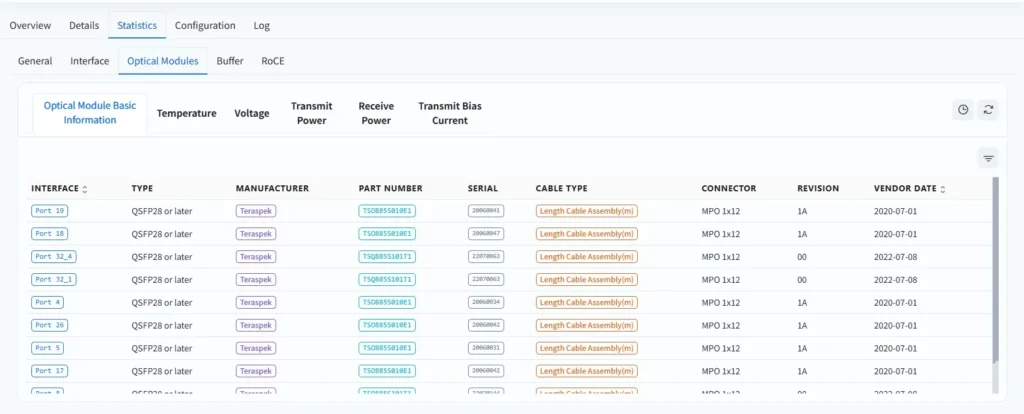
- Hardware details: optical module Tx/Rx power, fan speed, power supply status, and chip temperature.
- Traffic statistics: CPU/memory utilization history, interface packet loss rate, buffer occupancy, and RoCE-related metrics.
- Service-level information: VLAN, ARP, MC-LAG, BGP, EVPN tunnel, PBR, AI-Network, ARS, RoCE, and other protocol states.
- Optical modules: Displays detailed real-time status of transceivers, including insertion status, Tx/Rx power levels, and temperature.
Device operations
The controller provides device-level operational capabilities for network maintenance. It supports remote device access via rtty, delivering an experience equivalent to SSH-based switch login.
It also supports common operational tasks, including device reboot, factory reset, packet capture, and script execution.
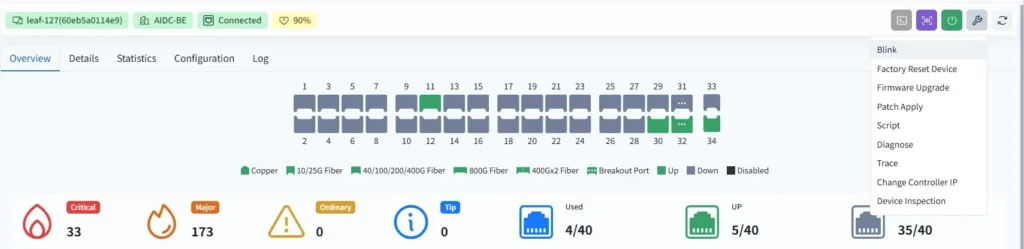
One-click network device image upgrade
The system provides comprehensive firmware and patch management capabilities. Administrators can upload local image versions and patch files to the controller. Through one-click upgrade operations, new software versions or fixes can be deployed to managed devices efficiently, ensuring that all network elements remain up to date in terms of performance and security.
These documents provide a complete operational guide for network planners, field engineers, and network administrators. If you need deeper details on any specific feature (such as RoCE lossless policy configuration or configuration migration procedures), feel free to ask.
Intelligent inspection and alarm system
The controller implements a robust operational assurance framework:
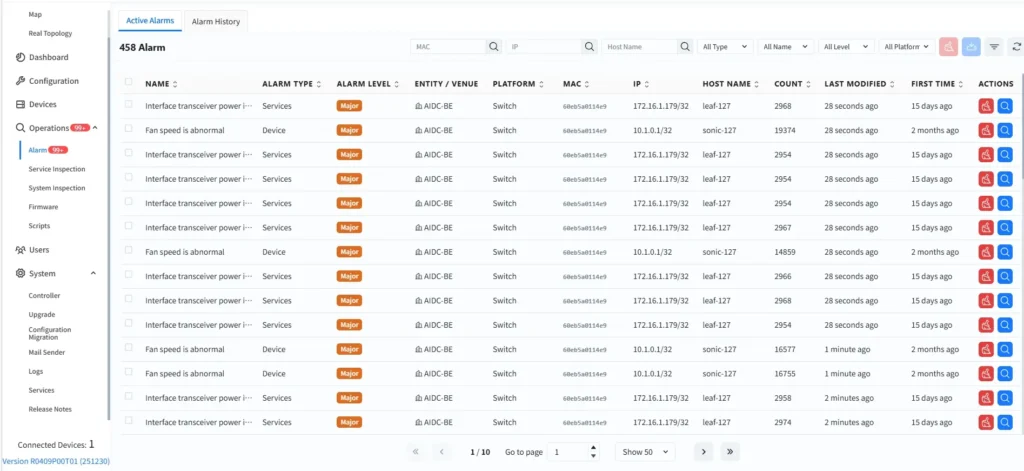
- Multi-dimensional alarms: Supports configurable thresholds for device hardware (temperature, fan, power supply), changes in wireless terminal types, and server connectivity status. When anomalies are detected, notifications can be sent through multiple channels, including email (Mail Sender), ensuring timely response from operations teams.
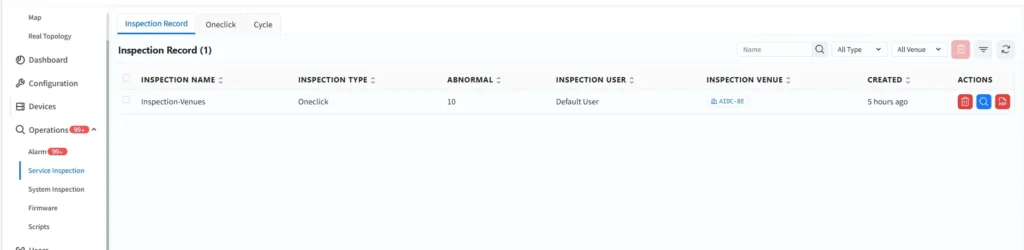
- Automated inspections: Provides both one-click and scheduled periodic inspections. The system automatically checks CPU usage, memory utilization, critical process status, and system logs. It generates detailed inspection reports, enabling early detection and prevention of potential failures.
Conclusion
In summary, the Data Center Network Controller provides a unified and scalable approach to managing complex AIDC networks. It enables template-based topology planning, one-click deployment of critical AI networking features such as BGP, RoCE, ARS, and intelligent routing, and delivers full-stack visibility from organization to device level. With integrated image upgrade, automated inspection, and multi-dimensional alarm mechanisms, it significantly reduces operational complexity and improves network reliability.
By shifting from fragmented CLI-based operations to centralized, model-driven management, it ensures consistent configuration, faster troubleshooting, and better scalability. This makes it a key enabler for building and operating modern high-performance AI data center infrastructures.
Fill out the form for free trial !
Contact US !
- To request a proposal, send an E-Mail to bd@cloudswit.ch
- To receive timely and relevant information from Asterfusion, sign up at AsterNOS Community Portal
- To submit a case, visit Support Portal
- To find user manuals for a specific command or scenario, access AsterNOS Documentation
- To find a product or product family, visit Asterfusion-cloudswit.ch


