Table of Contents
Introduction
We previously introduced our new product, CX306P-48Y-M-H, and performed a hardware teardown. Thanks to its optional time synchronization modules — GNSS and PTP — the product is well-suited for time-sensitive applications such as media and entertainment, data centers, campus networks, and 5G O-RAN fronthaul scenarios.
This article focuses on the GNSS switch and time synchronization aspects, explaining how the product operates in time-critical environments.
Collaboration Between GNSS and PTP Modules
GNSS (Global Navigation Satellite System) is a system that provides global positioning, navigation, and timing services using satellite signals. The well-known GPS is just one type of GNSS.

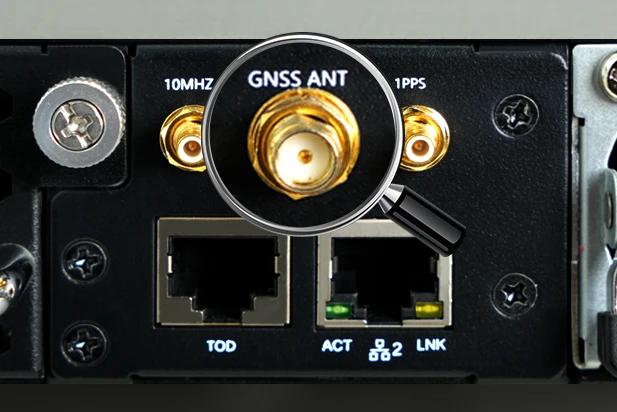
On the CX306P-48Y-M-H platform, a GNSS antenna SMA interface is available on the rear panel for connecting an external GNSS antenna. It supports concurrent reception of GPS/QZSS, GLONASS, BeiDou, and Galileo signals.
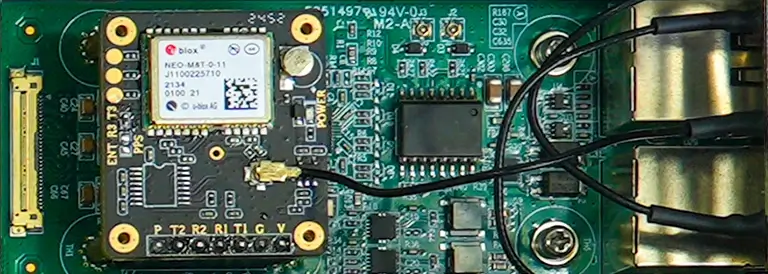
Inside the platform, the GNSS module uses a pluggable design, allowing for easy replacement and future upgrades as shown in the figure below. The pluggable GNSS module enhances the flexibility of the CX306P-48Y-M-H as a GNSS switch, allowing upgrades without impacting ongoing network synchronization.
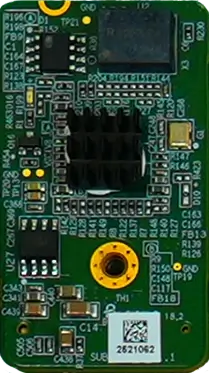
The following figure shows the platform’s internal PTP (Precision Time Protocol, IEEE 1588v2) module, which is used to distribute precise time across the network.
In operational mode, the antenna receives satellite signals and routes them through internal circuitry to the GNSS module, obtaining high-precision time synchronized with the satellites as the system reference clock.
Based on the reference time provided by the GNSS module, PTP processes the time signals and delivers them to the ASIC, distributing them across the network to achieve approximately 20 ns-level time precision.

Currently, our time synchronization solution has been successfully deployed in the media industry and can also meet latency-sensitive use cases such as 5G O-RAN fronthaul and financial timestamping.
Time Interfaces and PTP for Time-Sensitive Applications
As mentioned earlier, the GNSS module is optional. This allows the CX306P-48Y-M-H to function not only as a GNSS switch but also as a flexible time synchronization platform, leveraging multiple rear-panel interfaces—10 MHz, 1 PPS, and TOD—to support a variety of deployment scenarios.
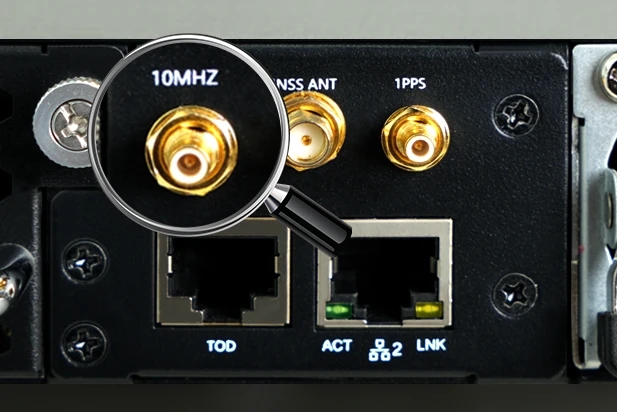
- 10 MHz: Serves as a frequency reference signal. It indicates the rate at which the internal clock “ticks” but does not carry absolute time information (i.e., it does not provide the current time.). This interface is used for SyncE (Synchronous Ethernet) to achieve frequency synchronization.
- Connection method: The SMB interface connects to an external clock source via coaxial cable.
- 1 PPS: Provides a high-precision pulse-per-second signal for phase alignment. It marks the start of each second.
- Connection method: The SMB interface connects to an external clock source via coaxial cable.

- TOD(Time of Day): Provides complete time information, i.e., absolute time including year, month, day, hour, minute, and second. Used together with the 1 PPS signal, it enables high-precision absolute time synchronization.
- Connection method: The RJ45 interface connects to an external clock source via twisted-pair cable.
Simply put, 1 PPS tells the system “a new second has started,” while TOD indicates “this second corresponds to xx year xx month xx day xx hour xx minute xx second.”

The external time signals obtained through the above interfaces are transmitted via internal wiring to the PTP module. The module synchronizes the system clock in frequency, 1 PPS, and time information based on parameters such as 10 MHz, 1 PPS, and TOD. The processed time signals are supplied to the ASIC and distributed across the network, achieving approximately 20 ns-level precision.
Note: The interface next to TOD serves as a management port and is redundant with the front-panel interface to ensure high reliability.
To provide a clearer overview of the interface combinations and their applicable use cases, the following table summarizes them:
| Mode | Time Source | Connection Interface | Synchronization Type | Use Case |
| GNSS + PTP | Satellite clock (GPS/Galileo/BeiDou/GLONASS) | GNSS Antenna | High-precision absolute time synchronization | Commonly used in 5G O-RAN fronthaul and base station synchronization; also applied in latency-sensitive scenarios such as live broadcast and media & entertainment |
| 10 MHz + 1 PPS + ToD + PTP | External clock source | 10 MHz SMB 1 PPS SMB ToD RJ45 | High-precision absolute time synchronization | Suitable for streaming/OTT, media data centers, enterprise networks, and other synchronization scenarios |
| 1 PPS + ToD + PTP | External clock source | 1 PPS SMB ToD RJ45 | High-precision absolute time synchronization | Suitable for data centers, enterprise networks, and media/live broadcast environments |
| 10 MHz only | External clock source | 10 MHz SMB | Frequency synchronization (SyncE) | For scenarios where absolute time is not critical |
From the table, the following can be observed:
- GNSS + PTP mode: Provides high-precision (~20 ns) time synchronization, suitable for latency-sensitive applications such as 5G O-RAN, video broadcasting, and media environments.
- Non-GNSS module mode: Interface combinations can be flexibly selected based on requirements:
- 10 MHz + 1 PPS + TOD: Used with PTP to achieve high-precision network-wide synchronization, covering large-scale data centers, enterprise networks, or media environments.
- 1 PPS + TOD: Provides local clock frequency reference; applicable to the same scenarios as above.
- 10 MHz only: Focused on frequency synchronization; suitable for networks that do not require absolute time, supporting SyncE.
- Flexible interface selection: Deployment and budget considerations can guide interface choice to optimize high-precision time synchronization and network reliability.
Even without these external interfaces, the CX306P-48Y-M-H can still distribute time via PTP (IEEE 1588v2) and operate flexibly as either a Boundary Clock (BC) or Transparent Clock (TC).
Conclusion
The CX306P-48Y-M-H is a high-performance GNSS switch designed for time-sensitive applications. With optional GNSS and PTP modules, it achieves ~20 ns precision, supporting stable operation in latency-sensitive scenarios such as 5G O-RAN fronthaul, live broadcasting, data centers, and enterprise campuses.
It supports GPS/QZSS, GLONASS, BeiDou, and Galileo signals. As a versatile GNSS switch, the CX306P-48Y-M-H ensures long-term reliability and precision across various deployment scenarios. The flexible combination of 10 MHz, 1 PPS, and TOD interfaces, together with a modular design, ensures that the CX306P-48Y-M-H meets current network requirements while allowing room for future upgrades and expansion.
For network deployments requiring high-precision and highly reliable time synchronization, the CX306P-48Y-M-H is a compelling option. Its modular design and optional modules position the CX306P-48Y-M-H as a future-ready GNSS switch for precision time networks.

Contact US !
- Join the discussion or leave your message in the Enterprise & Campus Column.
- To receive timely and relevant information from Asterfusion, sign up at AsterNOS Community Portal
- To submit a case, visit Support Portal.
- To find user manuals for a specific command or scenario, access AsterNOS Documentation
- To find a product or product family, visit Asterfusion-cloudswit.ch .
- To contact Sales, Send E-Mail to bd@cloudswit.ch


