Table of Contents
Introduction
In recent years, white-box switches and open networking have become increasingly common in data centers and enterprise networks. What used to be niche technology adopted mainly by hyperscalers is now the preferred choice for organizations seeking agility, lower cost, and freedom from vendor lock-in.
Among the many open network operating systems, SONiC (Software for Open Networking in the Cloud) has emerged as a de-facto industry standard. Its container-based, microservices architecture makes network functions as flexible as cloud-native applications.
However, many enterprise users face a practical question when looking at the community edition of SONiC on GitHub: if the software is free, why do I need a paid Enterprise SONiC Distribution? And with so many distributions available, how do I choose the right one?
This article reviews the current Enterprise SONiC distribution ecosystem and compares the major vendors to help you make an informed decision.
Why not Community SONiC Edition ?
The SONiC Community Edition is designed for cloud providers, internet companies, and teams with strong in-house engineering capability. It is powerful, but it creates clear technical barriers for most enterprises:
- Loose scenario integration: The community version offers basic L2/L3 functions, SNMP, and multiple hardware abstraction interfaces. These features cover common networking needs, but users must assemble and integrate the functions themselves.
- Complex software–hardware adaptation: Users need to debug drivers, ASIC behavior, and optical module compatibility on their own. Troubleshooting becomes difficult once issues appear.
- No operational support: There is no 24×7 technical support. Upgrades, security patches, and production troubleshooting are all handled by the user.
This gap led to the rise of Enterprise SONiC Distributions. These commercial versions build on the community edition with enhanced features, full validation, long-term maintenance, and improved automation and security. They also provide 24×7 support, giving enterprises the openness and flexibility of SONiC without sacrificing reliability or operational readiness.
Two Categories of Enterprise SONiC Distribution
Today’s Enterprise SONiC distributions generally fall into two categories: Turnkey Solutions and Software-Only Distributions.
Turnkey Solution (Hardware + SONiC)
These vendors deliver a complete package that includes the switch hardware pre-loaded with SONiC. The main advantage is true plug-and-play deployment with tightly aligned software and hardware.
When issues occur, the vendor provides unified support across the entire stack. This model fits enterprises that want fast rollout and do not want to spend time resolving compatibility problems.
We first delve into 6 vendors that offer mature and reliable SONiC-based turnkey solutions for network infrastructure deployment.
Asterfusion

1. Product Positioning
Asterfusion Enterprise SONiC Distribution is a turnkey, production-ready open networking solution covering cloud data centers (Cloud DC), enterprise campuses (Campus), and edge routing/gateway scenarios (Edge Routing/Gateway). It provides integrated hardware and software delivery.
Asterfusion is both a white-box switch vendor and a maintainer of its Enterprise SONiC distribution. Its product line includes white-box switches running the self-developed AsterNOS, supporting major chips such as Broadcom, Marvell and Intel, along with end-to-end commercial technical support. This approach addresses the challenges of the community SONiC edition, including complex assembly, difficult debugging, and lack of vendor-backed support.
👉Free trial for Routing Edition: AsterNOS-VPP, leave a comment on AsterNOS Community Portal if you need assistance.
2. Pros & Cons
Pros
- Enterprise-grade support: Vendor-backed support from pre-sales to post-sales. No need to troubleshoot hardware/software yourself. Quarterly releases with predictable production rhythm.
- Full scenario coverage:
- AI & Data Center: EVPN-VXLAN, RoCEv2 (low-latency, lossless), large routing tables.
- Campus: Adds PoE, QoS, MACsec, and OpenWiFi controller integration.
- Routing: Edge routing features (NAT, VPN, multi-protocol), with IPsec/WireGuard support.
- Network Packet Broker 2.0 Ready featuring containerized services built into the NOS
- Multi‑ASIC: Full support for Marvell Falcon and Teralynx, Broadcom Trident and Tomahawk series chips.
- Disaggregated NOS and hardware: AsterNOS‑BRCM for Broadcom switch platforms, AsterNOS‑VPP for routing, and AsterNOS DC Edition for data centers—each available standalone or pre‑integrated on validated systems.
- Cost-effective & flexible: Lower cost than closed vendors (Cisco/Huawei). Supports ZTP, Ansible, Python automation, no vendor lock-in.
- Automation & ops-friendly: Cisco-style Klish and Linux-style Bash for easy migration; one-click provisioning via OpenWiFi controller; REST API and gNMI for unified management and automation.
Cons
- High technical barrier: Still Linux-based; teams lacking automation, Linux, or DevOps skills face a steep learning curve.
- Limited hardware choices: Requires certified platforms for stability; cannot run on arbitrary old devices.
- Overkill for small networks: Designed for medium-to-large or complex networks; too complex for a few switches or simple L2 setups.
- Traditional trust barrier: Some regulated organizations may require additional validation and compliance work before adopting white-box + SONiC solutions
- CPU/DPU limitations: VPP software forwarding depends on CPU/DPU; high-volume complex NAT traffic may saturate processing.
3. Use Cases
Based on its features, Asterfusion enterprise SONiC distribution is best suited for the following four scenarios:
- Medium to Large Data Centers and AI/HPC Clusters:
- Require Spine-Leaf architecture and EVPN-VXLAN virtualized networks.
- Run workloads such as AI training and distributed storage that demand RoCEv2 for low-latency and high-throughput performance.
- Large Enterprise Campuses and University Networks:
- Scale of several hundred switches requiring unified management of access, aggregation, and core layers.
- Require wired and wireless integration (with OpenWiFi), PoE power delivery, and secure access control.
- Edge Computing and Gateway Deployments:
- Require flexible routing policies, NAT, VPN, or DCI (Data Center Interconnect) functionality.
- Enable multi-branch interconnection in hybrid cloud environments.
- Organizations Pursuing Vendor-Neutrality and Automation:
- Internet companies and tech organizations aiming to avoid high licensing costs and hardware lock-in from traditional vendors.
- Teams practicing DevOps that seek to manage their network infrastructure as code (Infrastructure as Code, IaC).
Dell Technologies
1. Product Positioning
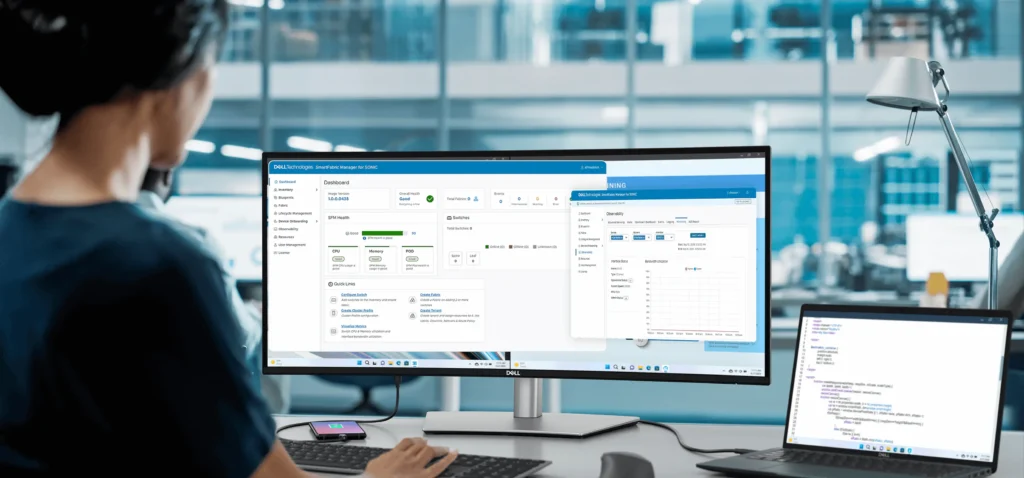
Dell defines its Enterprise SONiC distribution as an enterprise-grade open network operating system. It builds on the open-source SONiC with enterprise-level enhancements and deep optimizations, while providing global technical support.
Designed for data centers, cloud, and AI environments, it balances high performance with stability. It also supports the PowerSwitch open platform (Dell’s product lines), enabling software–hardware disaggregation to reduce vendor lock-in, and leverages Dell’s complete hardware and software ecosystem to ensure a reliable production environment.
2. Pros & Cons
Pros
- Enterprise-grade stability & global support:
- Thoroughly tested and validated by Dell, release cycles predictable, more stable than community SONiC.
- 24/7 global support and full lifecycle maintenance, addressing the “no one to help” issue of open source.
- Comprehensive & enhanced features:
- Fills gaps in L2/L3, VXLAN EVPN, QoS, ACLs.
- Improved security (RADIUS/TACACS+) and usability, truly enterprise-ready.
- Strong automation & orchestration:
- Native container support, REST API, gNMI, OpenConfig.
- Integrates with DevOps workflows, compatible with Ansible, Terraform, Kubernetes, suitable for large-scale automation.
- Open architecture & disaggregation: Based on standard SAI interface, separates software and hardware, avoids vendor lock-in.
Cons
- High technical barrier:
- Linux + container architecture with DevOps-style configuration; steep learning curve for engineers used to traditional CLI (e.g., Cisco IOS).
- Limited hardware compatibility:
- Mainly supports Dell PowerSwitch series and few verified white-boxes; cannot freely run on arbitrary hardware like community SONiC.
- Not ideal for small/simple networks:
- Overkill for small setups needing only VLANs or a few switches; maintenance cost may outweigh benefits.
- Dell Enterprise SONiC runs only on Dell-validated hardware, and any image or hardware changes fall outside Dell’s support scope.
3. Use Cases
Dell Enterprise SONiC distribution is best suited for the following high-demand network environments:
- Large-scale data center Spine-Leaf fabrics: BGP EVPN, ECMP multipath forwarding, and ZTP-based automated deployment are needed.
- AI training clusters and HPC networks: 400G/800G high-bandwidth fabrics, low latency, and large-scale horizontal expansion.
- Organizations aiming to reduce vendor lock-in: Minimizing reliance on traditional closed-source vendors (such as Cisco or Huawei) and gaining architectural autonomy.
- Highly automated DevOps environments
Edgecore
1. Product Positioning
Edgecore positions its distribution as a hardened version of community SONiC. It enhances L2, L3, and advanced L2+/L3+ capabilities and completes hardware compatibility validation, making it suitable for enterprise production environments. Its value proposition includes enterprise-grade readiness, full-stack interoperability validation—covering switch hardware, the NOS, and optics/cables—and support for open networking platforms from 1G to 800G, enabling broad deployment across different scenarios.
2. Pros & Cons
Pros
- Extreme openness & flexibility:
- Retains the white-box network philosophy, minimizes vendor lock-in, keeps high freedom of community SONiC.
- Verified hardware ecosystem:
- Resolves DIY hardware compatibility issues, validated switches, optical modules, and cables to ensure physical layer stability.
- Suitable for technical teams:
- Ideal for teams with network development skills, wanting control over the NOS kernel while avoiding low-level hardware adaptation issues.
Cons
- Limited feature depth & stability:
- Core still close to community SONiC, lacks deep enhancements (e.g., advanced routing, AI optimizations) and closed-source features.
- May be less stable in complex multi-tenant or high-performance scenarios compared to commercial releases.
- Weak operational support:
- Lacks long-term LTS, strict SLA, and extensive operation toolchains. Documentation and advanced support are basic, weaker than Dell or specialized vendors.
- High user skill requirements:
- Essentially “community code + working SAI drivers”; enterprises need extra operational resources and expertise to fill gaps in tooling and documentation.
3. Use Cases
Edgecore SONiC distribution is best suited for the following types of network environments:
- Tech companies and internet service providers with strong in-house capabilities: • Suitable for teams with dedicated network engineering or operations staff who want to customize or control the NOS stack.
- Campus networks and small data centers: • Designed for standard network architectures that rely on core L2/L3 features such as VLAN, LACP, and MLAG, without requiring advanced data center features.
- Laboratories and testbed environments: • Ideal for building low-cost, open, and standardized switching environments for validation and experimentation.
- Budget-sensitive projects pursuing white-box adoption: • Targeted at deployments that prioritize hardware openness and cost efficiency, and are willing to invest more engineering effort in exchange for lower procurement cost.
QCT
1. Product Positioning
Quanta Cloud Technology (QCT) Enterprise SONiC Distribution is an enterprise-grade, hardened, and validated open network operating system designed for modern data centers and cloud environments. It follows a disaggregated model that separates hardware from software, enabling vendor-neutral deployment and preventing hardware lock-in. The distribution is extensively tested on QCT’s QuantaMesh platforms to ensure production-level stability across 1G to 100G, and it is optimized for Leaf-Spine architectures used in high-density, high-bandwidth, and multi-tenant cloud data centers.
2. Pros & Cons
Pros
- Designed for large-scale cloud:
- Full Leaf-Spine support, high-density ports (e.g., 32×100G), Tbps throughput, low latency.
- Covers VXLAN, BGP-EVPN, ECMP, MLAG—suitable for virtualized, multi-tenant, and overlay networks.
- Hardware neutrality & flexibility:
- Supports multiple ASICs architecture, such as x86/ARM/etc
- Enterprise validation & support:
- Hardened version with compatibility and maintenance guarantees on QCT QuantaMesh hardware.
- High automation & programmability:
- Built on SONiC’s standard automation toolkit (CLI, scripting, and APIs).
Cons
- High operational skill required:
- Close to community SONiC, minimal enhancements; teams lacking Linux, DevOps, or automation skills may struggle.
- Hardware compatibility caution:
- Best stability requires QCT-verified hardware; unverified white-boxes may cause driver or performance issues.
- Not suitable for small/traditional networks:
- Overkill for small offices or simple setups; configuration and maintenance are complex.
- Limited edge support:
- Focused on core data centers; may not fully support non-standard edge hardware or protocols.
3. Use Cases
QCT Enterprise SONiC distribution is best suited for the following environments:
- Hyperscalers and public/private cloud providers: Teams building massive-scale Leaf-Spine fabrics with strict requirements for high density, multi-tenancy, and network virtualization.
- AI/HPC clusters and big-data platforms: Workloads that depend on high throughput and low latency to support high-performance computing and distributed storage.
- Large organizations seeking cost efficiency and vendor independence: Environments that adopt white-box hardware with an open network OS to reduce TCO, and have the technical capability to operate a fully disaggregated network stack.
Ufispace
1. Product Positioning
UfiSpace positions itself as a leader in open and disaggregated network infrastructure, with SONiC as a core part of its strategy. Its strong telecom background enables deployments not only in data centers but also in carrier environments such as 5G transport and core networks. UfiSpace provides vendor-neutral white-box platforms that support SONiC and other NOS options, enabling full-stack disaggregation and flexible hardware selection. The portfolio focuses on 400G and 800G high-density switching to meet the performance and requirements of AI, cloud, and 5G workloads.
2. Pros & Cons
Pros
- Carrier-grade hardware & full coverage:
- Hardware meets strict telecom standards (e.g., clock sync, temperature tolerance).
- Suitable for data centers, backbone, and backhaul networks; product line from 1G to 400G/800G.
- Decoupled design & flexible ecosystem:
- OCP(Open Compute Project) accepted, supports Broadcom and other ASICs.
- Can run SONiC or other NOS, avoiding vendor lock-in.
- High-performance architecture for the future:
- Strong for AI/HPC and large-scale cloud; supports high-density 400G ports and low-latency forwarding.
- Extensive partner ecosystem:
- Interoperable with optical modules, cables, and NOS vendors, reducing white-box compatibility risks.
Cons
- Features aligned with community SONiC:
- Largely tracks upstream SONiC feature set, with limited differentiation or enterprise‑grade enhancements.
- Insufficient documentation support:
- Sparse or inconsistent technical documents, deployment guides, and troubleshooting references increase adoption and O&M cost.
- Not plug-and-play:
- White-box model may have less intuitive fault isolation, warranty, and service response than traditional vendors.
- Not suitable for small/low-end deployments:
- Overkill for small offices or simple setups; higher cost and configuration complexity than traditional switches.
3. Use Cases
UfiSpace + SONiC is best suited for several high-end and technically demanding environments:
- Telecom operators and 5G networks
- Building open and disaggregated transport for 5G backhaul, aggregation, and core networks.
- Requiring open hardware that supports carrier-grade features such as SyncE and IEEE 1588v2.
- Hyperscale data centers
- Deploying high-density, high-bandwidth Spine-Leaf fabrics (400G and above).
- Supporting multi-tenant environments, virtualization, and large volumes of east-west traffic.
- AI/HPC and GPU compute clusters
- Needing ultra-low-latency and high-throughput networks to unlock the performance of large-scale AI workloads.
- Organizations focused on TCO optimization and architectural autonomy
- CSPs or large internet companies aiming to reduce cost with white-box hardware and open NOS.
- Teams that have the technical capability to maintain and evolve a fully disaggregated network design.
Micas Networks
1. Product Positioning
Micas Enterprise SONiC is a commercial SONiC distribution designed for data center and AI/HPC networks. Built on the open-source SONiC kernel, it is hardened and validated to run reliably on Broadcom-based white-box and ODM switches.
However, its technical transparency is limited, as key specifications and guides are not publicly available, making evaluation more difficult.
2. Pros & Cons
Pros
- Ideal for AI and HPC:
- Supports 400G/800G high-speed links, optimized for high-bandwidth, low-latency workloads.
- Full RDMA/RoCE support for large GPU clusters and AI training networks.
- Chip-level optimization & compatibility:
- Tuned for Broadcom StrataXGS ASICs to maximize performance.
- Covers platforms from 1G to 800G for various data center scales.
- Open architecture & automation:
- SONiC containerized architecture; supports CLI, REST API, and other standard interfaces.
- Easy integration with DevOps toolchains for automated, programmable network management.
Cons
- Documentation gaps:
- Technical visibility is limited; key artifacts such as the Enterprise SONiC feature matrix, HW/SW compatibility list, and northbound API documentation are not publicly accessible.
- Core limitations:
- “Lossless” features are fixed templates tied to specific ASIC + GPU setups; may not work on other platforms.
- Single-use scenario focus:
- Designed for large-scale, high-density, high-throughput networks; overkill for simple enterprise campus, office, or edge networks.
- Hardware dependence:
- Requires validated Micas hardware and ASICs to ensure performance and stability; unverified white-box devices may not work reliably.
3. Use Cases
Micas Enterprise SONiC distribution is best suited for environments:
- Hyperscale Data Centers (Hyperscale DC)
- Cloud Service Providers (CSPs) and Multi-Tenant Environments
- Technology-Driven Organizations Pursuing Performance and Openness
We will stop here for today. Software-only enterprise SONiC distribution will be covered in the next article: How to Choose the Right Enterprise SONiC Distribution from Different Vendors?(Ⅱ)

Contact US !
- To request a proposal, send an E-Mail to bd@cloudswit.ch
- To receive timely and relevant information from Asterfusion, sign up at AsterNOS Community Portal
- To submit a case, visit Support Portal
- To find user manuals for a specific command or scenario, access AsterNOS Documentation
- To find a product or product family, visit Asterfusion-cloudswit.ch


