Table of Contents
Introduction
In the MPLS to SRv6 migration process, building a Unified IS-IS Control Plane is key to reducing operational complexity. Traditional MPLS relies on heavyweight signaling protocols such as LDP or RSVP-TE to maintain tunnel state. SRv6 changes the data plane model by encoding path information directly into the IPv6 header.
Asterfusion CX-M Series switches integrate SRv6 extensions (TLVs) into the IS-IS protocol, allowing IS-IS to evolve from a pure routing protocol into a unified network-wide control system. This architecture enables long-term coexistence and interoperability between MPLS and SRv6, so enterprises can complete migration in phases, protect existing investments, and smoothly transition into a programmable network era.
Unified IS-IS Control Plane with MPLS
MPLS, as a traditional data plane, uses label-based forwarding. Its key characteristics are:
- High forwarding efficiency: label lookup instead of full routing table lookup
- Support for Traffic Engineering (TE)
- Mature and stable deployment model
At its core, MPLS delivers high-performance forwarding with traffic engineering capabilities.
With a Unified IS-IS Control Plane, MPLS gains a consistent foundation for topology and routing information:
- IS-IS operates as the IGP and advertises link-state data with TE extensions such as bandwidth and latency
- LDP or RSVP-TE distributes labels based on the IS-IS topology, while enabling precise LSP (Label Switched Path) control in advanced TE scenarios
- MPLS acts as the data plane and forwards traffic according to labels
Unified IS-IS Control Plane with MPLS is well suited for traditional transport networks that require high performance and high reliability, especially large-scale carrier backbones and service provider networks.
Unified IS-IS Control Plane with SRv6
SRv6, as a next-generation data plane technology, is based on IPv6 Segment Routing. Its key characteristics are:
- Path information is encoded into IPv6 addresses: the path is represented by a list of SIDs. The ingress node builds the Segment List, and packets execute the defined behaviors hop by hop along the path.
- Stateless core forwarding: this mainly means transit nodes do not need to maintain per-flow state. Core nodes only process the SID action, while path orchestration is handled by the ingress node or the control plane.
- Programmability: a SID is more than an address. It can represent forwarding actions, service chaining, traffic steering, VPN service functions, and other behaviors. This enables true network programming.
In essence, SRv6 is a programmable networking architecture that also simplifies the core network by reducing state in transit nodes.
With a Unified IS-IS Control Plane, IS-IS can be extended to advertise SRv6 capabilities, Locator information, and SID attributes. This allows the network to automatically discover SRv6-capable nodes:
- SRv6 Capabilities: advertises the node’s SRv6 processing functions, such as End and End.X behaviors
- SRv6 Locator: identifies the location of SRv6-capable nodes. It is flooded through Prefix-SID TLVs so all nodes know where SRv6 processing is available
- SID structure information: includes locator length, prefix details, and related attributes so other nodes can correctly interpret the SID
Unified IS-IS Control Plane with SRv6 is well suited for next-generation IPv6 backbones, metro networks, and cloud-network convergence deployments. It is a mainstream choice for service providers, financial cloud backbones, and 5G transport networks.
Unified IS-IS Control Plane Enables MPLS to SRv6 Migration
During the MPLS to SRv6 migration process, the core value of introducing a Unified IS-IS Control Plane is to enable SRv6 and MPLS data plane coexistence with a smooth transition, without redesigning the control plane architecture.
Dual-Stack Strategy:
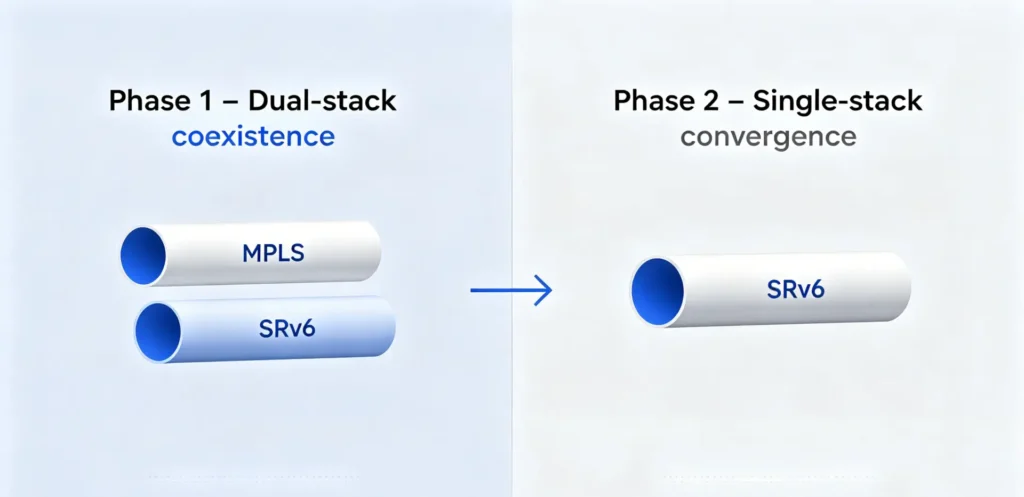
A typical migration path follows a dual-stack model:
- Phase 1: Dual-stack coexistence: Services run across both MPLS and SRv6 at the same time. The unified IS-IS control plane distributes topology, SID, and label information for both paths, enabling path redundancy, phased migration, and service validation.
- Phase 2: Single-stack convergence: After SRv6 path stability, performance, and operational readiness are verified, traffic is gradually shifted to SRv6. This enables an orderly MPLS retirement and a unified SRv6 single-stack network.
This dual-stack-first model preserves service continuity and avoids the high risk of a one-time migration cutover.
Native Extensibility of IS-IS
IS-IS is an ideal control plane for this transition because of its TLV-based extensibility.
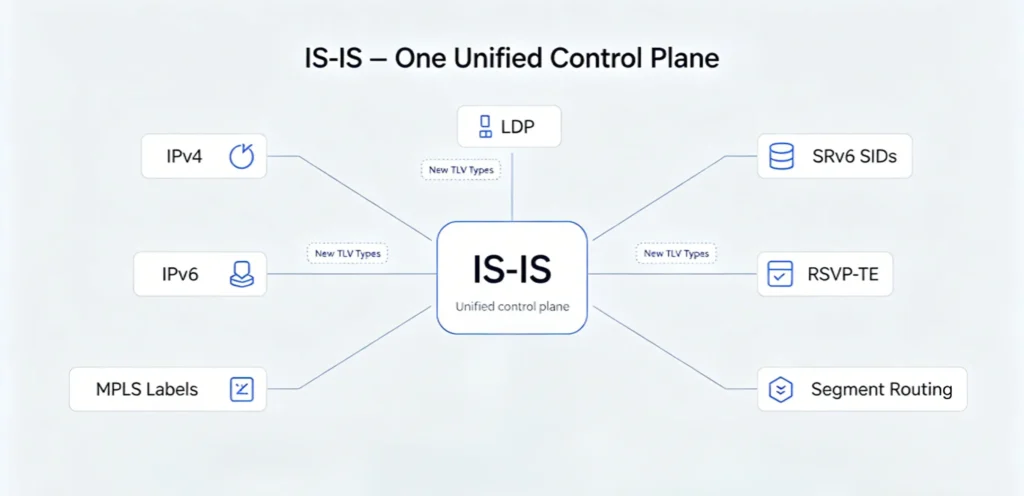
- Within the same protocol framework, IS-IS can carry IPv4, IPv6, Segment Routing, MPLS labels, and SRv6 SID information through new TLV types. The protocol itself does not need to be redesigned. New capabilities are added through TLV extensions.
- This design allows the network to reuse the same IS-IS control plane instance across multiple generations of technology evolution: from IPv4 to IPv6, from LDP / RSVP-TE to Segment Routing, and from MPLS to SRv6. Only the control plane information model needs to evolve over time.
This stable-protocol, extensible-TLV approach allows service providers and enterprises to plan a long-term migration path from MPLS to SRv6 with greater confidence, moving naturally from multi-protocol coexistence to a unified programmable control architecture.
Key Takeaway
IS-IS provides the network map and navigation intelligence, while MPLS and SRv6 deliver the forwarding mechanisms that execute defined paths across that network.
In modern backbone networks, the core value of a unified IS-IS control plane for MPLS and SRv6 is to provide control over multiple data planes through a single IGP. This avoids control plane fragmentation and supports smooth MPLS to SRv6 migration.
This architecture strengthens the TE capabilities of existing MPLS networks and also provides a stable foundation for the phased adoption of SRv6, allowing the network to continue evolving without redesigning the control plane.
Request a demo or need assistance ?
Fill out the form, and we’ll reach out to you today !


