Table of Contents
Customer Background – The Enabler Behind Global Tier-1 Live Broadcasting
G Company is a globally leading provider of broadcast facilities, live streaming, and production services, with expertise spanning Outside Broadcast (OB), equipment rental, and system integration. The company operates extensively across Europe and maintains a strong market presence in North America and Asia, delivering end-to-end live production and streaming solutions for major sporting events, entertainment programs, and live shows, including top-tier football leagues and international sporting events.
For this project, Asterfusion was selected as the networking partner for one of Australia’s premier live sports broadcasting events. Its high-performance PTP switches successfully addressed the challenges of the OB van environment, delivering precise synchronization and reliable operation throughout the live production workflow.
Why Asterfusion – Driven by Flexibility and Customization Requirements
The customer had extremely high requirements in multicast routing and system-level customization. After evaluating and integrating with multiple vendors, none of the existing solutions could fully meet their expectations. Asterfusion was finally selected due to its flexibility and openness in programmability and control.
Requirement 1: Control-plane customization for multicast routing
G Company required a customized PIM multicast routing control model aligned with live production workflows. Multicast routes needed to change dynamically and integrate with the customer’s in-house Broadcast Control System. This required coordination between the switch control plane, database modifications, and development-level integration on the switch side.
Requirement 2: SONiC-based solution exploration
The customer had strong in-house engineering capability and was actively evaluating SONiC-based solutions. However, community SONiC lacked sufficient support for PTP and multicast features to meet production requirements. Other SONiC vendors also failed to provide adequate technical support or openness for deep customization.
Solution Architecture
To support diverse OB van production and studio environments workflows, we adopted a hierarchical platform selection strategy. This ensures efficient alignment between compute resources and bandwidth requirements.
| Architecture Layer | Functional Role | Platform Models | Deployment Scale |
| Spine | Core backbone switching layer, responsible for high-density routing and forwarding across the network | CX732Q-N-V2 / CX532P-M-H | 60+ units |
| Sub-Spine | Aggregation layer for load balancing between edge and backbone networks | CX308P-48Y-M-H | 20+ units |
| Leaf | Access layer with direct connectivity to live production endpoint devices | CX206Y-48GT-M-HWP8 / CX204Y-24GT-M-SWP4 / CX206P-24S-M-H | Nearly 200 units |
This case study focuses on an IP-based broadcast production network deployed in an OB van environment, featuring the Asterfusion CX732Q-N-V2 as the core switching platform.
For more information about deployments in studio environments, please refer to: Asterfusion Enables Digital Transformation for a World-Class Broadcast Studio.
OB Van Internal Architecture
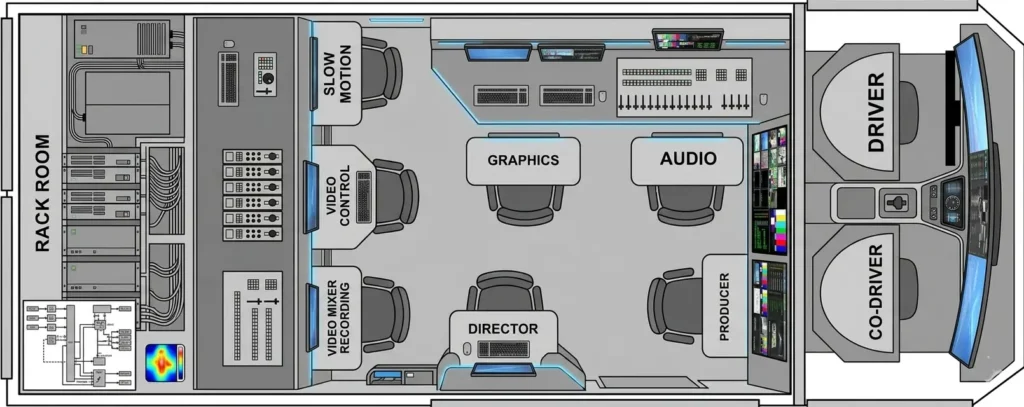
The OB van machine room serves as the central hub of the entire production system. Video, audio, and production equipment are highly integrated through modular segmentation. A Spine-Leaf architecture is used to logically interconnect all functional zones.
This design is optimized for extremely limited vehicle space. It reduces complex cabling requirements and ensures efficient aggregation of live signals. It also enables plug-and-play scalability for production workflows.
Network Deployment Architecture
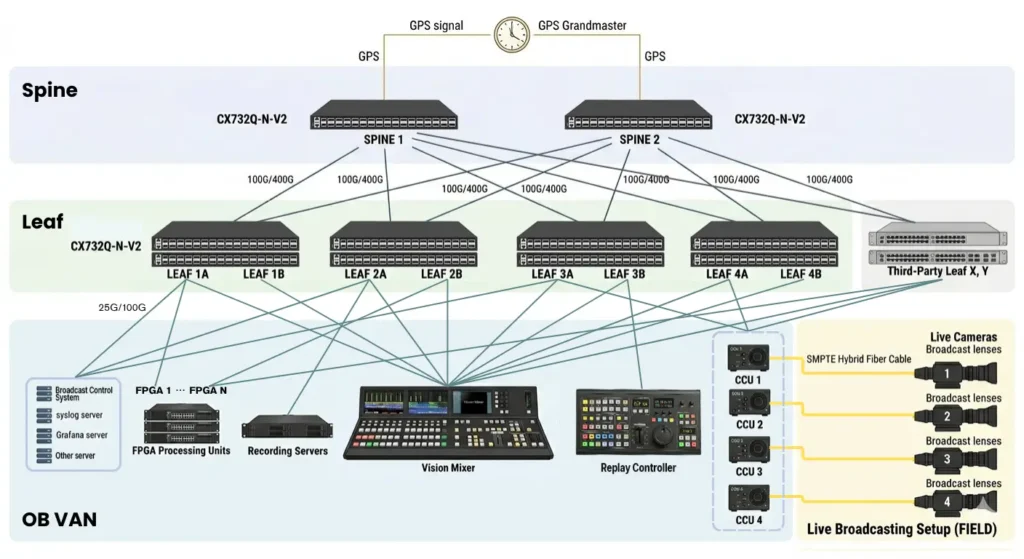
Although the physical space is constrained, the system requires extremely high stability. A redundant dual-plane Spine-Leaf architecture is deployed. Leaf switches connect downstream production devices such as vision mixers, replay controllers, CCUs, and FPGA cards.
A diagram is referenced below:
Dual-Spine Redundant Backbone
Two CX732Q-N-V2 switches are deployed as the Spine layer, forming a fully redundant backbone responsible for all network traffic forwarding across the OB van. The platform features hardware-optimized forwarding paths for nanosecond-level PTP synchronization, ensuring precise and stable timing distribution to every broadcast endpoint throughout the vehicle.
High-Density Leaf Layer Aggregation
Four pairs (eight units) of CX732Q-N-V2 switches are deployed in a distributed leaf layer. They provide localized access for vision mixers, FPGA cards, CCUs, and other production endpoints. High-speed 25G/40G/100G interfaces are used to deliver non-blocking throughput.
High-Precision Timing Foundation
Two Grandmaster clocks are deployed as the system-wide timing reference. They provide high-precision time synchronization, ensuring all devices maintain nanosecond-level alignment.
PIM Multicast and Business Integration
Unlike traditional designs, multicast routing state is directly programmable through a writable SONiC Redis control plane interface. The Broadcast Control System drives multicast state updates at runtime, establishing a joint control model between production logic and network behavior. Each switching action from the production control system is translated into immediate multicast route recalculation in the network, enabling frame-accurate signal switching based on dynamic PIM state updates.
Heterogeneous Endpoint Adaptation
For production devices such as FPGA cards and CCUs, which exhibit different timing behaviors, targeted protocol adaptation and iterative tuning are implemented. This ensures a smooth transition from traditional SDI-based workflows to a fully IP-based production architecture.
From Challenges to Broadcast-Grade Performance
In the high-stress validation environment of an IP-based OB production system, we encountered several issues that directly impact live broadcast stability. Asterfusion acted not only as a hardware vendor, but also as a technical partner. Through remote collaboration and on-site support with overseas teams, we achieved rapid issue resolution and closed-loop delivery.
- Optimizing PTP Stability for Continuous Synchronization
During validation, port instability on the switch triggered cascading synchronization loss across the network. This resulted in visible video flicker and audio-video desynchronization, posing a direct risk to live production quality.
To address the issue, Asterfusion engineers performed deep optimization of the Marvell SDK and updated the underlying implementation. By eliminating abnormal synchronization resets caused by port flapping at the hardware level, the solution achieved stable and continuous clock distribution throughout the network.
As a result, the PTP infrastructure maintained reliable synchronization performance under demanding production conditions, ensuring stable operation of all time-sensitive broadcast devices.
- Adapting Heterogeneous Endpoints for Production Workflows
Unlike standard NIC-based systems, FPGA cards exhibited unique timing behaviors that created synchronization alignment challenges within the production environment.
Through iterative co-debugging, protocol analysis, and system-level adaptation, Asterfusion worked closely with the customer to progressively resolve timing compatibility issues. This engineering-driven approach ensured stable operation across heterogeneous endpoints and enabled seamless integration of specialized production equipment into the IP workflow.
For complex production devices such as FPGA capture cards and CCUs, we addressed both timing and synchronization challenges by moving from a purely standardized approach to a scenario-driven engineering model.
By deeply customizing and optimizing the Marvell SDK, we improved clock synchronization stability to broadcast-grade requirements. In parallel, proactive protocol-level adaptation of endpoint communication behavior resolved compatibility issues under high-load conditions across heterogeneous devices.
These achievements demonstrate Asterfusion’s strong technical capability in professional broadcast IP systems. They also confirm that an open network architecture can fully support the most demanding live production environments worldwide.
Summary
This collaboration with G Company went beyond a simple deployment of a Spine-Leaf architecture. It represents a fundamental transition from a general-purpose data center network model to a dedicated IP-based broadcast production environment.
In live production scenarios, we recognized that traditional “standardization” often translates into “incompatibility.” Through deep expertise in PTP synchronization, fine-grained multicast routing control, and full adaptation to heterogeneous endpoints such as FPGA-based systems, Asterfusion demonstrated that SONiC delivers significantly higher flexibility and scalability than closed architectures in professional broadcast environments.
What we provide is not only switching infrastructure, but a future-ready IP signal processing foundation that is tightly integrated with the customer’s production logic and workflows.
Request a demo or need assistance ?
Fill out the form, and we’ll reach out to you today !


