Table of Contents
Introduction
Assume a residential scenario where the PON network spans from the OLT to the ONU. In the previous article, Asterfusion’s GPON Campus Solution, we explained that theAsterfusion OLT Stick converts Ethernet signals into optical signals and operates using the PON (Passive Optical Network) protocol. Traffic is distributed through the ODN, and the ONU converts optical signals back into Ethernet, delivering internet access to individual households.
In this process, have you considered how power is supplied? Can the commonly used PoE (Power over Ethernet) meet these requirements? What is PoF (Power over Fiber), and does it offer advantages compared to PoE?
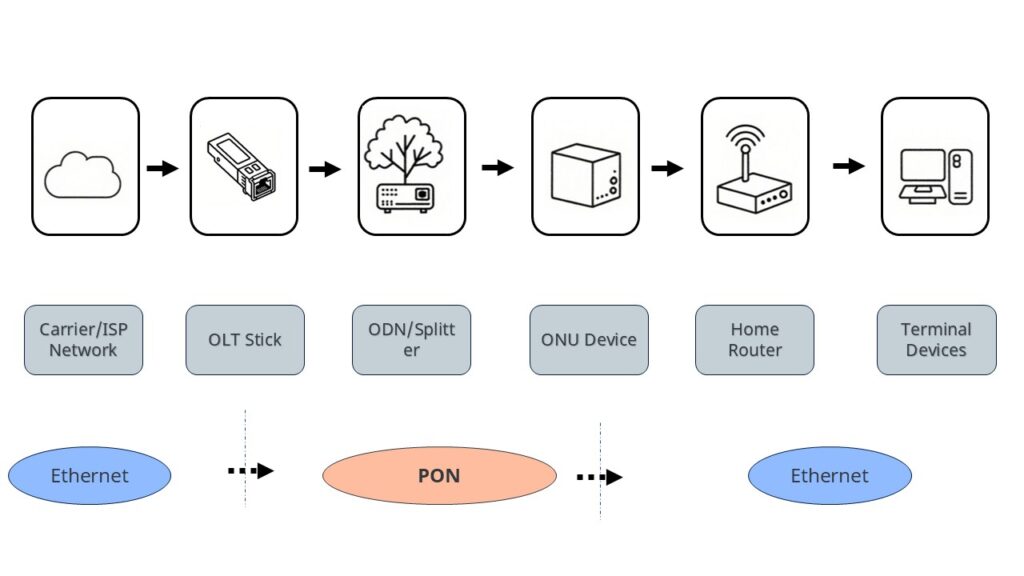
This article introduces PoE and PoF, compares their respective advantages and limitations, explains how to choose the option that best fits your requirements, and describes how Asterfusion deploys PON networks.
What Is PoE (Power over Ethernet)
PoE, or Power over Ethernet, is a technology defined by IEEE 802.3af (PoE) and IEEE 802.3at (PoE+). It uses the LLDP protocol for fine-grained power management and delivers both data and power over standard Ethernet twisted-pair cabling. PoE relies on the standard RJ45 interface and is the most widely used power delivery method in modern networks. It is typically used between access switches and endpoint devices.

Components and Internal Wiring
System Components In a PoE (Power over Ethernet) deployment, reliable link operation depends on a well-defined protocol handshake between the PSE (Power Sourcing Equipment) and the PD (Powered Device).
- PSE (Power Sourcing Equipment): Such as PoE switches or PoE power injectors.
- PD (Powered Device): Such as wireless APs, IP cameras, and IP phones.
- Medium: Cat5e, Cat6, or Cat6a twisted-pair cables are used to connect the PSE and PD, carrying both Ethernet data and electrical power.
Internal Wiring (Pinout) A twisted-pair Ethernet cable contains four pairs (eight copper wires). PoE can operate in Mode A, Mode B, or 4-Pair mode.
- Mode A (Phantom Power): Power and data share the same wire pairs, typically on pins 1,2 and 3,6.
- Mode B (Spare Pair): Data is transmitted on pins 1,2,3,6, while power uses the spare pairs on pins 4,5 (+) and 7,8 (−).
- 4-Pair (High Power): Defined in IEEE 802.3bt, all eight wires carry both data and power to support higher power levels, such as 90 W.
Key Metrics Analysis
From the perspectives of distance, cost, and availability, PoE has the following characteristics:
- Distance: PoE cabling is effective within 100 meters. Beyond this distance, voltage drop becomes excessive, and Ethernet signal attenuation increases significantly.
- Cost: PoE uses low-cost Ethernet cabling and does not require professional electrical installation.
- Support and Availability: This is the primary advantage of PoE. It is based on globally adopted standards (IEEE 802.3af/at/bt), and almost all enterprise-grade devices natively support RJ45 PoE interfaces.
Advantages and Limitations
Advantages: High level of standardization, wide range of supported endpoint devices, simple deployment and maintenance, and support for remote device reboot by disabling and re-enabling PoE power on the port.
Limitations: Limited transmission distance (100 m), thick and heavy cabling (especially in large-scale deployments), and susceptibility to electromagnetic interference. As a copper-based medium, the cable can pick up environmental electromagnetic noise, which may result in packet loss.
What Is PoF (Power over Fiber)
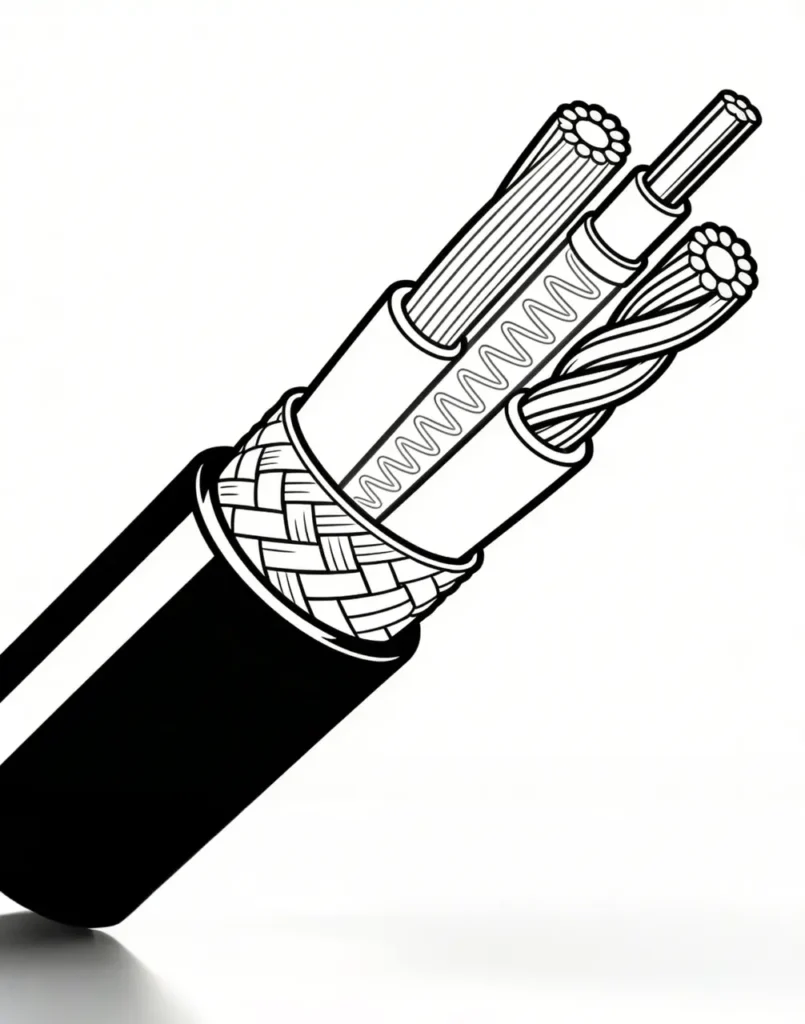
In engineering networks, PoF (Power over Fiber) typically refers to hybrid fiber cabling, where optical fibers and copper conductors are integrated into a single cable.
PoF, power over fiber, was originally used in deep-sea communication systems to supply power to signal repeaters deployed on the seabed at intervals of tens of kilometers. Later, as mobile networks evolved toward 3G and 4G, base stations adopted distributed architecture. The remote radio unit (RRU), responsible for RF processing, was mounted on towers tens of meters high. Deploying optical fiber and power cables separately was complex and costly, which led to the adoption of PoF solutions.
As a result, operators now deploy hybrid fiber cabling at scale. It has gradually been applied to fiber-to-the-room (FTTR) scenarios and provides a standardized solution for power delivery in long-distance video surveillance deployments.
Components
From an internal structure perspective, the optical fibers and power conductors are physically separated. The fiber cores carry data signals (single-mode or multimode glass fibers) and are fully insulated. The copper conductors deliver electrical power, typically using stranded copper wires with cross-sectional areas ranging from 0.75 mm² to 2.5 mm², each covered with an insulation layer.
In addition to these two core elements, PoF includes several auxiliary structures designed to ensure reliable operation in harsh environments:
- Strength Member: Usually located at the center of the cable, such as an FRP rod. It bears the primary tensile load during installation and prevents the fragile fibers from being pulled or damaged.
- Loose Tube: Encloses the fibers in gel-filled or oil-filled tubes, providing mechanical buffering and isolating them from pressure and moisture.
- Water-Blocking Materials: Placed within the cable core. These materials expand when exposed to water, sealing gaps and preventing longitudinal water ingress.
- Armoring: Corrugated steel tape or steel wire mesh located beneath the outer sheath. It protects the cable from rodent damage and external mechanical impact.
- Outer Sheath: The outermost protective layer of the cable. Depending on the deployment environment, it provides abrasion resistance, UV protection for outdoor use, or low-smoke, halogen-free flame-retardant properties for indoor use.
Key Metrics Analysis
From the perspectives of distance, cost, and availability, PoF (Power over Fiber) has the following characteristics:
- Distance: PoF supports long-distance transmission. Data transmission can reach several kilometers. The power delivery distance depends on voltage level and conductor gauge, and typically ranges from 300 m to 2,000 m.
- Cost: PoF is relatively expensive. Hybrid fiber cables cost more than standard Ethernet cables. Endpoints require additional optical-to-electrical conversion equipment, and fiber splicing increases deployment cost.
- Support and Availability: Moderate. Most common endpoints, such as wireless APs, do not natively support hybrid fiber interfaces. Power and data must be delivered through intermediate conversion devices or by modifying endpoint interfaces.
Advantages and Limitations
Advantages: Breaks the 100-meter limitation, offers high bandwidth with fiber-based data transmission, saves conduit space by replacing multiple cables with a single run, and enables centralized power supply from the central site, allowing network connectivity to be maintained during local power outages.
Limitations: Lack of unified standards, vendor-specific interfaces, complex deployment requiring both fiber splicing and high-voltage electrical skills, and the inability of endpoints to connect directly.
Why Compare Power over Ethernet and Power over Fiber?
In PON networks, the core challenge lies in the conflict between fiber’s electrical insulation and the power requirements of endpoint devices.
- The Inevitable Shift from Copper to Fiber: To achieve high bandwidth and long-distance transmission, fiber must be extended to rooms or even to the desktop.
- The Power Supply Dilemma:
- Fiber-only deployment: If only fiber is deployed, endpoints such as ceiling-mounted APs cannot be powered. Additional power outlets are required, which increases construction complexity and deployment effort.
- Fallback to PoE over copper: Using PoE over copper reintroduces the 100-meter distance limit. This forces switches to be distributed across multiple floors, preventing centralized management.
As a result, a trade-off is required between the convenience of PoE and the long-distance, high-bandwidth advantages of PoF (Power over Fiber).
The following table provides a clear comparison between PoE and PoF (Power over Fiber).
| Dimension | PoE (Power over Ethernet) | PoF (Power over Fiber) |
| Transmission Medium | A single Ethernet cable (twisted pair) carrying both data and power | A hybrid cable: fiber for data and copper conductors for power (physically separated) |
| Typical Deployment Location | Access layer: PoE switch in a rack or telecom room → endpoints within 100 m, such as APs, cameras, and IP phones | Between the central site and remote locations: data center or headend → buildings, corridors, outdoor poles, or rooms where long-distance data transmission and remote power are required |
| Effective Distance (Typical in Practice) | Data link typically within 100 m; beyond this, signal attenuation and voltage drop become significant | Data over fiber can reach kilometers; power distance depends on conductor gauge and supply voltage, typically ranging from hundreds of meters to over one kilometer (300 m–2,000 m as referenced) |
| Cost Structure | Low cable cost and simple installation; main costs are PoE switch ports and power budget | Higher overall cost due to hybrid cables, fiber installation (splicing and testing), and optical–electrical conversion or endpoint adaptation |
| Endpoint Ecosystem / Availability | Excellent: a large ecosystem of devices with native RJ45 PoE support | Moderate: most endpoints lack native hybrid fiber interfaces and require optical–electrical boxes, ONUs, media converters, or remote power units before converting to RJ45 or PoE |
| Electromagnetic Interference Resistance | More susceptible, as copper cables are more prone to noise coupling | Data is carried over fiber with strong EMI immunity; however, the power conductors still require compliance with electrical, lightning, and surge protection standards |
| Operations and Maintenance (Remote Reboot) | Simple power cycling via managed switch PoE ports | Typically implemented at remote boxes, small switches, or power modules; longer links and more devices introduce additional operational touchpoints |
Based on the comparison, PoE and PoF (Power over Fiber) are not a binary, either-or choice.
In enterprise deployments, PoE is typically used as the “last 100 meters” solution. Ethernet cables run directly from access switches in wiring closets to endpoints. This model fits offices, standard surveillance points, and other scenarios where distances are short, the number of endpoints is large, and fast deployment and recovery are required.
PoF, Power over Fiber, by contrast, is more commonly deployed upstream of PoE switches. It allows PoE-capable devices or downstream access equipment to be placed much farther away, even across harsh or complex environments. Power and network connectivity are delivered to a remote location first, and then distributed to endpoints, often by converting back to RJ45 or PoE for devices such as APs and cameras.
How to Choose Between Power over Ethernet & Power over Fiber
Based on the comparison above, the choice between PoE and PoF(Power over Fiber) in a PON network primarily depends on the deployment location and power availability.
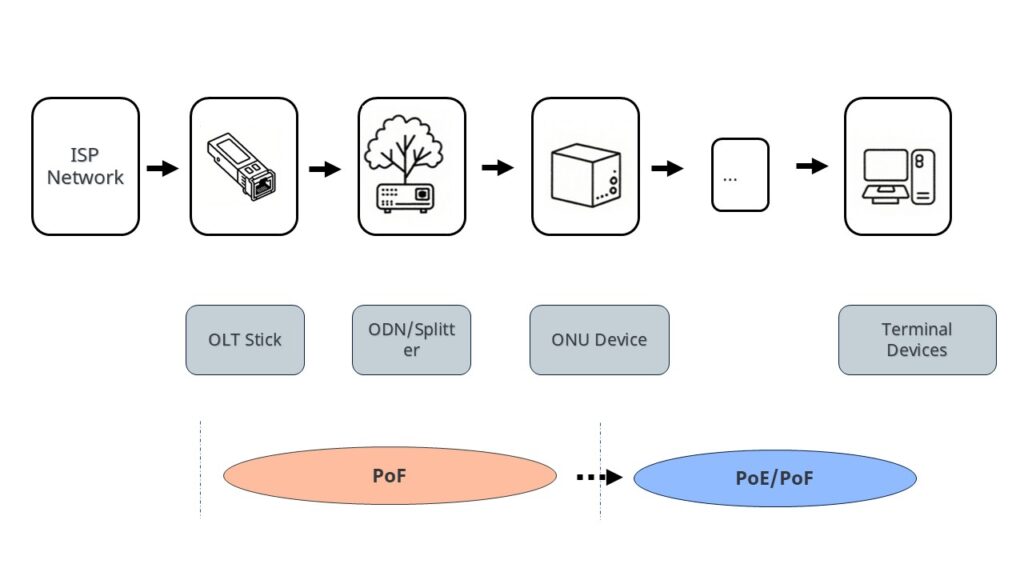
In the access segment from the ONU to endpoint devices, PoE remains the dominant solution. It delivers both data and power to APs, cameras, and similar endpoints with the lowest cost and operational complexity. In scenarios that span multiple rooms or floors, or where the distance to endpoints exceeds 100 meters, PoF (Power over Fiber) offers clear advantages in transmission distance and cabling flexibility.
In the ODN segment between the OLT and the ONU, the PON network itself remains passive. However, in outdoor deployments, locations with limited access to local power, or scenarios with strong requirements for centralized power supply, operators can use PoF (Power over Fiber, hybrid fiber cabling) to deliver both optical signals and electrical power to remote ONUs. This approach simplifies power architecture and improves overall network reliability.
Conclusion
In PON network deployments, the choice of power delivery is as important as the choice of transmission medium. PoE(Power over Ethernet) and PoF(Power over Fiber) are not competing or mutually exclusive approaches. Each addresses how endpoints are powered at different network layers and under different deployment conditions.
PoE, built on a mature IEEE standards framework, remains unmatched in the access segment from the ONU to endpoints. It offers simple deployment, broad device compatibility, and low operational cost. This makes it well suited for offices, indoor APs, and standard surveillance points within the “last 100 meters.” It is the most widely adopted and cost-effective power delivery method today.
PoF (Power over Fiber) targets engineering scenarios constrained by distance, environment, or power availability. By carrying both optical fiber and electrical power in a single cable, PoF overcomes the distance and environmental limitations of PoE. It is suitable for cross-floor and cross-building links, outdoor deployments, and locations where endpoints are far from switches. In PON networks, especially where utility power is unavailable or centralized power is required, PoF provides a practical, engineering-grade method to supply both optical connectivity and power to remote ONUs.
In practical network design, PoE serves endpoint access, while PoF (Power over Fiber), Power over Fiber, extends reach over longer distances. Together, they form a layered and complementary model that balances performance, deployment cost, operational complexity, and future scalability. By combining PoE and PoF appropriately, a PON network can achieve an optimal engineering balance across diverse deployment scenarios.

Contact US !
- To request a proposal, send an E-Mail to bd@cloudswit.ch
- To receive timely and relevant information from Asterfusion, sign up at AsterNOS Community Portal
- To submit a case, visit Support Portal
- To find user manuals for a specific command or scenario, access AsterNOS Documentation
- To find a product or product family, visit Asterfusion-cloudswit.ch


