Customer Background
T is a North America–headquartered global communications platform company and a leading player in the CPaaS (Communications Platform as a Service) industry. Its core offerings include voice communications (VoIP / SIP Trunking), global messaging services, number management, and real-time communication APIs. The company is also rapidly expanding into AI voice agents and real-time interactive communication capabilities, building the next-generation intelligent communications infrastructure.
T operates its own global communications backbone network and has deployed multiple Points of Presence (PoPs) across North America, Europe, and Asia-Pacific, enabling programmable global communications for enterprise customers. Its customer base spans contact centers, SaaS platforms, e-commerce, fintech, and AI application providers.
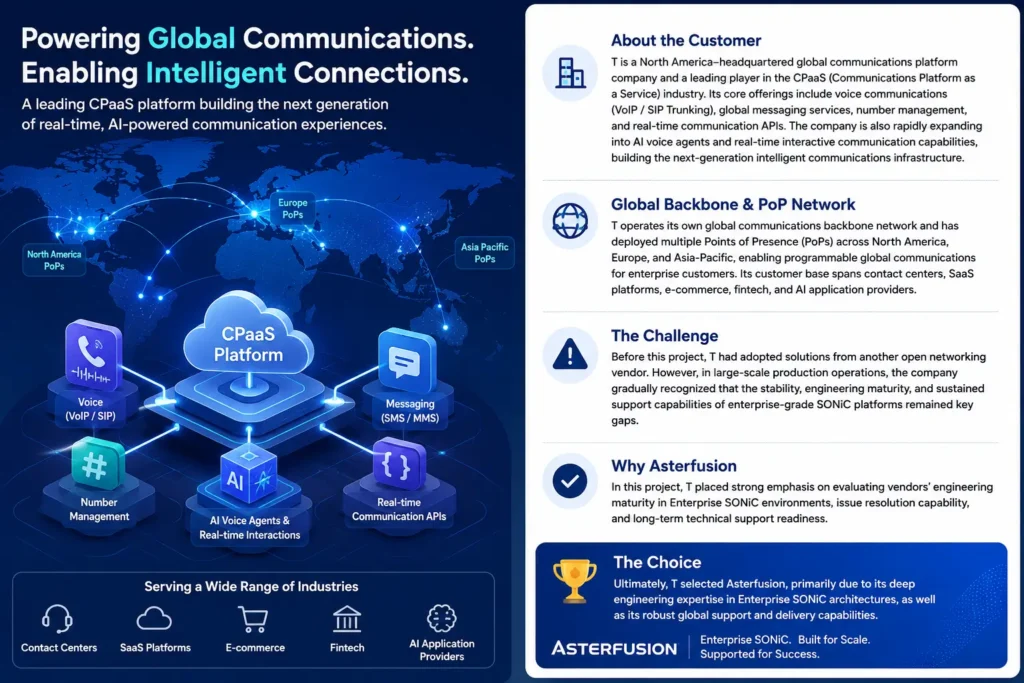
Prior to this project, T had adopted solutions from another open networking vendor. However, in large-scale production operations, the company gradually recognized that the stability, engineering maturity, and sustained support capabilities of enterprise-grade SONiC platforms remained key gaps.
As a result, in this project, T placed strong emphasis on evaluating vendors’ engineering maturity in Enterprise SONiC environments, issue resolution capability, and long-term technical support readiness.
Ultimately, T selected Asterfusion, primarily due to its deep engineering expertise in Enterprise SONiC architectures, as well as its robust global support and delivery capabilities.
Network Requirements
T’s network requirements are driven by three core objectives: real-time communication quality, global reachability, and network programmability.
First, in voice communication and AI-driven real-time interaction scenarios, the business is extremely sensitive to end-to-end latency. The network must provide deterministic low-latency forwarding and extremely low jitter to ensure natural voice quality and responsive AI interactions.
Second, due to its globally distributed PoP architecture, the network must support multi-region interconnectivity, low-hop cross-domain forwarding, and multi-carrier redundancy to ensure high availability and stable cross-border communication.
In addition, as an API-driven communications platform, T requires highly programmable network capabilities, enabling policy-based routing control, automated failover, and real-time traffic steering.
With the rapid growth of AI voice agent workloads, traffic patterns are evolving toward high concurrency, small-packet bursts, and real-time media streaming, placing significantly higher demands on switch latency, queue scheduling, and overall network consistency.
Deployment Architecture
Scale: ~300 × Asterfusion CX532P-N (32×100G switches)

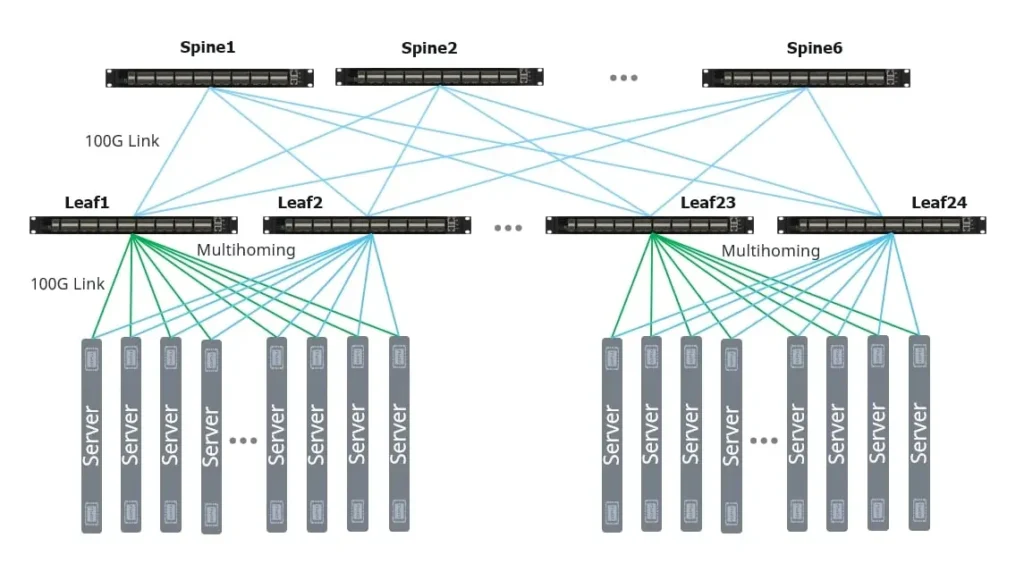
This deployment consists of approximately 300 units Asterfusion 32×100G switches, building a high-performance Spine-Leaf data center network with EVPN Multihoming for high availability.
ToR Layer (Leaf / Top-of-Rack)
• 24 × CX532P-N 32×100G switches (12 dual ToR pairs)
• Each rack is equipped with dual ToR (A/B) for redundancy
Each ToR provides:
• 32 × 100G downlinks (supporting 25G server breakout)
• 8 × 100G uplinks to the Spine layer
• Each rack supports approximately 18–24 servers
Spine Layer
• 6 × 32×100G Spine switches
• Builds a high-bandwidth, non-blocking Clos fabric
• Provides high-speed inter-rack forwarding and path redundancy
Server Connectivity
• Servers use dual 100G NICs
• Ensures high throughput and redundant connectivity
Network Redundancy Mechanism
• Enables cross-ToR link redundancy and service continuity
• Simplifies traditional MLAG-based control-plane complexity
⚠️ Challenges
1.Tight Deployment Timeline & First Large-Scale Rollout
This was the customer’s first large-scale deployment of Asterfusion solutions in a production environment. The operations team had limited familiarity with the platform, resulting in a steep learning curve during initial rollout.
2.Complexity of EVPN Multihoming Design
The multi-rack EVPN multihoming architecture required coordinated state across multiple devices. Troubleshooting often involved correlating data across ToR and Spine layers, increasing operational complexity.
3.Cross-Team Configuration Conflicts
The customer’s server team was simultaneously deploying new features and configuration changes. Misconfigurations (e.g., LACP or routing issues) occasionally led to network loops and abnormal traffic patterns, making root cause analysis more challenging.
Asterfusion Support & Resolution
1. Rapid Enablement & Configuration Support
Provided comprehensive technical documentation and real-time engineering support to assist with network design and configuration planning, accelerating customer onboarding and platform familiarity.
2. TechSupport Tool for Operational Efficiency
Developed and deployed an automated TechSupport tool to standardize log collection, significantly reducing operational complexity and enabling backend engineering teams to perform centralized analysis.
3. Proactive Cross-Domain Troubleshooting
Engineering teams proactively analyzed issues from the network perspective, helping clearly separate network-side and server-side problems, reducing ambiguity in root cause identification.
4. 24×7 Engineering Support Coverage
Provided round-the-clock engineering support, accelerating issue resolution and ensuring continuous operation of critical communication services.
Project Outcomes & Future Outlook
Although the project faced initial challenges—including first-time large-scale deployment, EVPN multihoming complexity, and cross-team operational conflicts—the system was successfully brought online with strong involvement and rapid response from the Asterfusion engineering team, ensuring stable operation of core communication services.
The customer highly recognized Asterfusion’s engineering capabilities in Enterprise SONiC environments, particularly its efficiency in troubleshooting complex multi-domain networks and its ability to deliver rapid operational recovery.
Based on the success of this deployment, the customer is now evaluating further expansion of Asterfusion solutions across its global data center infrastructure, including next-generation 400G and 800G architectures, to support the continued growth of AI voice agents and real-time communication workloads at scale.


