Table of Contents
In our previous two articles, we broke down exactly what PPPoE is and explored how it works under the hood. However, PPPoE isn’t the only player in the game.
In the networking world, PPPoE, DHCP, and IPoE are frequently compared. The core reason is that they all address the exact same fundamental question: “When a user connects to the network, how does the carrier (or network administrator) identify them, assign an IP address, and grant internet access?” Simply put, they represent different technological approaches to user authentication and network access.
Why Compare PPPoE and DHCP in the First Place?
Many wonder: DHCP is merely a protocol for dynamic IP allocation, while PPPoE is a tunneling protocol with built-in authentication—how can they even be compared? The reason is that in the history of broadband evolution (especially carrier fiber/ADSL broadband), they represent two entirely different architectural philosophies:
What is PPPoE?
How it works:
Users must input a “username + password” to dial in. It establishes a virtual “Point-to-Point (PPP)” tunnel right on top of the Ethernet layer. For more info: https://cloudswit.ch/blogs/what-is-pppoe-how-does-it-work/
Why carriers love it:
Since Ethernet is inherently a “broadcast” network, it is notoriously difficult for carriers to track individual users. PPPoE essentially creates a dedicated private line over the broadband connection, making authentication, billing (by time or data usage), and rate-limiting incredibly precise.
The downsides of PPPoE:
It introduces massive encapsulation overhead (an extra layer of headers reduces the MTU to 1492). Furthermore, any connection drop requires a re-dial, and its lack of native multicast support makes deploying IPTV a logistical nightmare.
What is DHCP? (The LAN-Based Rising Star)
How it works: True plug-and-play, commonly known as “dynamically obtaining an IP.” The moment a device connects via Ethernet cable or Wi-Fi, it broadcasts a request: “Who can give me an IP?” A DHCP server then hands one over instantly.
The advantages: Zero encapsulation overhead (enjoying a full 1500 MTU), blazing fast speeds, and absolutely no need for users to configure usernames or passwords.
For more: https://cloudswit.ch/blogs/what-is-dhcp-snooping-and-how-does-it-work/
Why it couldn’t replace PPPoE for broadband directly?
DHCP itself has zero built-in security or authentication. If a carrier used vanilla DHCP for residential broadband, a neighbor could easily splice into your line and steal your bandwidth. Worse, the carrier would have no way of knowing which paying customer was actually behind that IP. Therefore, comparing the two is fundamentally a debate over business logic: “Authenticate before assigning an IP” (PPPoE) versus “Assign an IP first, then figure out authentication” (DHCP/Web Portal).
Enter IPoE: Where Does It Fit In?
Because PPPoE’s encapsulation is too heavy and highly unfriendly to today’s data-heavy 4K/8K streaming and IPTV (multicast traffic), carriers have been desperate to ditch dialing and move toward a pure Ethernet (IP) architecture. However, as established, vanilla DHCP lacks security.
To bridge this gap, IPoE (IP over Ethernet) was born. In a nutshell: IPoE is not a single protocol, but an entire access control architecture centered around DHCP, combined with hardware binding or web-based authentication.
How Does IPoE Solve the Authentication Problem?
Without typing a username and password, how does the carrier know who you are? IPoE shifts the strategy to “authenticating the line, not the person” or “automated background authentication”:
- DHCP Option 82 (Location Credential): When you plug in your ONT/modem and your router sends a DHCP request, the neighborhood switch or the carrier’s Access Node (AN) quietly injects a tag (Option 82) into the DHCP packet. It explicitly states: “This request is coming from Room 11, Rack 3, Line Card 5, Port 2.” The carrier cross-checks this with their database, sees that this specific port belongs to “Ms. Yu’s broadband subscription,” automatically approves it, and pushes the IP down.
- MAC Address Authentication: The carrier directly binds and white-lists the hardware MAC address of your ONT or router.
- Web Authentication (Portal): Similar to connecting to Wi-Fi at a hotel or airport, a webpage automatically pops up requiring you to input a phone number or verification code.
Comparison of PPPoE vs. DHCP vs. IPoE
| Feature / Metric | PPPoE (PPP over Ethernet) | DHCP (Standalone Protocol) | IPoE (IP over Ethernet) |
| Authentication Method | Username + Password Dial-up (CHAP/PAP) | No built-in authentication | Line/Hardware binding (Option 82) or Web-based (Portal) authentication |
| User Experience | Requires dial-up configuration; manual/auto reconnection needed upon disconnection | Plug-and-play | Plug-and-play (completely seamless with zero “dial-up” perception) |
| Overhead & Efficiency | Higher overhead due to tunnel encapsulation | Extremely low | Extremely low ; high efficiency with native IP forwarding |
| Multicast / IPTV Support | Poor (requires complex multicast replication or VLAN isolation) | Perfectly supported natively | Perfectly supported natively (ideally suited for IPTV services) |
| Primary Use Cases | Traditional residential broadband, enterprise dial-up access | Internal LANs, downstream of home routers | Modern fiber broadband, dedicated IPTV networks, public Wi-Fi |
So, If IPoE is that great, is PPPoE finally dead?
Not even close. In fact, it remains the absolute backbone of residential broadband in many countries worldwide. While we technocrats talk day in and day out about how IPoE is highly efficient and represents the future, reality tells a different story: PPPoE still firmly sits on the throne. You might wonder, if it is so clunky with its encapsulation overhead and objectively worse at handling video traffic than IPoE, why hasn’t it been phased out? The reasons are brutally pragmatic:
1. Massive Legacy Burden: The Cost of Restructuring is Astronomical
Carriers’ billing systems (AAA servers, BRAS equipment) have run seamlessly around PPPoE for over two decades. This infrastructure is akin to a bank’s core legacy system—it might be ancient, but it is rock-solid and virtually bulletproof. Shifting entirely to IPoE would require carriers to upgrade or replace central office equipment, billing software, and millions of residential ONTs nationwide. The capital expenditure and manpower required for such a technical overhaul are astronomical. Simply put, carriers have zero financial incentive to touch this piece of the pie.
2. A Natural Moat Against Bandwidth Theft and Freeloading
At its core, PPPoE relies on a “username + password” lock. If you buy a new router, you must obediently input those credentials to get online.
By contrast, because IPoE authenticates the line rather than the person, anyone who splices into that fiber line could instantly access the internet as long as there is a signal. This would make the illegal reselling of broadband accounts and unauthorized network sharing incredibly difficult to police. PPPoE’s archaic “one account per household, no dial-in, no access” mechanism remains the carrier’s most effective weapon to prevent revenue leakage to this day.
What is the actual reality of PPPoE vs. IPoE today?
The current state of PPPoE can be summed up in one sentence: It fiercely defends its “home turf” while conceding “new business” to IPoE.
- In the Residential Broadband Domain: PPPoE still rules with an iron fist. The vast majority of fiber connections deployed by major carriers globally are still running PPPoE dial-in under the hood.
- In the IPTV and 4K/8K Video Streaming Domain: PPPoE has indeed been phased out. Live television relies heavily on multicast data, and forcing PPPoE to process these streams would completely bottleneck the central office’s equipment. Consequently, modern ONTs (modems) typically split the traffic into two separate paths: standard internet browsing goes through PPPoE, while TV services (IPTV) run via IPoE/DHCP.
Therefore, PPPoE is far from dead. It has simply reached a strategic “industry truce” with IPoE, where both sides mind their own business.
Since PPPoE remains mainstream, is there a better choice for carrier-side BNG equipment?
The “Two Fatal Flaws” of Traditional BNG/BRAS Gateways
The equipment responsible for handling residential broadband dial-in (PPPoE) is known as the BNG (Broadband Network Gateway). In past deployments, carriers were forced to make a painful choice between two extremes—each harboring its own intolerable, fatal flaw:
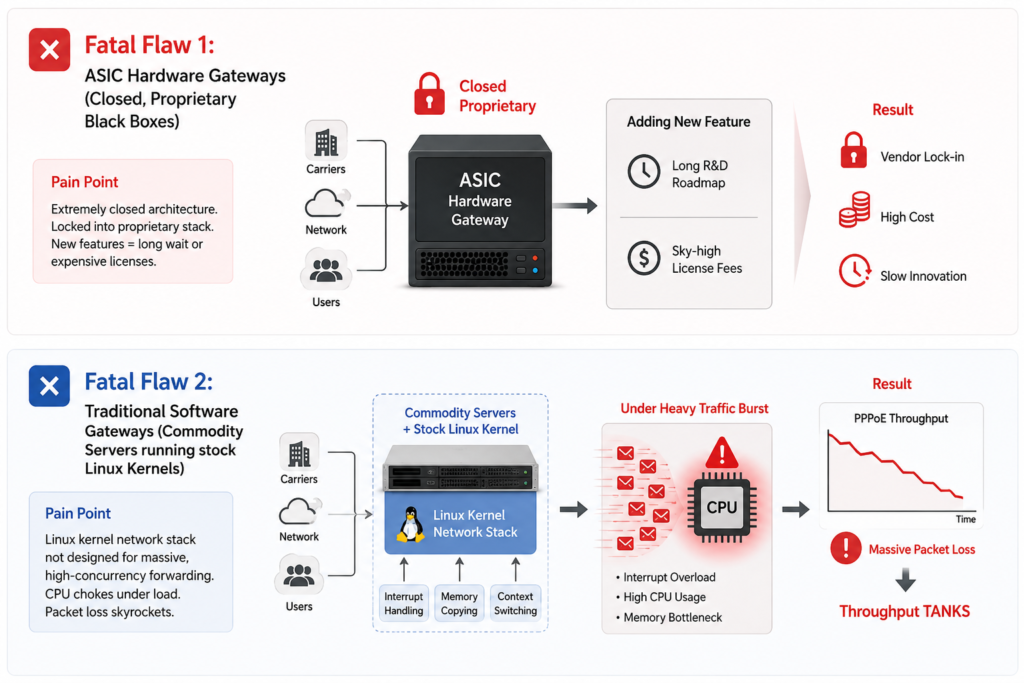
Fatal Flaw 1: ASIC Hardware Gateways (Closed, Proprietary Black Boxes)
While performance is undeniably powerful, the price tag is exorbitant. The Pain Point is that the architecture is extremely closed. Purchasing hardware from traditional big vendors means being permanently locked into their proprietary technology stack. If a carrier wants to add a feature for a new service (such as a new IPv6 extension protocol), they are left with two options: endure the vendor’s agonizingly long R&D roadmap or pay sky-high licensing fees.
Fatal Flaw 2: Traditional Software Gateways (Commodity Servers running stock Linux Kernels)
This approach leverages decoupled, commodity servers, offering a degree of flexibility.
The Pain Point is that the native Linux kernel network stack was simply never architected for massive, high-concurrency packet forwarding. When hit by sudden bursts of heavy traffic, the CPU chokes on interrupt handling and memory copying (context switching). This triggers massive packet loss, causing PPPoE throughput to tank miserably.
The Asterfusion Solution: The Powerhouse Combination of SONiC + VPP (AsterNOS-VPP)
To break this gridlock, Asterfusion has introduced a disruptive architectural overhaul: completely decoupling the control plane from the data plane with our next-generation routing operating system—AsterNOS-VPP.
AsterNOS-VPP is an innovative routing OS featuring a “SONiC Control Plane + VPP Data Forwarding Plane.” When running on the ET2508 Open Gateway Platform—powered by the Marvell Octeon 10 processor—the architectural beauty lies in its clear division of labor:
1. Why introduce VPP (Vector Packet Processing) as the Data Plane?
Developed and open-sourced by Cisco, VPP is a high-performance vector packet processing framework. While traditional Linux processes incoming packets “one by one” (scalar processing), VPP processes packets in “chunks and batches” (vectors).
- Shattering the Kernel Bottleneck: By utilizing DPDK/user-space driver technologies, VPP directly takes control of the NIC. Packets bypass the high-overhead Linux kernel entirely (Kernel Bypass), achieving zero-copy forwarding.
- A PPPoE Performance Monster: VPP abstracts packet processing into a “Graph Node” architecture. Running on the Marvell Octeon 10 (ARM Neoverse N2 architecture) within the ET2508, processing instructions reside flawlessly in the CPU’s L1/L2 cache. This allows PPPoE decapsulation and VLAN tagging to run at blistering speeds, squeezing every ounce of physical limit out of commodity hardware.
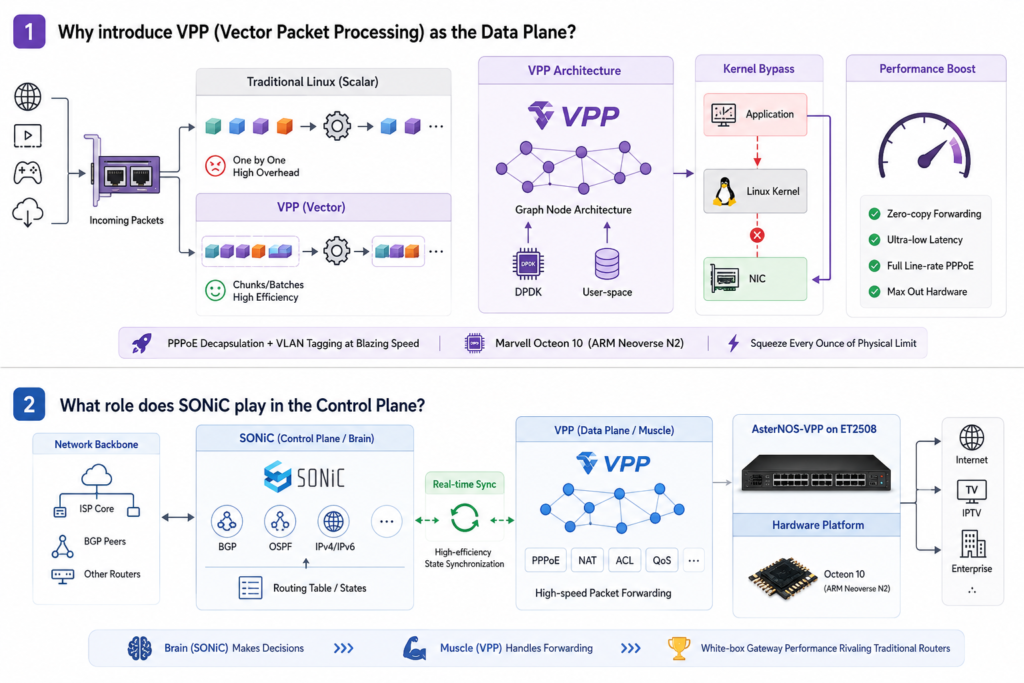
2. What role does SONiC play in the Control Plane?
No matter how powerful VPP’s forwarding engine is, it is merely the “executor” (data plane) and lacks the brainpower to calculate complex routing protocols. This is where SONiC steps in as the “brain” (control plane):
- Seamless Backbone Integration: SONiC runs standard routing protocols (such as BGP, OSPF, etc.), ensuring flawless compatibility with carriers’ existing infrastructure.
- Innovative Software-Hardware Synergy: Within the AsterNOS-VPP ecosystem, Asterfusion has engineered real-time, highly efficient synchronization between the SONiC routing table/states and the user-space VPP. The brain (SONiC) makes the decisions, while the muscle (VPP) handles the heavy-duty forwarding. This synergy empowers white-box gateways with performance that rivals traditional vendor hardware routers.
Three Core Technical Highlights of the Solution
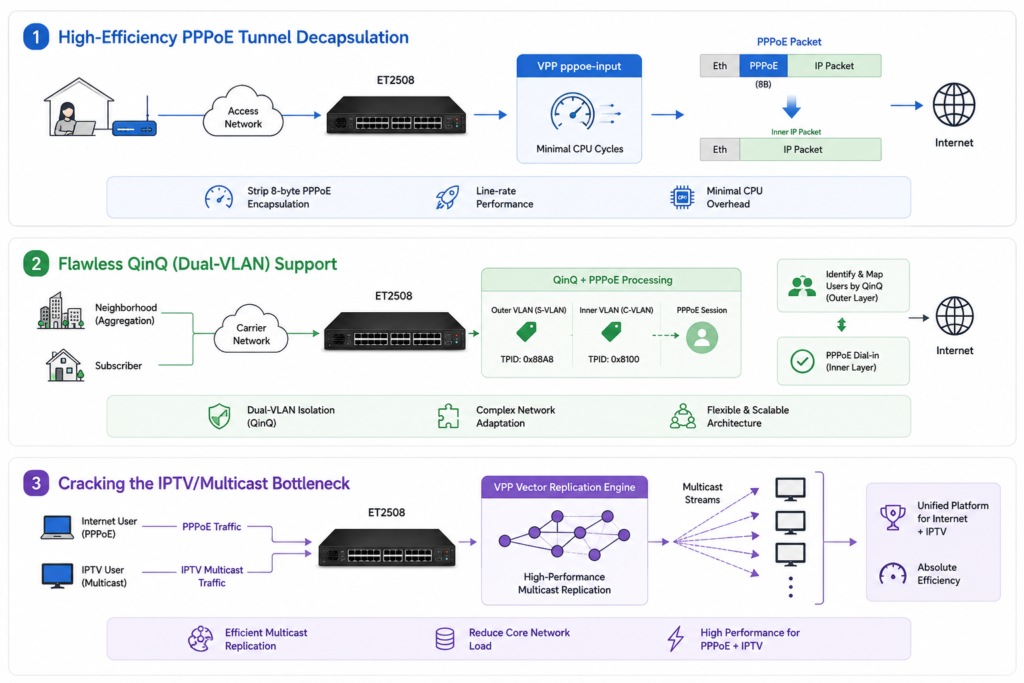
In real-world carrier deployments, this solution precisely hits the pain points of the business through several hardcore technical implementations:
- High-Efficiency PPPoE Tunnel Decapsulation: PPPoE introduces an extra 8-byte encapsulation overhead compared to standard Ethernet. On the ET2508, VPP’s
pppoe-inputnode strips this encapsulation using minimal CPU cycles, feeding the inner IP packet directly into line-rate routing workflows. - Flawless QinQ (Dual-VLAN) Support: To differentiate between neighborhoods and individual subscribers, carrier networks typically isolate traffic using dual tags (QinQ). This solution supports identifying and mapping users based on QinQ at the outer layer while smoothly running PPPoE dial-in at the inner layer, perfectly adapting to complex live network environments.
- Cracking the IPTV/Multicast Bottleneck: Running multicast video streams over traditional PPPoE architectures overloads central office equipment. This solution fully exploits VPP’s formidable vector replication capabilities to achieve high-performance multicast stream replication. Within a single, unified software-hardware platform, it processes both standard internet browsing (PPPoE traffic) and TV streaming (IPTV multicast traffic) with absolute efficiency.
Business Value: Why This Solution Destroys the Competition
This is not just a technical upgrade; it is a total disruption of network economics:
- A Dimension-Reduction Attack on Cost: By utilizing Commercial Off-The-Shelf (COTS) white-box hardware paired with an open-source software architecture, we deliver carrier-grade BNG performance that previously required expensive, proprietary ASIC chips. An ET2508 loaded with AsterNOS-VPP is priced at just $2,198 USD—offering a level of cost-efficiency that is completely off the charts! https://asteraix.com/product/50gbps-enterprise-router-sonic-vpp/
- Absolute Openness and Freedom: Because the foundation is a completely open Linux environment, carriers or technical teams can develop and extend tailored business logic (such as customized billing or security policies) directly on top of it. This completely smashes the “black box” monopoly and ecosystem hostage-taking of traditional equipment vendors.
Conclusion: Reshape Your Access Network with Asterfusion
In an era defined by explosive demands for 4K/8K live streaming and high bandwidth, continuing to scale traditional, closed BNG/BRAS hardware is a dead end. The Asterfusion ET2508 Open Gateway, running the AsterNOS-VPP operating system and backed by the DPU-class hardware acceleration of the Marvell Octeon 10 chip, redefines cost and efficiency for carrier access networks.
By replacing proprietary black boxes from legacy vendors with high-performance, cost-effective white-box gateways, network operators can achieve:
- Up to a 60% reduction in Total Cost of Ownership (TCO), completely eliminating the premium margins extorted by legacy hardware vendors.
- An absolute end to vendor lock-in, embracing a truly open, community-driven control plane ecosystem.
- Minute-level rapid deployment of business features, allowing swift adaptation to IPv6 evolution, IPTV policy tweaks, and frequent security profile updates.
Stop letting rigid, legacy hardware bottleneck your business growth.
How to Configure PPPoE on Asterfusion Enterprise SONiC Gateway
For more configuration details, please refer to the PPPoE Server Configuration Guide
Control in SONiC, Forwarding in VPP: A New PPPoE Design for Scalable Networks
Building a Scalable PPPoE Gateway with SONiC and VPP Integration


