Table of Contents
Introduction
If time is vision in broadcast systems, then in latency-sensitive financial trading, “time is money” is literal.
PTP network switches provide high-precision, traceable time across the entire trading network. They synchronize clocks between exchanges, clearing systems, and brokers. This ensures consistent timing and fair execution across all participants.

What are PTP Network Switches ?
PTP (Precision Time Protocol) network switches are Ethernet switches that support precise time protocols such as IEEE 1588v2. They use hardware timestamping to deliver high-accuracy time.
In financial trading networks, they typically carry two types of traffic:
- Application traffic: market data, order flow (buy/sell), and risk control traffic within broker systems.
- Time synchronization traffic: PTP messages.
At the port level, PTP network switches correct and propagate timing information. This keeps clocks aligned across servers, gateways, and matching engines, with sub-microsecond or even nanosecond accuracy.
PTP Network Switches and MiFID II Compliance
Under the EU MiFID II framework, Regulatory Technical Standard 25 (RTS 25) defines clock synchronization requirements for financial trading systems.
It mandates the use of UTC as the reference time. It also sets maximum divergence based on gateway-to-gateway latency. Systems with latency below 1 ms must stay within 100 µs. High-frequency trading requires 1 µs granularity. Brokers that fail to meet these thresholds may face significant penalties.
In this context, PTP network switches enable microsecond or even nanosecond-level synchronization. This exceeds the RTS 25 requirements.
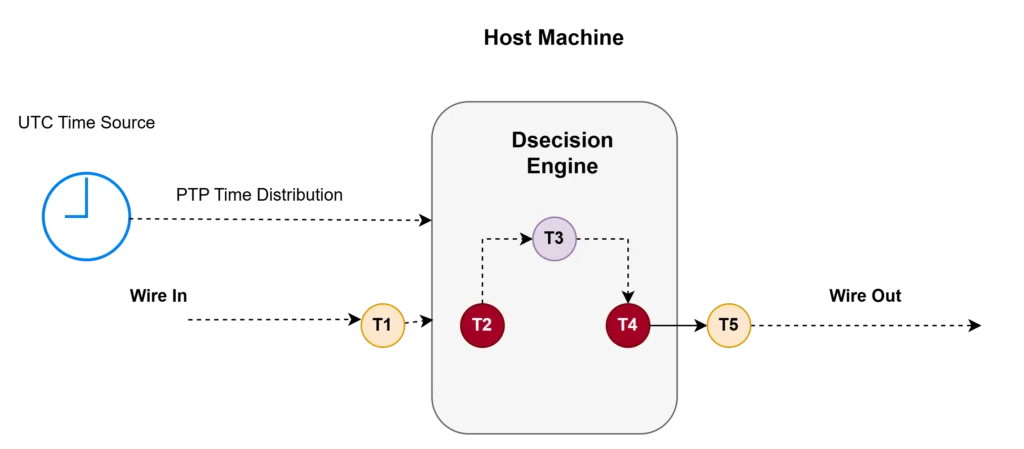
This is a classic low-latency measurement model for high-frequency trading (HFT). It shows the full timestamp distribution of a message (order) entering a host, passing through decision logic, and being sent out.
PTP network switches can integrate GNSS modules as the sole time source at the far left. They distribute high-precision time to decision hosts via PTP, which is then sent out over the physical link to the exchange through wire-out.


Enable Time Synchronization Inside and Outside Matching Systems
In trading networks, brokers and asset managers often connect to multiple exchanges and clearinghouses simultaneously. Within an exchange, the matching engine is the core component. Its role is to match buy orders with sell orders according to established trading rules.
The matching engine acts like a referee. If switch clocks inside the exchange are not synchronized, two orders from Broker A and Broker B arriving nearly simultaneously could be misordered. For example, if Switch A’s clock is 1 µs fast, Broker B’s order might be processed first. This can lead to legal disputes and regulatory penalties.
The system must also maintain time alignment with brokers during external interactions. Even microsecond-level differences between trading participants can create unfair advantages, known as “time arbitrage.” PTP minimizes these discrepancies by aligning clocks across all participants.
Top quantitative funds and high-frequency trading (HFT) firms operate at much higher timing precision than regular brokers. Regulatory and business pressures drive industry-wide upgrades. Using PTP network switches with hardware-based synchronization, and GNSS modules on devices receiving UTC from GPS, BeiDou, or Galileo satellites, provides a significant advantage in time alignment.
PTP Network Switches Ensure Fair Order Sequencing
From a broker’s perspective, high-frequency trading requires strict “first-come, first-served” ordering. All orders must reference a unified clock before entering the matching engine. Without synchronized clocks across trading nodes, determining true order arrival sequence is difficult, leading to disputes and questions about fairness.
A timing network built with PTP switches improves overall exchange time accuracy from milliseconds to microseconds or nanoseconds. This allows orders within the same millisecond to be precisely sequenced, enhancing the enforceability and credibility of matching and queuing rules.
Compliance Auditing and Risk Control Traceability via PTP
Financial regulators require unified timing across orders, matching, and risk control processes:
- Regulators mandate precise, consistent timestamps for every order, match, and risk action. These records support investigation of anomalies, market manipulation, and system failures.
- Risk engines rely on the “current real-time” position, price, and exposure. Any time discrepancy with the trading engine can cause delayed or incorrect risk intervention.
PTP switches provide high-precision timing, allowing trading, risk, clearing, and monitoring systems to operate on a shared time reference. This ensures reliable real-time risk decisions and precise triggering of alerts.
Conclusion
PTP solves the “order” problem in trading, and PTP switches form the solid foundation for this order. When integrated with AsterNOS, we deliver a trading platform that controls traffic accurately (Governance) while precisely aligning time (Precision).
Exchanges, brokers, and high-frequency trading (HFT) firms are the core participants. Exchanges use PTP switches to establish a unified time reference at matching centers. Brokers and quantitative firms deploy them at market data receivers, low-latency trading desks, and colocation facilities, ensuring end-to-end alignment from order initiation, risk validation, to execution feedback.
Beneficiaries:
- Engineering and Operations: Enables cross-system “timeline replay,” exposing performance bottlenecks and system faults.
- Compliance and Risk Control: Auditors gain regulator-approved microsecond-level evidence, and risk engines act on “real-time” with millisecond accuracy, reducing penalties and arbitration risk.
- Investors: Receive verifiable absolute fairness under “price-priority, time-priority” rules.
Although PTP architectures involve hardware and design costs, the benefits outweigh these investments. They eliminate expensive compliance risks and, through sub-microsecond deterministic timing, significantly enhance market liquidity. For financial institutions, this represents not just a technical upgrade, but a strategic shift from basic “pipeline maintenance” to high-value “trading order governance.”
Have a project in mind?
Fill out the form, and we’ll reach out to you today !
Contact US !
- To request a proposal, send an E-Mail to bd@cloudswit.ch
- To receive timely and relevant information from Asterfusion, sign up at AsterNOS Community Portal
- To submit a case, visit Support Portal
- To find user manuals for a specific command or scenario, access AsterNOS Documentation
- To find a product or product family, visit Asterfusion-cloudswit.ch


