Table of Contents
| Abbreviations | Explanation and Notes |
|---|---|
| PON | Passive Optical Network, a fiber-optic telecommunications network that uses only unpowered devices to transmit signals, as opposed to electronic equipment. |
| OLT | Optical Line Terminal, the core device in a PON network used to manage and control multiple ONUs/ONTs (Optical Network Units/Optical Network Terminals). Asterfusion has integrated the OLT device into an SFP+ module, adopting a plug-and-play approach. |
| ONU | Optical Network Unit, used to receive optical signals from the OLT and convert them into Ethernet or other interfaces for terminal use. |
Ⅰ. What is Unified PON and Wireless Management Solution ?
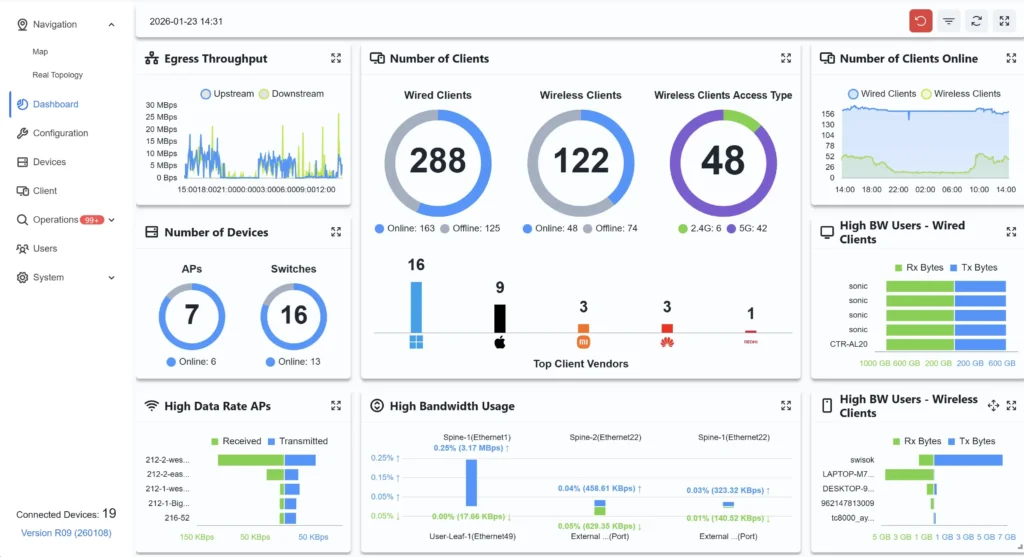
Unified PON and Wireless Management Solution is a method for unified control plane management of wireless APs and PON network devices, including OLT/ONU sticks, using the Asterfusion TIP-based Asteria OpenWiFi Controller. Through a single page, it monitors the status of all devices in the PON and wireless networks, allowing operators to quickly assess device status and troubleshoot network issues, ensuring smooth network recovery.
Ⅱ. Why Unified PON and Wireless Management Solution Appears?
In most traditional networks, the access layer is fragmented:
OLTs/ONUs are managed by the PON management system, while Wi-Fi APs are managed by the WLAN Controller.
In smaller networks, this issue may not be noticeable, but in scenarios such as campuses, education, and branch offices, this fragmentation quickly escalates the complexity of operations:
- When an AP goes offline, it is difficult to immediately determine whether the issue is with power, fiber, or wireless.
- With a decrease in optical power, has it already affected the Wi-Fi experience for end devices?
- Operators need to switch between multiple systems to piece together the full access link status.
The root cause of these issues is simple: the access network lacks a unified control and visibility plane that spans both “optical and wireless.”
The OpenWiFi Controller has evolved specifically to address this problem.
Ⅲ. Architecture Design: Treating the OLT as an “Access Device”
In OpenWiFi Controller Architecture, the OLT Stick is not considered an “external system” but is treated as an access node on par with the AP.
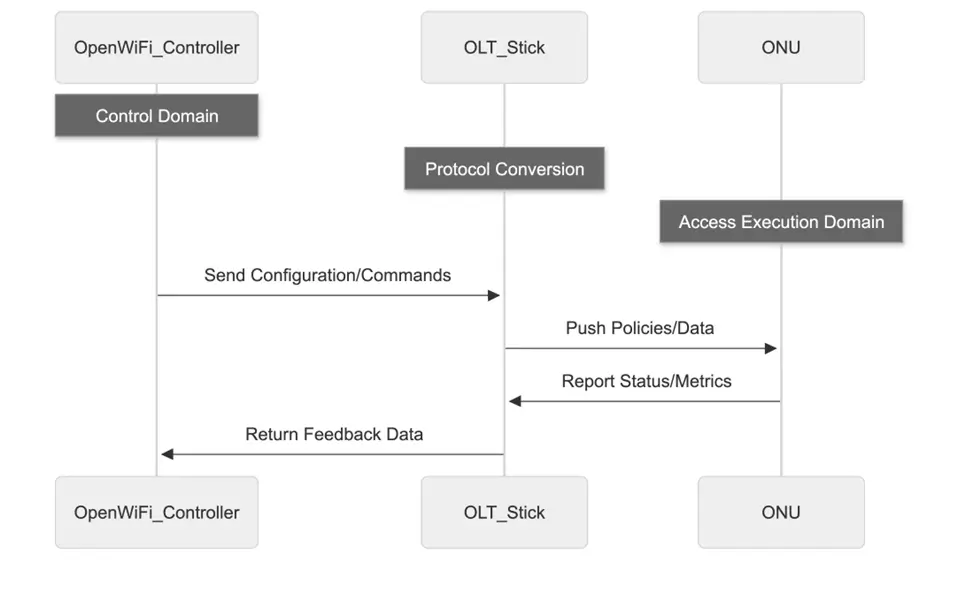
Logically, the system is divided into three main components:
OpenWiFi Controller
The brain and command center of the system, responsible for global strategy formulation, real-time monitoring, and intelligent decision-making.
Main Controller: Acts as the core controller, coordinating the operations of various modules and processing external API requests. It serves as the unified entry point to the system.
DHCP Service Module: Not only an IP allocator but also the guide for device discovery. By using Option 138, it transmits the controller address to OLT devices to achieve zero-touch auto-registration (alternatively, an external DHCP service can be used to obtain IP addresses).
Message Bus / Event Center: The system’s neural hub, utilizing a publish-subscribe model to achieve decoupled communication between components. All device state changes, alarm events, and configuration operations are routed through this bus.
Manager Components Set:
- Status Manager: Real-time aggregation of device statuses.
- Analytics Engine: Performs trend analysis and predictive maintenance based on historical data.
- Configuration Manager: Manages device configuration templates and policies, supporting bulk deployment and version control.
OLT Stick Domain
The executor of control policies and the aggregation point for access data, acting as the bridge between the controller and terminal devices.
- Protocol Conversion Hub: Connects to the optical port on the switch, communicating upwards to the controller through a standardized message interface, while managing ONU devices through the PON protocol, transparently converting between the two-layer protocols.
- Real-Time Data Proxy: Collects status information from all subordinate ONUs (optical power, online status, traffic statistics) and performs initial aggregation before reporting to the controller.
- Configuration Execution Engine: Receives configuration policies from the controller and converts them into specific OMCI/PLOAM instructions to be sent to each ONU.
- Local Intelligent Processing: Equipped with basic event filtering and alarm convergence capabilities, reducing the impact of invalid events on the controller.
ONU Domain
The final delivery point for network services, directly connecting to user devices.
- Physical Layer Access: Receives optical signals downstream from the OLT via fiber optics and sends user data upstream, completing the optical-electrical conversion.
- Service Carrier Platform: Provides multiple access methods for end-users, such as ONU Stick + SFP AP, PON AP, etc.
- Policy Implementation Endpoint: Implements QoS policies, security rules, VLAN assignments, etc., from the OLT to ensure service quality for users.
- State Sensing Unit: Monitors its working status (optical power, temperature, voltage) and the connected terminal information in real-time, reporting this data back to the OLT.
Core Design Principles
At the control plane level, OLT, ONU, OpenWiFi AP, and Switch all follow the same access, configuration, and status models.
Ⅳ. How Asteria OpenWiFi Controller Works: OLT/ONU Stick Onboarding Flow
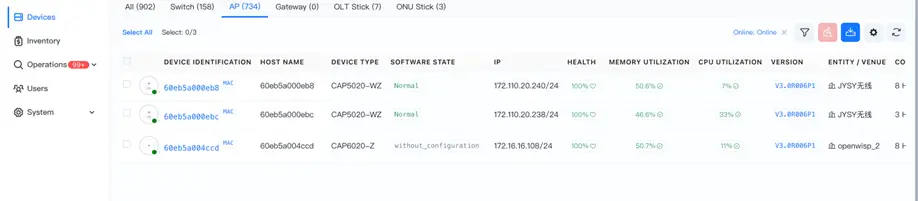
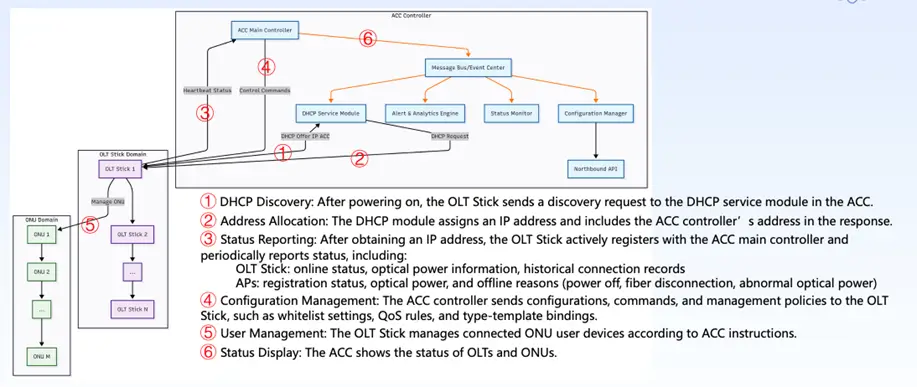
Asteria OpenWiFi Controller brings OLT and ONU sticks online through the following steps and functions, enabling unified PON and wireless management.
1. DHCP Discovery: Zero-Touch Provisioning (ZTP)
After power-up, the OLT stick sends a DHCP Discovery request, behaving like a standard access device. The request is received by the DHCP service module in the OpenWiFi Controller or on the spine switch.
This provides clear benefits:
- No preconfiguration of the controller address on the OLT
- Plug-and-play onboarding
- Suitable for large-scale deployments
2. IP Assignment and Controller Discovery
The DHCP response delivers the IP address and returns the OpenWiFi Controller address via DHCP Option 138. Then the OLT stick knows which controller to register with.
This process is identical to the OpenWiFi AP onboarding workflow.
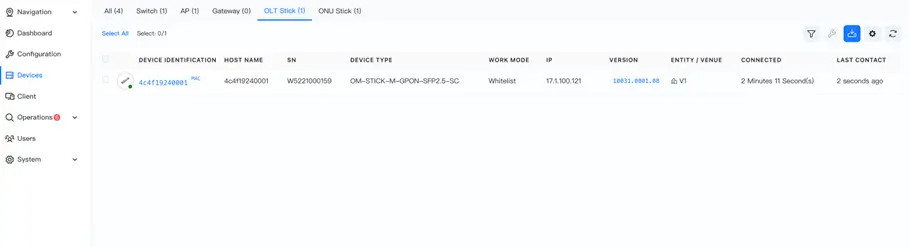
3. Registration and Continuous Status Reporting
After obtaining an IP address, the OLT stick initiates registration with the OpenWiFi Controller. It establishes persistent heartbeat and control channels.
The OLT periodically reports:
- Online and offline status
- Optical module information
- Real-time and historical optical power levels
- Connection history
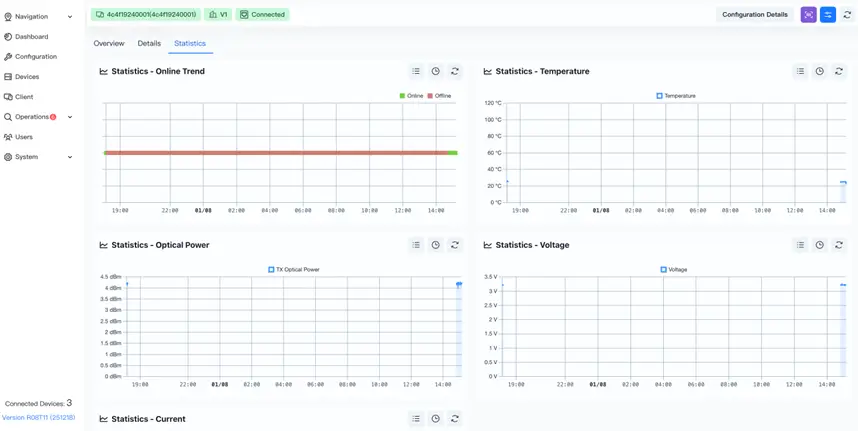
The controller correlates below data with AP status, for example:
- Whether AP outages are caused by abnormal optical power
- Whether Wi-Fi instability aligns with optical link fluctuations
From this point on, optical and wireless domains are managed within a single control plane.
4. Unified Policy and Configuration Delivery
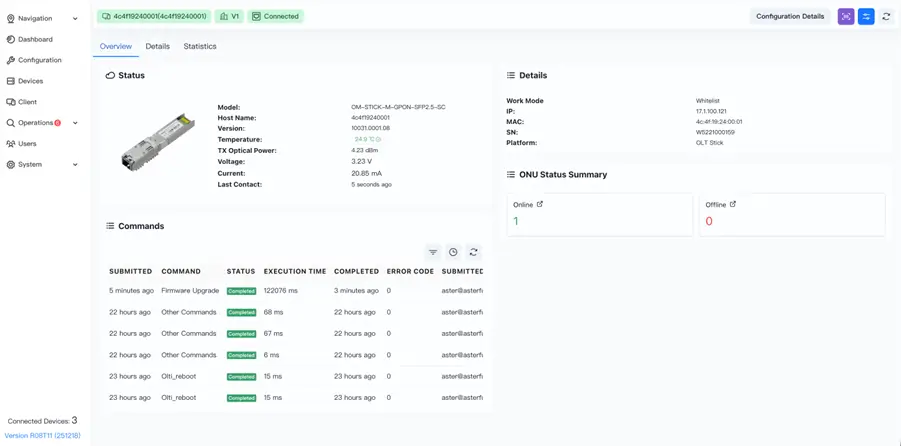
All policy decisions are centralized on the OpenWiFi Controller. The controller can push the following to the OLT stick:
- Whitelists and access control policies
- QoS and traffic shaping rules
- Type-template bindings
- Operations and management policies
This changes the OLT Stick role. It becomes a policy-driven and orchestrated access node, not a passive forwarding device.
5. ONU Access and Subscriber Management
Under unified controller instructions, the OLT stick executes actions on downstream ONUs:
- ONU admission control
- Per-subscriber policy enforcement
- Bandwidth and traffic management
The control model is explicit: The controller makes decisions, and the OLT enforces them.
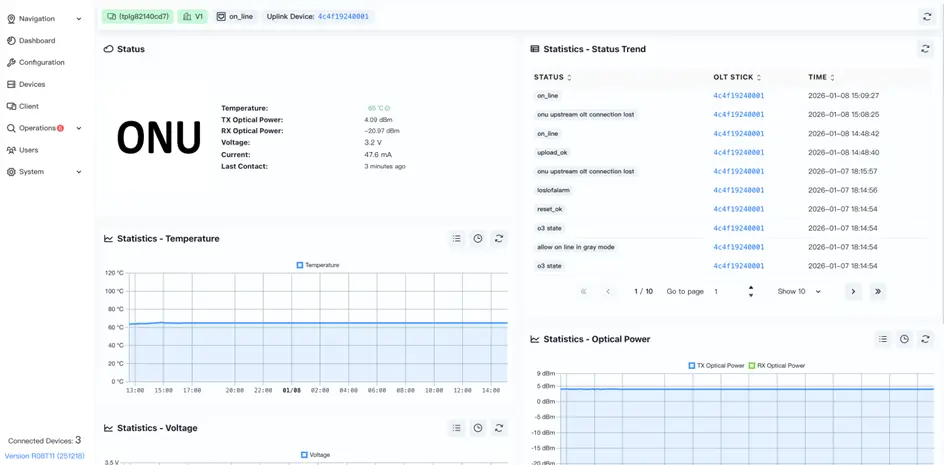
6. Unified Operational Visibility
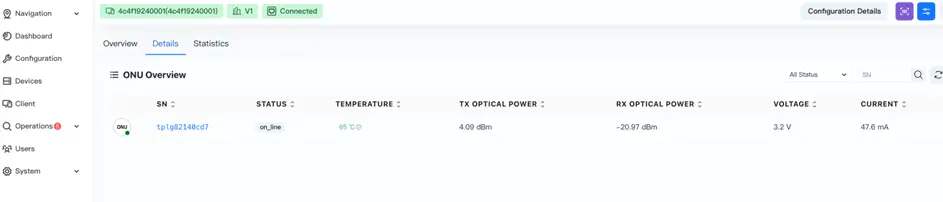
Within the OpenWiFi Controller, operators can directly view:
- Online status of all OLTs
- ONU topology under each OLT
- Optical power levels and online history per ONU
This delivers a true Single Pane of Glass for operations.
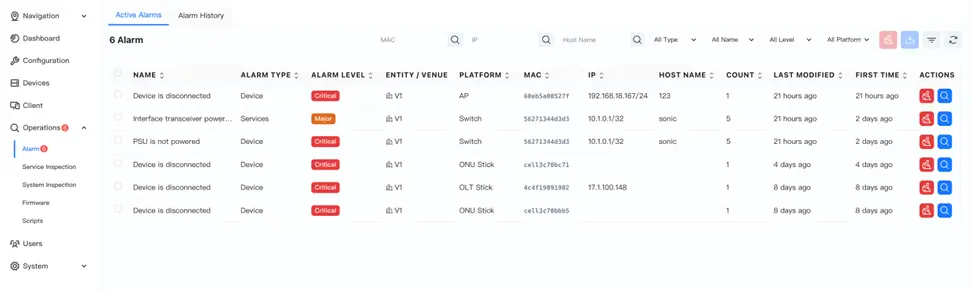
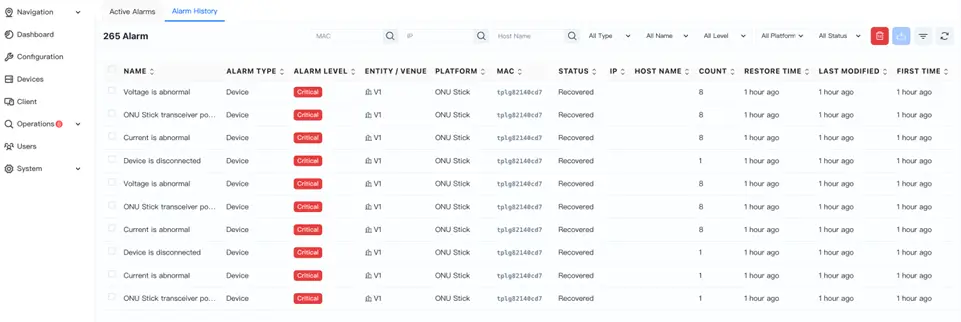
Ⅴ. Boundaries of OpenWiFi Controller’s Responsibilities
In the unified architecture, the OpenWiFi Controller does not participate in data forwarding. Its responsibilities focus on control and visibility layers:
The Controller is responsible for:
- Device registration and lifecycle management
- Aggregating OLT/ONU/AP status
- Policy decision-making and template binding
- Event, alarm, and historical data management
The OLT/ONU is responsible for:
- Data forwarding
- Optical link maintenance
- Executing policies delivered by the Controller
This clear division of responsibilities ensures stability and maintainability as the system scales.
Ⅵ. Use Cases and Advantages of Unified PON and Wireless Management
Take Educational Branch Network as an example:
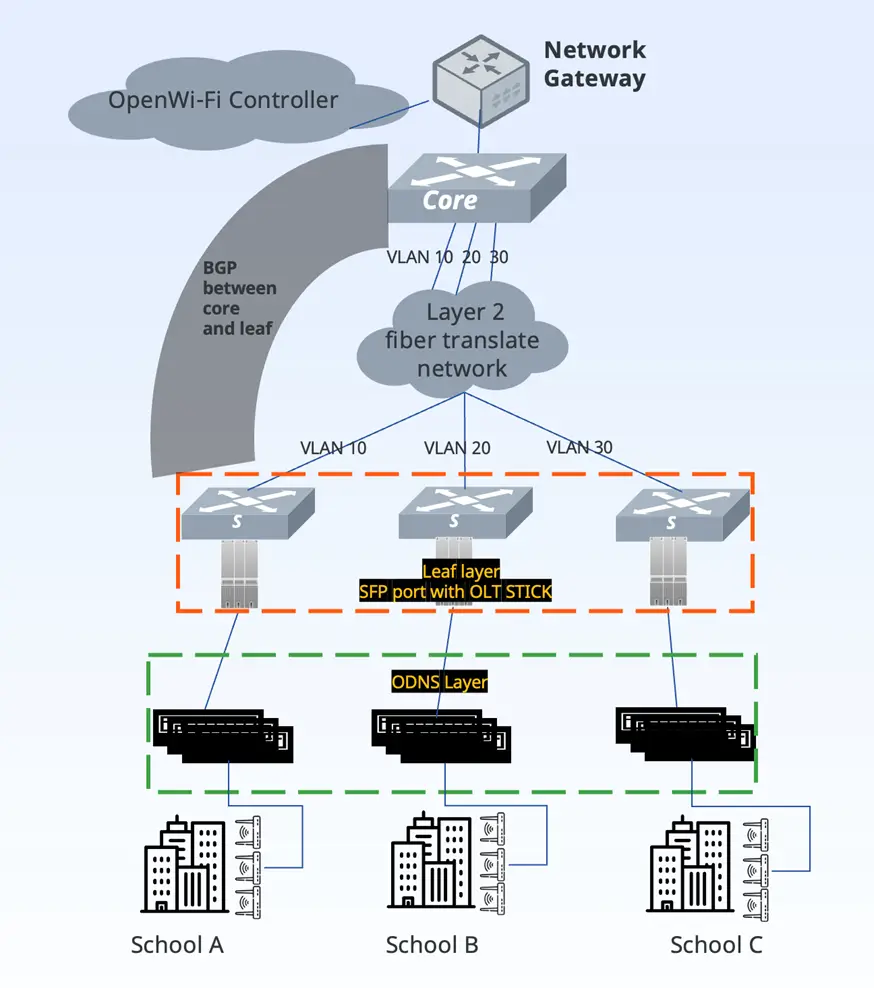
This topology illustrates the typical application of OLT Stick in a campus branch network. Using a Spine-Leaf architecture, the controller centrally manages the Spine, Leaf, OLT stick, and PON APs, with BGP running between the Spine and Leaf layers. The Leaf layer connects to the OLT Stick via SFP ports, converting various service VLANs (e.g., 10, 20, 30) from Ethernet to PON optical signals. These are then transmitted over fiber to the ODNs layer, ultimately connecting to OpenWiFi PON APs in multiple branch schools (School A, B, C), enabling efficient and scalable wireless access and management for the branch schools.
Network Advantages:
- Simplified Architecture: The Leaf switch directly connects to the OLT Stick, eliminating the need for traditional standalone OLT cabinets and reducing device complexity and space usage.
- Fiber Direct Connectivity: A single fiber carries services to a school, directly connecting to the OpenWiFi PON AP in the student dormitories, realizing FTTR (Fiber to the Room).
- Flexible Scalability: The Spine-Leaf architecture and BGP protocol allow for horizontal scaling. Adding new buildings to the school requires simply adding a port or OLT Stick at the Leaf layer for quick integration.
Operational Advantages:
- Centralized Control: The unified OpenWiFi Controller enables remote management of access devices at each branch, eliminating the need for on-site operations.
- Rapid Service Deployment: Template-based configurations for switches, OLTs, and OpenWiFi PON APs enable one-click configuration delivery, reducing service deployment time.
- Intuitive Fault Localization: The Controller can monitor OLT Stick and optical link status in real time, quickly identifying fiber cuts, VLAN errors, or device failures.
- Reduced Operational Costs: Simplifying physical layer devices reduces data center space requirements and energy consumption.
Ⅶ. Boundaries and Evolution of the Unified Control Plane
The Unified PON and Wireless Management Solution integrates the management of OLTs, ONUs, and OpenWiFi APs. However, this does not mean centralizing all network functions into a single system.
In the OpenWiFi architecture, the core value of the Controller lies not in “doing more,” but in consolidating the fragmented states, events, and control logic of the access network into a unified semantic space.
The introduction of this unified control plane brings several key changes:
- For the first time, the access network can be observed as a complete end-to-end path, rather than as two separate, independent systems.
- A traceable, correlated state relationship is established between the optical and wireless layers.
- Operations and architecture design shift to focus on “access experience” and “fault domains,” rather than a single technology stack.
It’s important to note that this model is not a simple replacement of traditional OLT management systems or wireless controllers. Instead, it provides a higher-level access control and abstraction for visualization.
As access methods continue to evolve toward “optical + wireless integration,” the responsibilities of the control plane are also gradually shifting—from a singular technical management tool to a unified platform capable of describing, correlating, and understanding the entire access path.
In this context, the value offered by the OpenWiFi Controller extends beyond device management. It provides a clearer and more scalable unified PON and wireless management solution for the future of access networks.

Contact US !
- To request a proposal, send an E-Mail to bd@cloudswit.ch
- To receive timely and relevant information from Asterfusion, sign up at AsterNOS Community Portal
- To submit a case, visit Support Portal
- To find user manuals for a specific command or scenario, access AsterNOS Documentation
- To find a product or product family, visit Asterfusion-cloudswit.ch


