Table of Contents
Introduction
With the evolution of 5G networks, the RAN architecture has been split into the Central Unit (CU) and Distributed Unit (DU). At the same time, the transport network has been further divided into fronthaul, midhaul, and backhaul segments.
In our previous article, we discussed how a GNSS-enabled switch provides synchronization in the fronthaul network. For details, refer to:
How to Deploy PTP Synchronization in 5G Open RAN Small Cell Networks with a GNSS-Enabled Switch
So, what should we focus on in the backhaul network?
What forwards traffic from the base station side to the operator network? What provides inter-site connectivity and aggregation between different sites?
The answer is the cell site router.
What Is A Cell Site Router ?
A cell site router (also known as a cell site gateway) is a routing device deployed at mobile network sites. It aggregates traffic from the access side and forwards it to the mobile backhaul network. It also provides wireless network-specific capabilities, such as time synchronization and service traffic steering.
For a 5G cell site router, the key functions include:
- Aggregating traffic from 4G/5G base stations and forwarding it to the upper-layer transport network or the mobile core network.
- Providing Layer 3 forwarding and carrier-grade network capabilities, such as MPLS and EVPN, to support network transport and hierarchical QoS.
- Supporting synchronization technologies, including IEEE 1588v2 PTP and SyncE, to provide frequency and phase synchronization for radio equipment.
As shown in the figure below, the network path can be simply understood as follows: a mobile phone connects to the edge network through a cellular tower and base station. The traffic is then forwarded through the cell site router into the operator’s backhaul network, and finally reaches the mobile core network and the Internet.

Cell Site Router Deployment Scenarios
Although the name cell site router includes “cell site”, its applications have expanded far beyond traditional sites such as utility poles and macro towers. Wherever mobile wireless access, multi-service aggregation, and high-precision synchronization are required, cell site routers can play a key role.
Macro Cell Site:
Macro cell sites provide wide-area coverage and handle high traffic volumes. The CSR acts as an aggregation node, forwarding traffic to the operator transport network. It requires high throughput capabilities and support for technologies such as SRv6/MPLS, HQoS-based network slicing, and PTP/SyncE synchronization to ensure multi-service isolation and high-SLA transport.
Small Cell / Indoor DAS:
Small cells are deployed for high-density coverage enhancement and are typically deployed in large numbers. In these scenarios, the CSR focuses on compact form factors, high port density, and remote O&M capabilities. It enables centralized aggregation of traffic from multiple small cells, edge traffic steering, and accurate time synchronization.
Outdoor Hardened Sites:
These sites are commonly deployed along transportation routes, in mining areas, or in locations without temperature-controlled cabinets. The CSR requires industrial-grade wide temperature support, dust and moisture protection, and highly redundant architecture to serve as an edge transport platform with strong environmental adaptability.
Edge Aggregation for Manufacturing, Ports, Transportation, and Other Industries:
In private 5G deployments, a small cell site router aggregates distributed base station traffic and forwards it through the private network to the enterprise core network or edge computing platform.
What Is Disaggregated Cell Site Gateway
After understanding the functions of a cell site router, you may frequently encounter another term in telecom and Open RAN discussions: DCSG (Disaggregated Cell Site Gateway).
Simply put, a DCSG is a cell site router based on a disaggregated architecture.
The DCSG concept was initially introduced around 2018 by the OOPT (Open Optical & Packet Transport) Working Group under the Telecom Infra Project (TIP).
At that time, global telecom operators, including Vodafone, Telefónica, TIM, and BT, jointly promoted this initiative. The goal was to break the dependency on traditional black-box telecom equipment and address new challenges brought by the 5G era. As a result, the disaggregation concept of Open RAN was extended to the transport and backhaul networks.
The core idea of a Disaggregated Cell Site Gateway is to decouple the hardware, network operating system, and network functions that are tightly integrated in traditional cell site routers. Similar to the open networking approach promoted by Asterfusion, the software-hardware disaggregated DPU-based ET Series platform is well suited for DCSG deployments. In a DCSG disaggregated architecture, the hardware platform, network operating system, and upper-layer network functions can be selected independently.
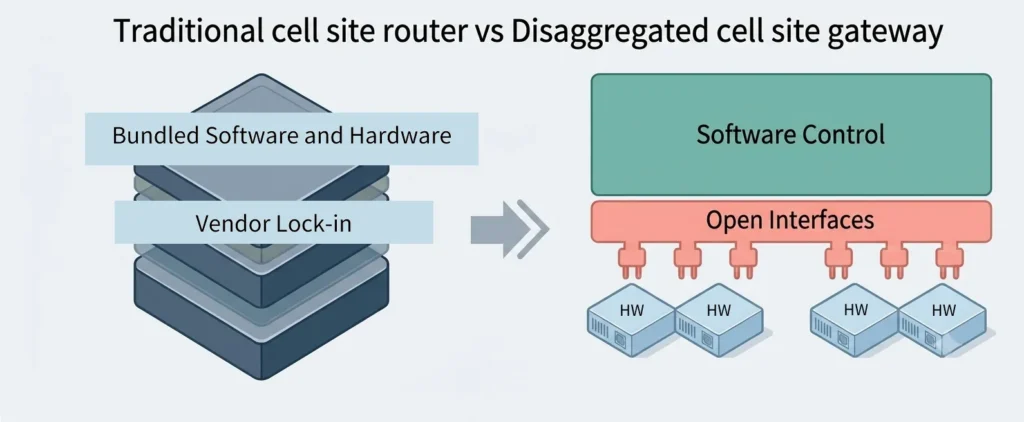
The open architecture of DCSG lowers the barriers for developers to build their own solutions on top of the platform and enter the mobile backhaul market. This approach accelerates innovation across the industry and encourages more emerging vendors to participate, bringing service providers more diverse and flexible solutions.
DCSG Benefits for Telecom
The reason DCSG was introduced is that traditional cell site routers accumulated several limitations during the 2G, 3G, and 4G eras, and these challenges have become more significant in the 5G era.
For telecom operators, the number of sites is increasing, deployment cycles are becoming shorter, and service requirements are becoming more complex. Continuing to rely on closed, single-vendor solutions can lead to higher costs, limited scalability, and more difficult integration.
The value of DCSG is to address these challenges. It enables operators to adopt a more open, flexible, and cost-effective approach when deploying 5G networks by allowing them to select hardware and software components independently, reducing the limitations of traditional cell site routers.
- Reducing vendor lock-in: Operators are no longer tied to a single vendor’s integrated hardware and software stack.
- Improving deployment flexibility: Different sites have different requirements in terms of scale, environment, synchronization, and backhaul connectivity. A disaggregated architecture makes it easier to support customized deployments.
- Accelerating technology evolution: Hardware can be upgraded based on its own lifecycle, while software and network functions can be updated independently without replacing the entire system.
What Makes a Good 5G Cell Site Router?
A good 5G cell site router is more than a router that simply forwards traffic. It acts as an edge transport node at the site, meeting both the bandwidth requirements of wireless backhaul and the telecom network requirements for synchronization, reliability, manageability, and future evolution.
As 5G base station interface speeds increase to 10Gbps and beyond, the site gateway must evolve accordingly. Otherwise, it can quickly become a bottleneck in the entire backhaul network.
1. Small Form Factor and Low Power
Space in telecom cabinets and resource-constrained edge environments is often limited, and these locations typically lack the standardized conditions of data centers. Therefore, the device must have a compact form factor, low power consumption, and strong environmental adaptability.
Common designs are typically based on a 1RU form factor or smaller. They must also support wide-temperature operation, efficient thermal management, and long-term operational stability.
2. High Interface Density
5G base stations typically require 10Gbps-level connectivity, while backhaul traffic continues to grow with increasing site density and new services. As a result, existing gateways deployed for 4G/3G/2G networks often require capacity expansion and connectivity upgrades.
A cell site router must provide higher interface density and higher access bandwidth to support different site requirements. Interfaces such as 25GE and 100GE should be supported to meet future backhaul demands.
3. Telecom-Grade Features
A device designed for 5G cell sites must provide a complete set of carrier-grade capabilities rather than basic routing and forwarding functions.
Typical capabilities include:
- PTP / SyncE: Provides frequency, phase, and time synchronization.
- MPLS: Supports carrier-grade transport and multi-service segmentation.
- HQoS: Enables hierarchical QoS management for different services.
- OAM: Simplifies operations, monitoring, fault diagnosis, and link management.
- Deep buffer: Handles burst traffic and congestion while reducing packet loss.
These capabilities are critical because mobile backhaul traffic differs from traditional enterprise network traffic. It has stricter requirements for latency, jitter, packet loss, and synchronization accuracy.
4. Easy Operations and Scalability
Complex configuration and operations can significantly slow down large-scale 5G deployments. An effective CSR should support features such as Zero-Touch Provisioning (ZTP), unified management platforms, and seamless scalability.
During long-term network evolution, efficient operations and maintenance become a key capability for telecom infrastructure.
How Asterfusion Builds a 5G DCSG
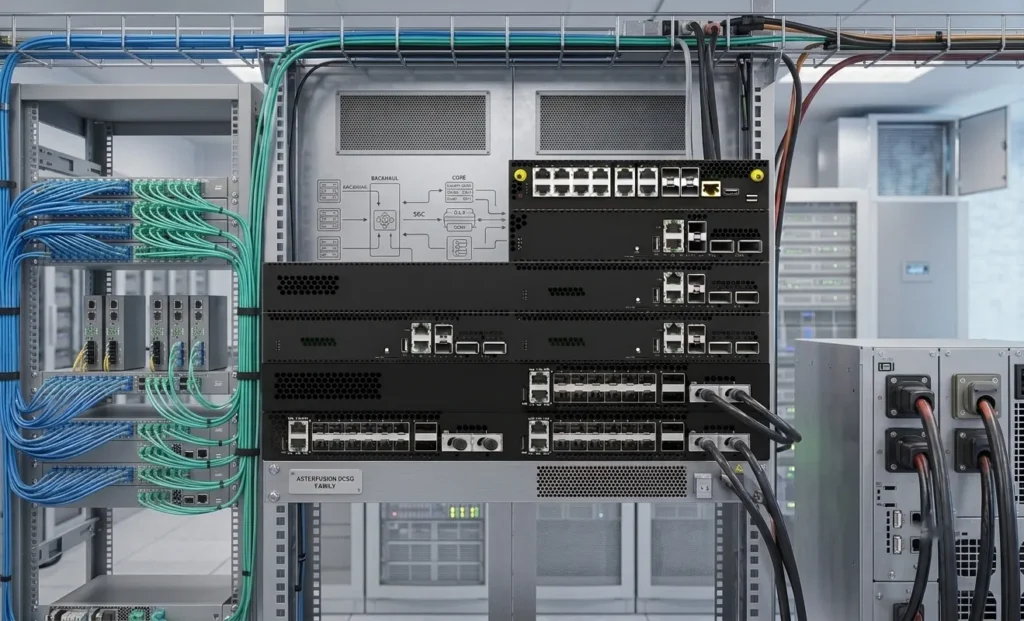
Asterfusion’s approach to building a 5G cell site router aligns with the goals of DCSG: creating a platform that can operate at the mobile network edge, handle high-bandwidth backhaul traffic, and retain the carrier-grade capabilities required for 5G sites.
From an architecture perspective, Asterfusion’s solution is built on open hardware and disaggregated software. It combines white-box hardware platforms with a mature SONiC-based network operating system (NOS), making it easier to adapt the platform to different network roles instead of limiting customers to a fixed proprietary device design.
This open architecture enables support for applications such as 5G UPF and network visibility, extending the platform beyond a traditional cell site router and enabling a broader edge platform model.
On the hardware side, Asterfusion’s ET Series provides a compact 1U form factor, high-speed Ethernet interfaces from 1G to 100G, and modular expansion options for 5G/LTE applications. These capabilities provide the hardware foundation required for cell site routers to scale from small cell deployments to higher-density edge aggregation sites.
The unified OpenWiFi Controller platform provides centralized operations and management capabilities. Through ZTP, devices can be remotely provisioned and configured automatically. The unified multi-dimensional dashboard enables operators to monitor device status, including CPU utilization and interface status, while also managing optical modules and other platform components.
Get a sample or evaluate the features: download the image here for free and contact us for more information.
Request a demo or need assistance ?
Fill out the form, and we’ll reach out to you today !


