Table of Contents
Introduction
During product learning, one routing protocol is often overlooked: IS-IS Protocol.
To better support MPLS and SRv6 ( More about SRv6 ) on CX-M series switches, the upcoming AsterNOS release introduces IS-IS support.
This article explains IS-IS protocol on SONiC, and how it operates in modern networks.
What is IS-IS Protocol ?
For routing protocols, we know they can be classified into EGP and IGP. For EGP, the most well-known protocol is BGP. For IGP, the one you are more familiar with is OSPF.
Actually, IS-IS is also an IGP, and it is similar to OSPF in many ways. Both are link-state protocols. They can learn the full network topology and compute the optimal path for routing forwarding.
Initially, IS-IS (Intermediate System to Intermediate System) was a dynamic routing protocol designed by ISO for its connectionless network protocol CLNP, and it is part of the OSI system.
Later, the IETF extended it in RFC 1195 to support both TCP/IP and OSI, known as Integrated IS-IS, which is what we commonly refer to as IS-IS today.
The reason why the IETF extended IS-IS to IP networks is that it valued its original framework of link-state + hierarchical design + TLV-based extensibility, which makes it suitable as a general-purpose and continuously evolvable IGP.
How does IS-IS Protocol Work ?
Let’s briefly understand how the IS-IS protocol works. The workflow can be divided into four steps:
- Neighbor establishment Routers first discover and establish neighbor relationships through Hello packets, confirming that both sides are in the same IS-IS domain and can exchange information.
- Link-state exchange Each router generates its own LSP, which describes local link-state information, and floods it to other routers. During this process, routers also use CSNP and PSNP for database synchronization, requests, and acknowledgements.
- LSDB synchronization All routers install received LSPs into their own LSDB, which is the Link-State Database. Once the databases are consistent, every router in the network has the same topology view.
- Shortest path calculation Each router runs the SPF algorithm based on the LSDB to compute the shortest path to each destination network segment, and then installs the results into the routing table.
At first glance, this process is very similar to OSPF.
Indeed, both share many similarities:
Commonalities:
- Link-State: Both use Dijkstra’s SPF (Shortest Path First) algorithm to build a topological map of the network.
- Fast Convergence: Both protocols converge quickly, making them suitable for modern, large-scale networks.
- Support for IP: Both support IPv4 and IPv6 routing.
Since both use the same underlying algorithm and are link-state routing protocols, why not just use OSPF instead of IS-IS? Why is IS-IS still needed? The next section will answer this question.
Why is IS-IS Protocol Necessary in Backbone Networks?
IS-IS Protocol is not designed to “replace” OSPF, it provides an alternative IGP design that is better suited for larger, flatter, and backbone-oriented networks.
In backbone networks, why is IS-IS more commonly used than OSPF? I think the answer should start from the differences between the two protocols.
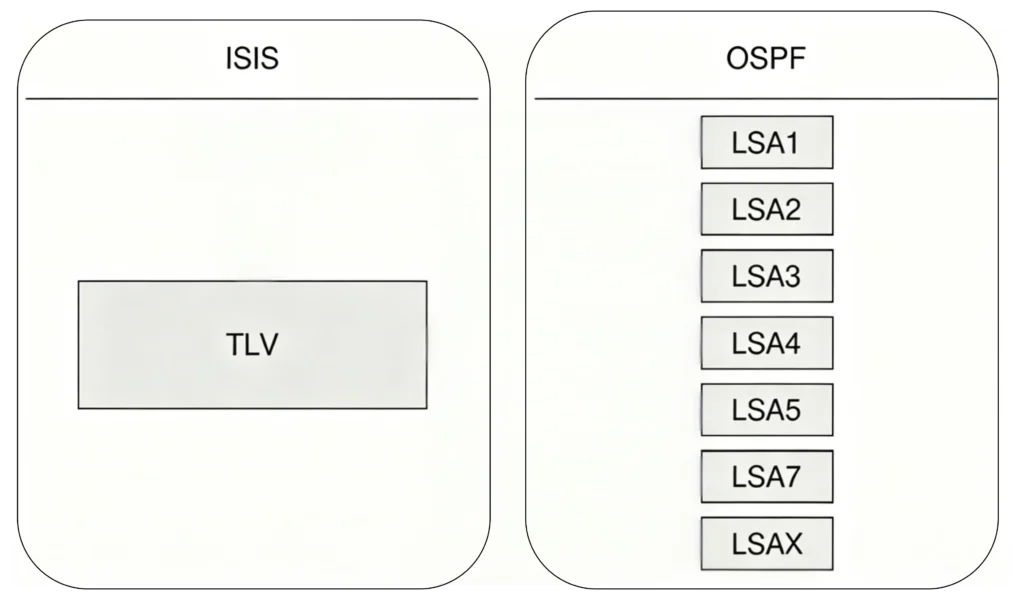
Key Differences Between OSPF and IS-IS Protocol
- Operating Layer: OSPF operates over IP (Protocol 89), while IS-IS protocol operates directly on the Data Link Layer (Layer 2), making it less susceptible to IP-based attacks.
- Structure: OSPF requires a rigid backbone area (Area 0) to connect all other areas. IS-IS uses a more flexible level-based system (Level 1/Level 2) where any contiguous set of Level 2 routers can act as the backbone
- Designation: OSPF uses a Designated Router (DR) and Backup Designated Router (BDR). IS-IS uses a single Designated Intermediate System (DIS).
- Network Size: IS-IS is often preferred for very large service provider networks due to its high stability and scalability.
- Scalability & Performance: Some networkers on Reddit and in Cisco Community discussions argue that IS-IS is more flexible and easier to maintain in large-scale deployments.
- Metric: OSPF uses cost based on interface bandwidth. IS-IS traditionally uses a simple metric, though it supports wide metrics, allowing more flexibility.
Among all these differences, the most important factor is the structural design.
IS-IS adopts a hierarchical architecture and a TLV-based extensible format. This is the key reason why IS-IS is considered an essential routing protocol in backbone networks.
Hierarchical Structure
IS-IS protocol typically divides the network into Level-1 and Level-2:
- Level-1 system: the communication domain composed of all Level-1 routers within the same IS-IS area (including Level-1-2 routers in that area), and it is responsible only for intra-area routing.
- Level-2 system: the backbone communication domain composed of all Level-2 routers, and also the portion of Level-1-2 routers participating in Level-2, responsible for inter-area routing and forwarding. The Level-2 backbone must be physically contiguous and must ensure connectivity across all Level-1 areas.
In an IS-IS network, routers also have three roles:
Level-1 routers are responsible for intra-area routing. Level-2 routers are responsible for inter-area backbone forwarding. Level-1-2 routers perform both roles simultaneously.
This hierarchical design makes IS-IS more suitable for large-scale networks, because the topology can scale in a layered manner instead of forcing all routers into a single flat topology domain.
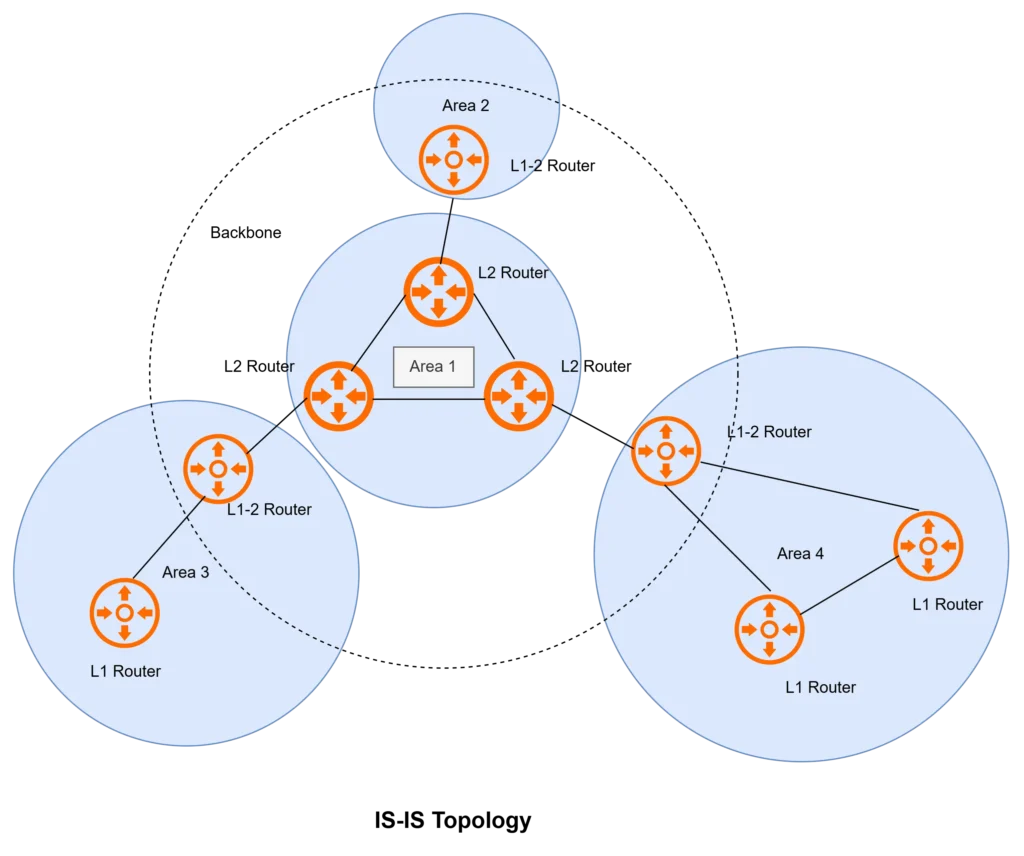
TLV makes IS-IS More Flexible
First, what is TLV. In IS-IS, TLV refers to Type-Length-Value, which is used to carry various extensible information in protocol messages.
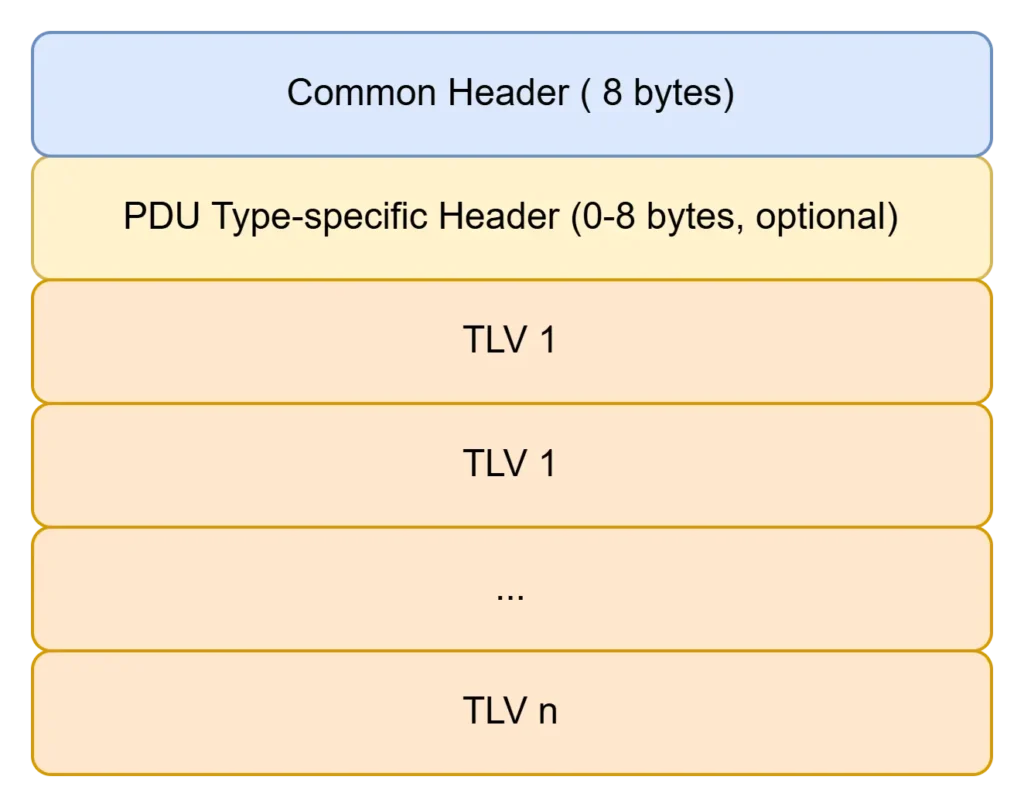
In simple terms, IS-IS PDUs carry multiple TLVs. Different TLVs represent different types of information, such as neighbor information, area addresses, authentication data, and IP reachability.
The benefits are as follows:
- Backward compatibility: Routers can process only the TLVs they understand. Unknown TLVs are skipped directly, and existing functions are not impacted.
- High extensibility: New technologies such as IPv6, MPLS, and Segment Routing are supported by introducing new TLV types. For example, when IS-IS is used with MPLS, it still requires signaling protocols such as LDP or RSVP-TE to build tunnels. However, IS-IS acts as the control plane protocol for routing decisions and RIB installation, and it provides strong extensibility.
- Flexibility and efficiency: Unlike OSPF, which uses fixed-format fields, IS-IS can carry information based on requirements. For example, when IS-IS is used with SRv6, it handles routing control together with the data forwarding mechanism.
- Protocol independence: IS-IS does not depend on IP. It can support IP, CLNP, and IPv6 simultaneously. It does not require separate processes for IPv4 and IPv6, unlike OSPF.
Conclusion
Why is IS-IS required in service provider networks?
- Protocol decoupling (no dependency on IP) OSPF runs over IP and depends on IP reachability. IS-IS runs directly over Layer 2 and does not depend on IP. When IP fails, the control plane can still converge. This makes IS-IS more suitable for large-scale backbone networks.
- TLV extensibility New features can be introduced by adding new TLVs without changing the protocol architecture. This supports extensions such as MPLS-TE, IPv6, and Segment Routing. It is a simple and efficient approach for service providers.
- Native hierarchical design The Level-1 / Level-2 structure is naturally suited for large-scale networks. It requires fewer area design constraints and provides more stable control of flooding behavior. This results in more stable performance in large topologies.
- Historical deployment advantage In the early stage, Cisco and Juniper dominated the service provider market. IS-IS was widely deployed from the beginning. MPLS-TE also matured first on IS-IS. Later, Segment Routing was standardized by the IETF on IS-IS as well (RFC 8667). This created strong industry adoption inertia and continued usage.
In our Enterprise SONiC implementation, IS-IS support is designed to provide a stronger foundation for MPLS-TE, Segment Routing, and SRv6. This enables a more flexible and resilient service provider backbone network.
Need assistance or more info ?
Contact US !
- To request a proposal, send an E-Mail to bd@cloudswit.ch
- To receive timely and relevant information from Asterfusion, sign up at AsterNOS Community Portal
- To submit a case, visit Support Portal
- To find user manuals for a specific command or scenario, access AsterNOS Documentation
- To find a product or product family, visit Asterfusion-cloudswit.ch


