Table of Contents
AsterNOS v6.1 Enterprise SONiC Distribution will support SRv6 in Q1 2026.
SRv6 (Segment Routing over IPv6) is an IPv6-based segment routing technology that deeply integrates the Segment Routing (SR) mechanism with the IPv6 protocol. By introducing the Segment Routing Header (SRH) extension into IPv6 packets, it enables flexible programming and optimization of network paths. SRv6 was standardized in the late 2010s (RFC 8754) to address the limitations of traditional networks, such as MPLS, in terms of complexity, scalability, and programmability. With the growth of 5G, cloud data centers, and service provider networks, SRv6 has become a core technology in modern network architectures. The AsterNOS v6.1 Enterprise SONiC campus edition will officially support SRv6 in Q1 2026, providing users with more agile, programmable, and scalable network capabilities.
What is SR (Segment Routing)?
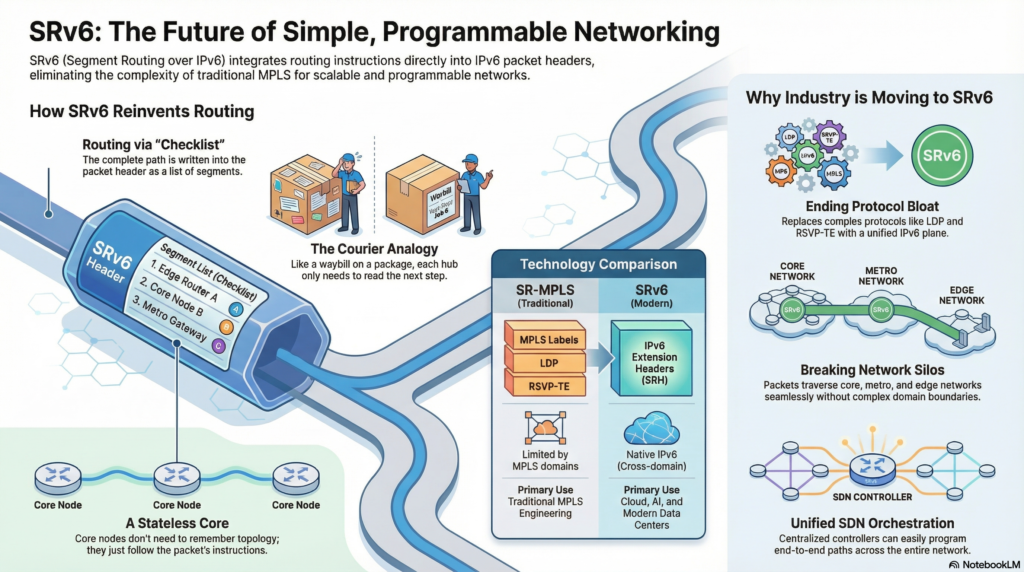
Before diving into SRv6, it’s important to understand what SR (Segment Routing) is. Although it may sound complex, the core idea is quite intuitive: break the network path into small “segments” and write the complete route into the packet, so the network can forward the packet step by step like following a checklist.
Key Concepts
- Segment
The basic unit of a network path. Each segment can represent:- A node (e.g., a switch or router)
- A link (the connection between two points)
- A service or function (e.g., firewall, load balancer)
- Segment List
A “route checklist” carried inside the packet, specifying the complete path from source to destination. - Stateless Core
Core network nodes don’t need to remember the entire network topology. They simply forward packets step by step according to the list inside the packet. This simplifies the network, makes it more scalable, and reduces management complexity.
How Segment Routing Simplifies Network Paths?
Traditional networks rely on many hop-by-hop protocols (such as MPLS’s LDP or RSVP-TE) to maintain paths, which makes the process complex and hard to scale. Segment Routing (SR) takes a different approach: plan the complete path at the source, write the path information into the packet, and let the core network simply follow the “next step” instructions.
Think of SR like attaching a travel checklist to each packet:
- The checklist specifies every node or service the packet should pass through
- Each network node only looks at the next step and forwards the packet accordingly
- The node doesn’t need to know the entire route, yet the packet still reaches its destination smoothly
Each step along the path is called a Segment, and every segment has a unique identifier (SID). The source node arranges multiple SIDs into a list and writes it into the packet, and subsequent nodes simply forward the packet step by step according to the list.
Analogy:You can think of SR like the transit process of an international courier: Suppose you send a package from Shanghai to New York, and it needs to go through multiple hubs, such as Hong Kong and Memphis: Shanghai (PVG) → Hong Kong (HKIA) → Memphis (MEM) → New York
When you place the order in Shanghai, the system has already planned the complete route for the package and written the path information onto the electronic waybill. Each hub only needs to check the next stop and forward the package accordingly, without needing to know the full transit chain. SR works in exactly the same way: the complete path is written into the packet, network nodes follow the “next step” instructions, and the packet ultimately reaches its destination.
Implementation Methods
SRv6 builds on the concept of SR, fully leveraging IPv6’s vast address space and extensibility to enable truly programmable, cross-domain, and cloud-native networks. Currently, there are two main ways to implement Segment Routing (SR):
SR-MPLS
- Implements segment routing using MPLS labels
- Each Segment corresponds to an MPLS label
- Packets are forwarded along the label list; the core network does not need to maintain end-to-end state
- Suitable for traditional MPLS networks and scenarios requiring compatibility with MPLS traffic engineering
SRv6
- Implements segment routing using IPv6 native extension headers (Segment Routing Header, SRH)
- Each Segment corresponds to a SID (Segment Identifier), which is an IPv6 address
- Packets carry the complete Segment List and are forwarded step by step across the IPv6 network
- Supports richer network functions and programmability, ideal for cloud, data centers, and modern network environments
| Implementation | Underlying Technology | Segment Representation | Core Network State | Typical Use Cases | Key Features |
| SR-MPLS | MPLS Labels | Each segment corresponds to an MPLS label | Stateless Core | Traditional MPLS networks, scenarios requiring MPLS traffic engineering compatibility | Leverages existing MPLS infrastructure; good compatibility; limited scalability and programmability |
| SRv6 | IPv6 Extension Header (SRH) | Each segment corresponds to a SID (IPv6 address) | Stateless Core | Cloud data centers, AI/HPC networks, modern programmable networks | Native IPv6; supports flexible path control and network function programming; highly scalable for future needs |
Why Do We Urgently Need SRv6?
With the rapid growth of cloud computing, 5G, enterprise digitalization, and AI, networks are expanding in scale and business types are increasing rapidly. The industry is demanding higher flexibility, automation, and end-to-end coordination. However, traditional IP/MPLS networks are beginning to show signs of being “outpaced” by modern requirements. The challenges can be summarized as follows:
1. Simplifying the Protocol Stack (Ending MPLS Complexity)
Traditional networks rely on a large number of protocols (such as LDP and RSVP-TE) to implement Traffic Engineering (TE) and Virtual Private Networks (VPNs). These protocols are intertwined, making the control plane extremely heavy. This leads to high maintenance costs and difficult troubleshooting.
SRv6 Solution: SRv6 leverages IPv6 extension headers (SRH) to carry routing instructions, achieving a unified control plane. The network no longer needs LDP or RSVP-TE; basic IGPs (like OSPFv3 or IS-IS) or BGP can handle all routing tasks. This simplified architecture is particularly friendly to modern white-box switches and open network operating systems such like SONiC, greatly reducing system complexity and overhead.
2. Breaking Network Silos and Simplifying Cross-Domain Interconnection
Pain Point of Traditional MPLS: Core, metro, and mobile networks belong to separate domains. MPLS labels are usually interrupted at domain boundaries (ASBR). To achieve cross-domain connectivity, operators had to rely on complex Inter-AS VPN solutions (Option A/B/C), which often require maintaining massive VRF tables on boundary routers (Option A) or complex multi-layer label stacking and back-to-back distribution. Cross-domain orchestration becomes a network operations nightmare.
SRv6 Solution: SRv6 is native IPv6. As long as the underlying IPv6 routing is reachable, SRv6 packets can traverse core, metro, and edge networks seamlessly. Intermediate ASBR nodes don’t need to maintain any complex VPN state or label mapping; they forward SRv6 packets just like ordinary IPv6 packets. This makes true end-to-end cross-domain orchestration possible.
3. The Foundation for Large-Scale Unified Orchestration
Pain Point of Traditional MPLS: Because networks are divided into domains and rely on multiple protocols, SDN controllers struggle to obtain a complete view of the topology and state, making it extremely difficult to implement end-to-end TE policies across multi-vendor domains.
SRv6 Solution: A unified IPv6 data plane combined with the highly programmable SRH (Segment Routing Header) allows a centralized SDN controller to easily collect network-wide information (via BGP-LS) and compute an optimal path across the entire network from the source node. The source simply encodes a list of SIDs (IPv6 addresses) into the packet header, and the service flows end-to-end without additional manual configuration.
Summary: Advantages of SRv6
One of the biggest features of SRv6 is that it makes the network programmable. Leveraging the vast IPv6 address space, each packet can carry detailed path information and processing instructions, allowing the network to intelligently schedule traffic based on service requirements instead of simply “guessing the route.”
SRv6 also greatly simplifies the network protocol stack. Compared to traditional MPLS networks that require managing multiple labels and complex protocols, SRv6 only needs IPv6 + SRH, along with a simple IGP or EVPN, to handle most service deployments. This means faster deployment, simpler operations, and lower error rates.
SRv6 naturally supports cross-domain unification. Whether in core networks, metro networks, or wireless access networks, a single SRv6 policy can span all domains without dealing with MPLS domain boundaries or complex inter-domain protocols—an especially important benefit for 5G and large-scale networks.
Finally, SRv6 is fully IPv6-based and can smoothly evolve within existing networks. Current IPv6 devices can forward SRv6 packets without modification and coexist with legacy networks. This enables the network to extend from the core to the edge and even to end-user devices, laying a solid foundation for future cloud-network convergence and IPv6+ architectures.


