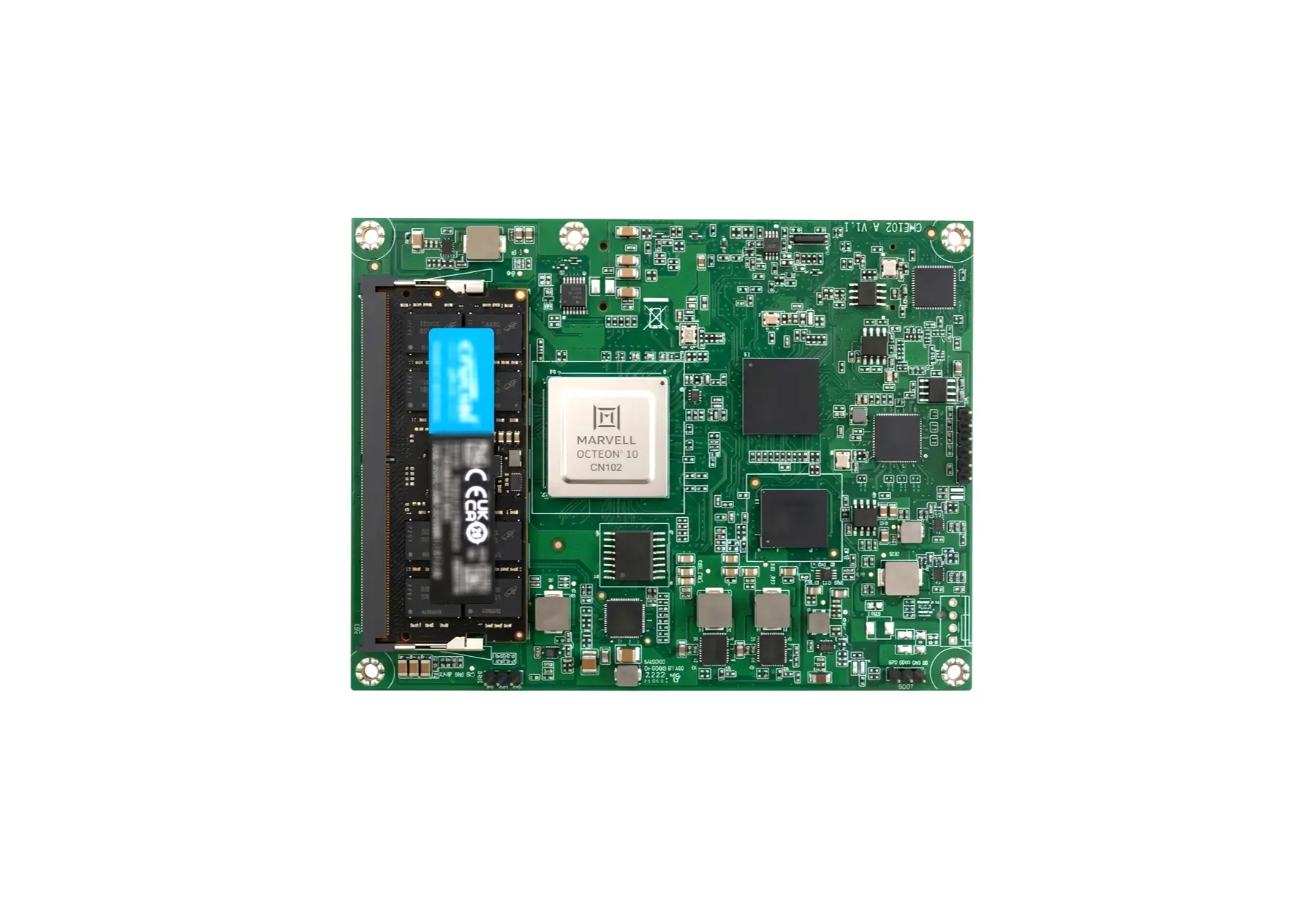
CME102
COM Express Type 7 Module with PCIe Gen3 Support, Marvell OCTEON
Highlight
Highlight
-
Leverage 5nm Marvell® OCTEON™ 10 CN102 processing power for superior efficiency
-
Achieve high-throughput performance with a SPECint® rate of 36.5
-
Utilize 48GB of DDR5 ECC memory at speeds up to 5600 MT/s
-
Feature integrated networking with 4× 10GBASE-KR plus Gigabit Ethernet
-
Support fanless operation within an ultra-low 33W TDP power envelope
-
Enable flexible system expansion via up to 5 PCIe lanes with Gen3 options
-
Used for white-box switches, storage devices, NGFW/UTM and SD-WAN
Computer-On-Module
Express Basic
Express Basic
Powered by Marvell OCTEON 10 CN102
The CME102 is a standard COM Express Basic module (125 × 95 mm) built on TSMC’s advanced 5 nm process. Powered by the Marvell® OCTEON™ 10 CN102 processor, it combines server-class Arm cores with dedicated hardware acceleration engines in a single SoC, providing an efficient alternative to traditional x86 platforms.
Designed for open networking and edge computing, it serves as the control plane CPU for white-box switches, storage systems, SD-WAN appliances, NGFWs, and 5G small cells.
The architecture separates control and forwarding functions. Eight Arm cores run Linux, network operating systems, storage services, and routing applications, while dedicated hardware engines handle packet processing and line-rate encryption.
This dual hardware offload design removes CPU bottlenecks in high-throughput and security-intensive workloads. Within a fanless 33W power envelope, it delivers full line-rate performance with significantly higher efficiency than conventional x86 solutions.
5nm
Process Node
8 x Neoverse N2
CPU Cores
33W Fanless
Processor TDP
KEY POINTS
Key Facts
5nm
Process Node
8 x Neoverse N2
CPU Cores
33W Fanless
Processor TDP
Specifications
|
Quality Certifications
Application Scenarios
The CME102 is designed as a flexible edge computing and networking engine, enabling deployment across a wide range of infrastructure roles including white-box switches, gateways, firewalls, AI edge nodes, SD-WAN systems, 5G small cells, NFV platforms, and industrial edge devices. It combines control-plane software execution with hardware-accelerated data-plane processing to support high-throughput, low-latency, and compute-intensive workloads at the edge.
| Device | Role & Function of CME102 |
|---|---|
| Switches | Control Plane CPU; runs SONiC OS and routing protocols. |
| Routers | Data plane acceleration; runs Routing and VPP control. |
| Gateway | Gateway services control; offloads intensive NAT and multi-protocol access. |
| Firewalls / NGFW / UTM | Security policy enforcement, DPI control, and VPN tunnel management. |
| SD-WAN | Edge computing node; offloads high-throughput Inline IPsec encryption. |
| Storage Devices | Host controller; runs Storage OS (Ceph/ZFS) and manages data services. |
| Edge Servers | Low-power compute core; powers localized containerized (K8s) workloads. |
| 5G Equipment | Core processor for vRAN, UPF, and MEC edge applications. |
| Industrial Devices | Ruggedized master control paired with edge AI computing algorithms. |
| AI Edge Boxes | Dedicated compute engine for real-time edge inference and video analytics. |
Features
Standard Basic Size, More Computing Power
This 125 × 95 mm Basic Size COMe module is better suited for higher compute performance and more complex I/O requirements, as it provides a larger PCB area to accommodate additional components. It features a 440-pin board-to-board connector (0.5 mm pitch, TE), with a matched heatsink solution available, and supports an operating temperature range of 0–60°C, ensuring supply continuity and a stable roadmap for long-term deployments.
Server-Class Performance, Edge-Class Efficiency
Powered by 8× Arm Neoverse N2 cores built on a 5 nm process, the platform delivers server-class throughput with 1 MB L2 cache per core and up to 16 MB shared last-level cache. Operating within a 33 W fanless power envelope, it eliminates the need for chassis fans, reducing BOM costs, simplifying thermal design, and enabling reliable deployment in space- and power-constrained edge environments.
VPP Integration for Carrier-Grade Networking
Featuring on-chip 4×10G-KR connectivity, a hardware VPP packet engine, and inline IPsec/crypto acceleration, the platform delivers wire-speed forwarding with minimal CPU involvement. Data-plane workloads run on dedicated hardware engines rather than general-purpose cores, enabling carrier-grade routing, firewall, and BNG performance in a compact footprint.
Comparison
Comparison with Intel® Xeon® D COM Express
| Parameter | CME102(CN102) | Intel Xeon D-1527 | Intel Xeon D-1700(17xx) |
|---|---|---|---|
| CPU Cores | 8x Neoverse N2 (Armv9) | 4C / 8T · Broadwell | Up to 10C / 20T · Ice Lake |
| Process Node | 5 nm | 14 nm | 10 nm |
| Processor TDP | 33 W · fanless-capable | 35 W | Up to 67 W |
| Memory | DDR5-5600, ECC | DDR4-2133 | DDR4-2933 |
| Integrated 10G Ethernet | 4x 10G-KR + GbE on-die | Up to 2x 10GbE | 4x 10G-KR |
| Packet+Crypto Offload | HW VPP + inline IPsec | AES-NI | Intel QAT |
| Fanless Operation | ✓ | Marginal | ✕ |
FAQs
1. What is COM Express (COMe)?
COM Express is an open industry standard (PICMG COM.0) that integrates the core of a computer (CPU, memory, bus interfaces) into a compact module, designed to be plugged into a custom carrier board. This modular architecture allows developers to build specialized embedded systems quickly and simplifies future hardware upgrades without redesigning the entire system.
2. What role does a COM Express module play?
It acts as the “core brain” of the system. In the context of the Asterfusion CME102, it serves as both a high-performance compute engine and a Data Processing Unit (DPU). It connects to the carrier board via standardized pinouts, providing the compute, high-speed I/O, and networking backbone for end-user applications like edge routers, firewalls, or 5G small cells.
3. How does this compare to Intel Xeon D modules, and what are its advantages?
-
Efficiency: The CME102 utilizes a 5nm process, achieving 8-core performance within a 33W TDP. It is capable of fanless operation, whereas the Intel Xeon D-1700 series typically requires active cooling due to a significantly higher power envelope (up to 67W).
-
Network Hardware Acceleration: Unlike Intel-based modules that rely on general-purpose cores for networking, the CME102 includes dedicated hardware VPP packet engines and inline IPsec/crypto offload, ensuring wire-speed processing without taxing the CPU.
-
Architecture: Based on the Arm Neoverse N2 architecture, it is specifically optimized for high-throughput, low-power networking at the edge.
4. What are the key hardware specifications to note?
-
Processor: Marvell OCTEON 10 CN102, 8-core Arm Neoverse N2 (5nm).
-
Memory: Supports up to 48GB of DDR5 ECC memory at speeds up to 5600 MT/s.
-
Networking: Integrated 4×10GBASE-KR and 1×GbE, perfect for high-bandwidth networking gear.
-
Connectivity: Features up to 6 PCIe lanes, with Gen3 (CME102) support to accommodate high-speed peripheral expansion.
