Table of Contents
What is a COM Express Type 7 Module?
COM Express (Computer-on-Module Express) is a highly integrated standard for embedded computer modules. Type 7 is a pinout type primarily tailored for servers and networking, introduced by the PICMG organization in the COM Express 3.0 specification.
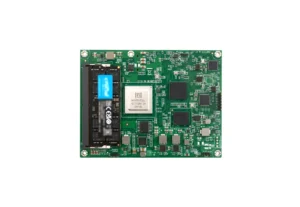
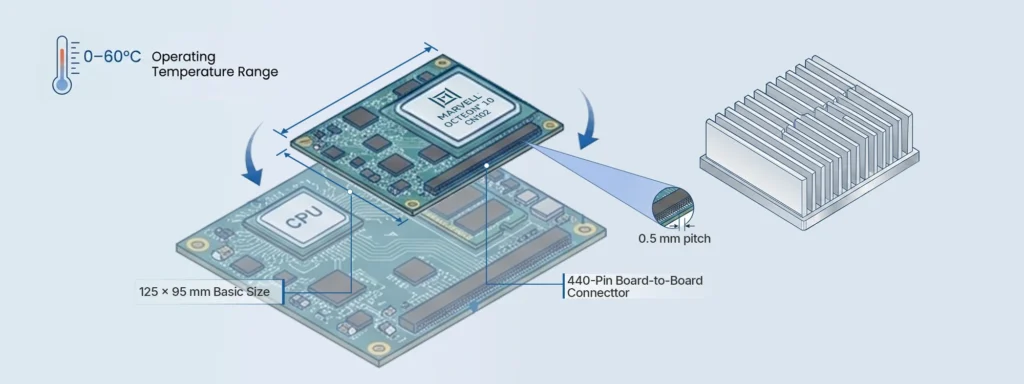
Simply put, it condenses a traditional server’s CPU, memory, and core control logic onto a single board roughly the size of a photo negative (typically the Basic form factor: ), while leaving all external interfaces (such as 10GbE ports and PCIe slots) to the Carrier Board.
Why Do We Need It?
Before the debut of Type 7, embedded edge computing faced an awkward performance gap: Type 6 modules boasted powerful graphics performance but lacked high-bandwidth data throughput. With the explosion of 5G, IoT, and edge AI, massive amounts of data must be processed and transmitted locally, creating a vital need for “edge servers.” Type 7 was engineered precisely to address this demand:
- Eliminating Displays to Free Up Pins: Edge servers have no need for 4K monitors. Type 7 completely removes all graphics interfaces found on Type 6 (such as HDMI/DP and LVDS), reallocating those freed-up pins entirely to high-speed data transmission.
- A Quantum Leap in Network Throughput: For the first time, it integrates up to four 10GbE (10 Gigabit Ethernet) network interfaces directly onto the module, while supporting NC-SI (Network Controller Sideband Interface) for remote out-of-band management.
- Massive Extensibility: The number of PCIe lanes skyrockets to up to 32 lanes, allowing for a seamless connection to high-speed NVMe SSDs, GPU accelerator cards, or FPGAs.
How Does It Work?
Type 7 utilizes a dual-board architecture consisting of a “Module + Carrier Board”.
+---------------------------------------------------+
|            COM Express Type 7 Module              |
|        (CPU + DDR4/DDR5 + Controllers)            |
+---------------------------------------------------+
                          |
             (Two 220-pin Connectors)
                          |
+---------------------------------------------------+
|               Custom Carrier Board                |
| (Power, 4x 10GbE SFP+, PCIe Slots, SATA, USB)     |
+---------------------------------------------------+- The core computing happens on the module itself. The module integrates server-class processors such as Intel Xeon-D, AMD EPYC, or embedded DPU like Marvell Octeon, which handle the main compute workload and complex data processing tasks.
- Signals are routed through high-density board-to-board connectors. The module uses two rows of connectors (Row A/B and Row C/D, totaling around 440 pins) to carry high-speed interfaces such as PCIe, 10GbE KR, USB, SATA, and other I/O signals down to the carrier board.
- The carrier board is responsible for physical interface breakout. It does not host any complex CPU logic. Instead, it converts high-speed electrical signals from the module into external interfaces such as SFP+ optical ports or RJ45 Ethernet ports.
- This architecture enables seamless upgrades. When compute performance is no longer sufficient after a few years, the entire system does not need to be redesigned. You simply replace the Type 7 module with a newer generation, while fully reusing the existing carrier board.
What are the application scenarios of a COM Express Type 7 Module?
A Type 7 COM Express module is not designed for consumer-facing or display-oriented systems like smart retail kiosks or automotive dashboards. Its real value shows up in environments where compute density, network throughput, and reliability matter far more than graphics or UI.
You typically find it in systems that sit close to the network or data plane, acting as the “brains” behind infrastructure workloads.
Control CPU of Networking and Storage Equipment:
In networking and storage equipment, for example, the Type 7 module often serves as the control plane CPU. It is responsible for managing routing tables, running protocols such as BGP or OSPF, monitoring system health, and coordinating high-speed forwarding ASICs. In other words, it doesn’t forward packets itself—it tells specialized chips how to do it efficiently.
5G Edge Computing and MEC Environments
The same logic applies in 5G edge computing and MEC environments. Instead of sending all data back to a centralized cloud, processing happens directly at the edge of the network, closer to base stations. This reduces latency and makes real-time services possible.
Industrial Automation and Machine Vision
In industrial automation and machine vision, the use case is also very different from traditional embedded systems. You’re no longer dealing with a few sensors—you might be connecting dozens of high-resolution cameras and running real-time AI inference for defect detection or quality inspection. That level of data throughput simply requires a much more capable compute-and-network platform.
Network Security and Storage Appliances
Network security and storage appliances are another natural fit. With multiple 10GbE interfaces combined with a server-class CPU, a Type 7 module becomes a strong foundation for building high-performance firewalls, VPN gateways, or enterprise-grade NAS systems.
Military and Aerospace environments
Even in military and aerospace environments, where ruggedness matters more than anything else, Type 7 modules can be deployed as sealed, thermally managed compute units. In scenarios like armored vehicles, aircraft, or radar stations, traditional rack servers are often impractical, while compact embedded server modules become the only viable option.
What is the Asterfusion COM Express Type 7 CME102?
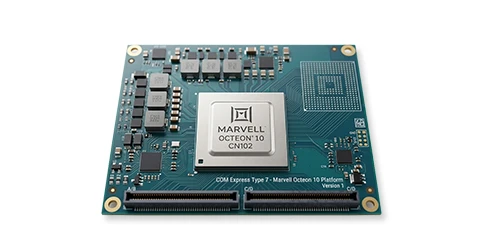
The CME102 is a high-performance control-plane CPU module designed for next-generation open networking systems. It integrates the Marvell® OCTEON™ 10 CN102 DPU into a standard COM Express® Type 7 Basic form factor, providing a fully plug-and-play compute core for custom carrier board designs.
Built with a low 33W thermal design power (TDP) and optimized for fanless operation, the module incorporates eight server-class Arm® Neoverse™ N2 cores based on a 5nm process. It is paired with high-bandwidth DDR5 memory, multiple native 10GbE interfaces, and rich PCIe connectivity. In addition, it includes on-chip acceleration engines dedicated to packet processing (VPP-style workloads) and inline IPsec encryption and offload.
Designed by networking engineers for real-world infrastructure use cases, it can serve as the control-plane brain in whitebox switches and network storage platforms, while also delivering strong data-plane acceleration capabilities for edge routers, next-generation firewalls (NGFW/UTM), SD-WAN gateways, 5G small cells, and other open networking systems.
What Problem Does It Solve?
By adopting a standardized COM Express architecture, the CME102 significantly simplifies system design and allows a true plug-and-play hardware model. This reduces hardware development cycles from years to just a few months.
Despite its compact 33W fanless design, the module still delivers eight full-fledged server-class Arm cores. More importantly, through its heterogeneous DPU architecture, heavy workloads such as packet processing and IPsec encryption are fully offloaded to dedicated hardware accelerators. This enables full line-rate performance without consuming general-purpose CPU resources.
In a market where traditional x86-based solutions are increasingly challenged by high power consumption and supply chain uncertainty, the CME102 provides a practical alternative for networking and edge equipment vendors seeking a balance between performance, efficiency, and system flexibility.
Highlight 1: A Server-grade 8-core CPU that Breaks Traditional Embedded Networking Performance Limits.
When traditional networking equipment moves away from x86 and adopts conventional embedded processors, it often runs into a familiar bottleneck: basic packet forwarding may be sufficient, but once the system is pushed into running advanced routing protocols, deep security policies, or complex service auditing workloads, compute resources quickly become strained.
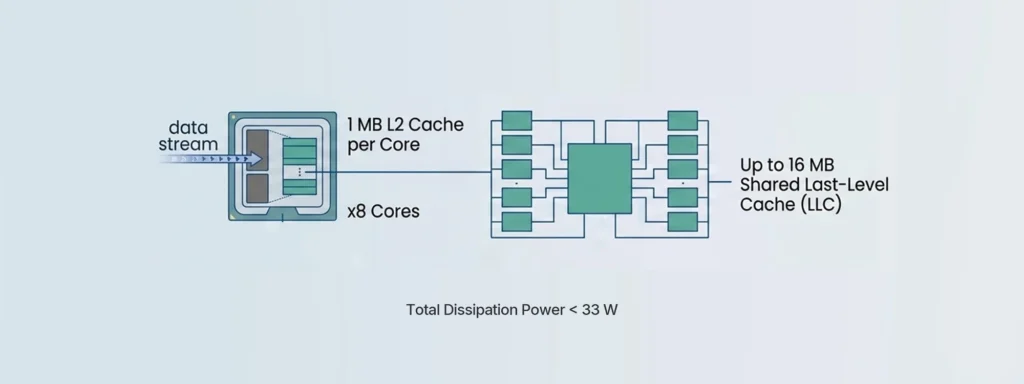
The CME102, however, takes a different approach. It is built on a solid server-class foundation, achieving a SPECint® rate of 36.5. At its core, it integrates eight true server-grade Arm Neoverse N2 cores, each equipped with a dedicated 1MB L2 cache, delivering a total of 16MB last-level cache (LLC).
This effectively moves the module beyond the category of typical low-power networking silicon. Instead, it behaves much more like a server-class compute engine with strong networking capabilities. No matter how complex the control-plane logic becomes, it can handle the workload smoothly and maintain stable system performance.
Highlight 2: Outstanding Power Efficiency Enabled by 5nm Process, with 33W TDP
One of the most pressing challenges in today’s industry is not only ensuring stable supply across different CPU architectures, but also dealing with the high power consumption of traditional x86 platforms, which often range from 50W to 70W or even higher. This inevitably creates significant thermal pressure and increases operational costs, typically requiring active cooling with fans. In harsh edge environments, however, fans become a point of failure—once a mechanical component fails, the entire system can be compromised.
The CME102 fully leverages the generational efficiency gains of the 5nm process node. It achieves a remarkable balance: up to 3× performance improvement compared to the previous-generation DPU, while reducing power consumption by around 50%. Despite its strong compute capabilities, the design thermal power (TDP) is kept within 33W.
This 33W power envelope makes fanless system designs not only possible but practical. By minimizing energy consumption while maintaining high performance, the module can be deployed seamlessly in sealed, rugged edge environments. The result is a system that offers excellent energy efficiency, dust resistance, and round-the-clock operational reliability.
Highlight 3: Dual Hardware Offload for Networking and Security
In traditional solutions based on Intel Xeon or general-purpose embedded CPUs, tasks such as PPPoE dialing, NAT translation, ACL enforcement, and IPsec encryption are all handled by the CPU through software-based protocol stacks. Under high traffic loads, this quickly leads to CPU saturation, increased latency, and reduced throughput. Once encryption is enabled, overall performance can even drop by more than 70%.
The CME102 takes a fundamentally different approach by leveraging the inherent control-plane and data-plane separation of a DPU architecture, built on the Marvell OCTEON 10 CN102 platform. Within a single SoC, workloads are clearly divided through efficient heterogeneous computing.
On the control plane, eight Arm Neoverse N2 server-class cores act as the system’s orchestration layer. They are responsible for running the Linux base system, the network operating system, VPP control components, and computing higher-level functions such as BGP/OSPF routing decisions and security policies.
On the data plane, all compute-intensive packet processing tasks—such as hardware-accelerated VPP processing and inline IPsec encryption/decryption—are fully offloaded to dedicated on-chip hardware engines.
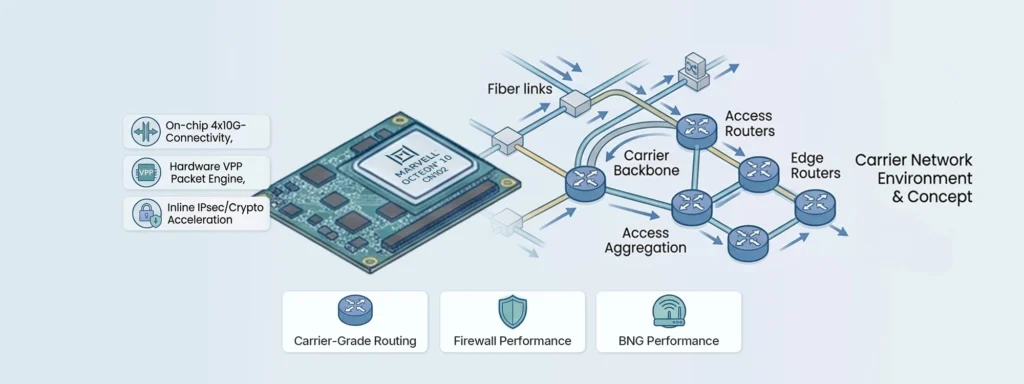
Unlike traditional architectures where general-purpose CPUs are forced to handle both control and forwarding workloads, the CME102 cleanly separates the two. The CPU focuses on intelligent control and coordination, while hardware engines handle high-speed execution in parallel.
When traffic scales up, NAT translation, IPsec encryption, and packet forwarding are executed directly through dedicated hardware pipelines at full line rate, without consuming ARM CPU resources. This tight software-hardware co-design enables a balanced system that delivers high throughput, low latency, and strong security compliance, making it an ideal foundation for BNG, next-generation firewalls, and SD-WAN platforms.
In the next article, we will summarize:
Where can the Asterfusion COM Express Type 7 ARM DPU be Used?
Asterfusion 33W ARM COM Express Type 7 Module: Top 6 Open Networking Use Cases
ARM vs x86 COM Express Type 7:Which to Choose?
ARM COM Express Type 7 vs x86 COM Express Type 7: Which to Choose?
Intel Xeon D Alternative: Asterfusion COM Express Type 7 DPU
Intel Xeon D Alternative: Asterfusion COM Express Type 7 DPU Powered by Marvell Octeon CN102


