Table of Contents
In our previous articles, we demystified the what is COM Express Type 7 and Asterfusion CME102 , explored its use cases, weighed the pros and cons of x86 versus ARM modular technologies, and established a strategic framework for hardware selection.
Now, we arrive at the definitive core of our technical breakdown. We have previously asserted that ARM-based COM Express modules—when serving as white-box switch control CPUs or powering 5G small cells, SD-WAN gateways, edge routers, and Next-Generation Firewalls (NGFW)—do not merely match x86 performance, but frequently surpass it.
Where is the empirical evidence? Below is the data-driven blueprint demonstrating the monumental generational advantages of the CME102 over the legacy Intel Xeon D series.
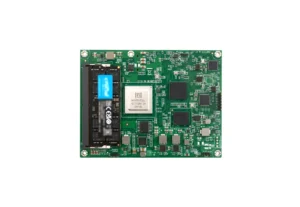
The Generational Advantages: CME102 vs. Intel Xeon D Series
Process Node & Microarchitecture: Gen-Over-Gen Technological Dominance (5nm vs. 14nm/10nm)
This architectural gap serves as the foundation for the massive canyon in energy efficiency between the two platforms:
- Process Node: The Intel Xeon D-1527 remains anchored to a legacy 14nm process, and even the newer D-1700 series (Ice Lake-D) maxes out at a 10nm node. Conversely, the CME102 leverages TSMC’s advanced, cutting-edge 5nm finFET technology.
- Core Architecture: The CME102 implements 8 genuine server-class Arm® Neoverse™ N2 cores (built on the Armv9.0-A architecture), backed by a 16 MB shared Last Level Cache (LLC) alongside a dedicated 1 MB L2 cache per core.
The Engineering Edge: The sheer transistor density of the 5nm process, combined with a highly advanced microarchitecture, empowers the CME102 to hit a robust SPECrate2017_int benchmark score of 36.5. This allows the module to deliver single-core computing efficiency and data throughput that vastly outclasses aging x86 layouts while minimizing physical overhead.
Radical Performance-per-Watt: 33 WExtreme Fanless Deployment vs. 67W Thermal Liabilities
In edge computing and industrial environments, performance-per-watt metrics and thermal dissipation boundaries represent the strict dividing line between system viability and field failure:
- Energy Efficiency Duel: Evaluated at peak workloads, the CME102 achieves an extraordinary efficiency metric of approximately 1.5 SPECint / watt. This translates to a single-core power consumption footprint that is roughly half that of a comparable Xeon D-1700 module.
- Thermal Design Power (TDP): Even with all 8 cores fully engaged and memory and network I/O channels running at maximum capacity, the CME102 locks its total TDP at a lean 33W. This enables seamless, reliable fanless system integration (Fanless-capable). In stark contrast, the Intel Xeon D-1700 spikes up to a demanding 67W.
The Engineering Edge: Because of their thermal profile, Xeon D deployments typically require active fan cooling in enclosed edge setups (typically a non-starter for fanless form factors). In dusty, humid industrial spaces or tightly sealed outdoor enclosures, mechanical fans introduce critical points of failure. The CME102, with its 33W fanless capability, enables continuous, zero-maintenance deployments at the absolute physical edge.
Silicon-Level I/O Integration: DDR5 + 4×10G Native On-Die Synergy
- The CME102 perfectly executes a highly integrated System-on-Chip (SoC) methodology, whereas the legacy Intel alternative relies on a fragmented, multi-chip board layout:
Memory Bandwidth: The CME102 pioneers native support for DDR5 running at 5600 MT/s (featuring ECC error correction, up to a 48GB capacity). - The Xeon D-1700 remains restricted to DDR4-2933, while the D-1527 is bottlenecked at legacy DDR4-2133. By doubling the memory throughput bandwidth, the CME102 creates a massive pipeline for ultra-fast packet buffering and rapid data streaming.
- Native Network Integration: The CME102 natively integrates 4× 10G-KR + GbE MAC directly onto the silicon die. The legacy Xeon D-1527, by comparison, tops out at a native 2× 10GbE allotment.
The Engineering Edge: This extreme level of chip integration means hardware developers do not need to populate the custom carrier board with expensive discrete network interface controller (NIC) silicon. This design cuts down bill-of-materials (BOM) overhead, reclaims valuable board space, and drastically minimizes overall hardware layout complexity.
Data Plane Acceleration: Hardware VPP + Inline IPsec vs. Brute-Force Software Stacks
This represents the definitive architectural offloading mechanism where a true DPU completely alters the economics of processing compared to a general-purpose x86 CPU:
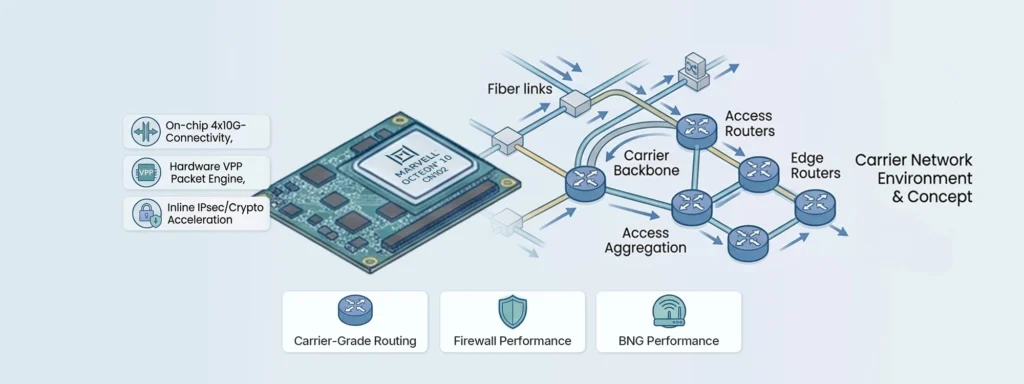
- Acceleration Mechanics: The Intel Xeon D-1527 relies on basic AES-NI instruction sets, and while the D-1700 features Intel QAT, it still functions as an asynchronous, look-aside acceleration architecture (where the CPU must constantly intercept, manage, and dispatch tasks). The CME102 features domain-specific, silicon-hardened hardware streaming units: a native Hardware VPP packet engine and an Inline IPsec / crypto engine.
- The Engineering Edge: The CME102 executes simultaneous, dual-engine hardware offloading at absolute line-rate. High-throughput data streaming and heavy cryptographic encryption/decryption are processed entirely within specialized hardware pipelines. The classic x86 vulnerability—where enabling deep security encryption pins CPU utilization to 100% and triggers a catastrophic 70% collapse in throughput—is entirely eliminated. Crucially, this high-speed execution consumes 0% of the 8 general-purpose ARM cores’ compute resources.
CME102 vs. Intel® Xeon® D Modules: Hard Spec Comparison
| Technical Specifications | CME102 (Marvell CN102) | Intel® Xeon® D-1700 | Intel® Xeon® D-1527 | CME102 Generational Advantage |
| Process Node | 5 nm | 10 nm | 14 nm | Multi-generation leap in lithography, delivering massive transistor density. |
| CPU Cores | 8× Neoverse N2 (Armv9) | Up to 10C / 20T (Ice Lake) | 4C / 8T (Broadwell) | Server-class general compute cores with exceptional single-thread efficiency. |
| Processor TDP | 33 W | Up to 67 W | 35 W | Cuts power consumption nearly in half compared to modern equivalents. |
| Fanless Operation | Yes (Native) | Typically no | Marginal | Eliminates mechanical fan failures; ideal for sealed, harsh environments. |
| Memory | DDR5-5600, ECC | DDR4-2933 | DDR4-2133 | More than doubles memory bandwidth for faster packet buffering and metadata handling. |
| Integrated 10G Ethernet | 4× 10G-KR + GbE on-die | 4× 10G-KR | Up to 2× 10GbE | Silicon-level I/O integration; eliminates the need for external NIC chips on the carrier board. |
| Packet + Crypto Offload | HW VPP + Inline IPsec | Intel® QAT | AES-NI | True line-rate hardware offloading for the data plane, consuming zero CPU cycles. |
Why Asterfusion CME102 is the the Intel Xeon D Alternative?
Evaluating next-generation network hardware architectures reveals that the legacy x86 approach is no longer the sole, or even the default, choice for high-performance boundary appliances. The Intel Xeon D series ultimately relies on the brute force of general-purpose computing to handle network traffic, forcing developers to accept costly thermal and power penalties.
The Asterfusion CME102 COM Express Type 7 DPU completely rewrites the rules. Through hardware-driven heterogeneous offloading, it strips the heaviest, most grueling data plane tasks away from the CPU, handing them over to dedicated, silicon-hardened engines for line-rate processing. For next-generation network appliances demanding high throughput, commercial cryptography-grade hardware encryption/decryption, minimized BOM costs, and a strict 33W fanless footprint, the CME102 stands as a definitive, generation-defining alternative.
Feel free to share more of our series articles:
What is a COM Express Type 7 Module?
What is a COM Express Type 7 Module? Why Do We Need It?
Where can the Asterfusion COM Express Type 7 ARM DPU be Used?
Asterfusion 33W ARM COM Express Type 7 Module: Top 6 Open Networking Use Cases
ARM vs x86 COM Express Type 7:Which to Choose?
ARM COM Express Type 7 vs x86 COM Express Type 7: Which to Choose?


