Table of Contents
Introduction
Recently, three new 64-port AI switches for 400G networks have been introduced: CX764QO-N, CX764QD-N, and CX764QH-N. These three switches use chips from different vendors, including Marvell and Clounix, with different technology adaptations to address different network requirements and deployment scenarios.
In this article, we will examine the differences between the three products, their typical application scenarios, and how to choose the right model based on your network requirements.
For more information about 400G fundamentals, refer to What Is 400G Ethernet? Standards, Technologies, and Deployment in Modern AI Data Centers.
Product Specification Comparison
First, the following table provides an overview of the key specifications of the three products:
| Hardware Specification | CX764QO-N | CX764QD-N | CX764QH-N |
| 400G Ports | 64 | 64 | 64 |
| 400G Port Type | OSFP | QSFP-DD | QSFP112 |
| 400G Lane Configuration | 4 × 100G | 8 × 50G | 4 × 100G |
| Other Ports | 2 × 10G SFP+ | 2 × 10G SFP+ | 1 × 25G SFP28 |
| ASIC | Marvell Teralynx 10 | Marvell Teralynx 10 | Clounix |
| Switching Capacity | 25.6 Tbps | 25.6 Tbps | 25.6 Tbps |
| Forwarding Rate | 28.8 Bpps | 28.8 Bpps | 21.6 Bpps |
| Packet Buffer | 200+ MB | 200+ MB | 120MB |
| Port-to-Port Latency | 560 ns | 560 ns | 700 ns |
| Typical Power | 2150W | 2100W | 2000W |
| Form Factor | 2RU | 2RU | 2RU |
| Breakout Modes | 2 × 200G / 4 × 100G | 2 × 200G / 4 × 100G | 2 × 200G / 4 × 100G |
| PSU | 1+1 | 1+1 | 1+1 |
| Airflow | Front to Power | Front to Power | Front to Power |
The following sections explain these specifications in more detail.
Similarities
The three switches share the same 64-port design. They are high-density switches designed for AI networking. With sufficient port density, you can add more downstream servers without having to increase the number of upstream switches at the same time. This is the primary rationale behind the 64-port 400G AI switch design.
All three switches also deliver 25.6 Tbps of high-density switching capacity in a compact 2RU chassis. This reduces rack space requirements while leaving more room for airflow management and thermal design, improving overall rack resource utilization.
Within the limited 2RU footprint, the three switches combine high-density 400G data center ports with high-performance switching capabilities. They also provide a comprehensive feature set for AI Fabric, lossless Ethernet, multipath load balancing, network observability, and cloud data center interconnects. The next section will cover their software and networking features in more detail.
All three switches use a 1+1 power supply configuration for redundancy and failover. They also use a front-to-power airflow design. This allows cool air to enter from the port side and hot air to exit through the power supply side. It helps reduce hot-air recirculation and provides lower inlet temperatures for the switch ASICs, optical modules, and power supplies, improving thermal reliability.
Differences
With the similarities covered, let’s focus on the key differences between the three models.
First, the port form factor
The three models use different port form factors: OSFP, QSFP-DD, and QSFP112. The form factor also reflects the positioning of each switch to some extent and can serve as an important factor when selecting a model.
CX764QD-N: CX764QD-N uses QSFP-DD ports and is designed to bridge existing network architectures with 400G. During a migration from 100G/200G to 400G, many data centers still have equipment using QSFP, QSFP28, or QSFP56 interfaces. Some of these devices may still carry critical workloads and cannot be replaced easily. In this case, a QSFP-DD switch can provide a practical migration path. It supports the existing QSFP28/QSFP56 module and cabling ecosystem while enabling 400G deployment. This allows existing equipment and cabling investments to be retained, reducing upgrade risk and overall migration costs.
CX764QH-N: CX764QH-N uses QSFP112 ports and represents the evolution of 400G from 8 × 50G to 4 × 100G electrical lanes. QSFP112 retains the four-lane QSFP architecture but increases the electrical lane rate to approximately 112 Gb/s per lane to support 400GbE. It is therefore designed for next-generation 400G networks based on 100G SerDes. QSFP112 also maintains backward compatibility with 40G QSFP, 100G QSFP28, and 200G QSFP56.
CX764QO-N: CX764QO-N uses OSFP ports and targets the evolution toward 400G, 800G, and future 1.6T high-speed interconnects. Compared with QSFP and QSFP112, OSFP has a slightly larger physical form factor. This provides more space for the module and greater thermal capacity, which is beneficial for high-speed DSPs, silicon photonics, and higher-power optical modules. The trade-off is that existing QSFP-series modules cannot be directly reused. It is therefore better suited to new data center deployments designed for 800G and 1.6T networking.
The second difference is the auxiliary port configuration
CX764QD-N and CX764QO-N each provide two additional 10G SFP+ ports, while CX764QH-N provides one additional 25G SFP28 port. This configuration reflects a trade-off based on existing network architectures and future migration requirements.
2 × 10G SFP+ on CX764QD-N and CX764QO-N: These ports are designed to connect to the large installed base of 10G equipment and infrastructure, such as management switches, legacy servers, storage devices, edge gateways, and existing 10G uplinks. The focus is on compatibility with existing infrastructure and flexible deployment.
1 × 25G SFP28 on CX764QH-N: This port targets next-generation 25G servers, NICs, storage systems, and leaf access environments. 25G is a common server access speed in data centers. According to a market report, demand for 25G server connectivity represents a significant share of the market. Among cloud service providers, 25G is used for server connectivity in 58% of rack deployments. In the Asia-Pacific region, 25G server connectivity is used in 61% of new rack deployments. SFP28 also typically supports 10G and 1G, providing a smooth migration path from 10G to 25G.
The third difference is the choice of switching ASIC
The three products use different switching ASICs, resulting in different trade-offs between performance, ecosystem compatibility, and overall cost.
CX764QD-N and CX764QO-N both use the Marvell Teralynx 10 switching ASIC. They target high-performance data center and AI networking environments that prioritize a mature ASIC ecosystem, larger packet buffers, and lower latency. Both provide the same 25.6 Tbps switching capacity, 28.8 Bpps forwarding rate, 200+ MB packet buffer, and approximately 560 ns port-to-port latency. In other words, whether you choose the QSFP-DD form factor for compatibility with existing QSFP assets or the OSFP form factor for future 800G and higher-speed migration, both provide sufficient resources for high-concurrency traffic, bursty workloads, and low-latency fabric designs.
However, not every 400G deployment requires extremely low latency or a large packet buffer as the primary objective. For customers building a new-generation 400G network based on 4 × 100G lanes and the QSFP112 architecture, CX764QH-N uses a Clounix ASIC. It maintains the same 25.6 Tbps switching capacity while providing 21.6 Bpps forwarding performance, a 120 MB packet buffer, and 700 ns port-to-port latency. This design provides line-rate switching for high-density 400G deployments while achieving a more targeted balance between performance and cost. It is suitable for customers whose requirements are less stringent in terms of maximum Bpps, packet buffer size, and minimum forwarding latency.
The final difference is Typical Power
Typical power is an important indicator of the overall power efficiency of the system. It reflects the combined impact of the port form factor, optical module thermal requirements, fan configuration, and switching ASIC design.
CX764QO-N has a Typical Power of 2150 W, CX764QD-N is rated at 2100 W, and CX764QH-N at 2000 W. CX764QO-N has the highest typical power because its OSFP design targets the thermal requirements of higher-power, high-speed optical modules. CX764QD-N maintains a similar power level while supporting QSFP-DD compatibility with existing infrastructure and high-performance forwarding. CX764QH-N uses the QSFP112 form factor and a different ASIC architecture to achieve relatively lower typical power consumption.
This means the three switches differ not only in port form factor and performance. They also represent different trade-offs in rack-level power delivery, thermal planning, and long-term operating costs.
Technical Differences
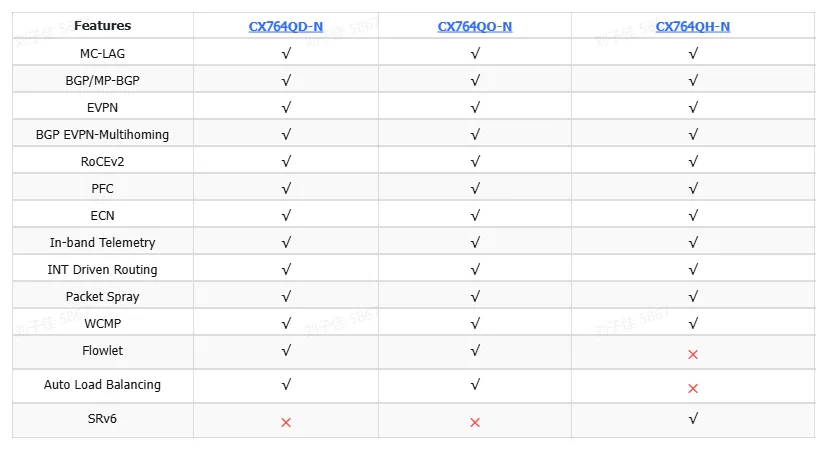
From a technology perspective, all three switches target AI Ethernet Fabric deployments. Their core AI networking capabilities are largely consistent, with support for RoCEv2, PFC/ECN, INT, and other key features. The main differences lie in advanced traffic scheduling and network architecture capabilities. These features are still designed around specific deployment requirements.
The core positioning of the three models can be summarized as follows:
- CX764QD-N and CX764QO-N: Designed for high-performance AI/HPC data center networks that place greater emphasis on low latency, large packet buffers, and adaptive load balancing.
- CX764QH-N: Designed for next-generation 400G compute and cloud data center fabrics based on 112G SerDes. It is also suited to deployments that require SRv6 network slicing, cloud-network coordination, and DCI evolution.
Flowlet and Auto Load Balancing
In AI data centers, AI workloads generate highly dynamic and bursty traffic. CX764QD-N and CX764QO-N support INT, Flowlet, and Auto Load Balancing to form a complete traffic scheduling loop. Telemetry first collects real-time network information. Large elephant flows are then divided into flowlets, which are dynamically distributed through Adaptive Routing. Compared with traditional ECMP, this approach provides more adaptive traffic distribution.
Therefore, CX764QD-N and CX764QO-N are better suited to high-performance AI/HPC data center networks, such as AIDC Fabric and lossless Ethernet deployments. Their focus is on efficient interconnection within the compute cluster and reducing the time GPUs spend waiting for data transfers.
In contrast, CX764QH-N targets more conventional cloud data center or WAN traffic, where there are many distributed flows and mouse flows account for a large proportion of traffic. In these scenarios, traditional ECMP and WCMP can already provide efficient load distribution. There is less need to consume ASIC resources and packet buffer capacity for per-packet or microflow-level dynamic rebalancing.
SRv6 — Segment Routing over IPv6
SRv6 is another key feature that differentiates the three models. SRv6 is an important protocol for modern WANs and cloud-based data center networks. It uses IPv6 addresses to carry Segment Identifiers (SIDs) and can use the Segment Routing Header (SRH) to carry explicit path information or network function instructions. This enables end-to-end path programming, traffic engineering, and cross-domain service chaining.
SRv6 is used in DCI and WAN transport. It is also increasingly used in cloud data centers and inter-region networks. This helps reduce protocol fragmentation between data center and WAN networks and provides a unified IPv6 data plane. Supporting SRv6 requires the switching ASIC to provide sufficient resources for deep IPv6 lookup tables, as well as the parsing and processing of the additional SRH header.
On CX764QH-N, the switching ASIC allocates more pipeline and TCAM resources to SRv6 processing. These resources support large SRv6 SID spaces, large IPv6 LPM tables, and SRH parsing. This enables explicit path selection and traffic engineering for specific traffic flows across data centers, within data centers, and across network domains.
CX764QD-N and CX764QO-N do not include SRv6 support. This leaves more ASIC table space and processing resources for other functions. It also avoids potential interaction between SRv6-based path planning and Auto Load Balancing. These resources can instead be focused on low-latency forwarding, large-buffer management, and fine-grained congestion control through PFC, ECN, and INT. This makes the two models better suited to GPU-to-GPU training traffic within AI clusters.
Use Case
Scenario 1: Large-Scale AI Training Cluster Fabric (Intra-DC East-West)
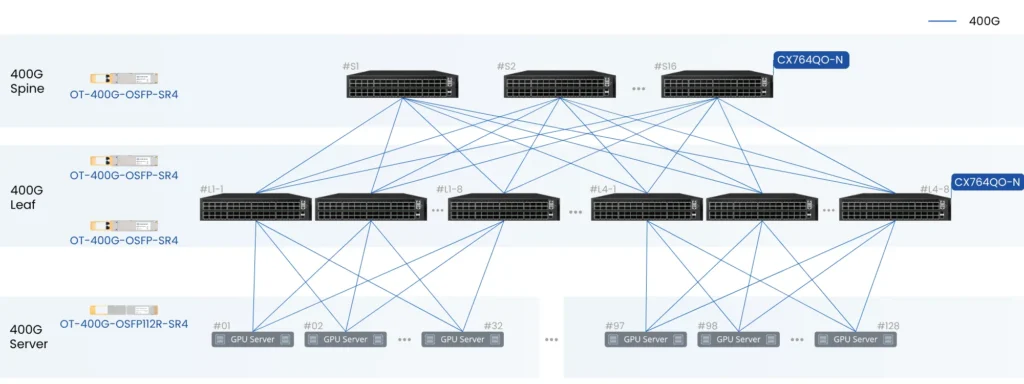
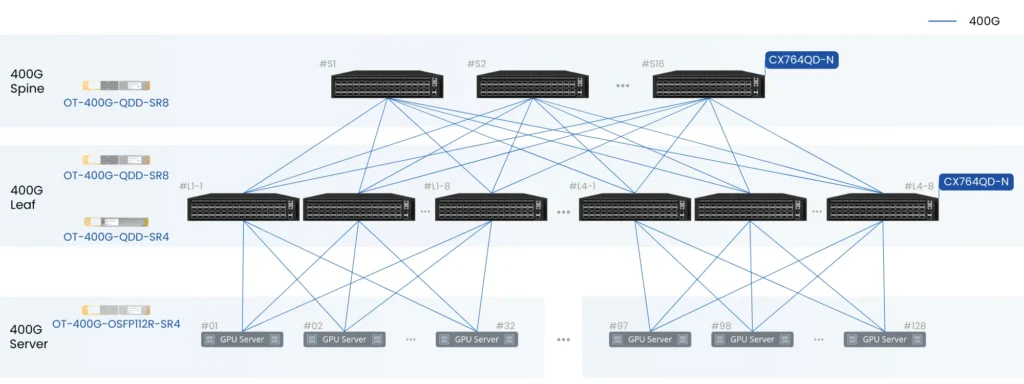
Designed for RoCEv2 traffic generated by All-Reduce and GPU-to-GPU workloads. Flowlet, Auto Load Balancing, and INT form a closed-loop traffic scheduling mechanism. This helps maintain lossless operation, microsecond-level latency, and high bandwidth utilization within the data center.
Scenario 2: SRv6 Cloud-Network Coordination and Cross-Domain AI Fabric
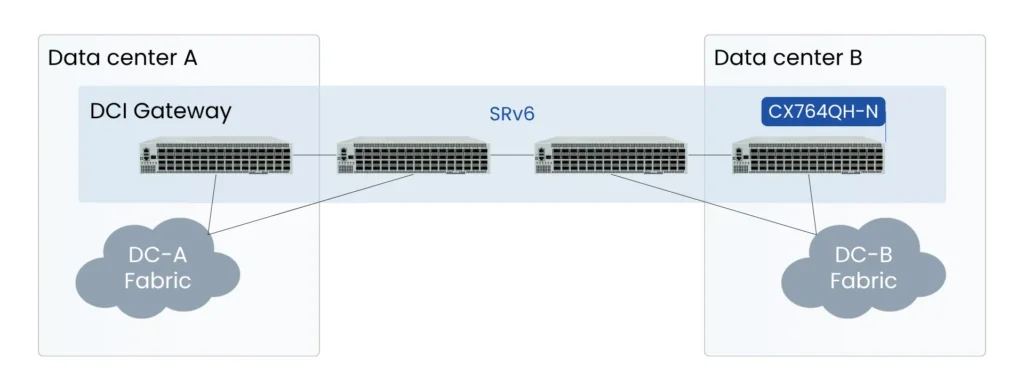
- Recommended Model:CX764QH-N
- Topology Position: Data center Spine/Super-Spine, DC Fabric Gateway, or edge nodes connecting to DCI and transport networks
SRv6 enables consistent end-to-end explicit path planning and SLA-based service slicing across regions, data centers, and the networks connecting them. It is suitable for North-South traffic and cross-domain traffic.
How to Choose Among 64-Port 400G AI Switches
Quick Selection Decision Tree
Based on the hardware specifications and software capabilities discussed above, the following decision tree provides a quick way to select a model:
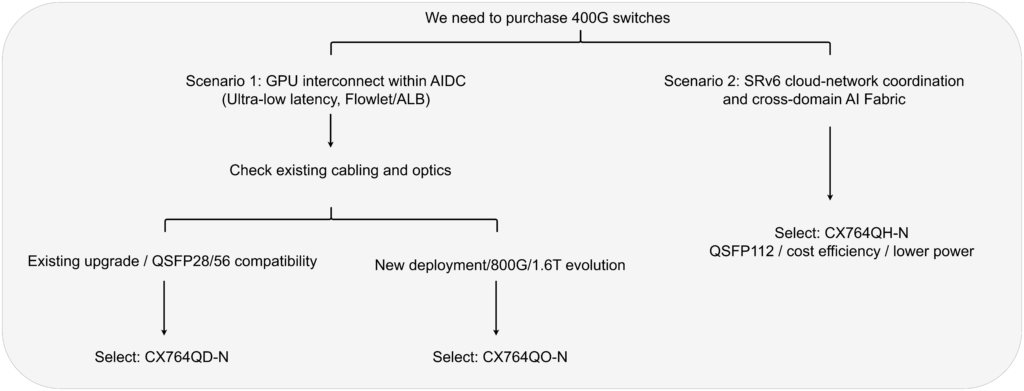
Selection Checklist
| Consideration | Recommended Model | Key Reason |
| Pure AI training workloads with a large installed base of QSFP28/56 optics and cabling | CX764QD-N | QSFP-DD supports the existing asset ecosystem, protecting existing investments while providing the required AIDC Fabric capabilities. |
| Pure AI training workloads in a new data center, with an expected migration to 800G/1.6T within the next 2–3 years | CX764QO-N | The larger OSFP form factor provides greater thermal capacity for future high-power silicon photonics and 800G+ optical modules. |
| Cross-domain interconnection, SRv6 cloud-network coordination, or a strong focus on cost efficiency and lower power consumption | CX764QH-N | Supports SRv6 explicit routing and uses the next-generation 4 × 100G QSFP112 electrical architecture, with lower system power consumption. |
Choosing between CX764QD-N, CX764QO-N, and CX764QH-N is not simply a matter of deciding whether Marvell is stronger than Clounix. The three models represent different deployment paths:
- CX764QD-N: Designed for GPU compute clusters within AIDCs. It combines high-performance Fabric capabilities with compatibility with the existing 100G/200G QSFP ecosystem, making it a suitable choice for protecting existing investments and enabling a smooth migration.
- CX764QO-N: Also focused on high-performance AI Fabric, but uses the OSFP form factor for greater thermal headroom. It is designed for higher-power optical modules and long-term migration toward 800G/1.6T networks.
- CX764QH-N: Provides the same 25.6 Tbps switching capacity and uses a next-generation 4 × 100G SerDes architecture. It combines high-density 400G line-rate forwarding with SRv6-based cross-domain traffic engineering. With lower power consumption and a focus on TCO, it is suitable for deployments evolving from AI/cloud data center Fabric toward DCI, cloud-network coordination, and multi-tenant networking.
Conclusion
As AI model training and cloud-network integration continue to drive network requirements, infrastructure selection is shifting from a simple speed upgrade to scenario-specific design.
CX764QD-N, CX764QO-N, and CX764QH-N form a 400G AI networking portfolio covering deployments from Intra-DC Fabric to DCI Edge. The portfolio spans lossless RoCEv2 cluster interconnects with low latency, SRv6-based wide-area traffic engineering, QSFP-DD designs that protect existing investments, and OSFP and QSFP112 platforms for future network evolution. Through different ASIC choices and technology adaptations, the three models address different requirements for building and evolving high-density 400G AI networks.
Request a demo or need assistance ?
Fill out the form, and we’ll reach out to you today !


