Table of Contents
Introduction
As AI clusters, cloud computing, and distributed storage continue to scale, a single data center can no longer handle the growing volume of 400G network traffic. This has driven the adoption of distributed data centers, creating a need for interconnects that can span tens or even hundreds of kilometers. However, traditional 400G DR4, FR4, and LR4 optical transceivers are designed primarily for short-reach links, typically covering distances from several hundred meters to around 10 km. They are therefore not well suited to this new cross-data-center connectivity requirement.
400ZR is designed to address this requirement. By inserting a 400ZR coherent optical transceiver directly into a compatible 400G switch port, enterprises can use tunable DWDM (Dense Wavelength Division Multiplexing) wavelengths to transmit 400GbE traffic over amplified point-to-point optical links. The transmission distance can reach up to 120 km.
Why 400G Connectivity Must Extend Beyond the Data Center
As large-scale AI model training, massive cluster checkpoint synchronization, real-time data replication, and intensive East-West traffic continue to grow, compute and storage can no longer be confined to a single data center campus.
Unlike the 100G era, when DCI was driven mainly by disaster recovery, active-active deployments, and CDN content distribution with strict latency requirements, the drivers for extending 400G connectivity beyond a single data center have evolved. Three factors are particularly important.
Physical Constraints: Power, Cooling, Land, and Capacity Limits
As AI clusters and cloud infrastructure scale, power availability, cooling capacity, rack density, land resources, and construction timelines can constrain expansion within a single data center campus. Some cloud service providers, research institutions, and large enterprises deploy compute, storage, or disaster recovery resources across multiple nearby campuses or metro sites. High-capacity DCI links are then used for data synchronization, resource sharing, and business continuity.
AI Data, Storage Replication, and Cross-Site Resource Coordination
The growth of AI and data-intensive workloads is naturally extending the 400G high-speed pipelines used inside data centers for inter-data-center connections. A single AI training job can now involve petabytes of data, while checkpoint images can reach hundreds of gigabytes. Large volumes of data must therefore move from the data center to metro or remote storage nodes.
Traditional 100G links can become a bottleneck during these bursty, high-volume synchronization operations. This is driving 400G connectivity into DCI environments. At the same time, large model weights generated in a central data center need to be distributed frequently and with low latency to metro and edge inference nodes. This supports high-concurrency online services and further extends high-bandwidth 400G connectivity from within the data center to inter-data-center networks.
High Availability, Disaster Recovery, and Distributed Resource Pooling
- Metro Active-Active and Multi-Active Deployments: Modern hyperscalers and financial or enterprise customers no longer rely on a single site for all compute and data. High-bandwidth DCI enables metro active-active deployments, allowing workloads to switch between sites with minimal service disruption when one data center fails.
- Data Tiering and Compute Scheduling: 400G links can connect multiple suburban and remote data centers into what functions as a single logical large-scale data center. This enables cross-site storage resource pooling and unified compute scheduling.
This raises an important question.
Before the adoption of 400G DCI, multiple 100G DCI links were commonly used for inter-data-center connectivity. The architecture was relatively complex. A typical deployment connected client-side optics on the switch to a standalone DWDM transponder or muxponder through fiber patch cables. The transponder or muxponder performed electrical-optical-electrical conversion and wavelength modulation before sending the signal into the DWDM transport system. The signal was then transmitted to the remote data center.
This architecture increased CAPEX and required additional rack space and power. Fiber costs also limited the scalability of 100G DCI. If every additional 100G of bandwidth required another pair of fibers, the cost could quickly become difficult to control.
The introduction of 400ZR changes this model. It integrates the coherent optical technology that previously resided in a dedicated optical transport box into a compact 400G optical transceiver.
With 400ZR, no intermediate transponder or muxponder is required. The 400ZR module can be inserted directly into a compatible 400G switch port. The switch can then transmit 400GbE traffic as a long-reach DWDM coherent optical signal over an amplified optical link, with reach of up to 120 km.
What Is 400ZR?
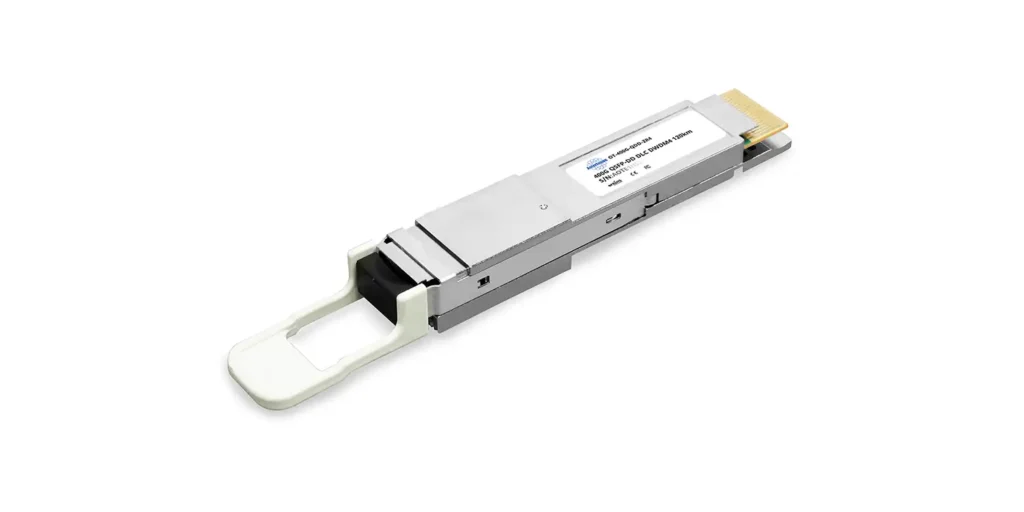
Simply put, 400ZR is a 400G pluggable coherent optical interface designed primarily for Data Center Interconnect (DCI). Defined by the Optical Internetworking Forum (OIF), it enables network engineers to turn a standard 400G switch port into a long-reach optical interface for transmitting 400GbE traffic over DWDM wavelengths. It is designed for high-capacity, point-to-point metro DCI links rather than short-reach connections of a few hundred meters within a data center.
To provide a more intuitive view of the hardware characteristics of 400ZR, the following table summarizes its key specifications:
| Item | 400ZR Description |
| Primary use case | Point-to-point metro DCI |
| Ethernet service | 400GbE |
| Optical approach | Coherent optical transmission |
| Wavelength | One tunable C-band DWDM wavelength |
| Form factor | Commonly QSFP-DD or OSFP |
| Modulation | DP-16QAM |
| FEC | C-FEC |
| Standard | OIF 400ZR Implementation Agreement |
| Reference reach | Up to 120 km over a point-to-point DWDM link with optical amplification |
| Unamplified design reference | 11 dB optical link loss budget |
Unlike conventional 400G optical transceivers commonly used within data centers, which use PAM4 modulation, 400ZR uses coherent optical technology. This enables it to better tolerate the dispersion and attenuation introduced by long-distance fiber transmission. According to the OIF 400ZR IA specification, it can support up to 120 km over a point-to-point DWDM link with optical amplification. It can also meet an 11 dB optical link loss budget on a direct link without optical amplification.
Today, the 400ZR market is also significant. According to market tracking by Cignal AI, pluggable coherent optics based on 400ZR/ZR+ accounted for nearly half of the deployed bandwidth in telecom networks in 2025. This indicates that IPoDWDM architectures, where switch or router ports directly carry coherent DWDM wavelengths, have moved beyond early validation and into large-scale deployment.
For cloud, AI, and high-capacity metro DCI, this evolution allows network teams to adopt an architecture based on 400G switch ports + pluggable coherent optics + an Open Line System (OLS). This reduces the need to dedicate a separate transponder or muxponder to each 400G service wavelength.
Key Takeaway: The core value of 400ZR is that it extends compatible 400G switch ports to point-to-point coherent DWDM DCI. It is not simply a “longer-reach version” of traditional DR4, FR4, or LR4. DR4, FR4, and LR4 typically use conventional single-mode fiber to directly connect devices at both ends. They are used for 400G Ethernet connectivity within data centers, between buildings, or across campuses. 400ZR also uses single-mode fiber, but converts 400GbE traffic into a tunable C-band DWDM coherent wavelength and connects it to a DWDM system. This enables high-capacity, long-distance connectivity between metro data centers.
How 400ZR Works in a 400G DCI Architecture
A 400ZR DCI architecture relies on three components working together: a compatible 400G switch or router host port, a 400ZR pluggable coherent optical module, and a properly designed and validated DWDM optical line system. The switch carries and forwards 400GbE traffic while providing the high-speed electrical interface, power, and management functions for the module. The 400ZR module generates and receives coherent DWDM wavelengths. The DWDM optical layer multiplexes, amplifies, and transports these wavelengths.
It is important to note that a 400G port does not automatically support 400ZR. Before deployment, verify the port form factor, module power consumption, device thermal capacity, NOS version, module firmware, and compatibility matrix.
1. 400G Switch Provides the Host Port
A 400G switch typically provides a high-performance QSFP-DD or OSFP electrical host interface. Instead of inserting conventional short-reach optical transceivers such as DR4, FR4, or LR4, the network administrator can insert a 400ZR coherent optical module directly into the switch port. The switch port serves as the host interface, providing high-density packet switching as well as power and management support for coherent transmission.
2. 400ZR Module Provides the Coherent Optical Interface
A 400ZR module can be viewed as a highly integrated optical transport system in a pluggable form factor. It converts the 400GbE electrical signal from the switch host interface into a coherent optical signal that can be tuned across the C-band. The module integrates key components such as a digital signal processor (DSP), coherent laser, coherent optical engine, and forward error correction (C-FEC) functionality. These components perform core functions that traditionally required dedicated optical transport equipment.
In simple terms, the switch provides the 400G host interface, while the 400ZR module converts the signal into coherent optics for transmission.
3. DWDM Line System Carries the Optical Wavelengths
After leaving the 400ZR module, the optical signal enters a purpose-designed point-to-point DWDM optical path. Unlike traditional gray-optics 100G interconnects without DWDM, where each service typically uses a dedicated pair of single-mode fibers, a 400ZR DCI architecture maps each 400GbE service to a tunable DWDM wavelength. Different wavelengths from multiple 400ZR modules can be multiplexed onto the same fiber pair through MUX/DEMUX equipment. This allows network teams to scale aggregate inter-data-center bandwidth in 400GbE increments without requiring additional fiber pairs.
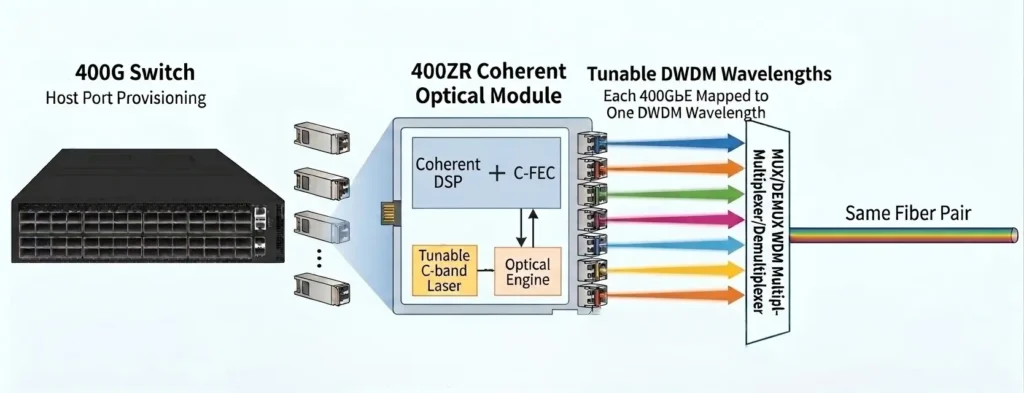
Important Note: 400ZR eliminates the need for expensive dedicated optical transport boxes such as transponders. However, it does not mean that optical line engineering can be ignored. Physical-layer equipment such as EDFAs and DWDM MUX/DEMUX units still requires careful planning, configuration, and optimization.
From 400G Switch Port to DCI Link: A Reference Architecture
After understanding the basic principles and selection advantages of 400ZR, the next question is how to deploy it in a real data center network. From 400G switch ports to metro DCI links, there are two typical reference architectures:
| Architecture | Description | Typical Capacity | Best-Fit Scenario |
| Single-Wavelength P2P 400ZR DCI | One 400ZR module is deployed at each end. One 400GbE service is mapped to a single DWDM coherent wavelength. The link can use an unamplified single-wavelength dark fiber connection or a simple point-to-point DWDM optical path. | 400GbE | Simple metro connectivity between two data centers and direct dark fiber deployments. |
| Multi-Wavelength P2P 400ZR DCI | Multiple 400ZR modules are deployed at each end. Each module carries one 400GbE service on an independent DWDM wavelength. Multiple wavelengths are multiplexed onto the same fiber pair or multiple fiber pairs through MUX/DEMUX or other wavelength multiplexing equipment. | N × 400GbE | Large-scale cloud and AI clusters, high-capacity active-active data centers, and aggregation of multiple 400G services. |
In large-scale deployments, multi-wavelength 400G DCI aggregation is more common. High-density 400G switches can host multiple 400ZR coherent modules and multiplex different wavelengths onto shared fiber resources.
Because 400ZR is a tunable coherent optical module, the DWDM frequency must be configured before deployment. Frequency planning is used to assign a dedicated DWDM channel to each 400G service. First, multiple 400ZR modules on the same data center side must use different DWDM frequencies to avoid wavelength conflicts. Second, the corresponding 400ZR modules at the two ends of the same point-to-point 400G service must be configured to the same DWDM frequency. This allows the two modules to establish and receive the optical link correctly.
Choosing the Right 400G Switch for 400ZR DCI
When selecting a 400G switch for coherent DCI, port speed alone is not enough. In addition to 400G throughput, key evaluation criteria include coherent module form-factor compatibility (OSFP, QSFP-DD, or QSFP112), airflow and thermal design, system power budget, CMIS software support, and end-to-end interoperability.
For a more concrete reference, consider five 400G switches from Asterfusion. These platforms cover several common data center configurations, including 12.8T and 25.6T switching capacities, QSFP-DD, OSFP, and QSFP112 form factors, and standard 1U/2U rack as well as OCP ORv3 deployments. All five platforms natively support 400ZR coherent optical modules.
Depending on data center scale and node role, the five 400G switches can be positioned in 400ZR coherent DCI architectures as follows:
| DCI Requirement and Use Case | Applicable 400G Switch Platform | 400ZR DCI Deployment Value and Use Case |
| Backbone DCI aggregation for hyperscale cloud and large-scale AI clusters | 64×OSFP 25.6T switch (CX764QO-N) | High-density coherent DCI aggregation platform with up to 25.6 Tbps of switching capacity. The OSFP form factor provides strong thermal performance and is well suited to high-density deployment of power-hungry 400ZR modules at hyperscale data center exits. |
| High-capacity DCI aggregation for enterprise and hybrid cloud | 64×QSFP-DD 25.6T switch (CX764QD-N) | High-density 400ZR aggregation platform based on the established QSFP-DD ecosystem and Enterprise SONiC. It aggregates multiple 400G East-West traffic flows within the data center and maps them to 400ZR wavelengths for transmission over the metro DWDM backbone. |
| Cost-sensitive inter-data-center connectivity for AI clusters with simplified airflow requirements | 64×QSFP112 25.6T switch (CX764QH-N) | Compact 25.6T platform for inter-data-center connectivity. The QSFP112 form factor simplifies the hardware and airflow design, making it suitable for modern AI data centers that require high-density 400ZR DCI aggregation under cost constraints. |
| OCP ORv3 open architecture DCI access | ORv3 32×QSFP-DD 12.8T switch (CX732Q-N-ORV3) | Open-rack DCI platform designed for Open Rack v3. It combines centralized 48V power delivery with optimized rack-level thermal design, providing a standardized 400ZR coherent DCI interface for hyperscale and open-architecture data centers. |
| Compact DCI node for metro active-active and regional deployments | 32×QSFP-DD 12.8T switch (CX732Q-N) | Cost-effective 1U DCI node with standard QSFP-DD ports. It is well suited to regional cloud nodes, disaster recovery data centers, and medium-scale active-active DCI deployments where rack space and DCI scalability must be balanced. |
In practical deployments, hardware selection should be combined with the following considerations:
- Form-factor and module compatibility: 400ZR modules are available in different form factors. Ensure that the selected 400ZR module matches the switch port exactly, such as using an OSFP-based 400ZR module with an OSFP switch port. Where applicable, use the adapter or compatibility solution specified by the equipment vendor.
- Power, thermal, and port-population planning: Coherent modules typically consume more power than conventional short-reach optical modules, often around 15–20 W per module. They therefore generate significantly more heat. Actual port-population limits must be verified against the switch platform’s hardware specifications and thermal design.
- Do not assume that all ports can be populated with 400ZR modules: Due to system power and thermal constraints, a switch may not support 400ZR modules in every port simultaneously. Follow the vendor’s validated port-population rules. Where required, distribute 400ZR modules across the chassis or mix them with conventional optical modules to maintain adequate airflow and thermal margins.
- Control the operating temperature: For deployments using 400ZR modules, the data center operating environment should be maintained below 30°C, where required by the module and switch platform specifications.
- Validate hardware and software compatibility: Port distribution and thermal planning should account for fan redundancy, system airflow, NOS support, and CMIS compatibility. Verify the results against the vendor’s 400ZR compatibility matrix before deployment.
Read this article to learn the differences among the three 64-port 400G switches: How to Choose a 64-Port 400G AI Switch: QSFP-DD vs. OSFP vs. QSFP112.
When to Consider OpenZR+ or ZR+
When discussing 400ZR DCI solutions, you will often encounter the terms OpenZR+ and ZR+. They are mentioned here to clarify the technical boundaries of standard 400ZR. 400ZR is optimized for point-to-point metro DCI links within approximately 120 km. When an inter-data-center deployment goes beyond this typical operating range, or when the optical path becomes more complex, OpenZR+ or ZR+ solutions may need to be considered.
In simple terms, OpenZR+ extends pluggable coherent optics beyond the typical 120 km point-to-point range of 400ZR. It uses more flexible modulation schemes, stronger forward error correction (FEC), and multi-rate operation to support more demanding transmission environments.
| Requirement | Recommended Direction |
| Point-to-point metro DCI within approximately 120 km | 400ZR (standardized and optimized for simple, efficient DCI) |
| Transmission distance beyond approximately 120 km | Evaluate OpenZR+ / ZR+ |
| High optical loss or multiple ROADM nodes | Evaluate OpenZR+ / ZR+ or dedicated DWDM transport equipment |
| Flexible 100G / 200G / 300G / 400G rates | OpenZR+ or a coherent optical transport platform |
| Complex regional backbone or long-haul networks | Dedicated coherent optical transport platform or advanced pluggable coherent solution |
Note: OpenZR+ and vendor-specific ZR+ implementations are not automatically interoperable or fully compatible. Before selecting an OpenZR+ or ZR+ solution, verify the compatibility of the switch hardware platform, NOS version, supported transmission modes, FEC type, and DWDM line system. The supported reach and operating parameters should also be validated against the actual optical link design.
FAQs About 400ZR and 400G Switches
Q1: Can 400ZR Completely Replace Expensive Traditional DWDM Transport Equipment (Transponders)?
Answer: For point-to-point metro DCI deployments within approximately 120 km, 400ZR can eliminate the need for dedicated transponders at the endpoints. 400ZR integrates coherent modulation, DSP, and C-FEC functions that were traditionally implemented in dedicated optical transport equipment into a pluggable optical module. This removes the need for additional endpoint transport hardware.
However, it does not eliminate optical line engineering. You still need a DWDM line system, including multiplexers/demultiplexers, EDFAs, and optical link budget planning. 400ZR simplifies the endpoint equipment, not the physical optical path.
Q2: Why Does the Switch Fan Speed Increase or Trigger an Alarm After Installing 400ZR Modules?
Answer: This is one of the most frequently discussed issues, and the main factors are power consumption and heat dissipation. Conventional short-reach 400G optical modules such as DR4 and FR4 typically consume around 8–10 W, while 400ZR modules can consume 15–20 W per module due to their integrated DSP and coherent optical components.
- Thermal risk: Installing multiple 400ZR modules at high density can quickly increase local temperatures inside the switch. This can cause the fans to run at full speed, increase fan noise, or even trigger thermal protection.
- Engineering approach: Do not assume that all ports can be populated with 400ZR modules. During deployment, keep the data center ambient temperature below 30°C, where required by the platform specifications, and use port-population strategies such as interleaved placement to maintain sufficient airflow and thermal headroom.
Q3: How Does a Switch NOS, Such as Enterprise SONiC, Manage 400ZR Physical-Layer Parameters?
Answer: Conventional Ethernet optical modules typically expose parameters such as transmit and receive optical power through DDM/DOM. Coherent optics require additional configuration and monitoring capabilities, including DWDM frequency or wavelength tuning, TX output power, pre-FEC bit error rate, and optical signal-to-noise ratio (OSNR).
Modern 400G switches can use CMIS 4.0 / 5.0+ (Common Management Interface Specification) to manage pluggable coherent optical modules. When the switch NOS, such as Enterprise SONiC, provides the required CMIS coherent-optics support, network engineers can configure and monitor wavelength and other optical parameters through the CLI or APIs and telemetry. This can reduce the need for separate optical management software at the module-management layer.
Q4: Both 400ZR and 400G LR4 Can Reach Around 10 km or More. How Should You Choose?
Answer: The key consideration is whether your fiber architecture requires DWDM multiplexing.
- If you have a dedicated pair of single-mode fibers for a direct connection and the distance is within the supported range of 400G LR4, 400G LR4 is generally the simpler choice. It uses PAM4 modulation and provides a straightforward point-to-point Ethernet connection.
- If you need to multiplex multiple 400G services over the same fiber pair using DWDM MUX/DEMUX equipment, or if the link requires the reach and optical architecture supported by 400ZR, 400ZR is the appropriate direction.
Q5: Why Does a 400ZR Link Fail to Establish When Configured on a Switch?
Answer: In addition to common issues such as incorrect fiber connections or reversed TX/RX paths, coherent DCI deployments typically have two less obvious causes:
- Wavelength or frequency mismatch: 400ZR uses tunable wavelengths. The 400ZR modules at both ends must be configured to the same C-band DWDM channel or frequency, such as a 50 GHz or 100 GHz grid where supported. The configured channel must also match the corresponding MUX/DEMUX port.
- Optical power outside the receiver operating range: Coherent receivers have defined input power ranges. Excessive optical loss can reduce OSNR below the level required for reliable FEC operation. Excessive input power, such as during a direct connection without the required attenuation, can overload the receiver and potentially damage the coherent optical engine.
Conclusion
As AI model training, large-scale data synchronization, and distributed cloud computing continue to drive higher network traffic, Data Center Interconnect (DCI) is undergoing a significant architectural shift. Traditional short-reach optical modules and single-site data center architectures are increasingly constrained by the scale and distribution of compute and storage resources. 400ZR provides an efficient approach for high-capacity metro DCI.
The key value of 400ZR is that it integrates coherent optical capabilities traditionally implemented in dedicated DWDM transport equipment into compact pluggable modules such as QSFP-DD and OSFP. This allows network architects to use compatible 400G switch ports for DWDM-based 400GbE transmission over distances of up to approximately 120 km, depending on the optical link design. By reducing the need for dedicated endpoint transponders or muxponders, 400ZR can simplify the DCI architecture and reduce associated CAPEX and OPEX.
However, successful coherent DCI deployment depends on more than the optical module itself. The host switch must provide sufficient power and thermal capacity, and the deployment must meet the required environmental and cooling conditions. The NOS must also provide appropriate CMIS support for coherent optical module management. These factors are essential for maintaining stable long-term operation.
Looking ahead, as traffic between data centers continues to increase, open networking architectures that combine modern 400G switches with 400ZR or OpenZR+ coherent optics will become increasingly relevant to distributed cloud and AI infrastructure. This approach provides a path toward higher-capacity DCI while reducing the dependency on dedicated optical transport equipment at the network endpoints.
Explore More in Our 400G Technical Series
Building a resilient, high-performance 400G infrastructure requires a unified understanding of standards, interconnects, and hardware choices. Whether you are scaling an AI data center or upgrading campus backbones, explore our comprehensive 400G guide series to master every layer of the architecture:
- 1. Fundamentals: Learn core standards and deployment models in What Is 400G Ethernet? Standards, Technologies, and Deployment in Modern AI Data Centers.
- 2. Transceiver Specifications: Compare reaches, fiber types, and form factors in 400G Transceivers Explained: VR4, SR4, SR8, DR4, FR4, LR4, ER4 and ZR.
- 3. Coherent DCI Solutions: Explore how 400G ZR and coherent optics enable direct switch-to-switch data center interconnects in What Is 400ZR? How 400G Switches Enable Coherent DCI.
- 4. Switch Architecture: Solve bandwidth and latency bottlenecks by choosing the right platform in How to Choose a 64-Port 400G AI Switch: QSFP-DD vs. OSFP vs. QSFP112.
- 5. 400G QSFP-DD Cable Connection for AI Fabric: 400G QSFP-DD Cable Connectivity for AI Fabrics: DAC vs. ACC vs. AEC vs. AOC
- 6. AI Checkpoint Traffic: How 400G Switches Prevent Network Bottlenecks in GPU Training
- 7. 400G AI Switch Real-World Performance Test: Validating Lossless Ethernet with H100 GPUs
- 8. Why GPU Utilization Drops in AI Clusters: The Role of Networking


