Table of Contents
In our previous article, we introduced Audio Video Bridging (AVB), explaining what it is, why traditional AV networks are evolving toward Ethernet, how AVB works, and the key benefits it brings to professional audio and video applications.In this article, we’ll take a closer look at what Asterfusion brings to AVB networking. What AVB switches does Asterfusion offer? What features and connectivity options do they provide? And where can these switches be deployed? We’ll explore Asterfusion’s AVB-capable Ethernet switches, their key capabilities, and practical deployment scenarios — from conference rooms and multipurpose venues to live events, recording studios, and other professional AV environments.
What Are AVB Class A and Class B?
An AVB network may carry multiple audio and video streams simultaneously. Since different applications have different real-time requirements, AVB defines two Stream Reservation (SR) classes: Class A and Class B. They differ mainly in their maximum transmission interval and end-to-end latency requirements.
| Specification | SR Class A | SR Class B |
|---|---|---|
| Maximum Transmission Interval | 125 μs | 250 μs |
| End-to-End Latency Target | 2 ms | 50 ms |
| Typical Applications | Professional real-time audio, digital mixing consoles, and live sound systems | Other real-time audio and video applications |
In simple terms:
- Class A is designed for applications with very strict timing requirements, such as professional audio systems, digital mixing consoles, and live stage sound.
- Class B supports applications with less stringent timing requirements, while still providing predictable, time-sensitive audio and video delivery.
An important distinction: The 2 ms and 50 ms figures refer to the AVB end-to-end network latency targets, not the switching latency of an individual switch. Actual performance depends on network topology, link speed, traffic conditions, and successful stream reservation.
Asterfusion AVB Ethernet Switches for Networked Audio and Video
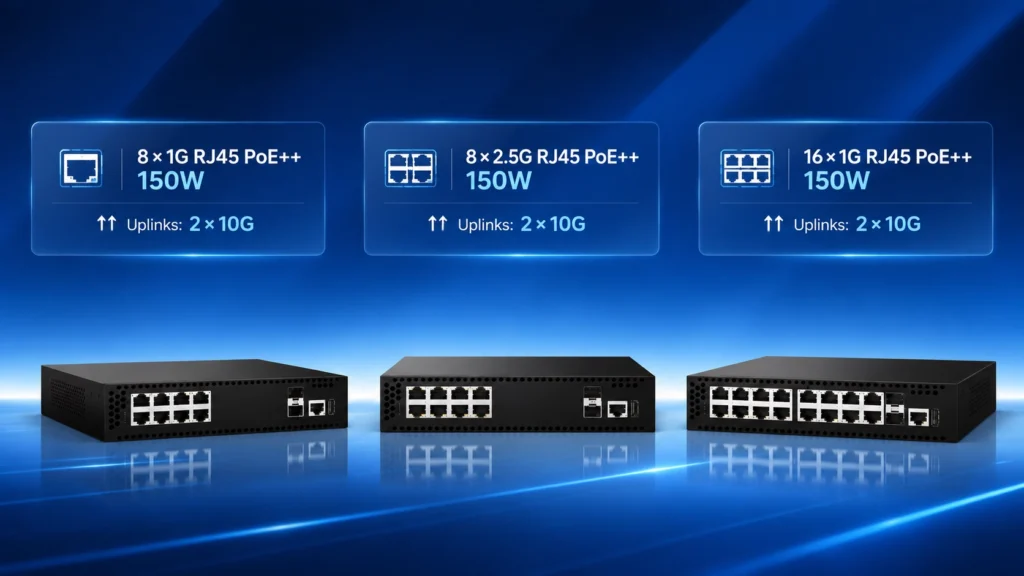
The Asterfusion CX102S-M series powered by Marvell Ironman ASIC and Enterprise SONiC NOS,provides Ethernet switching platforms for networked audio and video applications that require precise time synchronization, predictable latency, and efficient bandwidth management. Combining AVB-related networking capabilities with flexible access-port configurations and PoE options, the CX102S-M series supports a range of professional AV deployment requirements.
| Port Configuration | 10G Uplinks | POE Power Bugget | POE++ | Typical Deployment |
| 8 × 1G RJ45 | 2 × 10G | 150W | 8 PoE+ ports (30W max) and 8 configurable PoE++ ports (60W max) | Compact AV networks with Gigabit endpoints |
| 8 × 2.5G RJ45 | 2 × 10G | 150W | 8 PoE+ ports (30W max) and 8 configurable PoE++ ports (60W max) | Higher-bandwidth AV endpoint connectivity |
| 16 × 1G RJ45 | 2 × 10G | 150W | 8 PoE+ ports (30W max) and 8 configurable PoE++ ports (60W max) | AV networks with a larger number of Gigabit endpoints |
Predictable Latency for Real-Time Media
In AVB networks, different audio and video applications have different latency requirements. Professional audio systems, for example, require highly predictable delivery, while other real-time media applications may tolerate slightly longer delays. The Asterfusion CX102S-M series supports both AVB SR Class A and Class B latency requirements, making it suitable for a wide range of professional audio-video deployments. To ensure predictable media delivery, the switch uses two key AVB mechanisms:
- IEEE 802.1Qav Credit-Based Shaping (CBS): Controls the transmission of AVB traffic by managing bandwidth allocation and traffic scheduling, helping prevent bursty data traffic from disrupting time-sensitive media streams.
- IEEE 802.1Qat Stream Reservation (MSRP): Checks bandwidth availability along the network path and reserves the required resources before admitting an AVB stream.
Working together, CBS and MSRP help ensure that admitted AVB streams receive the network resources they need for predictable delivery. Under the applicable AVB operating conditions, the supported latency targets are:
- SR Class A: Up to 2 ms end-to-end latency across seven network hops, designed for highly time-sensitive applications such as professional audio and live sound systems.
- SR Class B: Up to 50 ms end-to-end latency across seven network hops, suitable for other real-time audio and video applications.
These latency targets refer to end-to-end network latency, not the forwarding latency of an individual switch. Actual performance depends on network topology, link speeds, traffic conditions, and successful stream reservation.
Simplified AVB Network Deployment
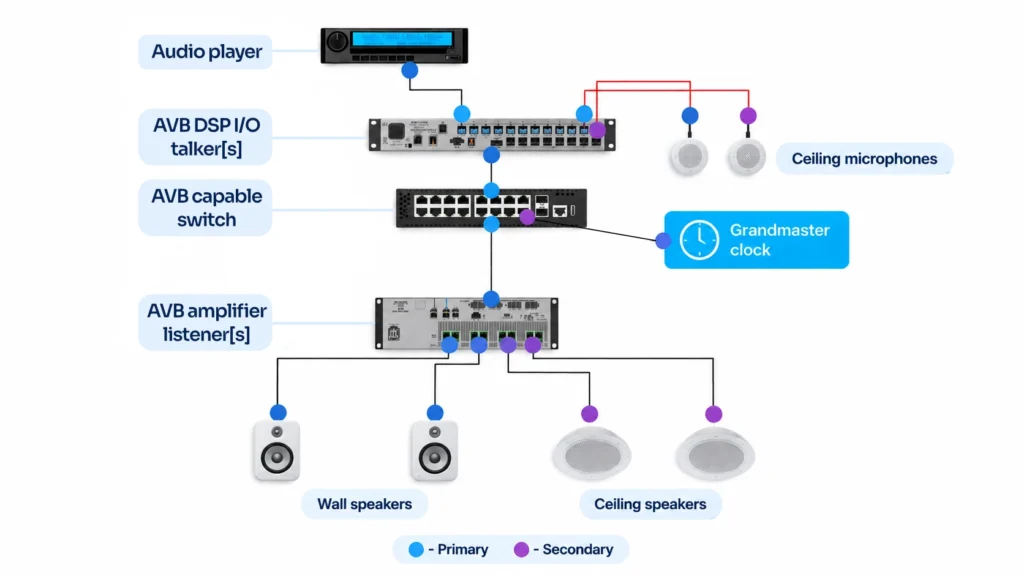
The CX102S-M series combines MSRP stream reservation, MVRP dynamic VLAN registration, and IEEE 802.1Qav traffic shaping to simplify AVB network deployment.
MSRP automates stream resource reservation, while MVRP helps dynamically register VLAN membership across participating switches. Together, these capabilities reduce manual configuration, simplify network changes, and make it easier to manage multiple AVB streams across a shared Ethernet infrastructure.
Flexible PoE Power for AV Devices
For compatible PoE models, the CX102S-M series provides up to 60W of power per RJ45 port, supporting IEEE 802.3af/at/bt power delivery.
By carrying both data and power over a single Ethernet cable, PoE simplifies the installation of compatible AV endpoints, including networked audio devices, wireless access points, cameras, and other connected equipment. It reduces the need for separate power adapters and helps create cleaner, more flexible AV installations.
Flexible Port Configurations and 10G Uplinks
Different AV deployments have different endpoint densities and bandwidth requirements. The CX-M series offers multiple access-port configurations, each with dual 10G optical uplinks for connecting to aggregation or backbone networks.
This flexibility allows system integrators to select the appropriate switch configuration based on endpoint quantity, access bandwidth, and network expansion requirements.
With precise time synchronization, AVB stream reservation, traffic shaping, flexible Ethernet connectivity, and optional PoE power delivery, the Asterfusion CX102S-M series provides a practical switching foundation for networked audio and video systems.
Enterprise SONiC for AVB Network
Together, they provide an open and scalable networking foundation for professional audio-video systems, from individual meeting rooms and recording studios to larger enterprise AV installations.
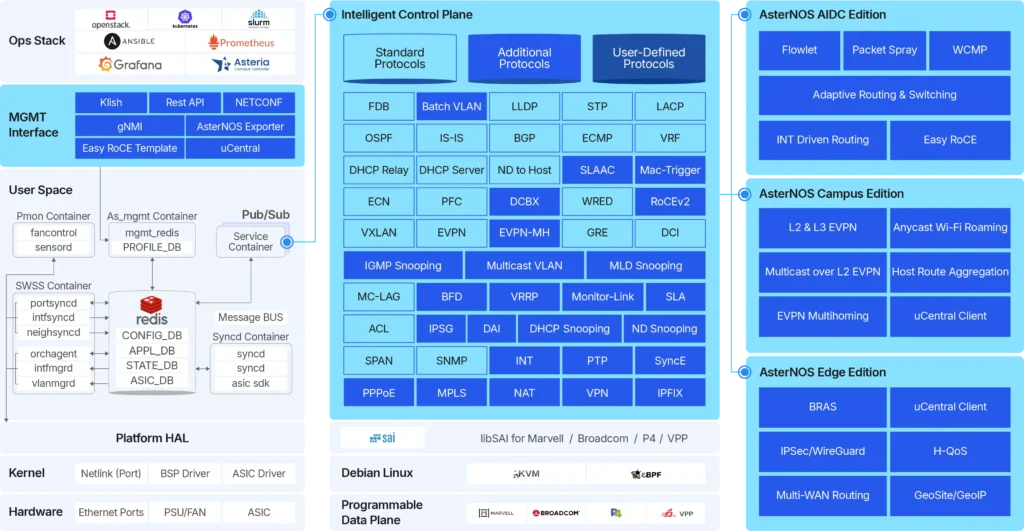
When building a professional AVB network, AVB protocol support is essential, but the network operating system also plays an important role in device management, network security, and infrastructure scalability.
The Asterfusion CX102S-M series runs AsterNOS, an enterprise-grade network operating system built on SONiC. Based on Linux and the Switch Abstraction Interface (SAI), SONiC provides an open and flexible software foundation for Ethernet networks.
Building on this open architecture, AsterNOS adds enterprise networking capabilities that help system integrators manage AVB infrastructure, connect media endpoints, and integrate professional audio-video networks with existing enterprise networks.
Ethernet Interface and AV Device Management
AVB networks connect various devices, including microphones, DSPs, digital mixing consoles, amplifiers, cameras, and networked speakers. AsterNOS provides flexible interface and Layer 2 management capabilities for these connected endpoints.
- Multi-Speed Ethernet Interfaces: Supports 10M/100M/1G/2.5G/10G interface configuration and auto-negotiation, accommodating different endpoint and uplink requirements.
- PoE Management: Supports IEEE 802.3af/at/bt power management, delayed power supply, PD Alive detection, and power status diagnostics on compatible hardware.
- VLAN Segmentation: Supports up to 4K VLANs, Voice VLAN, Basic and Flexible QinQ, and VLAN Mapping to separate AVB traffic from other network services.
- Link Aggregation and Port Isolation: Supports LACP and Port Isolation for flexible connectivity and traffic separation.
High Availability and Network Resilience
Powered by Enterprise SONiC, the Asterfusion CX102S-M Series AVB Switches support IEEE 802.1AS gPTP, IEEE 802.1Qav CBS, and SR Class A and Class B traffic requirements for synchronized, low-latency audio and video transmission.
For network reliability, STP/MSTP and Loopback Detection help prevent network loops and maintain stable connectivity. Asterfusion provides a reliable and scalable Ethernet foundation for professional audio, broadcasting, recording studios, and live performance environments.
Open Networking Software for Professional AV Infrastructure
By combining IEEE AVB capabilities with AsterNOS Enterprise SONiC, the Asterfusion CX102S-M series brings together time-sensitive media transport and enterprise-grade network management. While AVB technologies provide precise time synchronization, traffic shaping, and stream reservation, AsterNOS adds flexible Ethernet management, network security, Layer 3 routing, and high availability.
Typical AVB Network Applications
Meeting Rooms and Multipurpose Spaces
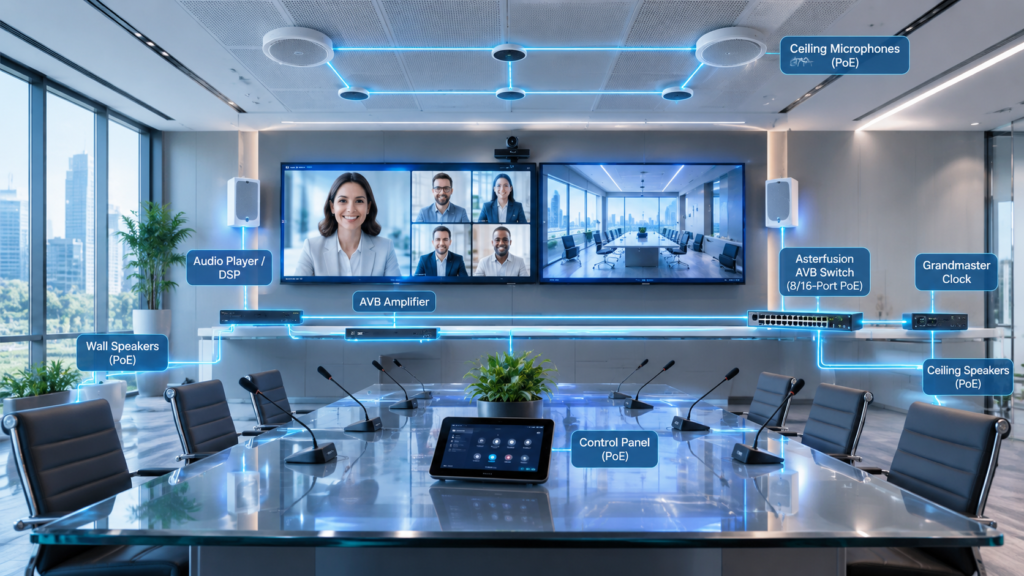
Modern meeting rooms combine microphones, DSPs, amplifiers, loudspeakers, cameras, and conferencing systems. AVB connects compatible devices over Ethernet, allowing multichannel audio to be transported and distributed across the room.
With synchronized media transport and network-based signal routing, audio distribution can adapt to different room layouts and usage scenarios, including presentations, remote meetings, training sessions, and local sound reinforcement.
Professional Sound Reinforcement and Live Events
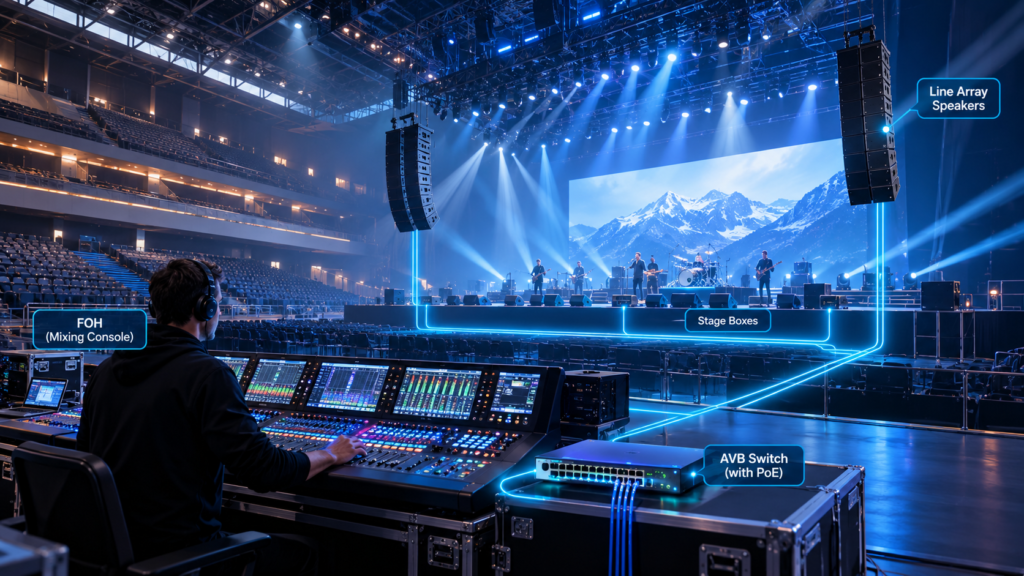
In theaters, concert halls, and live performance venues, AVB connects stage boxes, digital mixing consoles, audio processors, amplifiers, and loudspeaker systems.
Low-latency transport and bandwidth reservation help support multichannel audio distribution, while a shared network time reference enables synchronized output across connected devices. This simplifies signal routing and reduces the need for dedicated point-to-point audio cabling.
Recording Studios and Production Monitoring
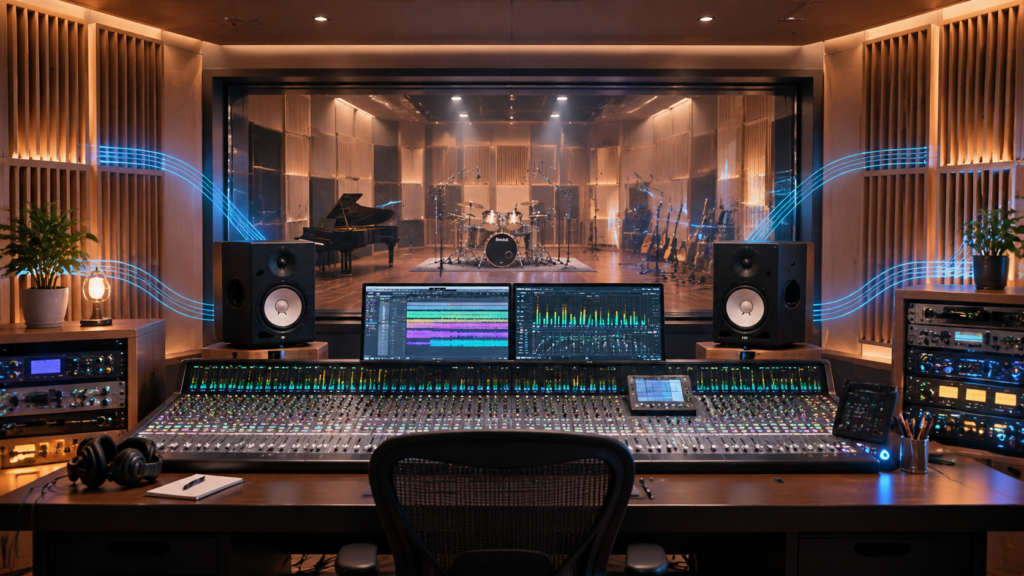
Recording studios and production facilities often need to distribute multiple audio channels between recording interfaces, digital mixing consoles, workstations, and monitoring equipment.
AVB allows compatible devices to share multichannel audio streams over a common Ethernet network. This provides more flexible signal routing between recording, mixing, and monitoring environments while maintaining synchronized media presentation.
In-Vehicle Infotainment

Modern vehicles contain multiple interconnected audio and video endpoints, including head units, amplifiers, displays, and other infotainment devices.
AVB supports time-sensitive media transport between compatible components, helping coordinate multichannel audio and synchronized audio-video playback across the vehicle cabin. Its bandwidth reservation and synchronization mechanisms are particularly relevant to distributed in-vehicle media architectures.
Flexible Ethernet Connectivity for AVB Deployments
AVB networks can include a wide range of endpoints with different port-speed and connectivity requirements. The CX1S-M-S series provides several access-port configurations to accommodate these deployment needs:
- 1G RJ45 Access: Suitable for connecting compatible audio interfaces, control devices, and other Gigabit Ethernet endpoints.
- 2.5G RJ45 Access: Provides higher-speed connectivity for devices requiring more than 1G access bandwidth.
- 10G Optical Uplinks: Aggregate traffic from access switches and connect AVB networks to the wider network infrastructure.
By combining flexible access connectivity with high-speed uplinks, Asterfusion switches provide a practical Ethernet foundation for building scalable networked audio and video systems.
For AVB deployments, the exact switch model, hardware capabilities, and software release should be selected according to the required IEEE 802.1AS, IEEE 802.1Qat/MSRP, and IEEE 802.1Qav functions, as well as the number and bandwidth requirements of the connected media streams.
As professional audio and video applications continue to evolve, Ethernet networks must deliver more than bandwidth. They need precise time synchronization, predictable latency, and efficient traffic management to ensure consistent media delivery.
Powered by Enterprise SONiC, the Asterfusion CX102S-M Series AVB Switches support key AVB technologies, including IEEE 802.1AS gPTP, IEEE 802.1Qav Credit-Based Shaping (CBS), and SR Class A and Class B traffic requirements.
By combining synchronized network timing with intelligent traffic scheduling, Asterfusion provides a reliable Ethernet switching foundation for professional audio and video environments, including recording studios, broadcast facilities, and live performance venues.
With Asterfusion, professional AV networks can move beyond traditional connectivity toward more flexible, scalable, and predictable real-time media infrastructure.


