Table of Contents
For ISPs, WISPs, and satellite network operators, scaling a Broadband Network Gateway (BNG) to 50,000 concurrent subscribers (~70 Gbps of real-world IMIX traffic) has historically meant compromising among three painful options:
- Legacy Proprietary BRAS (e.g., Juniper MX, Nokia): Rock-solid performance, but burdened by $50K–$100K+ upfront CapEx, recurring per-subscriber and bandwidth licensing fees, and massive 2U–7U chassis drawing 1,000W–3,000W+—a non-starter for constrained edge sites.
- General-Purpose x86 Servers + DPDK: Breaks vendor lock-in, but introduces a power and operational nightmare—typically requiring a cluster of 2–3 dual-socket Xeon servers (500W–1,500W per node) with CPUs pinned at 100% polling, plus the overhead of maintaining a complex user-space stack decoupled from native Linux.
- Entry-Level Compact Routers (Switch ASIC + Low-Power ARM): Attractive on price (~$2,800) and power (~80W), but once complex BNG logic (PPPoE sessions, QoS, NAT) fails L3HW hardware offload, traffic punts to the weak ARM CPU slow path, capping real-world BNG throughput at a meager 5–8 Gbps.
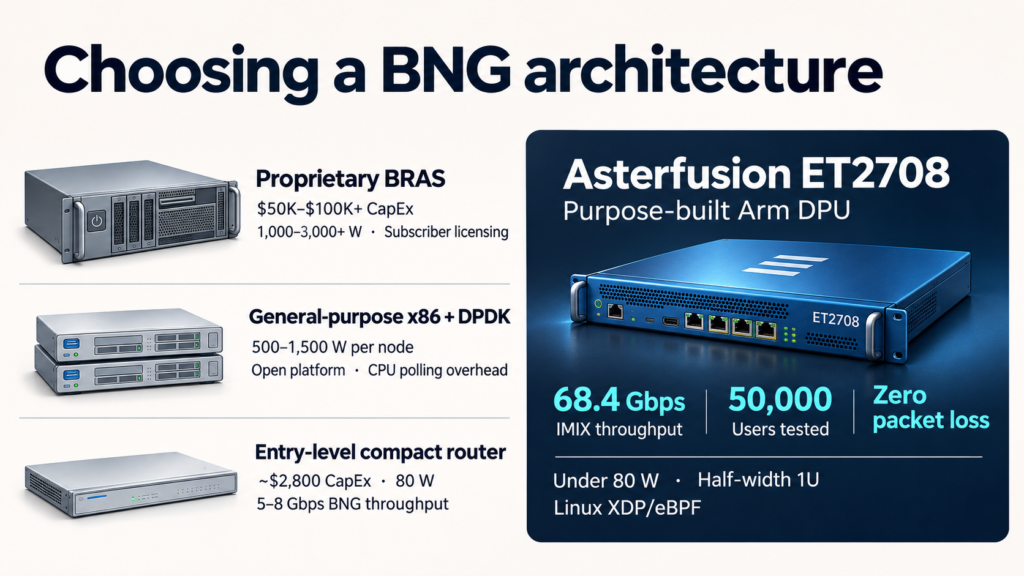
Today, a fourth path has been proven in global production networks: purpose-built ARM DPU hardware paired with a high-performance software data plane.
Production-Proven: 50,000 Concurrent Subscribers in Half-Width 1U Under 80W
Led by Todd Alwell, NGX Soft built a custom XDP/eBPF BNG stack deployed across global PoPs managing Starlink and Low Earth Orbit (LEO) satellite networks—edge environments where rack space, power, and cooling are severely constrained.Below is the test data:
- 50,000 Concurrent Broadband Subscribers: Handled full subscriber session state, accounting statistics, and policy enforcement natively on the DPU.
- 68.4 Gbps IMIX Throughput: Sustained high-intensity, real-world mixed packet traffic (IMIX) without hitting the CPU thermal throttling or memory bandwidth bottlenecks common on x86 servers.
- 100G Large-Packet Line Rate at Just ~80W: Saturated 100GbE interfaces at full line rate while keeping total system power at roughly ~80W—less than a quarter of a comparable 100G x86 server—proving that a compact DPU appliance can directly replace bulky, high-wattage x86 rack servers in production carrier broadband aggregation networks
Running on the Asterfusion ET2708 (powered by the Marvell OCTEON 10 CN103 DPU), this solution shatters the traditional BNG trilemma:
| Dimension | Legacy Proprietary BRAS | x86 Server + DPDK | Entry-Level Compact Router | Asterfusion ET2700 (OCTEON 10 CN103) |
| Hardware & Licensing Cost | $50K–$100K+ upfront + recurring license fees | $6K–$10K/node + 100G NICs (2–3 nodes required) | Low (~$2,800) | Disruptive white-box TCO (no port/bandwidth tax) |
| Real-World BNG Throughput | High | High (heavy multi-core CPU saturation) | Severe bottleneck (~5–8 Gbps slow path) | 68.4 Gbps IMIX / ~23 Mpps (50K subscribers, zero packet loss) |
| Power & Footprint | 2U–7U, 1,000W–3,000W+ | 2U, 500W–1,500W | 1U, ~80W | Half-width 1U (2 units per 1U rack slot), <80W |
| Core Architecture | Expensive proprietary NPU + closed OS | CPU polling (DPDK) | ASIC offload fallback to weak ARM CPU | OCTEON 10 hardware offload + high-performance software data plane |
The Tuning Reality: Unlocking a 3.4x Performance Jump (6.73 Mpps to 23 Mpps)
One of the biggest misconceptions when evaluating ARM DPUs with Linux XDP is judging the silicon’s true capability based on out-of-the-box default parameters. Todd Alwell’s tuning benchmarks on the ET2708 (CN103) clearly illustrate the hardware’s real performance ceiling:
- Run 1 (Default RX Rings): Unable to achieve a stable zero-loss rate—bottlenecked entirely by default ring buffer and kernel parameters.
- Run 2 (Minor Tuning from CN102, RX Ring 16384): Achieved 6.73 Mpps (20.55 Gb/s) with zero packet loss at 63.4% CPU utilization.
- Fully Tuned XDP/eBPF Pipeline (80/20 Operating Ratio): Sustained 68 Gb/s IMIX (~23 Mpps) across three consecutive 30-second test windows with zero receive-queue drops, driving per-packet processing overhead down to just 748 CPU cycles.
Key Takeaway: Proper pipeline tuning alone delivered a 3.4x jump in packet forwarding rate over initial tuning. The bottleneck was never the silicon—it was the default software configuration.
Two Paths to Deploy Next-Gen BNG on the Marvell Octeon 10CN103
Whether you have a hardcore kernel engineering team or need a turnkey gateway ready to go live tomorrow, the Asterfusion ET2708 gives you open-hardware freedom without locking you into a single software stack:
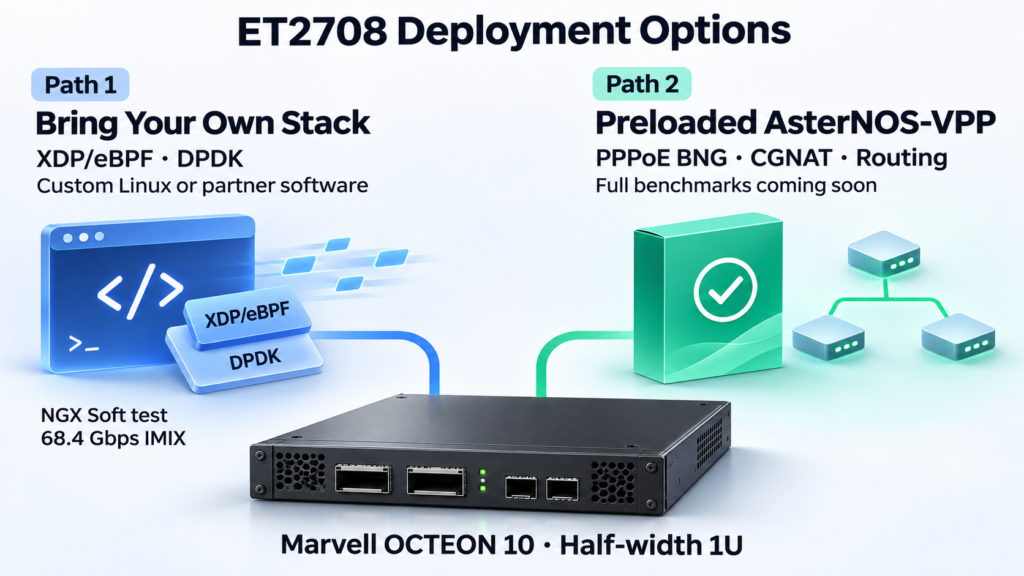
Path 1: Bring Your Own Software Stack (XDP/eBPF, Custom Linux, or Ecosystem Partners)
If you are a network software vendor, CDN, or Tier-1 ISP with in-house development capabilities (like NGX Soft), you can deploy the ET2708 as an open OCTEON 10 bare-metal platform. Run your own XDP/eBPF or DPDK data plane—or an ecosystem partner’s solution—to extract 68+ Gbps of forwarding power from a half-width 1U box under 80W.
Path 2: Turnkey with Asterfusion SONiC-VPP (Full Benchmarks Coming Soon)
Don’t want to spend months writing and tuning an XDP pipeline from scratch? The exact same ET2708 hardware is available pre-loaded with AsterNOS-VPP. Get production-grade, carrier-class PPPoE BNG, CGNAT, and routing right out of the box—no kernel tuning required, while keeping the sub-80W power envelope and white-box economics.
Sneak Peek: Full AsterNOS-VPP Benchmark Report Coming Soon
Many engineers ask: “Can an out-of-the-box AsterNOS-VPP stack really match a heavily customized XDP/eBPF pipeline?” The short answer: They are neck and neck. In our latest internal lab baseline tests on the same ET2708 platform, AsterNOS-VPP delivered rock-solid PPPoE forwarding throughput—hitting full 100G line rate on large packets and holding steady above 90 Gbps on 512-byte packets, putting its overall forwarding performance squarely in the same tier as a tuned XDP stack. Better yet, because it runs on a full user-space protocol stack, AsterNOS-VPP offers more predictable performance scaling and faster feature velocity when layering complex CGNAT, QoS shaping, and routing policies.
Our engineering team is currently completing final optimizations on specific flow distributions (RSS hashing) and full-feature concurrency. We will publish the complete AsterNOS-VPP benchmark report and deep-dive analysis on the ET2708 shortly—stay tuned.
How Easy Is It to Port Your Software Stack from x86 to OCTEON 10?
For customers who already own in-house networking software, migrating to a new hardware platform is rarely about rewriting a system from scratch—what matters most is how much existing code can be retained, which parts require modification, and how quickly it can be deployed.
The Asterfusion ET Series adopts an open, disaggregated hardware-software architecture built on the ARM64 Linux ecosystem, supporting standard Linux distributions such as Ubuntu and Debian, alongside modern networking frameworks including DPDK, VPP, and XDP/eBPF. Customers have full freedom to bring their own OS, network protocol stacks, and business applications—without relying on our turnkey AsterNOS-VPP or building a software environment from the ground up.
The engineering effort required to move off x86 depends primarily on how tightly your existing codebase is coupled to x86-specific CPU instructions and proprietary NIC drivers. R&D teams can evaluate migration scope across three distinct layers:
Linux Control Plane & Ops Tooling Routing configurations for FRRouting and BIRD, along with deployment scripts and monitoring/telemetry logic built on standard Linux tools. Install ARM64 packages or recompile user-space applications for the target system; verify third-party dependencies, NIC interface naming conventions, and configuration file paths. DPDK / VPP Forwarding Applications Core packet-processing logic, subscriber/routing policies, and northbound management APIs written against standard interfaces. Adapt to target PMD drivers and RX/TX queue mappings; audit and replace any x86-specific SIMD instruction optimizations; enable and validate DPU hardware offloads (crypto, QoS, packet parsing) as needed. In-House XDP/eBPF Data Planes Packet-processing programs built on standard XDP hooks, alongside existing subscriber session management and accounting/policy logic. Verify target Linux kernel version, NIC driver support, and XDP attachment modes; benchmark throughput under production packet sizes and active policy rules.
Ready to Benchmark the ET2708 as next generation BNG in Your Lab?
Stop paying steep premiums for 3,000W legacy chassis or wrestling with power-hungry x86 DPDK clusters. Contact our team to request an ET2708 evaluation unit—whether as bare-metal hardware for your custom XDP/eBPF stack or as a turnkey BNG appliance pre-loaded with AsterNOS-VPP, we are ready to ship.