Table of Contents
Introduction
In previous articles, we discussed the evolution from traditional BNG to OpenBNG, and the key technologies used in the BNG network aggregation layer. Building on that, we now introduce an integrated solution that takes network convergence to a new level.
This solution, through Unified PON and BNG, achieves:
- Unified management of PON and Ethernet access networks
- One-click service deployment and automated delivery
- Zero-touch provisioning(ZTP) and intelligent alarms to simplify daily operations
- Significant savings in devices and servers, drastically reducing Total Cost of Ownership (TCO)
Let’s explore how this unified PON and BNG solution reshapes the economics and agility of access networks.
Ⅰ. Current Status of Traditional BNG/BRAS Architecture
The traditional BNG/BRAS architecture adopts a layered network model, consisting of the end-user side, access network, and a supporting management system within the regional network.
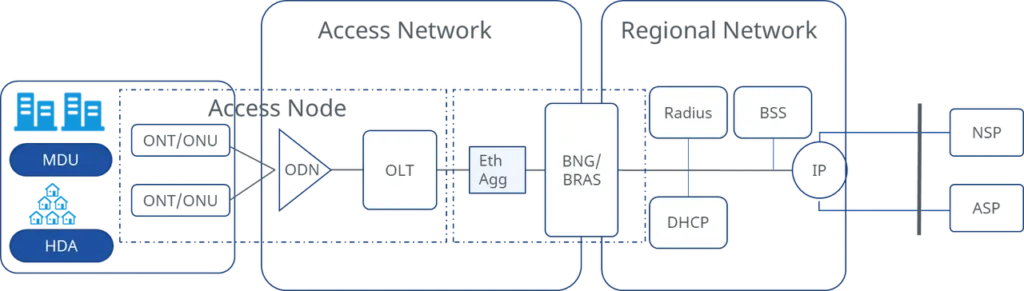
Abbreviation Explanation:
| Acronym | Desc. |
| BNG | Broadband Network Gateway |
| BRAS | Broadband Remote Access Server |
| MDU | Multi-Dwelling Unit |
| HDA | High-Density Area |
| NSP | Network Service Provider |
| ASP | Application Service Provider |
1. Network Architecture
- End User Side: Optical Network Terminal (ONT) devices in multi-dwelling units and high-density areas, connected to the Optical Line Terminal (OLT) at the central office via a passive optical distribution network.
- Access and Core Layers: The OLT aggregates traffic to the BNG/BRAS device, which handles subscriber authentication, manages IP sessions, enforces QoS policies, and routes traffic between connections and the core network.
- Regional Network: Relies on independent RADIUS, Business Support Systems (BSS), and DHCP servers to perform user authentication, service activation, and address allocation.
2. Core Pain Points
In traditional BNG networks with layered architecture and multiple independent systems, the following issues exist:
High Hardware Dependency: Traditional BNG devices rely on proprietary ASIC/NP chip hardware, resulting in high equipment costs, high power consumption, and poor scalability as new physical devices are needed for expansion.
Decentralized Management Architecture: AAA, BSS, PON, and Ethernet management systems are independent, requiring cross-platform configuration and operations, leading to inefficiency.
High Deployment Complexity: The lack of automation tools prevents zero-touch deployment, requiring manual integration of new devices, resulting in high operational and maintenance costs.
Ⅱ. Asterfusion Unified PON and BNG Network Solution
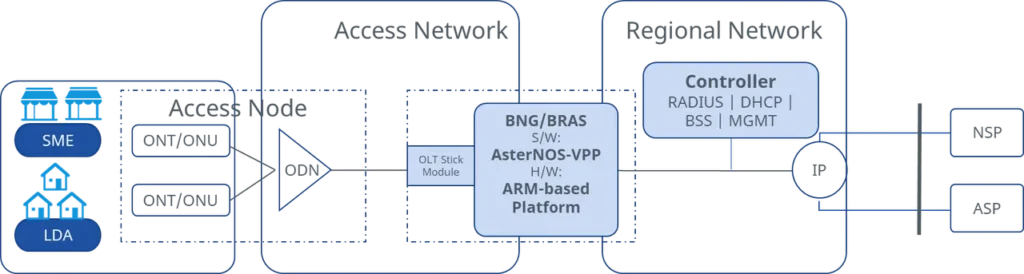
The Asterfusion solution, based on ARM architecture hardware and the AsterNOS-VPP operating system, achieves architectural innovation through three core replacements, as detailed below:
Replacing x86 + vBNG: AsterNOS-VPP + DPU Architecture
- Traditional Solution: Uses x86 servers and network cards paired with virtualized BNG, relying on DPDK pipelines and the PFCP protocol to separate control and data planes. This results in high hardware resource usage and significant performance loss.
- Unified PON and BNG Solution: Leverages a 1RU rack-mounted DPU + switch architecture, running the AsterNOS-VPP OS integrated with SONiC and VPP, avoiding the high load on x86 CPUs. This architecture supports full functionality, including PPPoE Server, HQoS, CGNAT, MAP-E/T, and offers interfaces like REST/gNMI, replacing the proprietary dependencies in x86 vBNG. It also supports both ARM and x86 platform deployments.
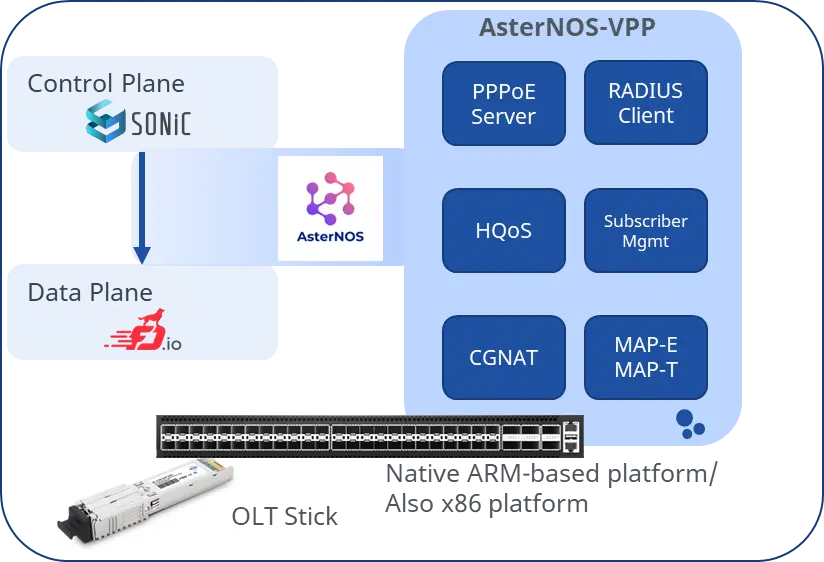
Replacing Independent AAA/DHCP Servers: Integrated AAA & DHCP in OpenWiFi Controller
- Traditional Solution: RADIUS, BSS, DHCP, and device management systems are independent, with no data intercommunication. User management and policy delivery require multiple steps.
- Unified PON and BNG Solution: Deploys an openWiFi Controller on cloud or local devices, integrating AAA, DHCP, BSS, and device management functions. It supports multi-tenant user management, role-based IP allocation, and OAuth 2.0 portal authentication, enabling one-stop control for user authentication, address allocation, service activation, and pre-configured topology.
Replacing Traditional OLT Devices: OLT Stick Modular Solution
- Traditional Solution: Uses high-density OLT chassis, which are large, power-hungry, and only suitable for high-density area deployments, with limited scalability.
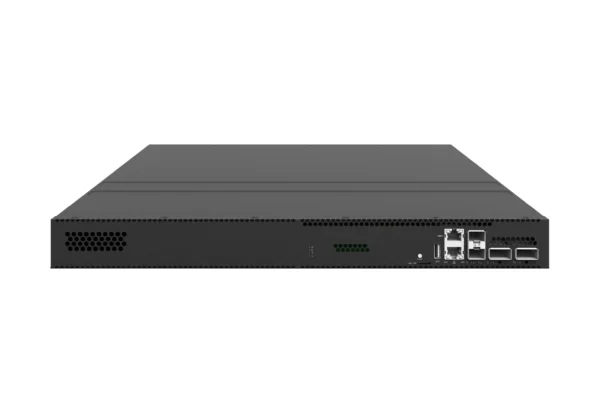
- Unified PON and BNG Solution: Uses the XGSPON OLT Stick module, supporting a 1:128 split ratio and a 20 km transmission distance. It can be directly inserted into the DPU device slot. The CX306P-48Y-M-H device can support up to 48 OLT Stick modules, making it ideal for small- to medium-scale access scenarios, offering flexible deployment and lower costs.
Through these three technological replacements, the Unified PON and BNG Solution by Asterfusion revolutionizes traditional BNG network architectures, achieving cost optimization, performance enhancement, and simplified operations.
Ⅲ. Unified PON and BNG Solution Performance Verification
The Unified PON and BNG Solution is not just a concept; we have conducted actual performance calculations based on the device capabilities.
Taking a typical urban community deployment scenario as an example: assume a single device covers 3,000 households, with an average contracted bandwidth of 80 Mbps per household and a peak online rate of 80%. The instantaneous total traffic demand would be: 3,000 x 80% x 80 Mbps = 192 Gbps.
Faced with such dense concurrent traffic, the Unified PON and BNG Solution demonstrates impressive capacity. Both core devices, the ET3608-2P2S and CX306P-48Y-M-H, support 2×100 Gbps routing throughput and 2×20k (total 40,000) PPPoE session processing capacity. This means that the total 200 Gbps bandwidth can not only deliver near-line-speed performance to perfectly cover all concurrent traffic during peak business periods, ensuring zero-latency experience for delay-sensitive services like video-on-demand, online education, and remote work, but also provides ample performance headroom for the future growth of ultra-high-bandwidth services like 4K/8K video streaming and AR/VR.
Moreover, thanks to the advantages of the VPP (Vector Packet Processing) architecture, even with HQoS traffic fine-grained control and CGNAT translation enabled, the devices can maintain stable high throughput and low latency. This addresses the packet loss and jitter issues typically encountered by traditional software BNGs under high load, truly enabling high-performance, high-reliability access network convergence.
Ⅳ. Best Deployment Scenario: Small & Medium ISPs
Based on the above performance verification, this solution is ideal for deployment by small- and medium-scale ISPs, regional ISPs, and MSP (Managed Service Provider) hosting service providers, with a focus on low-density residential areas.
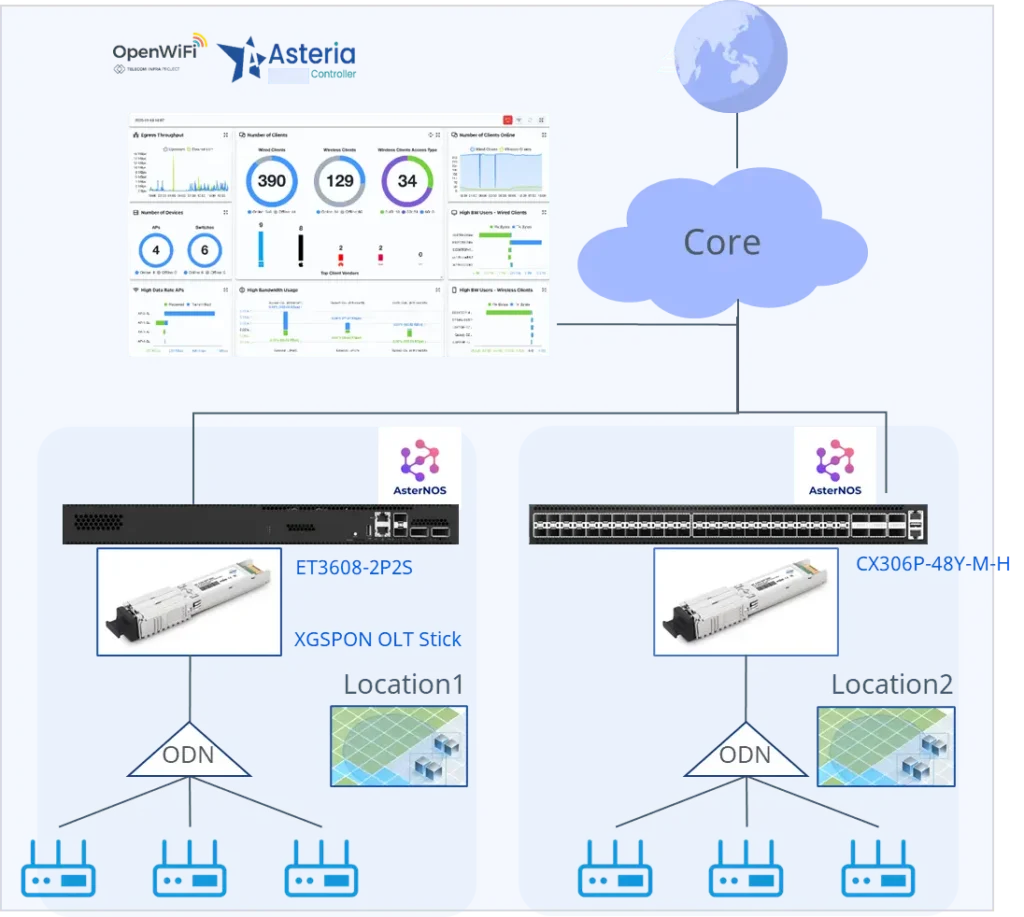
For dispersed user scenarios in rural, town, and remote suburban areas, If a single CX306P-48Y-M-H with DPU device is used with 48 XGSPON OLT Stick modules as the BNG device, it can support a 1:128 split ratio to cover approximately 3,000 households (with an average of 50 Mbps per household), with a transmission distance of up to 20 km.

Alternatively, the ET3608-2P2S device can also support daily use for 3,000 households.
Ⅴ. Core Advantages of Asterfusion Unified PON and BNG Solution
Extreme Cost Optimization: Lower Costs + Space Savings
- Low Hardware Costs: Utilizes a universal DPU architecture to replace expensive, proprietary hardware, reducing equipment procurement costs. The 1RU compact design saves rack space compared to traditional OLT chassis + x86 servers.
- Low Operational Costs: Integrated management reduces manpower input, while the low-power design reduces data center electricity costs. The on-demand scalability of OLT Stick modules prevents resource wastage and underutilization.
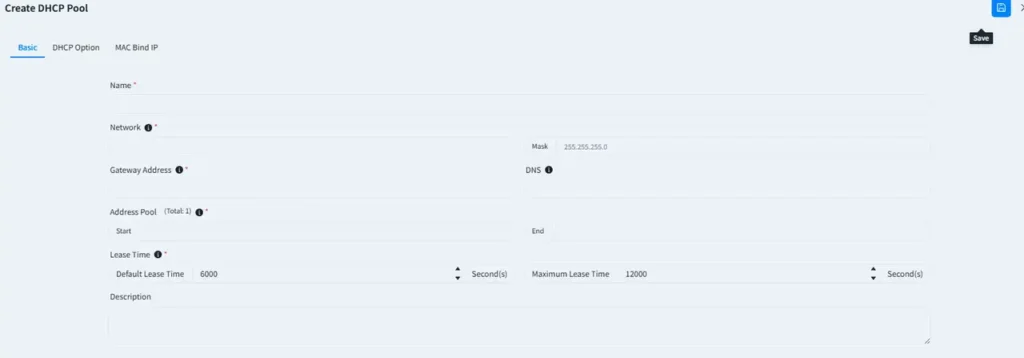
Integrated 3A & DHCP
By integrating the AAA and DHCP servers within the OpenWiFi Controller, the risks associated with purchasing licenses from external vendors or unstable regions are eliminated.
Unified Management: PON + Ethernet + Wireless Integrated Control
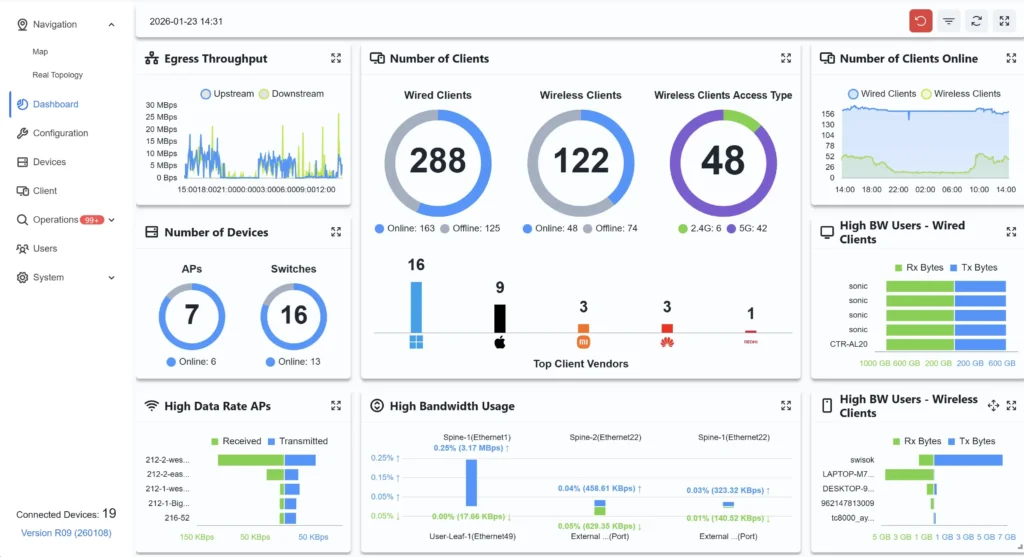
- Unified Device Management: The controller centrally manages OLT Stick, switches, routers, wireless APs, and BNG devices, breaking down device type barriers.
- Unified Data View: Provides multi-dimensional real-time monitoring of wired, wireless, and PON networks, allowing intuitive viewing of overall network traffic, device health status, and terminal online status.
Multi-Tenant Management
Multi-tenant management is achieved through subscribers. Different users are logically isolated on the same physical network, with differentiated bandwidth and access permissions, enabling refined management.

Fast Service Deployment & ZTP Automation
- Zero-Touch Deployment: Based on predefined network topology, device configurations are automatically generated and pushed, enabling plug-and-play and significantly shortening deployment cycles.
- One-Click Configuration Delivery: Leveraging the centralized control capabilities of the controller, operations such as user activation, service plan changes, and policy adjustments can be pushed with one click, eliminating the need for per-device configuration. Business activation time is reduced from days to minutes.
- Smart Alarm Integration: The integrated alarm system supports email, Slack, and other platform notifications, enabling real-time monitoring of power, fan, interface links, and other faults.
Simplified Architecture: Reduced Complexity + Improved Reliability
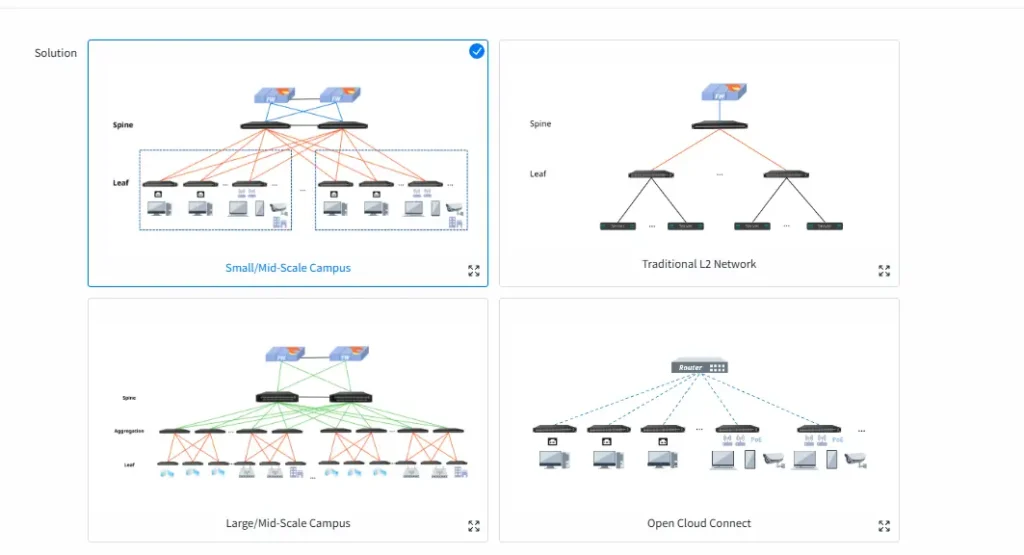
The traditional multi-layer forwarding architecture is eliminated. Traffic processing is handled nearby by the distributed BNG, reducing network nodes. At the same time, disparate management systems are consolidated, reducing architectural complexity and enhancing overall network reliability.
Ⅵ. Conclusion: Unified PON and BNG Solution Helps ISPs “Reduce Costs and Increase Efficiency”
The Asterfusion Unified PON and BNG Solution provides a pathway to high-performance, low-cost networks for small- and medium-sized ISPs and regional operators through disruptive architectural innovation.
Compared to traditional architectures, this solution achieves the following advancements:
| Dimension | Traditional BNG/BRAS Architecture | Asterfusion Unified Solution | Core Benefits |
|---|---|---|---|
| Hardware Form | Large OLT chassis + x86 server cluster | 1RU compact DPU (ET3608 / CX306P) | Saves rack space and reduces power consumption |
| Access Method | Expensive, proprietary PON cards | Universal OLT Stick modules (plug-and-play) | On-demand scalability, eliminates resource wastage |
| Performance | x86 vBNG faces bottlenecks, forwarding performance limited | ARM + VPP hardware acceleration | 200 Gbps line-speed forwarding, 40,000 concurrent users |
| Management Costs | Independent AAA/DHCP servers, expensive licenses | Controller integrated with free AAA & DHCP | Eliminates software license fees, reduces TCO |
In conclusion, by deploying ET3608-2P2S or CX306P-48Y-M-H devices along with cost-effective OLT Stick modules, you can replace bulky traditional hardware stacks and achieve unified management of PON and Ethernet through the OpenWiFi Controller. This not only dramatically reduces CAPEX and OPEX for network construction but also shortens business delivery from “days” to “minutes” through ZTP automated operations, truly helping ISPs transform from a cost center to a profit center.

Contact US !
- To request a proposal, send an E-Mail to bd@cloudswit.ch
- To receive timely and relevant information from Asterfusion, sign up at AsterNOS Community Portal
- To submit a case, visit Support Portal
- To find user manuals for a specific command or scenario, access AsterNOS Documentation
- To find a product or product family, visit Asterfusion-cloudswit.ch


