Table of Contents
As enterprise data centers transition from traditional SAS/SATA SSDs to high-performance NVMe storage, the underlying network infrastructure faces an unprecedented challenge. To unlock the ultra-low latency and massive IOPS potential of NVMe over Fabrics (NVMe-oF), standard TCP/IP is no longer enough. Enter RDMA over Converged Ethernet (RoCEv2).
Recently, a Tier-1 infrastructure architect approached Asterfusion with a highly specific inquiry. They were benchmark-testing 1U 32-port 400G switches from various silicon vendors—including Broadcom Tomahawk 3 (TH3), Tomahawk 4 (TH4), and NVIDIA Spectrum-3—is also considering evaluatd a Asterfusion Marvell Teralynx7-based 400Gswitch now.
Below, we open-source this deep-dive technical Q&A to explain why the Asterfusion CX732Q-N (powered by Marvell Teralynx 7) is engineered to be the optimal backbone for lossless RoCEv2 NVMe-oF environments.

Q1: How optimized is the Asterfusion 400G switch for RoCEv2 functionality? What makes it “lossless”?
Asterfusion: For NVMe-oF setups, even minor packet drops can cause massive I/O timeouts. The CX732Q-N is engineered from the ground up for lossless RoCEv2 deployments, powered by our enterprise-grade SONiC distribution: AsterNOS
- Advanced Control Plane Protocol Stack: AsterNOS provides robust, native support for core traffic management mechanisms required for lossless networks, including PFC (Priority Flow Control), ECN (Explicit Congestion Notification), DCB (Data Center Bridging), and Fast CNP (Congestion Notification Packets)
- “Easy RoCE” One-Click Deployment: To eliminate the complexity of manual queuing and thresholds, our management plane features Easy RoCE. It automatically configures recommended, validated RoCE parameters across your fabric with a single action
- Granular Telemetry Monitoring: AsterNOS integrates a built-in Prometheus Exporter This allows network operations teams to stream critical RoCE metrics—such as real-time queue utilization, buffer headroom occupancy, PFC pause frames, and ECN statistics—directly into standard Grafana dashboards
Q2: What are the advantages of TL7 compared to Broadcom Tomahawk 3/4 or Spectrum-3 in an NVMe-oF architecture?
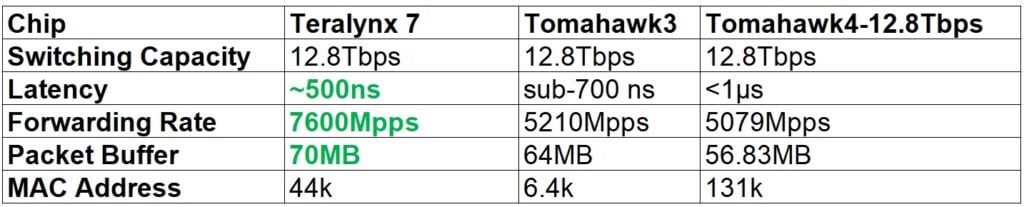
Asterfusion: In flash storage networks, every nanosecond counts. Minimizing I/O response time and maximizing IOPS requires three pillars: ultra-low port-to-port latency, maximum forwarding rates, and large on-chip buffers.
- The Teralynx 7 Edge: Compared to Broadcom Tomahawk 3 and Tomahawk 4 based platforms, the Marvell Teralynx 7 silicon architecture delivers significantly tighter predictable tail-latency and superior fabric buffer efficiency.
- Platform-Level Co-Engineering: Asterfusion works in close alignment with Marvell engineers. This deep platform-level optimization allows AsterNOS to extract and fully utilize the raw, unthrottled capabilities of the underlying ASIC hardware.
- The Ultimate Proof (NVMe-oF Benchmark vs InfiniBand): Using the same Teralynx silicon family, we conducted rigorous NVMe-oF benchmarking against an industry-standard InfiniBand (IB) switch . Under intensive 8 KB read/write random workloads, our Teralynx-powered network architecture achieved 6% to 10% higher IOPS than the IB setup .
Marvell Teralynx 7 compared to Broadcom Tomahawk 3/4
Q3: You provide your own enterprise implementation of SONiC (AsterNOS). Is the software license free?
Asterfusion: Yes. Asterfusion advocates for open, disaggregated networking without software traps. We deliver a hardware + software bundled solution.
Every CX732Q-N switch ships from our factory with AsterNOS (Enterprise SONiC) pre-installed. When you purchase the hardware bundle, AsterNOS is included at zero additional software license cost. There are no exaggerated subscription fees or hidden feature locks.After one year,the future software renewal fee will be approximately 10% of the hardware price.
🔗 Explore the full open-source feature matrix here:Asterfusion Enterprise SONiC Distribution
Q4: Does the switch support PAM4 50G, 100G, or both signaling rates?
Asterfusion: The current CX732 architecture operates on 50G PAM4 signaling only and does not natively support 100G PAM4 lanes .
However, it provides highly flexible high-density breakout options to adapt to various NIC and storage target speeds :
- 2 × 200G Breakout: (4 lanes × 50G PAM4 per port)
- 4 × 100G Breakout: (2 lanes × 50G PAM4 per port)
- Legacy speeds including 40Gbps, 25Gbps, and 10Gbps are also fully backward-compatible and supported .
Q5: Does AsterNOS provide robust API support for infrastructure automation?
Asterfusion: Absolutely. Automation is mandatory for scale-out modern data centers. AsterNOS exposes multiple open, programmable management interfaces for seamless integration into 3rd-party orchestrations and NetOps toolchains:
- Modern NetOps Automation: Native support for REST API, NETCONF, and gNMI .
- Traditional Administration: For network engineers who prefer command-line execution, we provide a familiar, carrier-grade Cisco-style Klish CLI .
Q6: Do you enforce vendor lock-in via firmware coding on transceiver cables?
Asterfusion: No. Asterfusion switches are built strictly in compliance with open IEEE Ethernet standards . We believe vendor lock-in hurts the customer. We do not enforce firmware locks or whitelist encodings on DACs, AOCs, or optical transceivers—mainstream third-party optics work out of the box .
Note: While we allow any standard compliant cable to work, Asterfusion also manufactures its own line of high-quality optical modules and cables . They are 100% validated on our hardware for performance and thermal reliability, providing you with a highly cost-competitive alternative during evaluation .
🔗 For more:https://asteraix.com/products/optical-transceivers/
Q7: What are the cooling and airflow direction options?
Asterfusion: The standard CX732 configuration is built with standard data center Front-to-Back (F2B) airflow .
If your specific rack deployment demands a Back-to-Front (B2F) airflow direction, please let our sales engineering team know . Because a change in airflow direction impacts internal power supply layouts and chassis thermal design verification, we can initiate a formal evaluation to customize the box layout for your project requirements .
This blog post summarizes active customer inquiries regarding the Asterfusion CX732Q-N switch infrastructure . Every nanosecond counts—build your network on true open silicon.)
Ready to Experience Teralynx 7-Powered 400G RoCEv2 Ethernet Switches in an NVMe-oF architecture ?
Welcome to download and read the following test report:


