Table of Contents
This article continues from Asterfusion PTP Switch Powers Live Streaming of Australia’s Premier Sporting Events.
Customer Requirement
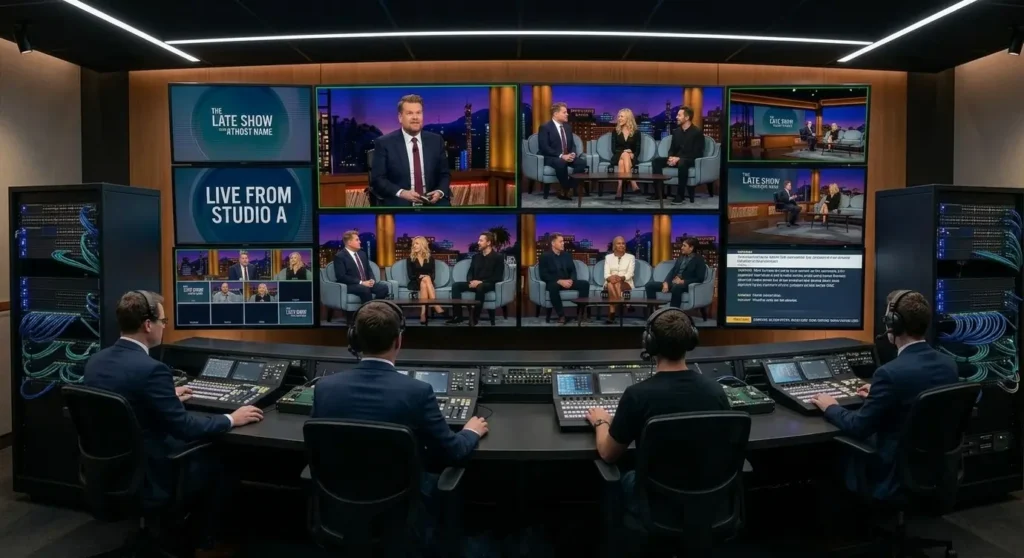
G Company, as a global benchmark in the broadcast industry, not only relies on OB Vans for mobile live production, but also supports complex production requirements in large studio environments, including talk shows and interview programs for live-to-air broadcasting.
Compared with OB Van scenarios, studio environments present different and more demanding requirements, particularly in multi-camera synchronization, high-frequency real-time switching, and deterministic signal distribution.
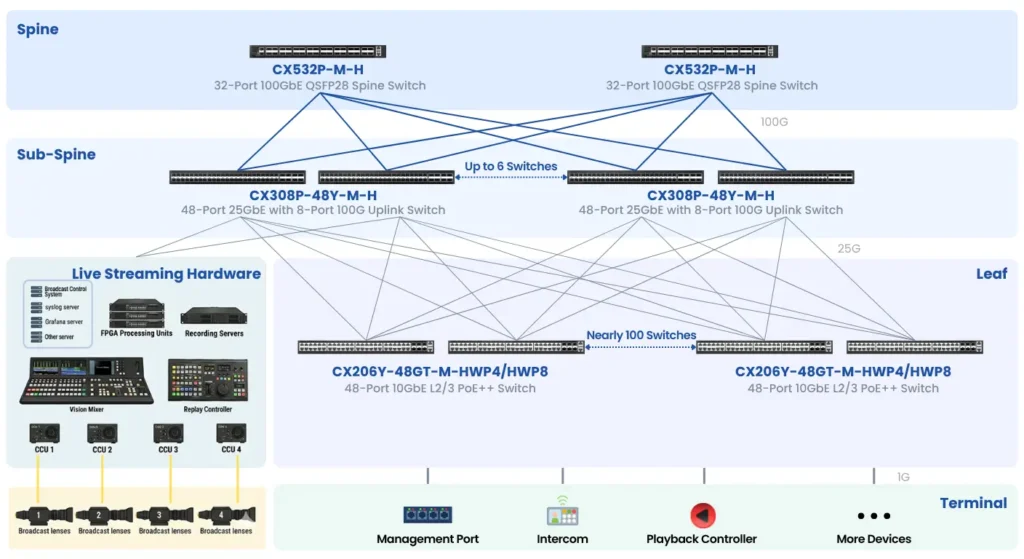
To address these requirements, the deployment adopts Asterfusion switches compliant with the SMPTE 2110 standard, and is built on a Spine–Sub-Spine–Leaf architecture to ensure high-bandwidth transport, low-latency forwarding, and scalable media signal orchestration within an IP-based production workflow.
Network Deployment Architecture
The following section uses a studio deployment as an example.
A diagram is referenced below:
- Dual-Spine Redundant Backbone
Two CX532P-M-H switches are deployed as the core backbone. They handle full-network traffic switching. Hardware-level optimization is applied for nanosecond-level Precision Time Protocol (PTP) synchronization, ensuring system-wide timing accuracy across all endpoints.
- Aggregation and Scheduling Layer (Sub-Spine Layer)
A total of 18 CX308P-48Y-M-H switches were deployed as the core aggregation layer of the network. Their primary role is to provide high-performance aggregation for 25G production endpoints and ensure low-latency transport for high-bandwidth video streams.
- Management and Signaling Plane (Management Leaf Layer)
Nearly 100 CX206Y/CX204Y series switches were deployed for device management and control services across the entire network. These switches carry configuration management, software upgrades, control signaling, intercom, and tally system traffic. A physically isolated 1G management network is used to separate control traffic from production video streams.
- High-Precision Timing Foundation
Two Grandmaster are deployed as the system-wide timing reference. They provide high-precision time synchronization, ensuring all devices maintain nanosecond-level alignment.
- PIM Multicast and Business Integration
Unlike traditional designs, multicast routing state is directly programmable through a writable SONiC Redis control plane interface. The Broadcast Control System drives multicast state updates at runtime, establishing a joint control model between production logic and network behavior. Each switching action from the production control system is translated into immediate multicast route recalculation in the network, enabling frame-accurate signal switching based on dynamic PIM state updates.
- Heterogeneous Endpoint Adaptation
For production devices such as FPGA cards and CCUs, which exhibit different timing behaviors, targeted protocol adaptation and iterative tuning are implemented. This ensures a smooth transition from traditional SDI-based workflows to a fully IP-based production architecture.
The following table describes the role of each endpoint device for reference.
| Production Device | Core Function Overview |
| CCU (Camera Control Unit) | Provides power to cameras and enables remote control of color and exposure parameters, establishing the baseline for image quality. |
| Vision Mixer | Core control system of the production workflow. Performs real-time video aggregation, transitions, keying, and effects composition. |
| Replay Controller | Subscribes to specific multicast streams to enable precise slow-motion replay of critical sports events. |
| FPGA Card (Media Processing Card) | Uses high-performance compute resources for real-time audio/video encoding, decoding, and format conversion. |
| Large Screen Controller / Matrix | Distributes video streams to studio monitors or on-site large displays for real-time visual presentation. |
| Recording Server | Stores broadcast-grade program content in a structured format, providing high-quality material for post-production. |
| Broadcast Control System | Centralized control of PIM multicast flow direction, mapping director commands to physical signal paths with millisecond-level precision. |
End-to-End SMPTE 2110 Workflow powered by Asterfusion
- Acquisition and Ingress
On-site cameras are connected to the CCU via fiber links. The CCU converts the raw camera feed into a standard IP stream (SMPTE 2110) and injects it into the in-vehicle network.
- Aggregation and Production
The Vision Mixer retrieves multiple camera feeds from the Leaf switches. It performs real-time signal aggregation, switching, and effects compositing. The resulting program output (PGM) stream is then sent back into the switching fabric.
- Replay Workflow (Slow-Motion Path)
Replay servers (e.g., EVS systems) subscribe to selected camera multicast streams for buffering. When key events occur, the replay system generates slow-motion video, encapsulates it into an IP multicast stream, and re-injects it into the network. The stream is then distributed by the switches to PGM outputs or monitoring devices.
- Distribution and Processing
The switches distribute the PGM stream and replay streams in coordination with the Broadcast Control System. Streams are delivered to FPGA processing cards for compression and distribution, to on-site display controllers for real-time visualization, and to recording servers for post-production storage.
- Command Delivery
Acting as the “control plane” of the entire architecture, the signaling network isolates control services through dedicated physical links. It carries Vision Mixer control commands, CCU control traffic, intercom, tally, and PTP timing signals. This design ensures real-time and reliable delivery of production control instructions.
Across the entire signal flow, multicast capabilities of the switches combined with the Broadcast Control System enable end-to-end live production. This ensures high signal integrity, stability, and consistent broadcast quality.
Deployment Results
- Value 1: Control-Plane Flexibility — Fine-Grained Multicast Routing Control
Asterfusion exposes SONiC Redis database interfaces and extends multicast routing control to the Broadcast Control System. This architecture enables millisecond-level synchronization between director commands and physical network state. When a switch action is triggered from the production console, multicast routes are instantly reprogrammed in the network.
- Value 2: PTP Timing Stability — Broadcast-Grade Precision
To address PTP unlock issues caused by port instability, the system was stabilized to tens-of-nanoseconds-level accuracy. A redundancy mechanism was introduced to mitigate port flap events. This eliminates video flicker and audio-video desynchronization, while delivering a synchronization foundation comparable to top-tier broadcast studios.
- Value 3: Real-Time Responsiveness — Fast Adaptation for Heterogeneous Endpoints
For non-standard devices such as FPGA cards, we avoided the conventional “incompatibility” approach. Instead, we entered a deep engineering phase with continuous SDK optimization and iterative software releases to actively adapt to customer requirements. This combined on-site support and remote collaboration model significantly reduced deployment risk for G Company’s new production workflows.
- Value 4: Live Production Focus — Evolution from Data Center to Broadcast IP
This project represents more than a technical upgrade. It reflects a shift from generic data center networking to professional broadcast IP production environments. Live production networks are not only about data transport. They require precise control over every frame path.
Through deep work on PTP engineering, fine-grained multicast control, and heterogeneous endpoint adaptation, we demonstrated that open networking (SONiC) can deliver significantly greater flexibility and extensibility than closed systems in professional broadcast environments.
Summary
This deployment validates that SONiC can outperform proprietary systems in SMPTE 2110 professional broadcast environments. By providing fine-grained control over multicast routing and rigorous PTP engineering, Asterfusion has delivered a scalable, future-proof blueprint that transforms standard data center networking into a high-precision, SMPTE 2110-ready broadcast IP ecosystem.
Request a demo or need assistance ?
Fill out the form, and we’ll reach out to you today !


