Table of Contents
Introduction
Delivering SRv6 compatibility with open source platforms is more than adding a new feature. For users, it means a shorter development cycle, tighter alignment with cloud-scale automation frameworks, and a unified operations and troubleshooting model for both DC and DCI built on the same protocol stack.
At Asterfusion, we have pioneered this transition by enabling deep SRv6 integration within AsterNOS, our enterprise-grade NOS built on the SONiC ecosystem. By focusing on SRv6 compatibility with open source platforms, AsterNOS extends the foundation of open networking with advanced path orchestration and high-performance service delivery.
Further reading: understand how SRv6 works (Ⅰ, Ⅱ, Ⅲ)
Why Deliver SRv6 Compatibility with Open Source Platforms
The value of SRv6 has never been limited to packet forwarding. It enables operators to encode paths, services, and policies directly into the network, supporting VPN, traffic engineering, FRR, and service chaining. The challenge is that if these capabilities exist only on closed systems or single-vendor platforms, they are difficult to integrate into the unified automation, orchestration, and operations frameworks used by cloud providers.
That is why enabling SRv6 compatibility through SONiC matters. SONiC structures network configuration, state, control-plane functions, and hardware forwarding behavior, then exposes them through a common data model and open interfaces. This allows SRv6 to become a truly orchestratable capability instead of an isolated feature.
SRv6 Implementation Logic in SONiC
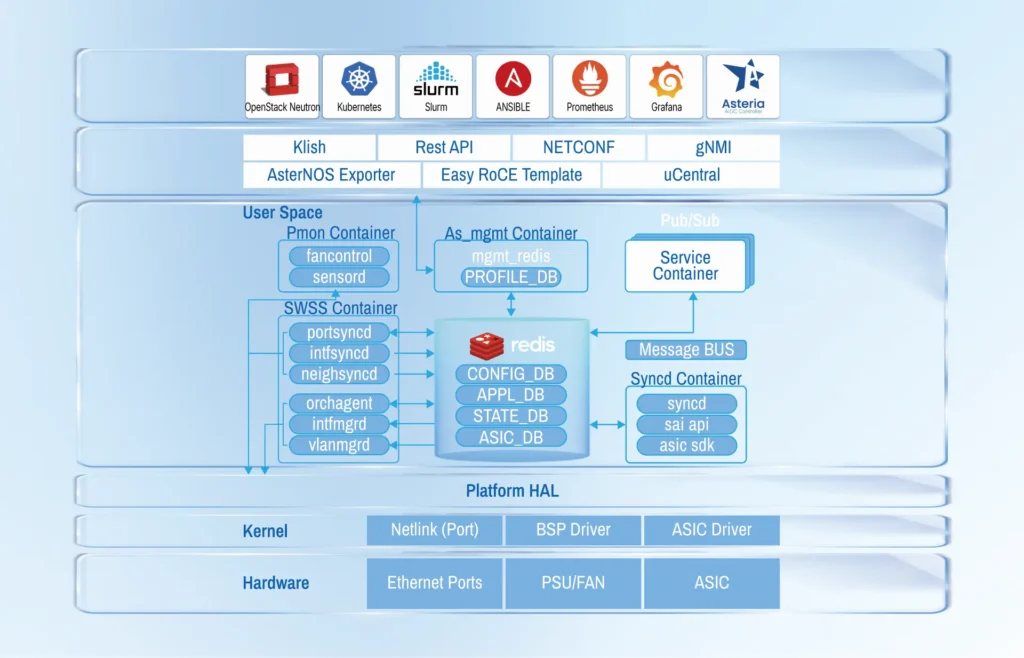
From an implementation perspective, SRv6 on SONiC is not delivered by a single module. It is achieved through coordinated interaction among SONiC, SAI, and FRRouting.
Based on public architecture design, SONiC’s SRv6 capability spans multiple functional areas, including headend encapsulation, endpoint behaviors, overlay and VPN services, underlay integration, and traffic engineering. It is also evolving toward mechanisms such as uSID to reduce SRv6 header overhead caused by long SID lists.
More precisely, SRv6 in SONiC is not implemented inside a single Docker container or isolated service. Instead, it relies on SONiC’s containerized architecture, where control-plane components such as FRR work together with OrchAgent, FPM/fpmsyncd, ConfigDB, and AppDB. These modules interact to translate SRv6 routes, SID information, and service behaviors into hardware forwarding entries through the SAI abstraction layer, ultimately programming the underlying ASIC forwarding plane.
Real Problems Solved by SRv6 in SONiC
SRv6 compatibility with open sourec platforms addresses several practical challenges in modern networks.
Bringing Advanced Services to White-Box Platforms
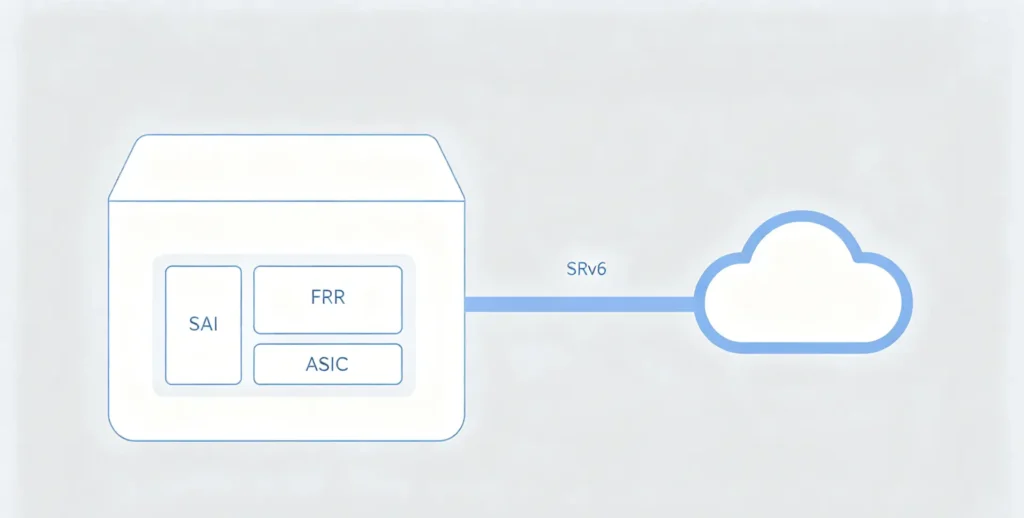
In traditional networks, advanced routing and service features such as complex traffic engineering, VPN isolation, and fast reroute have often been core differentiators of proprietary router vendors. These capabilities are typically embedded in closed network operating systems and are difficult to port.
SONiC decouples upper-layer service logic from underlying silicon through the SAI. SRv6 is implemented by offloading the data plane to switching ASICs, combined with the control plane provided by FRRouting, enabling direct deployment on standard white-box hardware.
Consolidating Multiple Protocol Stacks
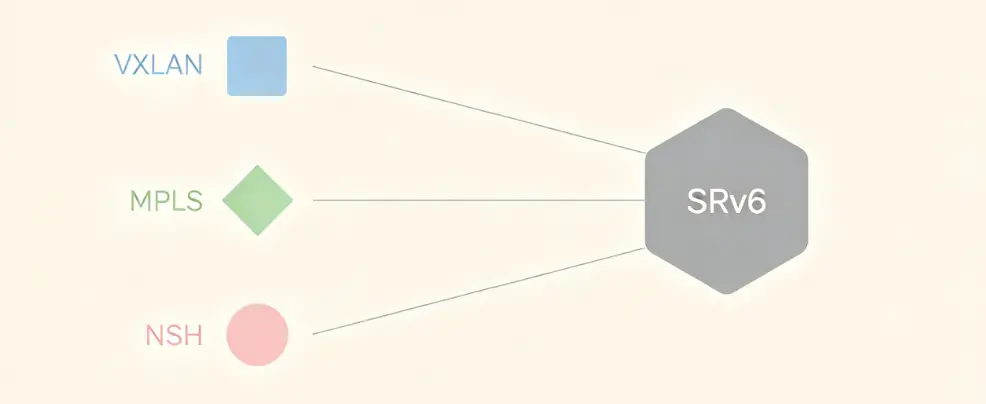
Traditional networks often rely on multiple protocols to support different services, such as VXLAN inside data centers, MPLS for interconnect, and NSH for service chaining. As a result, many gateway devices are deployed at network boundaries for protocol translation. This adds performance overhead, increases failure domains, and complicates operations.
SRv6 introduces a unified model. It provides end-to-end source routing by extending the IPv6 header with programmable instructions. The same SRv6 header can carry VPN context, traffic-engineering paths, and service-chain behaviors.
When DC, DCI, and WAN environments adopt a common SRv6 framework, the network becomes a flatter IPv6 forwarding domain. VXLAN-to-MPLS translation is no longer required, and separate NSH overlays can be removed. This simplifies network boundaries and improves end-to-end forwarding efficiency and determinism.
Deep Integration with Cloud-Scale Automation Ecosystems
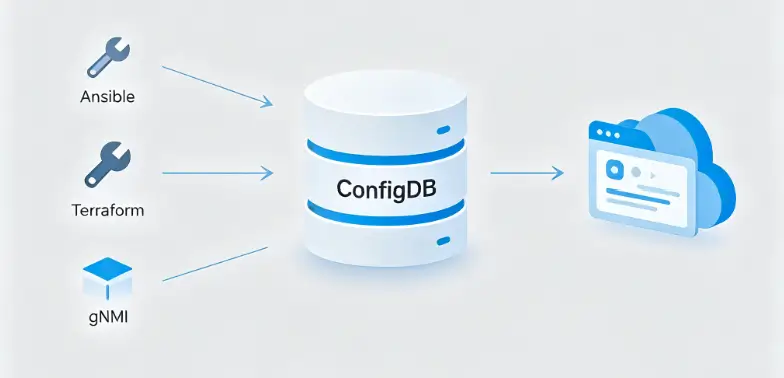
Traditional network devices are often isolated in automated operations. They require dedicated drivers or vendor-specific APIs for integration, which slows down coordination across teams and systems.
SONiC is built on a structured data model based on ConfigDB and AppDB. It is designed for automation toolchains such as Ansible, Terraform, gNMI, and gRPC.
When SRv6 configurations, policies, and telemetry are integrated into SONiC’s database layer, they are naturally exposed as API-accessible objects. This allows cloud management platforms to consume and orchestrate them directly, without additional translation layers.
Benefits of SRv6 in SONiC
From a customer’s perspective, the value of this capability can be summarized in three areas.
First, it enables greater procurement flexibility. Customers are no longer locked into a single vendor’s integrated hardware and software stack. Hardware, silicon, software, and control plane components can be combined in a more open and modular way.
Second, it provides operational consistency. Data center (DC), data center interconnect (DCI), and even parts of WAN environments can converge on a unified SRv6 architecture. This reduces complexity caused by multi-protocol stitching and protocol translation across domains.
Third, it simplifies operations. A unified open platform is better suited for automation, orchestration, monitoring, fault localization, and bulk configuration changes. This reduces manual intervention and lowers coordination overhead across boundary systems.
Explore the feature set of SRv6 !
Conclusion
In summary, the core value of SRv6 compatibility with open source platforms is not simply porting SRv6 into SONiC. It is about making SRv6 a scalable, automatable, and continuously evolvable capability in open white-box networks.
At the same time, SRv6 elevates SONiC from an open network operating system into a platform capable of supporting advanced services such as DC, DCI, traffic engineering, VPN, and FRR.
Request a demo or need assistance ?
Fill out the form, and we’ll reach out to you today !


