Table of Contents
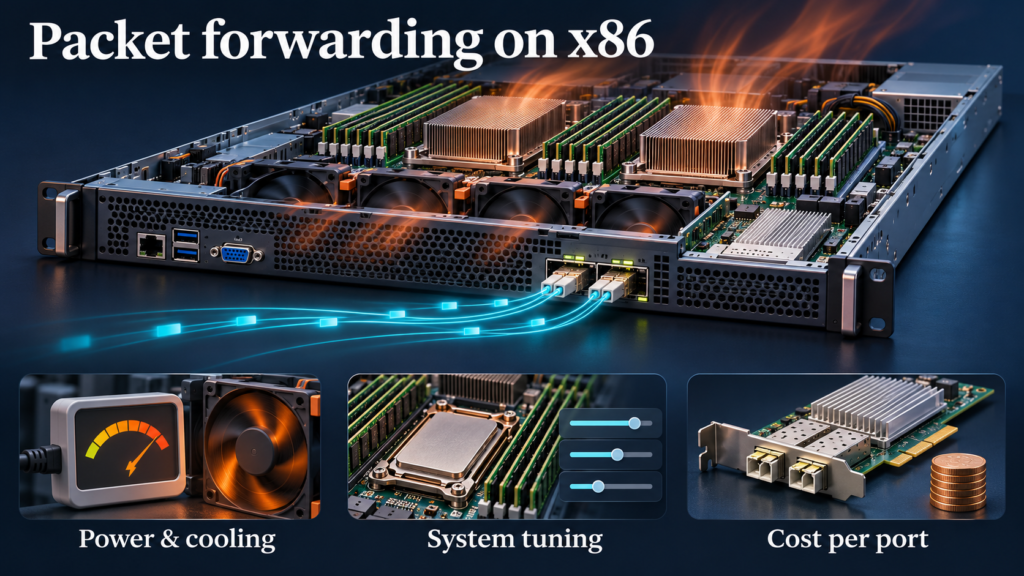
If you are building a next-generation Border Router, Broadband Network Gateway (BNG), or Carrier-Grade NAT (CGNAT) appliance using open-source or in-house packet processing stacks—such as FD.io VPP, DPDK, XDP/eBPF, BIRD, or FRRouting—chances are you started on a commodity x86 rack server. On paper, x86 looks convenient. In production, scaling it to 10G–100G line rates quickly turns into an operational and financial nightmare:
- Power & Thermal Overhead: Burning 12 to 16 Xeon physical cores just to push packets easily drives single-box power consumption to 250W–400W+, inflating colocation power bills and rack cooling costs.
- Fragile System Tuning: Achieving zero packet loss on x86 requires endless “babysitting” at the low level—pinning NUMA nodes, populating every memory channel to avoid bandwidth bottlenecks, isolating CPU cores, configuring hugepages, and micro-tuning NIC ring-buffer parameters.
- Low Port Density & High TCO: A 1U server packed with 100G NICs carries a significantly higher total cost of ownership (TCO) per port than hardware purpose-built for packet forwarding.
It is time to rethink your hardware foundation. Purpose-built Marvell OCTEON 10 DPU whitebox appliances (such as the Asterfusion ET2500, ET2700, and ET3608 Series) offer a true x86 DPDK router alternative—delivering carrier-grade throughput at a fraction of the power, while allowing you to port your existing Linux, DPDK, VPP, or eBPF software stack with minimal migration overhead.
How Easy Is It to Port Your Software Stack from x86 to OCTEON 10?
For customers who already own in-house networking software, migrating to a new hardware platform is rarely about rewriting a system from scratch—what matters most is how much existing code can be retained, which parts require modification, and how quickly it can be deployed.
The Asterfusion ET Series adopts an open, disaggregated hardware-software architecture built on the ARM64 Linux ecosystem, supporting standard Linux distributions such as Ubuntu and Debian, alongside modern networking frameworks including DPDK, VPP, and XDP/eBPF. Customers have full freedom to bring their own OS, network protocol stacks, and business applications—without relying on our turnkey AsterNOS-VPP or building a software environment from the ground up.
The engineering effort required to move off x86 depends primarily on how tightly your existing codebase is coupled to x86-specific CPU instructions and proprietary NIC drivers. R&D teams can evaluate migration scope across three distinct layers:
| Software Layer | What You Can Reuse Directly | What to Validate During Migration |
| Linux Control Plane & Ops Tooling | Routing configurations for FRRouting and BIRD, along with deployment scripts and monitoring/telemetry logic built on standard Linux tools. | Install ARM64 packages or recompile user-space applications for the target system; verify third-party dependencies, NIC interface naming conventions, and configuration file paths. |
| DPDK / VPP Forwarding Applications | Core packet-processing logic, subscriber/routing policies, and northbound management APIs written against standard interfaces. | Adapt to target PMD drivers and RX/TX queue mappings; audit and replace any x86-specific SIMD instruction optimizations; enable and validate DPU hardware offloads (crypto, QoS, packet parsing) as needed. |
| In-House XDP/eBPF Data Planes | Packet-processing programs built on standard XDP hooks, alongside existing subscriber session management and accounting/policy logic. | Verify target Linux kernel version, NIC driver support, and XDP attachment modes; benchmark throughput under production packet sizes and active policy rules. |
Real-World Proof: Two Production Benchmarks Replacing x86
Don’t just take datasheet numbers at face value. Here is how Marvell OCTEON 10 whitebox appliances perform in real-world ISP and carrier validation tests—running both a customer’s completely in-house XDP/eBPF BNG stack and our turnkey VPP stack.
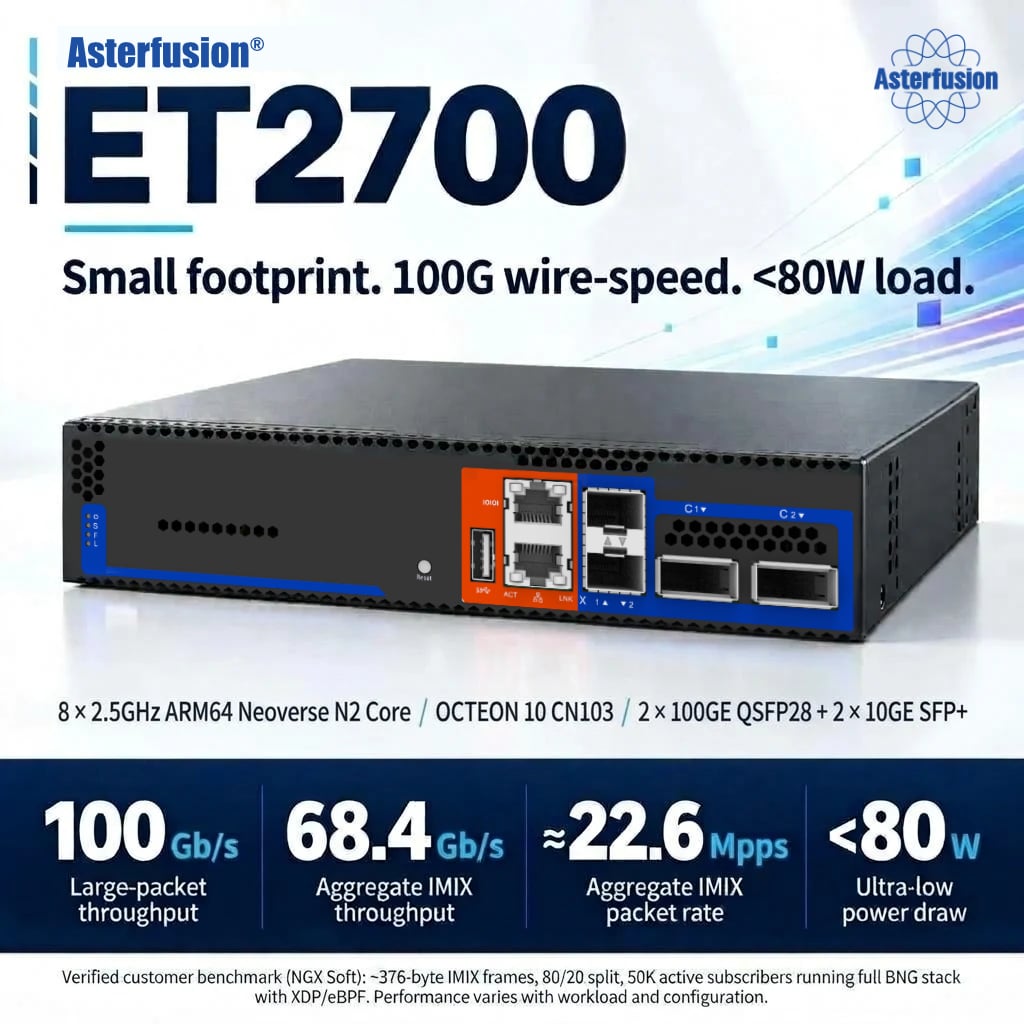
Case 1: Asterfusion ET2708 — Customer’s In-House XDP/eBPF BNG Stack at 100G Line Rate (~80W)
For more check this out: https://www.linkedin.com/company/352653/admin/page-posts/published/
For operators with in-house packet-processing R&D teams, migrating from power-hungry x86 servers onto the ET2708 (powered by a higher-core-count Marvell OCTEON 10 DPU) preserves full software customization flexibility while unlocking massive power efficiency gains.
An ISP engineering team ported its completely in-house XDP/eBPF full BNG protocol stack onto the ET2708 and benchmarked it directly against its existing x86 BNG servers for production validation:
- 50,000 Concurrent Broadband Subscribers: Handled full subscriber session state, accounting statistics, and policy enforcement natively on the DPU.
- 68.4 Gbps IMIX Throughput: Sustained high-intensity, real-world mixed packet traffic (IMIX) without hitting the CPU thermal throttling or memory bandwidth bottlenecks common on x86 servers.
- 100G Large-Packet Line Rate at Just ~80W: Saturated 100GbE interfaces at full line rate while keeping total system power at roughly ~80W—less than a quarter of a comparable 100G x86 server—proving that a compact DPU appliance can directly replace bulky, high-wattage x86 rack servers in production carrier broadband aggregation networks.
These test results come directly from the NGX Soft team, a specialized network software and solution provider focused on low-Earth orbit (LEO) satellite operations. NGX Soft develops NGX VIEW, a centralized telemetry, monitoring, and edge management platform built for large-scale Starlink and Amazon LEO deployments—serving remote school networks (such as 34 sites in Eswatini), Pacific island connectivity hubs (32 terminals across the South Pacific), and carrier satellite backhaul networks (such as MTN Nigeria).
The NGX Soft team is highly satisfied with the POC benchmark results on Asterfusion’s open hardware—validating its edge telemetry stability, forwarding throughput, and ultra-low power efficiency—and confirmed that the platform is now moving directly into live production deployment as their global satellite site footprint rapidly scales.
Case 2: Asterfusion ET2500 — Handling 64k PPPoE & 50k IPoE Sessions at 20–30W
In a recent carrier BNG proof-of-concept (POC), the compact ET2500 platform running AsterNOS-VPP demonstrated massive subscriber concurrency while drawing less power than a standard household lightbulb:
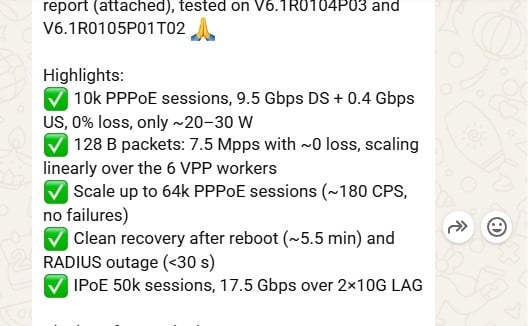
- Ultra-Low Power Footprint: Sustained 10,000 active PPPoE sessions at 9.5 Gbps downstream + 0.4 Gbps upstream with 0% packet loss, consuming only ~20–30W total system power.
- Linear Multi-Core Scaling: Achieved 7.5 Mpps on 128-byte small packets (near-zero loss), scaling linearly across 6 VPP worker cores.
- High-Concurrency Stress Resilience & Stability: Scaled smoothly up to 64,000 concurrent PPPoE sessions (~180 connections per second, zero setup failures), and validated 50,000 IPoE sessions delivering 17.5 Gbps throughput over a 2×10G LAG.
- Carrier-Grade Rapid Self-Healing: Delivered clean full-service recovery in ~5.5 minutes after a cold system reboot, and automatically recovered services in <30 seconds following a RADIUS authentication server outage.
Data from a Senior Core Network Architect from an Indonesian ISP recently completed an in-depth BNG/CGNAT technical evaluation on the Asterfusion ET2500 (AsterNOS-VPP) platform.
Head-to-Head: Commodity x86 Servers vs. Asterfusion ET Series (OCTEON 10)
| Evaluation Metric | Commodity x86 Server (e.g., 1U Xeon + 100G NICs) | Asterfusion ET2500 / ET2700 (Marvell OCTEON 10) |
| Typical System Power | 250W – 400W+ | 20W – 30W (ET2500) / ~80W at 100G line rate (ET2708) |
| Software Ecosystem Compatibility | Linux, DPDK, VPP, XDP/eBPF, BIRD, FRR | Fully compatible with the same standard Linux, DPDK, VPP & XDP/eBPF ecosystem |
| Hardware Acceleration | Pure CPU software packet loops (unless adding costly SmartNICs) | Integrated DPU packet parsing, QoS traffic scheduling & crypto engines |
| Low-Level Ops & Tuning | Requires tedious NUMA, memory-channel & ring-size micro-tuning | Purpose-built deterministic forwarding architecture—stable out of the box |
| Deployment Flexibility | Bring and deploy your own software | Turnkey AsterNOS-VPP OR bare-metal open platform for your in-house code |
Validate Your Own Stack Against Your Current x86 DPDK Server
If your BNG, border router, or CGNAT software is already running in production on x86, you can bring your existing software build, target session scale, and typical traffic profile to request an Asterfusion ET remote lab or evaluation unit. By directly comparing throughput and measured wall-plug power consumption under identical packet-size distributions, business policies, and packet-loss thresholds, you can accurately determine which Marvell OCTEON 10 whitebox platform is best suited to carry your live production workloads.


