Table of Contents
Introduction
You have probably experienced this frustrating situation before.
You’re walking through a shopping mall or attending a meeting in an office building. Your phone shows a full 5G signal, yet a simple webpage refresh keeps spinning without loading. Or during a video conference, a slight increase in movement causes the signal quality to fluctuate, leading to dropped connections and interrupted sessions.
The signal appears strong, so why does the network feel painfully slow?
In fact, this is one of the most elusive and troublesome issues in indoor 5G deployments. In the telecom industry, it is often associated with synchronization misalignment, which can ultimately lead to service degradation and traffic forwarding issues.
Front-haul Networks Are a Common Source of Failures
A closer look at a 5G network reveals a highly complex architecture. In an O-RAN (Open Radio Access Network) deployment, the RU (Radio Unit) handles radio transmission and reception, the DU (Distributed Unit) processes real-time traffic and scheduling functions, and the CU (Centralized Unit) provides centralized control and management.
Network services are carried across four logical planes: the User Plane (U-plane), Control Plane (C-plane), Synchronization Plane (S-plane), and Management Plane (M-plane). Together, these components form the foundation of modern mobile networks.
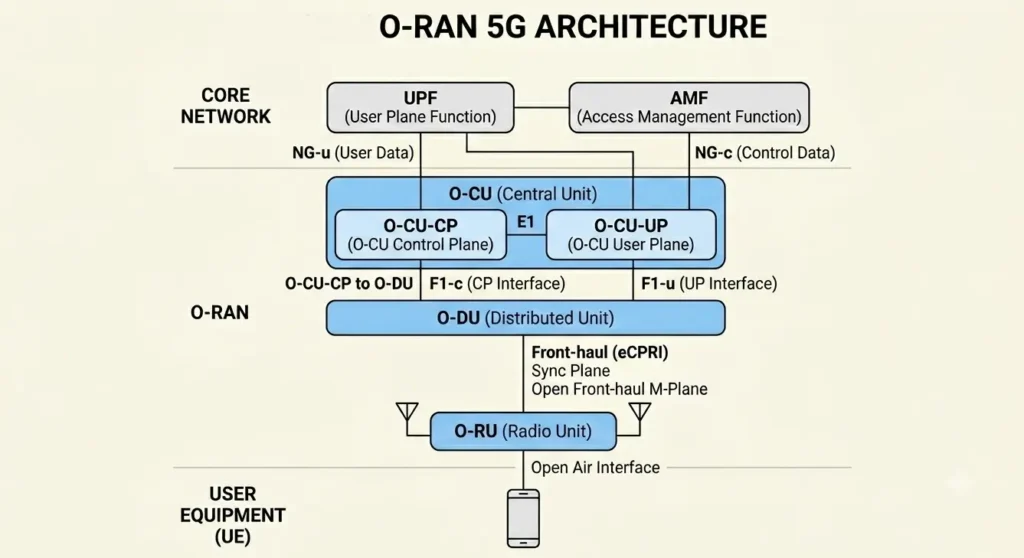
The connection between the RU and DU is known as the fronthaul network. It is the closest part of the mobile network to end users and typically carries the highest density of radio traffic. At the same time, it is also one of the most failure-prone segments of a 5G deployment.
Why is this the case? Unlike home Wi-Fi networks, 5G has extremely stringent timing requirements. You can think of a mobile network as an orchestra, where PTP (Precision Time Protocol) serves as the conductor’s baton. In a 5G network that relies on advanced technologies such as massive MIMO and beamforming, every RU must remain synchronized with the GNSS reference clock at nanosecond-level accuracy.
This synchronization requirement operates on two levels.
- Waveform coherence at the physical layer: If the timing reference drifts, even by a few hundred nanoseconds, radio signals transmitted from different antennas can become misaligned. Instead of combining into a stronger signal, the waveforms may partially cancel each other out due to phase offset, reducing overall radio performance.
- Protection mechanisms at the protocol layer: The 5G protocol stack is even more sensitive to timing deviations. When an RU detects that its local clock differs from the timing associated with DU control instructions carried over the Synchronization Plane (S-plane) and Control Plane (C-plane), and the offset exceeds the allowable threshold (typically 150 ns), the system considers synchronization to be lost. To prevent interference caused by timing errors, the RU immediately activates a protection mechanism, disables RF transmission, and enters a muted state.
This leads to a common symptom seen in the field. A mobile device may still display a strong signal, yet data services fail to establish, web pages do not load, or connections drop unexpectedly. At its core, the issue is a timing mismatch between the end device and the mobile network. Once synchronization is lost, traffic forwarding can be blocked at the protocol level, disrupting the entire communication chain.
Achieving Nanosecond-Level Synchronization in Fronthaul Networks with PTP Switches
To address this challenge, we introduced a PTP-enabled switch that integrates GNSS, SyncE, and PTP into a single platform, creating a highly accurate timing distribution network. Based on deployments and testing in real customer environments, the solution has proven effective in meeting key synchronization requirements.
An Integrated Timing Hub: GNSS, SyncE, and PTP in One Platform
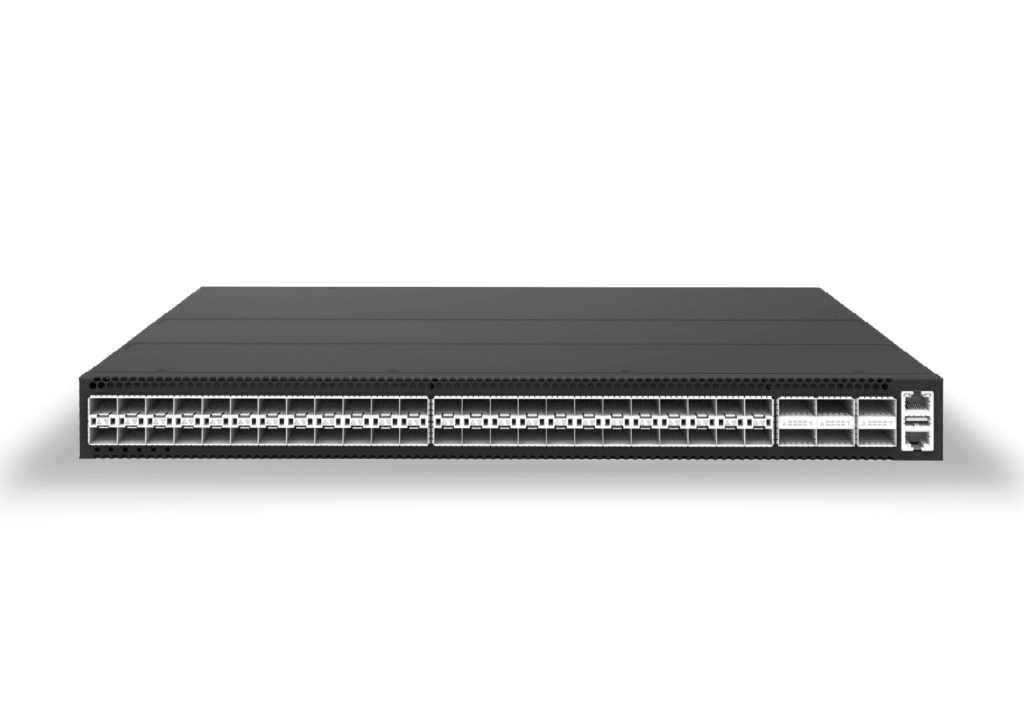
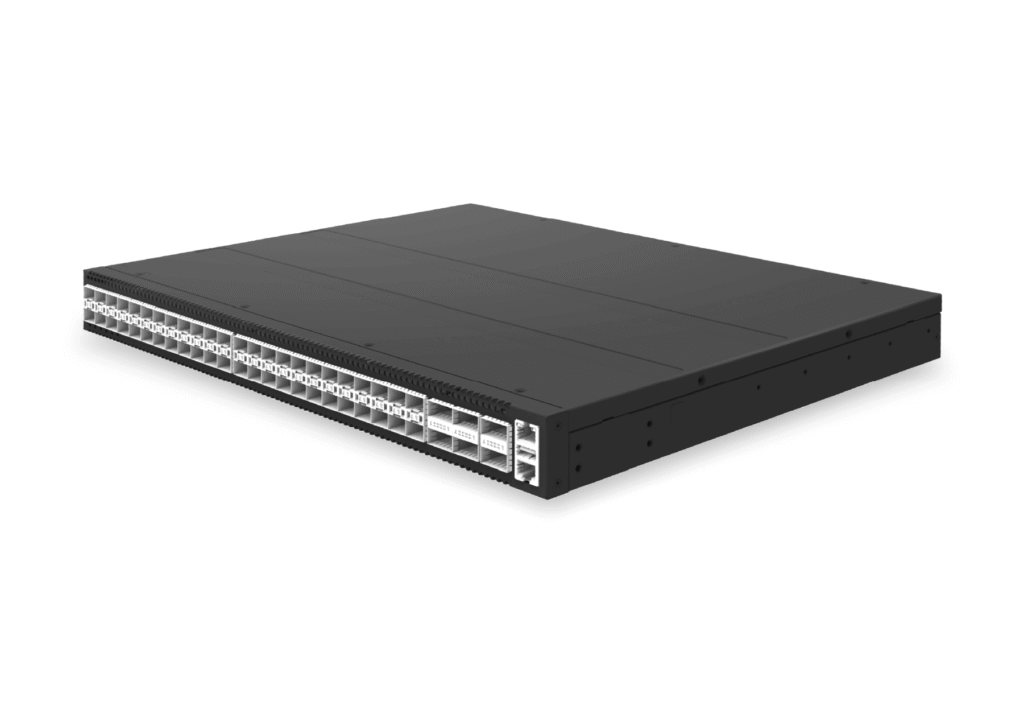
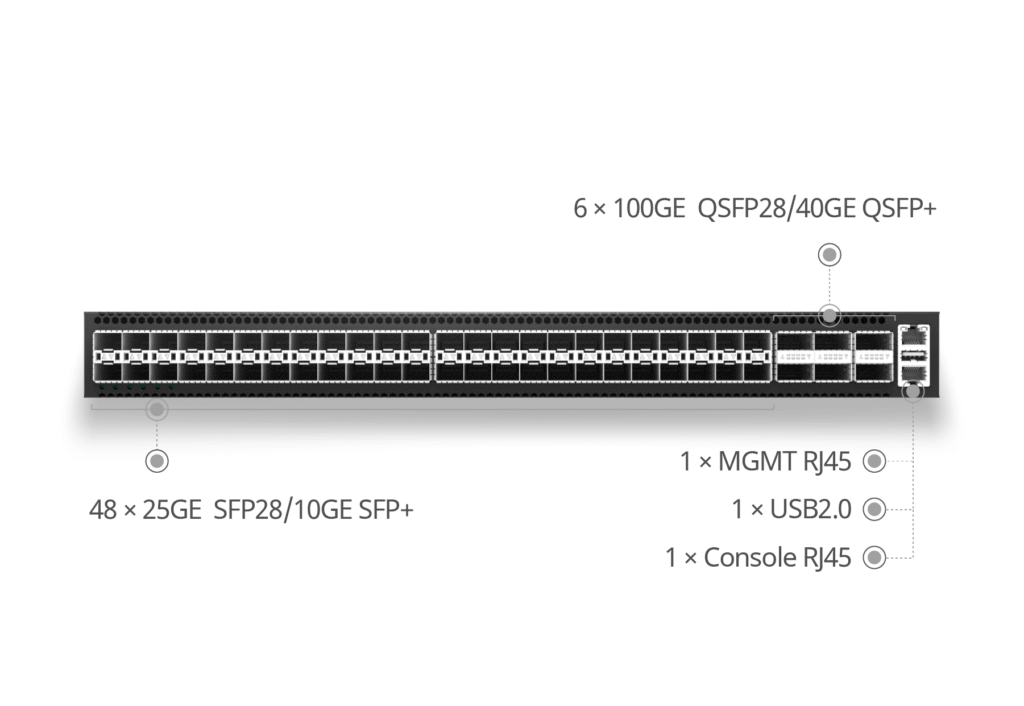
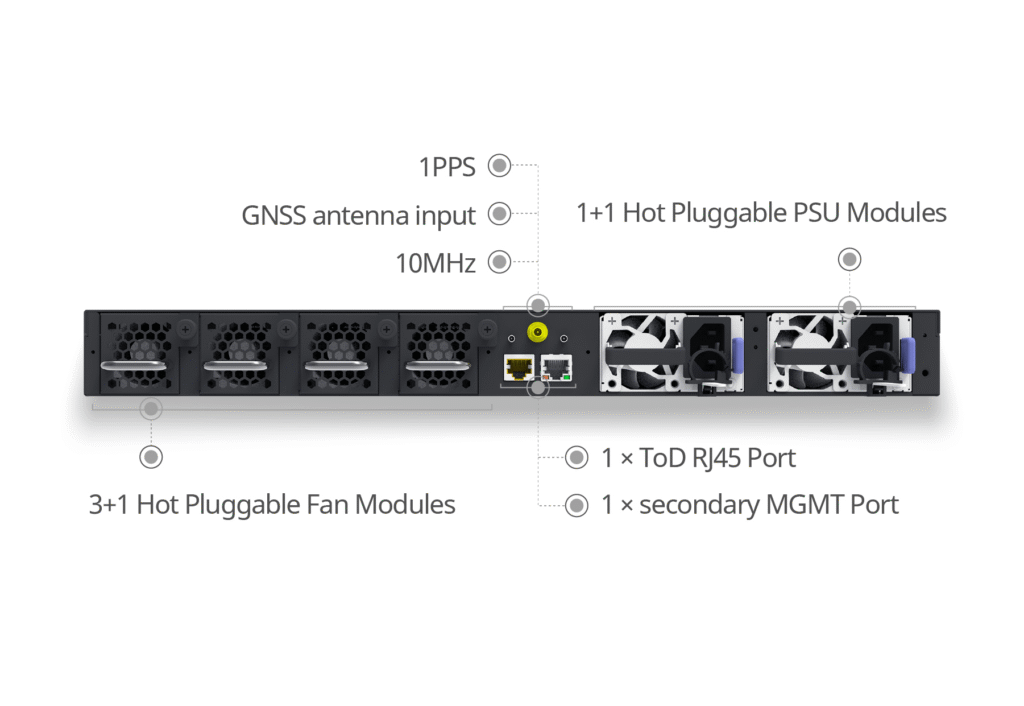
Traditional 5G synchronization architectures often face a difficult trade-off. Deployments similar to macro base stations require each device to be connected to a dedicated GNSS antenna, which is impractical in environments such as subway systems and office buildings. Alternatively, architectures that rely on external Grandmaster (GM) clocks introduce additional devices, longer timing paths, higher costs, and more potential points of failure.
Our approach integrates GNSS, SyncE, and PTP into a single switch platform. By embedding a GNSS receiver directly into the access switch, synchronization can be established at the source. Even in locations where satellite signals are unavailable, such as underground shopping centers or subway tunnels, the switch can operate as a local timing hub and deliver high-precision clock synchronization to downstream small cells.
This integrated design also eliminates the need for dedicated SyncE equipment, simplifying network architecture and reducing deployment complexity. Fewer devices in the synchronization chain improve overall reliability and reduce operational risks.
Dual-Domain Operation for O-RAN Deployments
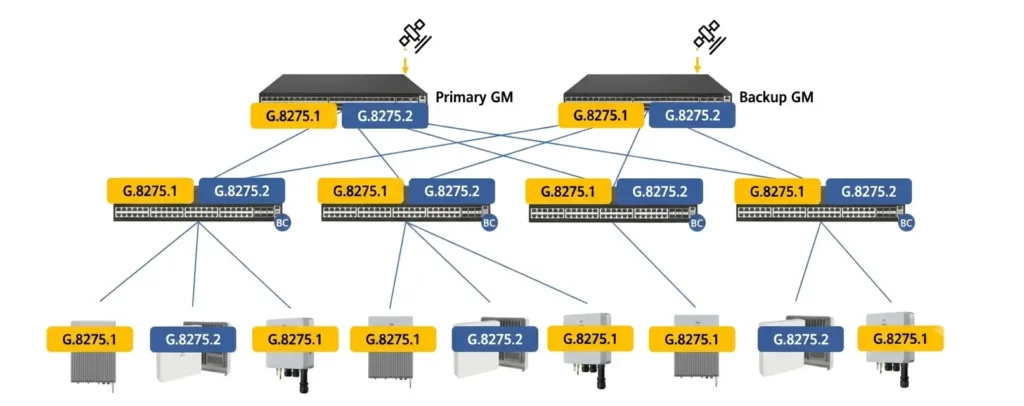
Heterogeneous network environments are common in O-RAN deployments, but they often introduce synchronization challenges. The ITU-T G.8275.1 profile requires full timing support across the transport network and delivers the highest synchronization accuracy. However, it imposes strict requirements on network design. In contrast, ITU-T G.8275.2 offers greater deployment flexibility by allowing PTP traffic to traverse networks that are not fully timing-aware.
To address mixed deployment scenarios, our switches support multiple PTP profiles and multiple PTP domains operating simultaneously. This dual-domain capability enables the switch to interoperate with different synchronization architectures and RU implementations within the same network.
As a result, operators can deploy equipment from different vendors without redesigning the synchronization infrastructure. The switch automatically adapts to the required timing domain, enabling smooth interoperability and a seamless migration path across different O-RAN synchronization models.
Netconf API for Simplified Operations and Visibility
In production networks, nanosecond-level synchronization accuracy is only part of the equation. Operators also need end-to-end visibility into network timing status from the O-RAN controller.
As a widely adopted management protocol in 5G networks, NETCONF enables our switches to integrate seamlessly into multi-vendor environments. Through standardized YANG models and open APIs, the switch can interoperate with DUs, RUs, and other network elements, allowing centralized provisioning, monitoring, and management from a single controller platform.
Prioritizing PTP Traffic with QoS
Network congestion is inevitable during traffic bursts. If PTP packets compete with regular data traffic for the same forwarding resources, packet delay or loss can quickly degrade synchronization accuracy.
To address this challenge, the switch implements dedicated QoS policies for PTP traffic. Synchronization packets are assigned higher scheduling priority, ensuring they are forwarded ahead of best-effort traffic even during periods of heavy congestion. This helps maintain stable timing distribution and prevents synchronization degradation under load.
Standard Enterprise Switches Are Not Enough
A common mistake is attempting to build a PTP aggregation network using standard enterprise switches. While these devices can forward PTP packets, they are typically not designed to maintain the timing accuracy required by 5G fronthaul networks.
Without hardware-assisted timestamping, timing packets are processed through software-based forwarding paths, introducing additional delay variation and packet timing jitter. These inaccuracies can accumulate across the network and directly impact synchronization performance.
For 5G synchronization networks, switches should provide hardware timestamping capabilities and dedicated PTP processing in silicon. This allows synchronization errors to remain within nanosecond-level tolerances and ensures stable timing delivery to downstream RUs and small cells.
One Platform for Power, Timing, and Transport in Small Cell Networks
For indoor environments that demand high user density and seamless coverage, the goal is not simply to build a faster network. The real challenge is maintaining precise synchronization across every node in the fronthaul network.
Our solution goes beyond traditional switching by integrating GNSS directly into the platform, enabling the switch to act as a local timing source. This removes many of the deployment constraints associated with conventional macro-cell synchronization architectures. Combined with support for GM and BC roles, dual-profile operation for ITU-T G.8275.1 and G.8275.2, and physical-layer synchronization through SyncE, the solution addresses interoperability challenges commonly found in multi-vendor O-RAN deployments.
The platform also integrates high-power PoE, dedicated QoS scheduling for PTP traffic, and standardized NETCONF APIs. Together, these capabilities create a synchronization hub that can be integrated into existing O-RAN management frameworks while maintaining open interoperability across different vendors and network architectures.
By deploying the CX306P-48Y-M-H or CX206Y-24MT-M-HWP4 to support PTP synchronization in 5G Open RAN environments, a controllable, open, and high-precision synchronization foundation can be built. This enables the elimination of indoor 5G coverage gaps and delivers high-quality, continuous coverage.
Other PTP Blogs You Should Read
- What is PTP and How does it Work?
- All PTP Clock Types and How to Configure in Asterfusion
- PTP Profiles for Network Engineers: How to Pick the Best Profile
- AV over IP Switches Enable Cost-Effective Live Streaming Networks
- Why 10ns PTP Switches for Broadcast Are the Industry Gold Standard
- Why PTP Network Switches are Used in Financial Trading?
- PTP Design Best Practices for Media & Entertainment IP Networks
- How to Maintain PTP Time Synchronization During Configuration Changes
- AES67 vs. ST 2110-30: How to Choose the Right Audio over IP Standard
Real Case Study:
- SMPTE 2110 in IP-Based Broadcast Studio Design: A Transforming with Asterfusion
- Asterfusion PTP Switch Powers Live Streaming of Australia’s Premier Sporting Events
Request a demo or need assistance ?
Fill out the form, and we’ll reach out to you today !


