Table of Contents
Following up on our previous discussion on the ARM Type 7 DPU’s performance and use cases, a critical question remains for seasoned engineers: “Is ARM’s raw compute inherently weaker than x86?”
In 2026, viewing ARM merely as a “low-power mobile chip” is a costly miscalculation for network equipment selection. The reality is far more fundamental than a simple matter of “which is faster”—they represent two entirely different engineering philosophies. While x86 Type 7 delivers maximum absolute performance for generic sequential computing, ARM Type 7 triumphs in energy efficiency, rich on-chip integration, and domain-specific hardware acceleration.
To guide your upcoming hardware evaluation, here is the objective, head-to-head architectural showdown broken down into 4 key pillars.
Silicon Philosophy & Architecture: CISC vs. RISC
The fundamental performance variance stems from the architectural divergence at the silicon level.
x86 (Complex Instruction Set Computer – CISC): x86 processors (such as Intel Xeon-D or AMD EPYC) are designed as “all-round heavy lifters.” They excel at complex, unpredictable, and highly diverse sequential tasks. If your control plane demands extreme single-core serial processing—such as complex pathfinding algorithms for colossal routing tables—or needs to run heavy, unoptimized, proprietary legacy x86 closed-source software, x86 remains the single-core leader.
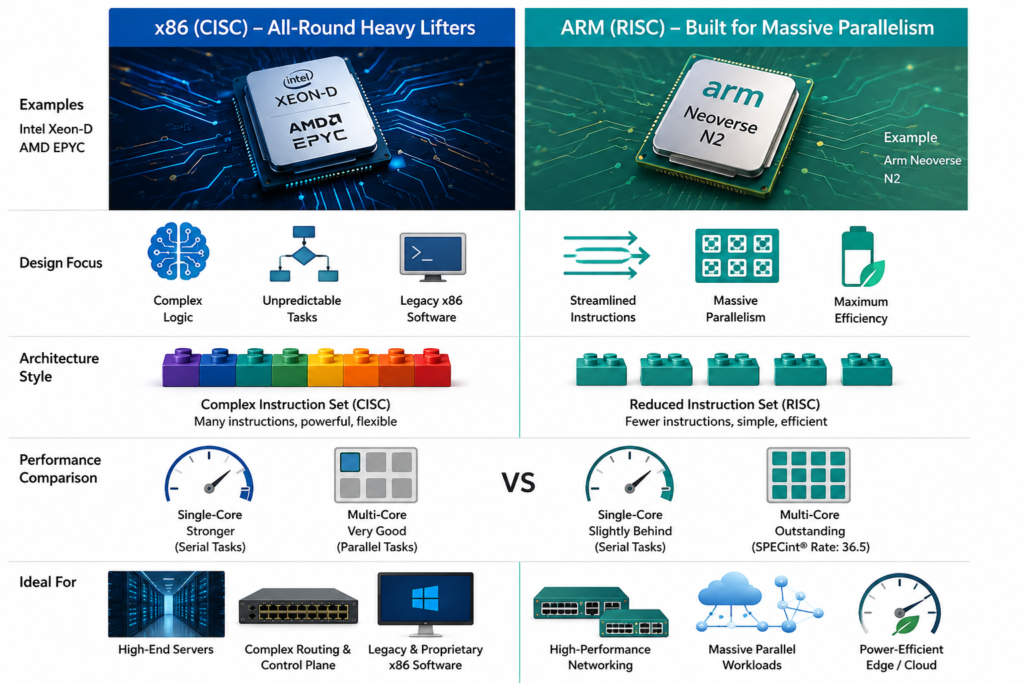
ARM (Reduced Instruction Set Computer – RISC): Processors like the Arm Neoverse N2 utilize a streamlined, highly parallelized architecture. ARM is engineered to execute massive volumes of streamlined, flow-based instructions with maximum efficiency and minimal power. While its multi-core concurrent processing is outstanding (delivering an impressive SPECint® rate of 36.5), its absolute single-core raw serial horsepower sits slightly behind a high-frequency x86 server core. However, it is optimized to do one thing perfectly: driving massive parallel workloads without breaking a sweat.
System Integration: SoC Synergy vs. “Heavy CPU + Discrete Cards”
The way these two platforms handle specialized workloads represents a massive paradigm shift in hardware design.
The x86 Approach (CPU + Discrete Accelerators): An x86 Type 7 module is essentially a pure, generic compute engine. If you need specialized network packet processing, crypto offloading, or AI inference, the x86 CPU must either brute-force it via software protocol stacks or rely on discrete, external accelerator cards hung off the PCIe lanes. This results in higher forwarding latency, a massive physical footprint, and soaring overall hardware costs.
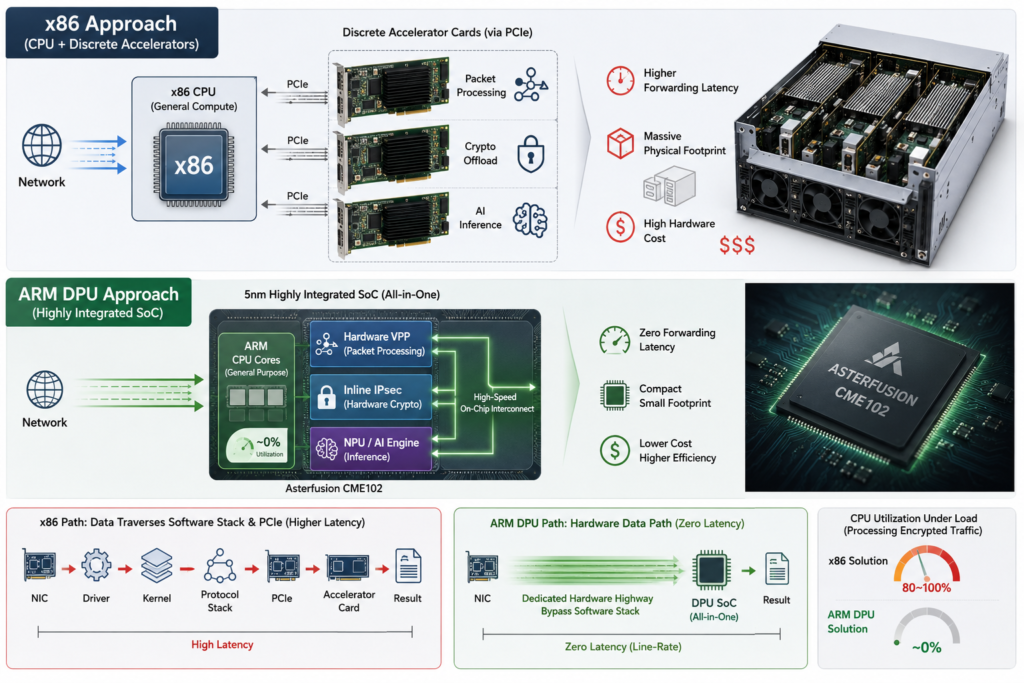
The ARM DPU Approach (Highly Integrated SoC): A DPU-based module like the Asterfusion CME102 relies on a “System-on-Chip” (SoC) heterogeneous synergy. Instead of a lone CPU, a single 5nm silicon die tightly packages the generic processor alongside specialized hardware execution units, such as Hardware VPP (packet processing engines), Inline IPsec (hardware crypto offloading), and native NPU/AI engines. The data traffic bypasses the software stack entirely, running through dedicated silicon-level hardware highways at full line-rate with zero latency. While processing massive, high-bandwidth encrypted traffic, the ARM general-purpose CPU cores remain virtually idle (~0% utilization), allowing the control plane to focus on management tasks and ensuring exceptional real-time deterministic performance.
Thermal Design & Real-World Efficiency (TDP Power Play)
Power consumption and thermal boundaries are where theory meets harsh reality on the networking edge.
x86 Platforms: Heat dissipation is a persistent nightmare for x86. An x86 Type 7 module capable of handling server-class workloads typically demands a Thermal Design Power (TDP) of 50W, 70W, or even well over 100W. This demands massive heatsinks and high-RPM mechanical fans. In tight chassis boundaries or rugged edge environments (such as roadside cabinets or dusty factory floors), these mechanical fans become highly vulnerable single points of failure.
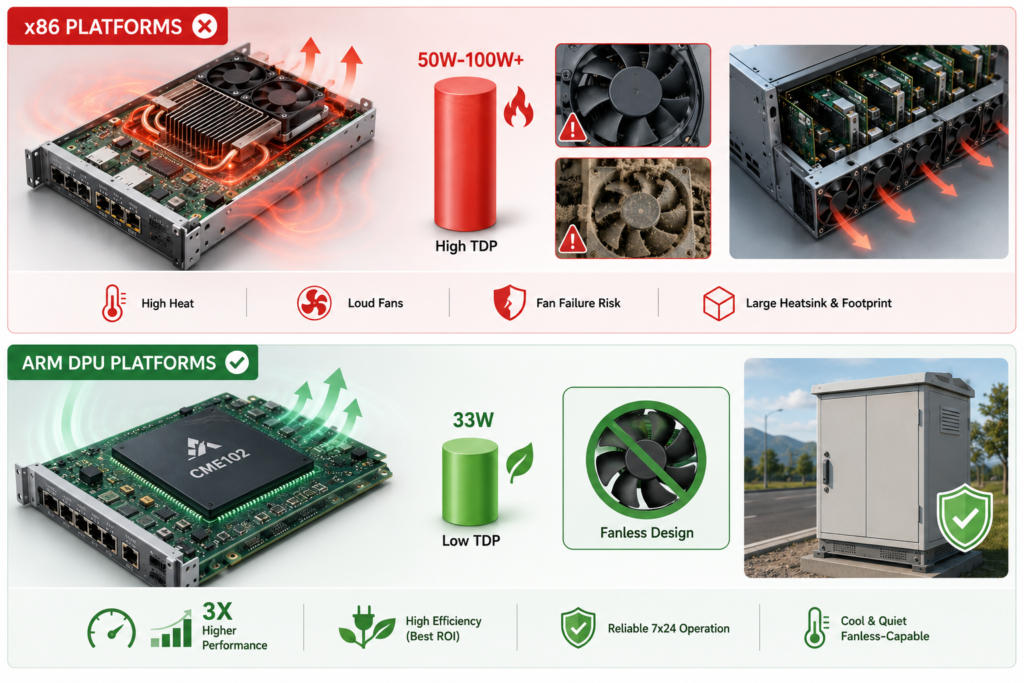
ARM DPU Platforms: Capitalizing on the generational dividends of the advanced 5nm process alongside ARM’s inherent efficiency, the CME102 locks its total TDP at a mere 33W while delivering 3x the performance of previous-generation DPUs. A 33W envelope enables fanless system designs (Fanless-capable). In terms of performance-per-watt (ROI) for 7×24 edge computing deployments, ARM completely alters the economics.
ARM vs x86 COM Express Type 7 Comprehensive Comparison Matrix
| Dimension | x86 COM Express Type 7 (e.g., Intel Xeon-D) | ARM DPU COM Express Type 7 (e.g., Asterfusion CME102) |
| Silicon Architecture | CISC (Complex Instruction Set Computer) | RISC (Reduced Instruction Set Computer) |
| System Design Philosophy | Heavy CPU + External/Discrete Cards | Highly Integrated Heterogeneous SoC |
| Pure Compute Power | High to Very High (Dominates in complex sequential computing) | Medium to High (Dominates in high-concurrency workloads) |
| Thermal Design Power (TDP) | High (50W – 100W+) | Ultra-Low (~33W) |
| Energy Efficiency | ⭐⭐⭐ | ⭐⭐⭐⭐⭐⭐ |
| Network Packet Processing | Processed via CPU software; high latency under heavy loads | Driven by Hardware VPP engines; stable, line-rate forwarding |
| AI & Acceleration | Rarely integrated natively (requires external hardware) | Rich integrated hardware engines (NPU, Crypto, VPP) |
| Deterministic/Real-time | Average | Excellent (Due to complete hardware-level offloading) |
| Software Ecosystem | Windows, Linux, and extensive legacy systems | Primarily Linux-based (Linux, SONiC, VPP, DPDK) |
| Relative Total Cost | Higher | Highly Cost-Effective |
Debunking the Ultimate Myth: “Is ARM Inherently Slower?”
The most common misconception in hardware evaluation is equating “ARM architecture” with “low performance.”
The truth is: ARM is not slower than x86; it is simply optimized differently. While an x86 core might win a raw mathematical benchmark in sequential processing, the ARM DPU will decisively outpace x86 in domain-specific execution. When handling massive data packet streaming, real-time NAT routing, and intensive VPN/IPsec encryption, the ARM DPU’s hardware-offloading engines deliver blazing speeds and rock-solid stability that x86 software-driven architectures simply cannot match.
ARM vs x86 COM Express Type 7 Which One to Choose?
Choose ARM Type 7 if your project requires:
- Next-Gen Networking Appliances: Designing 5G Small Cells, SD-WAN Gateways, Edge Routers, White-box Switch Control Boards, or Next-Generation Firewalls (NGFW).
- Strict Power & Environmental Constraints: Deploying in fanless, fully sealed, highly dust-proof, or ruggedized industrial edge enclosures.
- Open-Source Linux Infrastructure: Utilizing software architectures built entirely on native Linux, enterprise/open SONiC, or VPP ecosystems.
- On-Chip Acceleration: Requiring native, built-in IPsec cryptography, high-throughput data planes, or embedded AI/NPU capabilities.
Choose x86 Type 7 if your project requires:
- Legacy Software Dependency: Running heavy, proprietary x86-compiled commercial security software or Windows environments.
- Heavy Virtualization: Deploying dense, general-purpose Virtual Machines (VMs) or traditional hypervisors at the edge.
- General-Purpose Server Workloads: Requiring absolute, uncompromised single-core CPU horsepower for arbitrary, non-networking compute tasks.
Here is the comparison table to help you easily evaluate and decide between the two platforms:
| Selection Criteria | Choose ARM Type 7 if your project requires: | Choose x86 Type 7 if your project requires: |
| Target Application & Workloads | Next-Gen Networking Appliances: Designing 5G Small Cells, SD-WAN Gateways, Edge Routers, White-box Switch Control Boards, or Next-Generation Firewalls (NGFW). | General-Purpose Server Workloads: Requiring absolute, uncompromised single-core CPU horsepower for arbitrary, non-networking compute tasks. |
| Hardware & Thermal Environment | Strict Power & Environmental Constraints: Deploying in fanless, fully sealed, highly dust-proof, or ruggedized industrial edge enclosures. | Standard Server Environments: Deploying where active fan cooling, higher power budgets, and standard physical spacing are readily available. |
| Software & OS Ecosystem | Open-Source Linux Infrastructure: Utilizing software architectures built entirely on native Linux, enterprise/open SONiC, or VPP ecosystems. | Legacy Software Dependency: Running heavy, proprietary x86-compiled commercial security software or Windows environments. |
| Acceleration & Virtualization | On-Chip Acceleration: Requiring native, built-in IPsec cryptography, high-throughput data planes, or embedded AI/NPU capabilities. | Heavy Virtualization: Deploying dense, general-purpose Virtual Machines (VMs) or traditional hypervisors at the edge. |
The divergence between ARM and x86 on the COM Express Type 7 platform is not just a battle of benchmarks. It is a strategic choice between the brute force of general-purpose x86 computing and the precise, hardware-accelerated efficiency of the ARM DPU. For next-generation open networking, the ARM DPU represents a smarter, cooler, and far more cost-effective path forward.
In the next chapter, we will take off the gloves and dive into a live, head-to-head evaluation. By putting a heavyweight x86 COM Express Type 7 module (Intel) directly against its ARM counterpart (Marvell OCTEON 10), we will deliver a line-by-line parameter showdown. This data-driven comparison will clear up any remaining confusion and show you exactly where each architecture triumphs at a single glance.
Intel Xeon D Alternative: Asterfusion COM Express Type 7 DPU
Intel Xeon D Alternative: Asterfusion COM Express Type 7 DPU Powered by Marvell Octeon CN102
What is COM Express Type 7 ARM DPU ?
What is a COM Express Type 7 Module? Why Do We Need It?
Where can the COM Express Type 7 ARM DPU be Used?
Asterfusion 33W ARM COM Express Type 7 Module: Top 6 Open Networking Use Cases


