Table of Contents
1. Introduction: AVB vs. PTP — Why Are They Often Confused?
Imagine a live concert with dozens of microphones, digital mixing consoles, stage boxes, amplifiers, and video processing systems. Every audio stream must arrive at the right time. Even small timing differences can cause phase inconsistencies, audio artifacts, or synchronization problems between audio and video. Now consider a television broadcast facility. Multiple cameras, video servers, audio devices, and production systems must share a common time reference to keep video frames and audio samples synchronized across the entire facility. Both environments rely on precise network synchronization. Yet, they do not necessarily use the same technology.
This is where two commonly discussed terms come in: AVB (Audio Video Bridging) and PTP (Precision Time Protocol). At first glance, they seem to solve the same problem: synchronizing devices over Ethernet. But comparing AVB directly with PTP can be misleading because they operate at different architectural levels.
- PTP (IEEE 1588) is a time-synchronization protocol. It distributes precise time across networked devices so their clocks remain aligned.
- gPTP (IEEE 802.1AS) is a profile of PTP designed for time synchronization in bridged Ethernet networks. It is a fundamental component of AVB and many TSN applications.
- AVB (Audio Video Bridging) is a collection of Ethernet standards designed to deliver time-sensitive audio and video streams with predictable latency and reserved bandwidth.
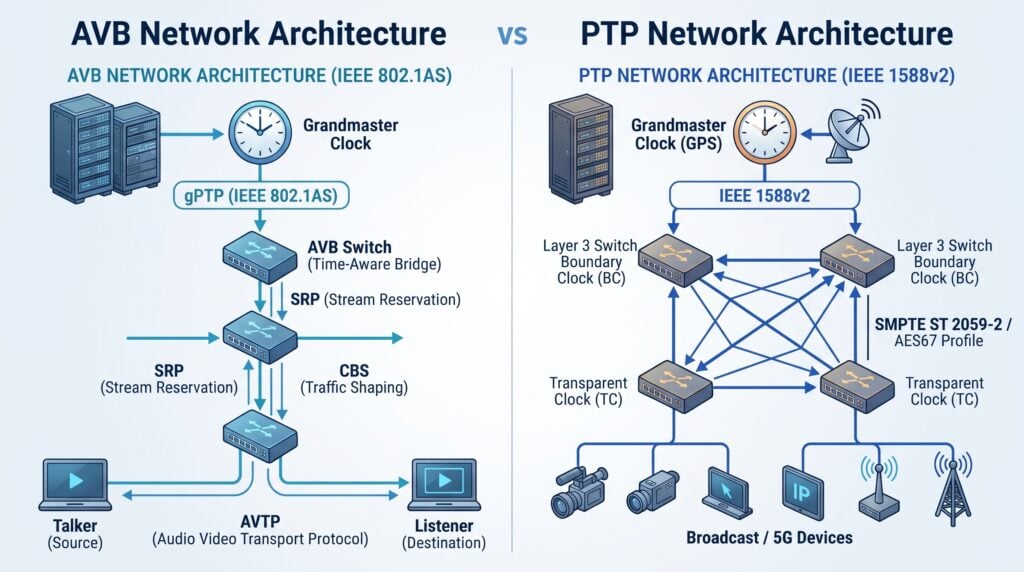
In other words, AVB uses gPTP for synchronization, while IEEE 1588v2 provides a more general framework for precision time distribution across different network architectures. Understanding this distinction helps network engineers choose the right synchronization technology, switching hardware, and network architecture for each deployment.
2. What Is gPTP (IEEE 802.1AS)?
gPTP, or Generalized Precision Time Protocol, is defined by IEEE 802.1AS. It provides a common time reference for devices communicating across a bridged Ethernet network.It is a key part of the IEEE Audio Video Bridging (AVB) architecture and the broader Time-Sensitive Networking (TSN) framework. Unlike a general-purpose PTP deployment, gPTP is designed around the behavior of Ethernet bridges and time-aware network devices. Its operating rules are tailored to maintain accurate synchronization across a local Ethernet network.
How Does gPTP Work?
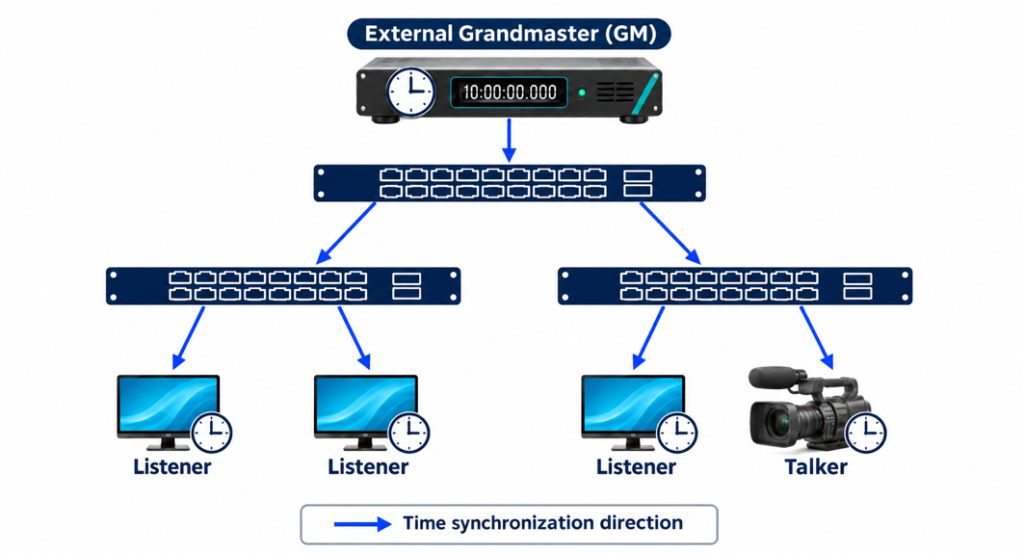
A gPTP network establishes a timing hierarchy with a Grandmaster Clock (GM), which provides the reference time for other devices.Network devices synchronize their local clocks to this reference through a sequence of timing messages. One important feature of gPTP is its Peer-to-Peer (P2P) path delay mechanism. Instead of measuring the entire path between two endpoints, neighboring devices measure the propagation delay of their directly connected Ethernet link using messages such as:
- Pdelay_Req
- Pdelay_Resp
- Pdelay_Resp_Follow_Up
This allows each time-aware device to account for link delay as timing information travels through the network. Hardware timestamping is particularly important. When timing messages enter and leave a network device, hardware timestamps help measure transmission and processing delays more accurately than software-only timestamping. The result is a synchronized timing environment suitable for time-sensitive applications such as professional audio, video, and industrial Ethernet.
The Role of gPTP in AVB Networks
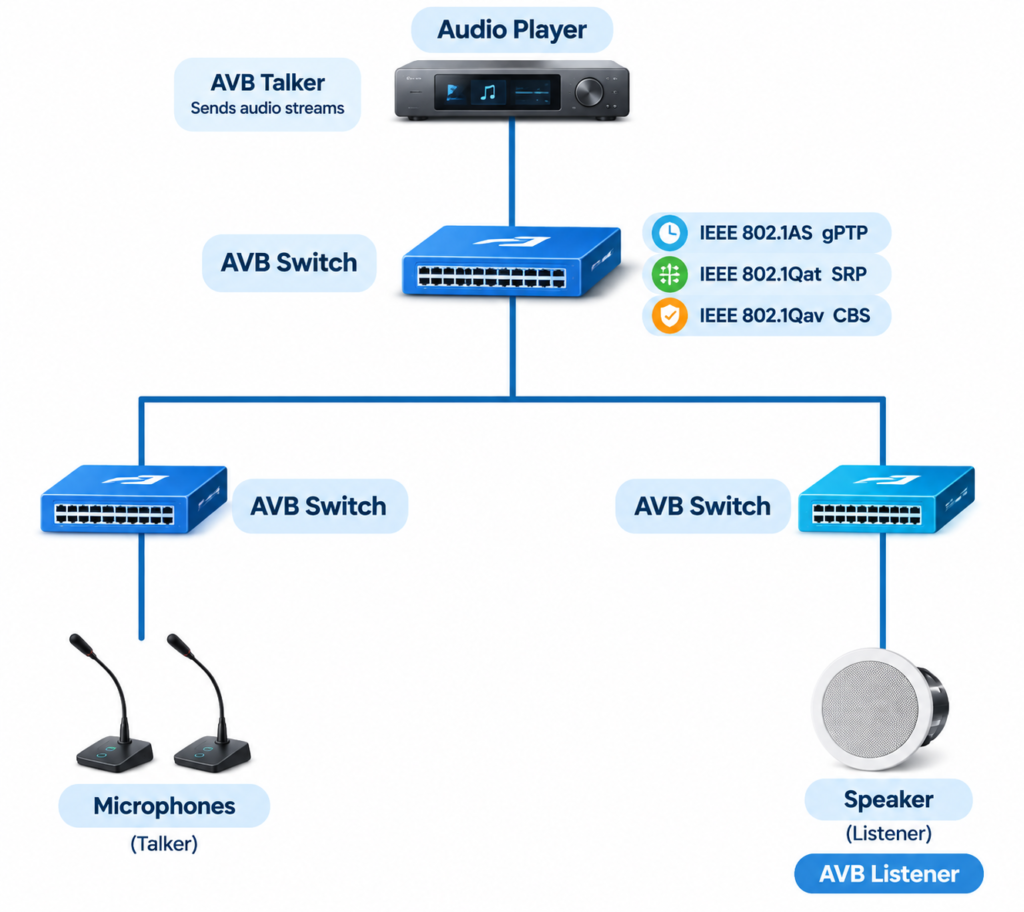
gPTP is only one part of an AVB network. It provides the shared time reference, but it does not reserve bandwidth or transport audio and video streams by itself. An AVB deployment combines several complementary standards:
| Standard | Function |
| IEEE 802.1AS | Synchronizes clocks across the network |
| IEEE 802.1Qat / SRP | Reserves network resources for AVB streams |
| IEEE 802.1Qav / CBS | Controls traffic transmission to reduce congestion and latency variation |
| IEEE 1722 / AVTP | Transports time-sensitive audio and video streams |
3. What Is IEEE 1588v2 PTP?
IEEE 1588v2, formally known as the Precision Time Protocol (PTP), is a widely adopted standard for synchronizing clocks across packet-based networks. It is used in applications where accurate time and phase alignment are essential, including:
- Professional IP broadcast
- 5G mobile networks
- Industrial automation
- Telecommunications
- Power utility networks
- Financial trading infrastructure
Unlike gPTP, which is specifically designed for bridged Ethernet environments, IEEE 1588 supports different transport mechanisms and network architectures. Depending on the selected PTP profile, PTP messages can be transported directly over Ethernet or over UDP/IP.
How Does IEEE 1588v2 Work?
PTP synchronizes clocks by exchanging timing messages between a Grandmaster and other network devices. Common message types include:
- Sync
- Follow_Up
- Delay_Req
- Delay_Resp
- Announce
By comparing timestamps and calculating network path delays, PTP devices estimate the difference between their local clocks and the reference clock. IEEE 1588 also defines different clock types, each with a specific role in the synchronization process.
For more: https://asteraix.com/blog/what-is-a-ptp-switch
Ordinary Clock (OC):An Ordinary Clock typically has one PTP port. It can act as a Grandmaster or synchronize its local clock to another PTP device. Examples include timing appliances, cameras, and endpoint devices.
Boundary Clock (BC):A Boundary Clock has multiple PTP ports. It synchronizes with an upstream PTP clock and then distributes timing information to downstream devices using its own clock. By regenerating timing messages at each network hop, Boundary Clocks help control the accumulation of timing errors across multi-hop networks.
Transparent Clock (TC): A Transparent Clock measures how long PTP event messages spend inside a network device. It updates the CorrectionField in PTP messages so downstream devices can account for the device’s residence time when calculating clock offsets. This helps reduce the impact of variable switching delays on synchronization accuracy.

Why Do Different Industries Use Different PTP Profiles?
IEEE 1588 provides a flexible framework. However, different industries have different requirements for synchronization accuracy, network topology, transport mechanisms, and message intervals. PTP profiles define specific operating parameters to ensure interoperability between devices in a particular application. Common examples include:
| PTP Profile / Standard | Application |
| SMPTE ST 2059-2 | Professional IP broadcast, including SMPTE ST 2110 |
| AES67 Media Profile | Audio-over-IP interoperability |
| ITU-T G.8275.1 | Telecom phase/time synchronization with full timing support from the network |
| ITU-T G.8275.2 | Telecom phase/time synchronization with partial timing support from the network |
For example, a broadcast facility using SMPTE ST 2110 relies on PTP-based synchronization to align video and audio equipment across the production network. Similarly, 5G networks use telecom-specific PTP profiles to distribute precise phase and time information to radio network equipment. The important point is that supporting IEEE 1588 alone does not automatically guarantee compatibility with every PTP-based application. The switch must support the required profile and clock functions.
For more :PTP Profiles For Network Engineers: How To Pick The Best Profile
4. gPTP vs. IEEE 1588v2: What Are the Key Differences?
Although gPTP and IEEE 1588v2 share the same fundamental goal of clock synchronization, their operating models and application requirements are different. Here is a practical comparison.
| Dimension | gPTP (IEEE 802.1AS) | IEEE 1588v2 PTP |
| Primary purpose | Synchronization in bridged Ethernet networks | General-purpose precision time synchronization |
| Transport | Link-local Ethernet | Ethernet or UDP/IP, depending on profile |
| Network architecture | Time-Aware Systems and bridges | Ordinary, Boundary, and Transparent Clocks |
| Delay measurement | Peer-to-Peer | Peer-to-Peer or End-to-End, depending on profile |
| Network scope | Primarily bridged LAN environments | LAN, routed networks, and telecom networks, depending on profile |
| Traffic management | Used with AVB/TSN traffic-control mechanisms | Timing protocol itself does not reserve media bandwidth |
| Configuration | Profile-defined behavior for time-aware networks | Profile-specific configuration and interoperability requirements |
| Typical applications | AVB, Milan, and other TSN deployments | SMPTE ST 2110, telecom, industrial timing, and other PTP applications |
The Most Important Difference: Synchronization vs. Network-Wide Media Delivery
One distinction is particularly important. gPTP and PTP synchronize clocks. They do not, by themselves, guarantee that audio or video packets will arrive without congestion or excessive delay. In an AVB network, synchronization works together with stream reservation and traffic shaping to provide predictable media delivery. In a conventional PTP network, timing accuracy depends on the clock architecture, timestamping capabilities, PTP profile, network topology, and traffic handling. This is why choosing a switch based only on a datasheet statement such as “PTP supported” or “gPTP supported” is not enough. You must understand what the application actually requires.
5. AVB vs. PTP: Which Technology Should You Choose?
There is no universal winner between AVB and PTP. The right choice depends on the devices being connected, the network topology, the required timing accuracy, and whether the application needs deterministic media transport in addition to clock synchronization.Let’s look at three common deployment scenarios.
Scenario 1: Live Concerts and Professional Audio — Choose AVB/gPTP for AVB-Based Systems
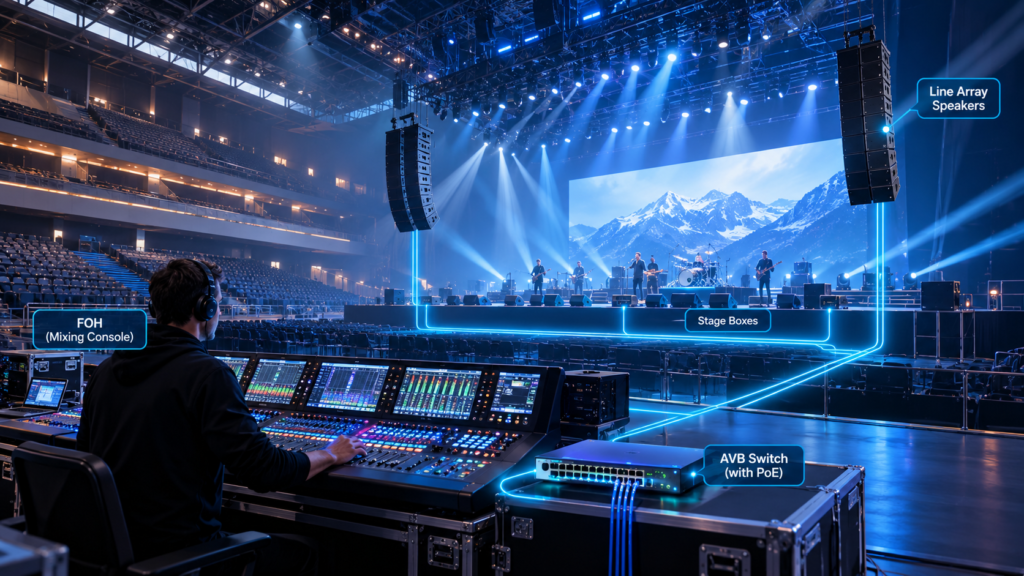
A live concert network may include:
- Digital mixing consoles
- Stage boxes
- Networked amplifiers
- Audio interfaces
- Loudspeaker management systems
These devices exchange multiple audio streams over Ethernet. If traffic is not properly managed, congestion and variable packet delays can affect real-time audio delivery. For an AVB-based ecosystem, gPTP provides a shared timing reference, while SRP and CBS help manage bandwidth and traffic behavior. AVB also supports defined traffic classes, including:
- Class A: A maximum end-to-end latency target of 2 ms.
- Class B: A maximum end-to-end latency target of 50 ms.
These classes help applications select an appropriate latency profile for their media streams. For example, a professional live-sound system using Milan-compatible devices can use an AVB-capable switch to establish timing synchronization and manage reserved audio streams.
Why AVB makes sense:
- Designed for time-sensitive audio and video transport.
- Supports network resource reservation.
- Provides defined traffic shaping mechanisms.
- Enables interoperability within compatible AVB ecosystems.
For this type of deployment, look for switches that support the required IEEE 802.1AS, SRP, CBS, and AVTP functions.
Scenario 2: Professional Broadcast and SMPTE ST 2110 — Choose IEEE 1588v2 PTP
Modern broadcast facilities increasingly use IP-based production architectures. Instead of relying entirely on traditional SDI connections, broadcasters transport video, audio, and ancillary data over high-bandwidth Ethernet networks.

A typical SMPTE ST 2110 environment may include:
- IP cameras
- Video production servers
- Media gateways
- Broadcast controllers
- Audio processing systems
- IP video routers
These devices need a common reference to maintain accurate synchronization between media streams. SMPTE ST 2059-2 defines the PTP profile used in SMPTE ST 2110 environments. For larger broadcast networks, switches may need hardware-assisted PTP functions, including Boundary Clock or Transparent Clock support, depending on the network design. High-density 25G, 100G, and 400G switching platforms may also be required to support high-bandwidth media transport.
Why PTP makes sense:
- Supports broadcast-specific timing profiles.
- Can be deployed across larger and more complex network architectures.
- Supports hardware clock functions such as BC and TC.
- Fits IP-based broadcast environments using SMPTE ST 2110.
For these deployments, engineers should evaluate PTP profile compatibility, hardware timestamping, clock performance, multicast handling, and network redundancy.
Scenario 3: 5G O-RAN Fronthaul — Choose Telecom-Specific PTP and SyncE

5G networks require accurate synchronization between radio equipment and network infrastructure. In O-RAN fronthaul deployments, timing alignment is essential for functions such as coordinated radio transmission and reception. Typical architecture may include:
- Radio Units (RUs)
- Distributed Units (DUs)
- Fronthaul aggregation switches
- Grandmaster clocks
- Telecom timing sources
Telecom networks commonly combine PTP with Synchronous Ethernet (SyncE). The two technologies serve different purposes:
- SyncE distributes frequency synchronization through the physical Ethernet layer.
- PTP distributes phase and time information across the network.
Telecom-specific PTP profiles, such as ITU-T G.8275.1 and G.8275.2, define the required operating behavior for different network timing architectures. The appropriate profile depends on whether the network provides full or partial timing support.
Why PTP and SyncE make sense:
- Designed for telecom frequency, phase, and time synchronization.
- Supports telecom-specific clock architectures.
- Enables synchronization across multi-hop fronthaul networks.
- Works with carrier-grade network designs and redundancy mechanisms.
For 5G deployments, selecting a switch requires more than checking whether it supports IEEE 1588. Engineers must verify the required telecom profile, clock type, SyncE capabilities, and timing performance.
For more: https://cloudswit.ch/blogs/ptp-synchronization-in-5g-open-ran-small-cell/
6. Can AVB and PTP Work Together on the Same Network?
Yes. AVB/gPTP and IEEE 1588v2 PTP can coexist in a converged network, but interoperability requires careful planning. Consider a performing arts center that operates:
- A Milan-based AVB audio system.
- An AES67 audio-over-IP network.
- An SMPTE ST 2110 broadcast production system.
These systems may share physical Ethernet infrastructure, but they do not necessarily use the same synchronization profile or timing domain. Simply connecting them to the same switch does not guarantee that their clocks will automatically synchronize with each other.
What Should Network Engineers Consider?
- Timing Domain Compatibility
gPTP and IEEE 1588 PTP use different profiles and operating mechanisms. If devices in different timing domains need to share a common time reference, engineers must determine how the clocks are related and whether a suitable timing gateway or clock-conversion architecture is required.
- Network Forwarding and Multicast Behavior
gPTP uses link-local Ethernet messaging, while PTP deployments may use Ethernet or IP-based transport depending on the profile. Switches must correctly handle the required timing packets, multicast traffic, and protocol-specific forwarding behavior.
- QoS and Traffic Isolation
Real-time audio and video streams should receive appropriate traffic priorities. VLANs, QoS policies, and multicast management can help organize different traffic types and prevent unrelated traffic from interfering with time-sensitive media delivery. However, VLAN separation alone does not solve clock-domain interoperability or guarantee timing accuracy.
- A Common Timing Reference
When AVB and PTP systems need to operate against a shared time reference, the overall architecture must define how that reference is distributed. This may involve a suitable Grandmaster Clock, multiple timing outputs, or a validated gateway architecture. The goal is to ensure that each system receives timing information in a format and profile it can correctly interpret.
7. How to Choose the Right Ethernet Switch for AVB or PTP?
Even when the timing protocol is correctly selected, the Ethernet switch remains a critical part of the synchronization architecture. A switch that only forwards PTP packets is not necessarily capable of delivering the timing accuracy required by a professional AV, broadcast, or telecom network. When evaluating switching hardware, consider the following capabilities.
For AVB and TSN Networks
- IEEE 802.1AS Hardware Support: The switch should support the required gPTP functions for time-aware Ethernet bridging, including accurate hardware timestamping where required by the application.
- Stream Reservation Protocol (SRP):SRP support enables the network to reserve resources for AVB streams along the forwarding path.
- Credit-Based Shaper (CBS): CBS regulates the transmission of reserved traffic to help maintain predictable latency and reduce interference from bursty traffic.
- AVTP Support: The switching platform should correctly handle AVTP traffic and the associated AVB forwarding requirements.
- Traffic Class and QoS Management: Verify support for the required traffic classes, priorities, and queue behavior.
For IEEE 1588v2 PTP Networks
- Hardware Timestamping:Accurate ingress and egress timestamping is essential for reducing timestamp errors caused by software processing and variable packet delays.
- Boundary Clock and Transparent Clock: Depending on the architecture, the switch may need BC or TC functionality to manage timing across multiple network hops.
- PTP Profile Support: Verify compatibility with the required profile, such as SMPTE ST 2059-2, AES67, or ITU-T G.8275.1.
- SyncE Support: For telecom deployments, SyncE may be required alongside PTP to distribute frequency synchronization.
- GNSS Support:uilt-in GNSS/GPS receiver interfaces (or 1PPS/ToD inputs) enable the switch to act directly as a Primary Reference Time Clock (PRTC) or Grandmaster, eliminating the need for an external timing appliance at edge sites
- High-Performance Switching Capacity: Broadcast and telecom networks may require high-density 10G, 25G, 100G, or 400G, 800G interfaces, together with suitable buffering, multicast forwarding, and redundancy capabilities.

Open Network Operating System and Manageability
For large-scale deployments, an open and programmable network operating system can simplify configuration, automation, telemetry, and integration with existing network management platforms. The key is to match the switch’s actual hardware and software capabilities to the required protocol profile and timing budget—not simply to choose a product with a generic PTP or AVB label.
8. Asterfusion AVB and PTP Switching Solutions
Different applications require different synchronization architectures. Asterfusion provides switching platforms designed for both AVB-based real-time media networks and IEEE 1588v2-based precision timing deployments.
For Professional Audio, Live Events, and AV Networks: Asterfusion CX102S-M AVB Switch Series
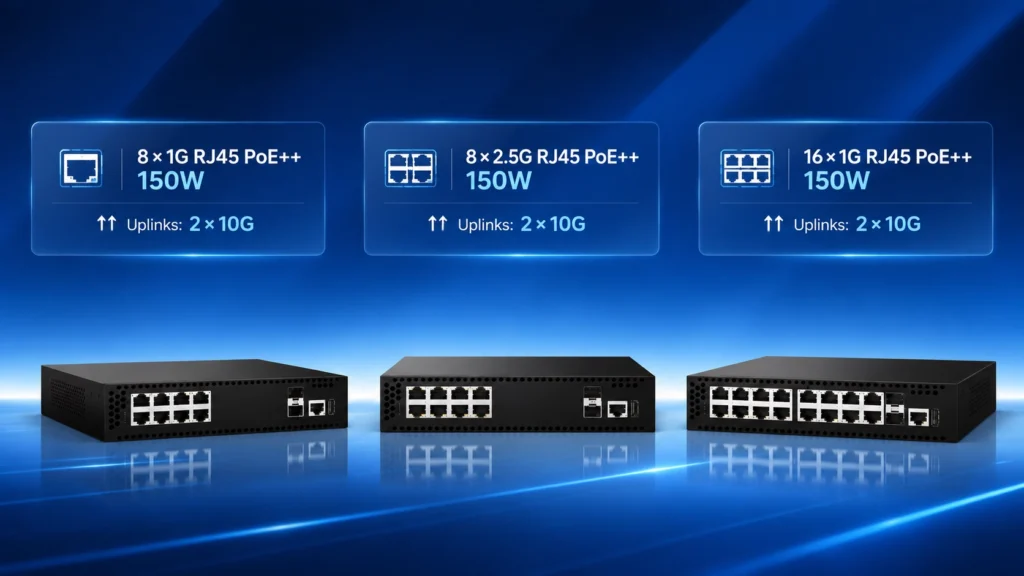
The Asterfusion CX102S-M series is designed for AVB and time-sensitive Ethernet applications. Its AVB capabilities include:
- IEEE 802.1AS: gPTP-based network time synchronization.
- IEEE 802.1Qat: Stream Reservation Protocol (SRP).
- IEEE 802.1Qav: Credit-Based Shaper (CBS).
- SR Class A and Class B: Support for defined AVB traffic classes and their latency requirements.
These capabilities help build predictable Ethernet networks for professional audio and video applications. Typical deployment scenarios include:
- Live concert audio networks.
- Professional sound reinforcement systems.
- Conference rooms and corporate auditoriums.
- Broadcast and media production environments.
- Industrial applications requiring time-sensitive Ethernet.
By combining gPTP synchronization with AVB traffic management, the CX102S-M series provides a switching foundation for real-time media delivery.
For IP Broadcast, Data Centers, and 5G Networks: Asterfusion PTP-Capable Switching Platforms

For applications requiring IEEE 1588v2 synchronization, Asterfusion offers PTP-capable open networking platforms based on high-performance merchant silicon and enterprise SONiC,the choice across 1G-800G switches. Depending on the specific hardware platform and software configuration, supported capabilities can include:
- Hardware-assisted IEEE 1588v2 timestamping.
- Boundary Clock and Transparent Clock functions.
- Telecom-specific PTP profiles.
- SyncE support.
- High-density 10G, 25G, 100G, and 400G/800G Ethernet interfaces.
These capabilities address the requirements of high-bandwidth and timing-sensitive network environments, including:
- SMPTE ST 2110 IP broadcast.
- AES67 audio-over-IP infrastructure.
- 5G O-RAN fronthaul and aggregation.
- Data center and enterprise timing networks.
Asterfusion’s enterprise SONiC approach also provides network programmability, telemetry, and automation capabilities for modern open networking environments.
Important: PTP capabilities, supported profiles, timing accuracy, and SyncE availability vary by switch model, ASIC, and AsterNOS software release. Contact Asterfusion to confirm the exact configuration required for your deployment.
Need Help Choosing Between AVB and PTP?
Whether you are building a professional AV network, upgrading a broadcast facility to SMPTE ST 2110, or deploying a synchronized 5G fronthaul network, choosing the right timing architecture is essential. Asterfusion can help evaluate your network topology, synchronization requirements, bandwidth needs, and switch capabilities.
Contact the Asterfusion team to discuss your AVB or PTP deployment and identify the right open networking solution for your application.
Frequently Asked Questions (FAQ)
Is gPTP the same as PTP?
No. gPTP (IEEE 802.1AS) is a specific profile based on IEEE 1588, designed for synchronization across bridged Ethernet networks. IEEE 1588 defines a broader precision time synchronization framework that supports different transport mechanisms and application-specific profiles.
Does AVB use IEEE 1588?
Yes. AVB uses gPTP, defined by IEEE 802.1AS, for network time synchronization. It also uses other standards, including SRP, CBS, and AVTP, to support reserved bandwidth and time-sensitive media transport.
Can a standard Ethernet switch support gPTP?
Not necessarily. A standard Ethernet switch does not automatically provide the time-aware bridging functions required by an AVB network. Engineers should verify IEEE 802.1AS support and the hardware timing capabilities required by the deployment.
Can AVB and PTP run on the same network?
They can coexist on shared physical infrastructure, but their timing profiles and forwarding requirements must be considered. If devices need a common time reference, a compatible clock distribution or timing gateway architecture may be necessary.
What is the difference between AVB and Dante?
AVB and Dante are different approaches to professional audio networking.
AVB is based on IEEE standards, including gPTP, stream reservation, and traffic shaping. Dante is a commercial audio networking platform that uses its own network timing and media transport mechanisms, with support for AES67 interoperability in applicable configurations.
They should not be treated as interchangeable protocols. The right choice depends on device compatibility, interoperability requirements, network design, and deployment objectives.
Does an IEEE 1588-supported switch automatically support SMPTE ST 2110?
No. Supporting IEEE 1588 alone does not guarantee compatibility with SMPTE ST 2110 timing requirements. The switch must support the relevant SMPTE PTP profile and the required hardware clock functions, timing performance, multicast behavior, and network architecture.


