Table of Contents
Introduction
In Asterfusion devices, the entire CX-M series and the CX308P-48Y-N-V2, CX532P-N-V2and CX732Q-N-V2 models in the CX-N series can serve as AV over IP switches. These devices support the PTP protocol, ensuring that they achieve Class C-level PTP accuracy in an AV over IP environment. This capability is crucial for applications such as live streaming, broadcasting, multi-camera IP production for events and performances, audio-visual teaching in education, and even surgical live-streaming scenarios, where low latency and high-precision synchronization of images are essential.
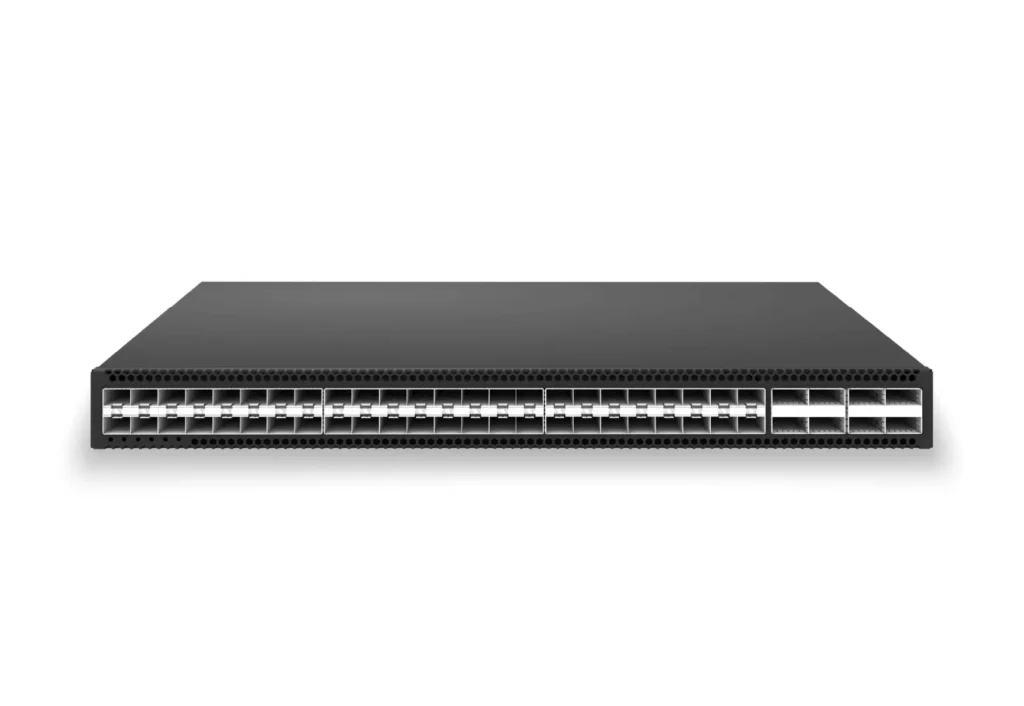
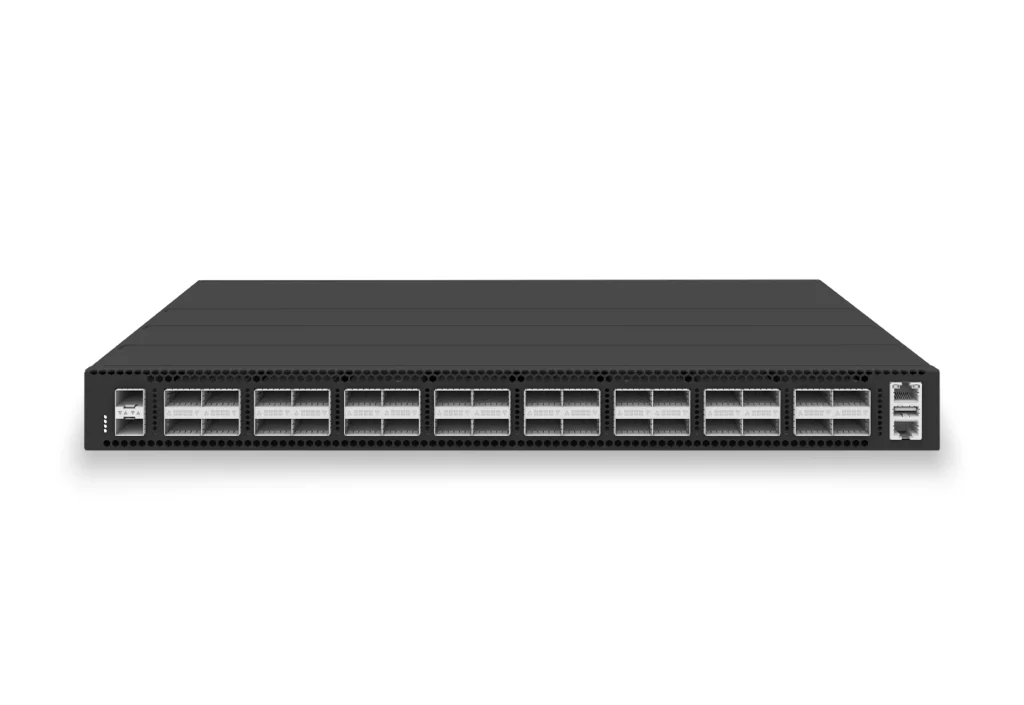
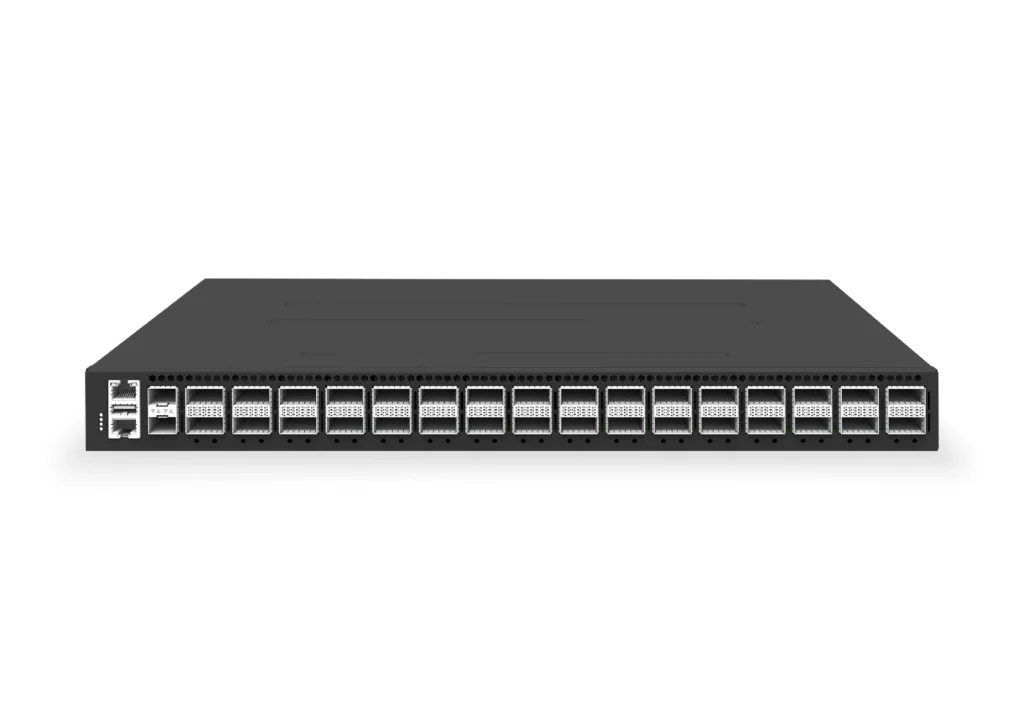
Next, let’s explore what AV over IP is and how Asterfusion supports networking as an AV over IP switch in such environments.
What is AV over IP ?
AV over IP (Audio Visual over Internet Protocol) is a technology that transmits audio and video signals over IP networks. The core concept is to digitize and encode audio and video into IP packets, which are transmitted over standard networks (such as Ethernet). The receiving end then decodes the packets to restore the signals, replacing traditional dedicated cables and matrix switchers.
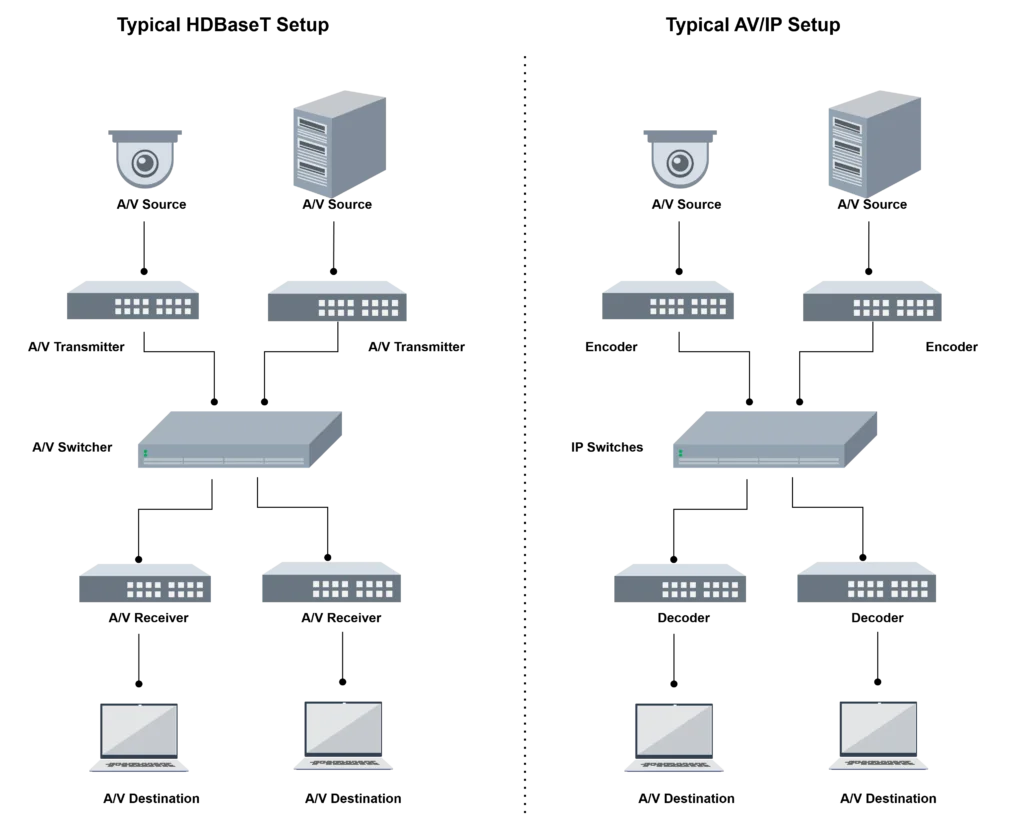
In traditional AV scenarios:
- A/V Transmitter: Captures audio and video from the A/V source, encodes it, and transmits it.
- A/V Switcher (also known as a video matrix switcher): Aggregates all the signals from the transmitters and outputs them to the receiver.
- A/V Receiver: Receives the signals, performs audio decoding, video optimization, and other functions.
In AV over IP scenarios, the elements are similar, but the Encoder replaces the A/V Transmitter, and the Decoder replaces the A/V Receiver. The key difference is that an Ethernet/IP Switch replaces the A/V Switcher.
This is where Asterfusion excels. We offer devices with port speeds ranging from 1G to 400G. Additionally, our devices support MLAG, VXLAN, multicast, QoS, PTP Class C with 10ns accuracy, and comply with the SMPTE ST 2110 standard, making them highly suitable for the audio-visual industry.
Key Advantages of AV over IP
Compared to traditional AV architectures, the advantages of the AV over IP architecture lie in the use of Ethernet/IP switches. These advantages can be discussed from five perspectives: transmission distance, scalability, cost, flexibility, and security.
- Transmission Distance: In traditional AV architectures, HDMI is limited by the physical characteristics of the cables, leading to signal degradation over distances of just a few dozen meters. Even with HDBaseT, the transmission distance is usually limited to 100 meters without repeaters. In AV over IP architecture, Ethernet/IP switches are used, where audio and video signals are encapsulated as IP packets. As long as the network is connected, the signals can theoretically reach anywhere, even across buildings, campuses, or globally.
- Scalability: Traditional matrix switchers have a fixed number of input/output ports (e.g., 8×8, 16×16, 32×32). Once all ports are occupied, adding even a single terminal often requires replacing the entire matrix with a larger unit. In AV over IP architecture, adding a new terminal only requires connecting to the switch. Asterfusion uses a spine-leaf network architecture, which offers superior scalability compared to traditional three-tier networks. It provides high bandwidth, low latency, and non-blocking transmission channels.
- Cost: AV over IP leverages existing IT networks, reducing the need for dedicated cabling and matrix investments. It also simplifies the overall network complexity. In high-concurrency 4K/8K scenarios, a dedicated VLAN or VRF is typically planned for AV services on the existing network, combined with QoS to ensure bandwidth and low latency.
- Flexibility: In traditional AV architectures, signal switching is usually a physical “hard switch,” and layout changes often require manual rewiring or manual operations on the matrix panel. However, in the AV over IP switch architecture, multi-screen splicing, KVM collaboration, and other functions can be orchestrated on the IP network using professional AV control software, eliminating the need for manual switching of underlying physical connections.
- Security: AV over IP switches can directly utilize mature Ethernet/IP network security technologies, incorporating the AV system into the enterprise IT security strategy. For example, Asterfusion’s 1G-400G AV over IP switches support features such as Storm Suppression, ACL, CoPP, DHCP Snooping, and AAA:
- AAA (Authentication, Authorization, Accounting): Ensures that only authorized users and devices can access the network.
- ACL (Access Control List): Provides granular control over which IP addresses or ports are allowed to communicate, blocking unauthorized access.
- DHCP Snooping: Prevents unauthorized DHCP servers from accessing the network, ensuring IP address assignment security.
- CoPP (Control Plane Policing): Protects the switch CPU from DoS attacks, ensuring the stability of the management plane.
- Storm Suppression: Effectively prevents broadcast and multicast storms from overwhelming the network, ensuring the stability of video streams.
Asterfusion AV over IP Switches Typical Topology
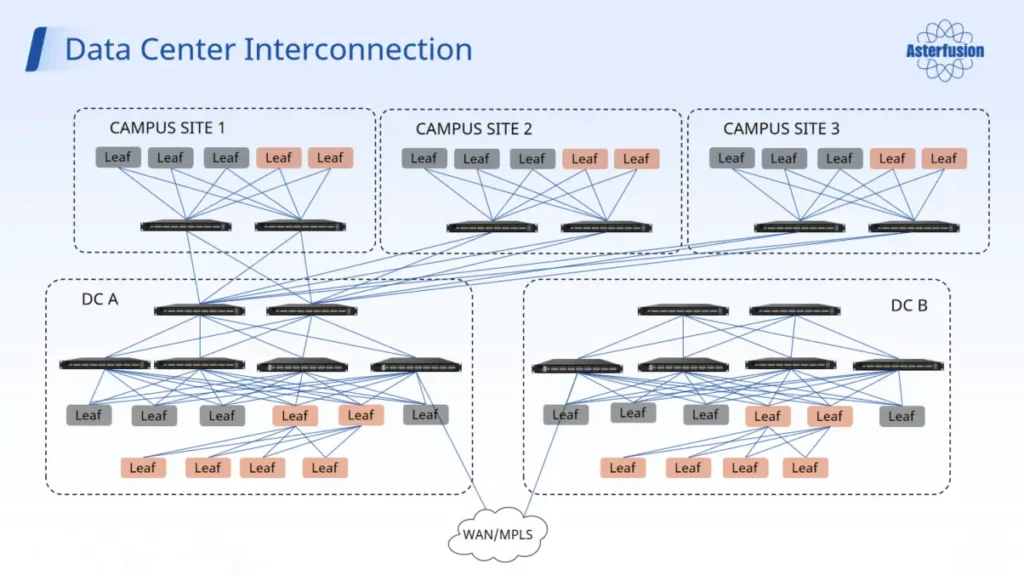
The above is a simplified topology for a PTP Class C live streaming scenario between data centers. It uses a Spine-Leaf architecture, with BGP EVPN control plane and VXLAN multicast for efficient traffic distribution.
Asterfusion platforms are deployed as AV over IP switches at various layers.
At the Spine layer, the deployed device models include CX532P-N-V2, CX732Q-N-V2
At the access layer, the full range of CX-M series devices, from 1G to 400G ports, is used as needed for terminal access. These devices address sudden traffic bursts during live streaming and support diverse bandwidth needs for high-data-rate video transmissions in scenarios like 4K and 8K ultra-high-definition live streaming, as well as regular office environments.
In this network, all devices support PTP protocol and SMPTE ST 2110 standard, and can be configured with OC, TC, and GM clock types.
Asterfusion platforms can serve as AV over IP switches because, by supporting PTP, SMPTE 2110, and IPMX compatibility, they achieve network-wide precision control within 10ns. Additionally, with QoS supporting 8 queues, AV processing capabilities are optimized and can easily scale based on user requirements.
AV over IP Switches Applications

Corporate & Conferencing
- Application Scenarios: Corporate headquarters, multi-functional conference rooms.
- Core Value:
- AV over IP for corporate use: Supports BYOD (Bring Your Own Device), allowing easy multi-signal screen sharing and switching via IP networks.
- AV over IP for conferencing: Seamless integration of high-quality audio and video streams into Zoom/Teams systems, supporting hybrid work models and breaking down geographical limitations.
Broadcasting & Live Events
- Application Scenarios: TV studio, eSports competitions, concerts, sports event broadcast trucks.
- Core Value:
- IP-based production: Replaces SDI matrices and supports the SMPTE ST 2110 standard, enabling full IP-based studio production.
- Remote production (REMI): Utilizes high-bandwidth Ethernet transmission to separate front-end filming and back-end production, significantly reducing on-site deployment costs.
- Low latency and synchronization: Ensures nanosecond-level synchronization (PTP) and ultra-low latency transmission for multi-camera signals, meeting the strict requirements of live broadcasting.
Education & Medical
- Application Scenarios: University campuses, lecture halls, operating rooms, teaching centers.
- Core Value:
- AV over IP switches for education: Real-time sharing of quality course resources across different campuses and buildings, enabling the normalization of “three classrooms” (remote, hybrid, and on-campus).
- AV over IP in the Operating Room: Lossless 4K/8K video transmission, ensuring clear reproduction of surgical details, supporting bidirectional voice interaction for remote consultations and teaching.
Exhibitions & Digital Signage
- Application Scenarios: Museums, science centers, theme parks, large screens in shopping malls.
- Core Value:
- Immersive video walls: Supports irregular screen splicing and ultra-high-resolution displays (e.g., 8K+ large screens), creating an immersive visual experience.
- Synchronized distribution: Ensures frame-level synchronization of content across all screens, eliminating screen tearing.
- Flexible changes: Exhibition area content adjustments can be made without rewiring, with screen layout redefined via software.
Security & Surveillance
- Application Scenarios: City command centers, campus monitoring rooms, traffic dispatch halls.
- Core Value:
- AV over IP for security: Supports the connection of thousands of camera signals, breaking the port limitations of traditional matrices.
- AV over IP switches for surveillance: Quick access to key surveillance footage on large screens, aiding in fast decision-making.
Conclusion
AV over IP is the core technology driving the convergence of audio-visual and IT systems. It meets the demands of 4K/8K, hybrid work, and remote collaboration, and is rapidly replacing traditional AV systems. However, the key to building an efficient system lies in the underlying network. When choosing AV over IP switches, it is essential to consider factors like latency, bandwidth, synchronization, and compatibility, paired with high-performance chips and standardized encoding solutions to balance cost and performance.
In all the scenarios mentioned above, switches are the core hub. In the fierce competition among the best AV over IP switch brands, Asterfusion stands out by offering the following competitive advantages:
- Comprehensive coverage: From gigabit access in meeting rooms to 100G/400G core switches in broadcast centers.
- AV-ready support: Factory-built to support the SMPTE ST 2110 standard and PTP functionality, achieving Class C 10ns precision. Asterfusion switches are not just IT switches, but AV-friendly switches.
- Security and scalability: Combining the Spine-Leaf architecture with enterprise-grade security features, perfectly adapting to various scale requirements, from AV over IP switches for conference rooms to AV over IP switches for surveillance.
Other PTP Blogs You Should Read
- What is PTP and How does it Work?
- All PTP Clock Types and How to Configure in Asterfusion
- PTP Profiles for Network Engineers: How to Pick the Best Profile
- Why 10ns PTP Switches for Broadcast Are the Industry Gold Standard
- How to Deploy PTP Synchronization in 5G Open RAN Small Cell Networks with a GNSS-Enabled Switch
- Why PTP Network Switches are Used in Financial Trading?
- PTP Design Best Practices for Media & Entertainment IP Networks
Real Case Study:
- SMPTE 2110 in IP-Based Broadcast Studio Design: A Transforming with Asterfusion
- Asterfusion PTP Switch Powers Live Streaming of Australia’s Premier Sporting Events

Contact US !
- To request a proposal, send an E-Mail to bd@cloudswit.ch
- To receive timely and relevant information from Asterfusion, sign up at AsterNOS Community Portal
- To submit a case, visit Support Portal
- To find user manuals for a specific command or scenario, access AsterNOS Documentation
- To find a product or product family, visit Asterfusion-cloudswit.ch


