Table of Contents
As enterprise networks adopt Wi-Fi 6/7 and bandwidth-intensive applications, 2.5G Ethernet provides a practical upgrade from traditional Gigabit access networks. Asterfusion offers a range of 2.5G switches powered by different Marvell chipset platforms, with flexible port densities, PoE options, uplink configurations, and Enterprise SONiC features to meet diverse enterprise network requirements.
1. Why Do Enterprise Networks Need to Upgrade to 2.5G?
With the growing adoption of Wi-Fi 6, Wi-Fi 6E, and Wi-Fi 7, together with increasing demands from enterprise endpoint devices, NAS storage, and high-speed data transfers, traditional Gigabit Ethernet access networks are gradually reaching their bandwidth limits. For many enterprises, upgrading the entire access network directly to 10G would not only increase the costs of switches, network adapters, and cabling, but could also result in unnecessary investment. 2.5G Ethernet offers a more flexible and cost-effective upgrade path.
Compared with traditional 1G Ethernet, 2.5G provides 2.5 times the port bandwidth while typically allowing enterprises to reuse their existing Cat5e or Cat6 copper cabling infrastructure, helping reduce network upgrade costs. 2.5G switches are particularly suitable for the following applications:
- Wi-Fi 6 / Wi-Fi 7 Access Networks: Provide higher-capacity wired backhaul for high-performance wireless APs.
- Enterprise Office Networks: Support high-performance workstations, collaboration devices, and high-speed file transfers.
- NAS and Edge Storage: Improve data transfer efficiency between endpoint devices and network storage.
- Video Surveillance Networks: Provide higher bandwidth for high-resolution cameras and centralized video management systems.
- Small and Medium-Sized Data Centers and Edge Computing: Deliver high-speed connectivity for servers, storage systems, and edge devices.
For enterprises looking to increase access-layer bandwidth while keeping overall upgrade costs under control, 2.5G is a compelling option.
2. What Key Factors Should You Consider When Choosing a 2.5G Switch?
Enterprise networks vary significantly in scale, endpoint density, and application requirements. Therefore, when selecting a 2.5G switch, you should look beyond port speeds and consider several factors, including port density, chipset platform, PoE capabilities, uplink bandwidth, and network operating system.
2.1 Port Density: 8 Ports, 24 Ports, or 48 Ports?
The number of ports directly affects a switch’s access capacity and deployment model.
| Port Configuration | Typical Applications | Key Advantages |
|---|---|---|
| 8 × 2.5G | Small offices, small wireless networks, and edge deployments | Compact design for small-scale high-speed access |
| 24 × 2.5G | SMBs, floor-level access, and wireless AP aggregation | Balances port density and deployment costs |
| 48 × 2.5G | Enterprise campuses and high-density wireless networks | Higher port density with fewer switches required |
| 8 × 2.5G + 24 × 1G | Mixed-speed access environments | Supports both high-speed endpoints and legacy Gigabit devices |
If only some devices on your network require 2.5G connectivity, a mixed-port configuration may be a practical choice. If most endpoints require high-speed access, consider a 24-port or 48-port all-2.5G switch.
2.2 Chipset Platform: Different Chipsets Serve Different Deployment Needs
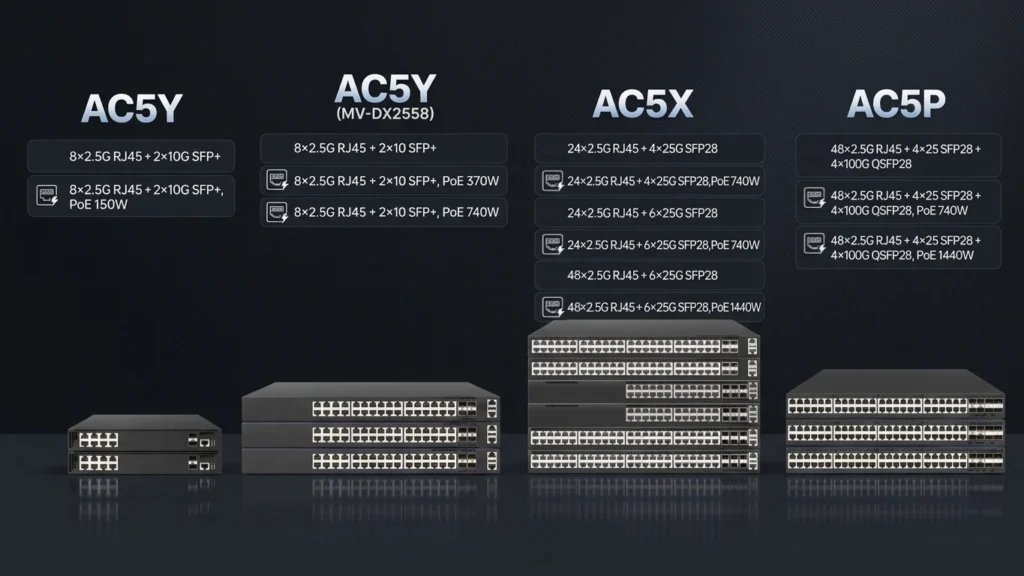
The switching chipset determines a switch’s packet-forwarding capabilities, port configurations, and hardware resources. For 2.5G switches, different chipset platforms are designed to address different access network scales and requirements. Asterfusion’s 2.5G product portfolio covers three major platforms:
Marvell Prestera AlleyCat5-Y
- a. DX2556: Features a compact, quiet design for branch offices, retail edge deployments, and small meeting rooms. It provides compact 2.5G access with 10G uplinks, making it suitable for deployments requiring a lightweight and space-efficient solution.
- b. DX2558: If 70% of an enterprise’s access devices are still Gigabit printers, IP phones, and office PCs, replacing all of them with dedicated 2.5G ports may introduce unnecessary upgrade costs. The AC5Y DX2558 mixed-port configuration provides 8 × 2.5G ports for wireless APs and 24 × 1G ports for existing Gigabit devices, maximizing infrastructure reuse while offering a highly competitive cost per port.
Marvell Prestera AlleyCat5-X
Based on the Marvell Prestera AlleyCat 5X platform, AC5X is designed for high-density 24-port and 48-port 2.5G access deployments. It is suitable for new Wi-Fi 7 campus networks, high-throughput graphics and financial R&D workstations, and modern campus fabrics supporting BGP EVPN-VXLAN. Unlike lower-tier platforms that remain limited to 10G uplinks, AC5X combines dense 2.5G access with high-speed 25G SFP28 uplinks. It delivers line-rate, non-blocking forwarding and natively supports extending Layer 3 EVPN-VXLAN virtualization to the access layer.
Marvell Prestera AlleyCat5-P
Designed for large university campuses, research laboratories, high-throughput smart buildings, and data center edge management networks. When the access layer needs to support multi-gigabit copper connectivity, local 25G fiber interconnections, and direct 100G uplinks to the core Spine, AC5P is the ideal choice. Its port configuration includes 48 × 2.5G RJ45 + 4 × 25G SFP28 (fiber downlinks) + 4 × 100G QSFP28 (backbone uplinks).
Therefore, when selecting a 2.5G switch, it is important to consider both the chipset platform and the specific product model, rather than focusing solely on series names such as AC5Y, AC5X, or AC5P.
2.3 PoE Power: Do Your Endpoint Devices Need Power over Ethernet?
If your switch needs to connect wireless APs, IP cameras, IP phones, or other PoE-powered devices, you should consider both the PoE standard and the total PoE power budget.
| IEEE Standard | PoE Type | Maximum PSE Output Power | Maximum PD Available Power |
|---|---|---|---|
| 802.3af | PoE | 15.4W | 12.95W |
| 802.3at | PoE+ | 30W | 25.5W |
| 802.3bt Type 3 | PoE++ | 60W | 51W |
| 802.3bt Type 4 | PoE++ | 90W | 71.3W |
In addition to the maximum power per port, you should also consider the switch’s overall PoE Budget.For example:
- 150W: Suitable for small-scale PoE deployments.
- 370W: Suitable for medium-sized PoE deployments.
- 740W: Suitable for higher-density wireless AP or surveillance deployments.
- 1440W: Suitable for large-scale deployments involving high-power PoE devices.
Note that the total PoE budget does not mean every port can simultaneously deliver its maximum rated power. The actual number of supported devices must be calculated based on both the per-port PoE standard and the switch’s total power budget.
2.4 Uplink Interfaces: 10G, 25G, or 100G?
Uplink bandwidth determines the data transmission capacity between access switches and the aggregation or core layer. As the number of 2.5G access ports increases, uplink bandwidth must also be planned appropriately to prevent congestion when traffic from multiple endpoints converges on a limited number of high-speed interfaces.
Common uplink configurations include:
- 10G SFP+: Suitable for small networks and medium-sized access deployments.
- 25G SFP28: Suitable for high-density 2.5G access and enterprise networks requiring greater aggregation bandwidth.
- 100G QSFP28: Suitable for high-bandwidth aggregation, core networks, and deployments with more demanding scalability requirements.
When selecting uplink interfaces, consider the number of access ports, application traffic, uplink redundancy, and future expansion requirements.
3. Asterfusion 2.5G Switch Portfolio: AC5Y, AC5X, and AC5P
Asterfusion offers a comprehensive portfolio of 2.5G Ethernet switches based on different Marvell chipset platforms, covering a wide range of enterprise access requirements, from compact branch deployments to high-density campus networks.The three platforms serve different deployment needs:
| Platform | Chipset | Product Positioning | Typical Configurations |
| AC5Y | DX2556 / DX2558 | Compact and mixed-speed 2.5G access | 8×2.5G; 8×2.5G + 24×1G |
| AC5X | Marvell Prestera AlleyCat 5X | High-density 24-port and 48-port 2.5G access | 24×2.5G; 48×2.5G; selected models with 4/6×25G uplinks |
| AC5P | Marvell Prestera AlleyCat 5P | High-density 2.5G access with 25G and 100G uplinks | 48×2.5G + 4×25G/10G + 4×100G/40G |
3.1 AC5Y: Compact 2.5G Access and Mixed-Speed Connectivity
The AC5Y platform includes two chipset configurations, DX2556 and DX2558, designed for compact high-speed access and mixed-speed enterprise networks.
DX2556: 8-Port 2.5G Access
Based on the DX2556 chipset, the CX102S series provides:
- 8×2.5G RJ45 ports
- 2×10G SFP+ uplink ports
- Non-PoE and 150W PoE configurations
Available models:
| Platform | Model | Port Configuration | PoE | Uplink Ports | Product Link |
| AC5Y | CX102S-8MT-M-S | 8×2.5G | Non-PoE | 2x10G SFP+ | https://cloudswit.ch/product/8-port-2-5g-l2-l3-access-switch-enterprise-sonic/ |
| AC5Y | CX102S-8MT-M-SWP | 8×2.5G | 150W | 2x10G SFP+ | https://cloudswit.ch/product/8-port-2-5g-l2-l3-poe-access-switch-sonic/ |
This compact configuration is suitable for small offices and branch deployments requiring 2.5G connectivity for wireless APs, workstations, or NAS devices.
DX2558: Mixed 2.5G and 1G Access
Based on the DX2558 chipset, the CX104S series provides:
- 8×2.5G RJ45 ports
- 24×1G RJ45 ports
- 4×10G SFP+ uplink ports
- Non-PoE, 370W PoE, and 740W PoE configurations
Available models:
| Platform | Model | Port Configuration | PoE | Uplink Ports | Product Link |
| AC5Y (MV-DX2558) | CX104S-8MT24GT-M-S | 8×2.5G + 24x1G | Non-PoE | 4x10G SFP+ | 8x 2.5G RJ45 And 24x 1G RJ45, 4x10Gb SFP+ Uplinks, Enterprise SONiC Ready |
| AC5Y (MV-DX2558) | CX104S-8MT24GT-M-SWP2 | 8×2.5G + 24x1G | 370W | 4x10G SFP+ | 8x 2.5G RJ45, 24-Port PoE++@370W L3 Switch, 4x10Gb SFP+ Uplinks |
| AC5Y (MV-DX2558) | CX104S-8MT24GT-M-SWP4 | 8×2.5G + 24x1G | 740W | 4x10G SFP+ | 8x 2.5G RJ45, 24-Port Gigabit PoE+Switch@740W, 4x10Gb SFP+ Uplinks, Enterprise SONiC Ready |
3.2 AC5X: High-Density 24-Port and 48-Port 2.5G Access
Based on the Marvell Prestera AlleyCat 5X platform, AC5X is designed for enterprise networks requiring higher 2.5G port density. The product portfolio includes 24-port and 48-port 2.5G configurations, with both PoE and Non-PoE options. Selected models also provide 6×25G SFP28 uplinks, offering greater aggregation bandwidth for high-density access deployments.
Available Product Configurations
| ASIC | Model | Port Configuration | PoE Option | Uplink | Link |
| AC5X | CX204Y-24MT-M-S | 24×2.5G | Non-PoE | 4x25G/10G SFP28/SFP+ | https://cloudswit.ch/product/24-port-2-5g-access-switch-enterprise-sonic/ |
| CX204Y-24MT-M-SPW4 | 24×2.5G | 740W | 4x25G/10G SFP28/SFP+ | https://cloudswit.ch/product/24-port-2-5g-poe-access-switch-sonic/ | |
| CX206Y-24MT-M-H | 24×2.5G | Non-PoE | 4x25G/10G SFP28/SFP+ | https://cloudswit.ch/product/24-ports-2-5g-access-switch-6x25gb-sfp28-uplinks-enterprise-sonic/ | |
| CX206Y-24MT-M-HWP4 | 24×2.5G | 740W | 4x25G/10G SFP28/SFP+ | https://cloudswit.ch/product/24-port-2-5g-poe-access-switch-6x25g-uplink/ | |
| CX206Y-48MT-M-H | 48×2.5G | Non-PoE | 4x25G/10G SFP28/SFP+ | https://cloudswit.ch/product/48-port-2-5g-access-switch-enterprise-sonic/ | |
| CX206Y-48MT-M-HWP8 | 48×2.5G | 1440W | 4x25G/10G SFP28/SFP+ | https://cloudswit.ch/product/48-port-2-5g-access-switch-with-6x25g-uplink/ |
3.3 AC5P: High-Density 2.5G Access with 25G and 100G Uplinks
Based on the Marvell Prestera AlleyCat 5P platform, AC5P is designed for high-density enterprise access networks that require both multi-gigabit connectivity and high-speed uplinks. Its representative configuration includes:
- 48×2.5G RJ45 ports
- 4×25G/10G SFP28 ports
- 4×100G/40G QSFP28 ports
- 740W and 1440W PoE options
The platform provides up to 800Gbps of switching capacity. Its combination of 25G and 100G interfaces offers greater aggregation bandwidth and flexibility for network expansion. Unlike access switches limited to 10G or 25G uplinks, AC5P provides both 25G and 100G interface options, supporting different network aggregation requirements.
Confirmed PoE Models
| ASIC | Model | Port Configuration | PoE Option | Uplink | Link |
|---|---|---|---|---|---|
| AC5P | CX204P-4Y48MT-M-H | 48×2.5G | Non-PoE | 4x25G SFP28 + 4x100G QSFP28 | https://cloudswit.ch/product/2-5g-rj45-and-25g-sfp28-copper-fiber-hybrid-access-switch-sonic/ |
| CX204P-4Y48MT-M-HWP4 | 48×2.5G | 740W | 4x25G SFP28 + 4x100G QSFP28 | https://cloudswit.ch/product/4-x-25g-sfp28-48-x-2-5g-rj45-enterprise-access-switch-enterprise-sonic/ | |
| CX204P-4Y48MT-M-HWP8 | 48×2.5G | 1440W | 4x25G SFP28 + 4x100G QSFP28 | https://cloudswit.ch/product/4-x-25g-sfp28-48-x-2-5g-rj45-poe-enterprise-access-switch-enterprise-sonic/ |
4. How to Choose the Right Asterfusion 2.5G POE Switch for Your Network Requirements
If you are still unsure which platform best fits your requirements, the following deployment scenarios can help guide your selection.
Scenario 1: Small Offices or Networks with a Limited Number of High-Speed Endpoints
If only a small number of devices in your network require 2.5G connectivity, such as wireless APs, workstations, or NAS devices, while other endpoints still operate at Gigabit speeds, consider the AC5Y DX2556 or DX2558.
Recommended Models:
- For a small number of high-speed endpoints: CX102S-8MT-M-S.
- If PoE power is required: CX102S-8MT-M-SWP.
- For mixed 2.5G and 1G connectivity: CX104S-8MT24GT-M-S.
- For mixed-port connectivity with PoE: Choose CX104S-8MT24GT-M-SWP2 or CX104S-8MT24GT-M-SWP4 based on your power requirements.
This approach allows enterprises to upgrade their networks gradually without replacing all existing Gigabit endpoints.
Scenario 2: Medium-Sized Enterprises or High-Density Wireless Access
If your enterprise needs 2.5G connectivity for multiple Wi-Fi 6 / Wi-Fi 7 APs, workstations, or other high-speed endpoints, consider the AC5X 24-port or 48-port series.
Recommended Configurations:
- 24×2.5G: Suitable for medium-sized access deployments.
- 48×2.5G: Suitable for higher-density access environments.
- For greater aggregation bandwidth: Choose models equipped with 6×25G SFP28 uplinks.
- If APs or other endpoints require power: Select the corresponding PoE models.
Scenario 3: Large Enterprise Campuses or High-Density PoE Networks
If your network needs to connect a large number of wireless APs, IP cameras, or other PoE-powered devices, with higher requirements for power delivery and access density, consider AC5P.
Recommended Configuration:
- 48×2.5G RJ45 ports.
- Choose between the 740W and 1440W PoE versions based on your power requirements.
- Use 4×25G SFP28 and 4×100G QSFP28 interfaces for high-speed uplinks and network expansion.
For enterprises requiring high-density 2.5G access and high-speed aggregation, AC5P offers a more flexible range of uplink options.
Scenario 4: High-Performance Uplinks and Future Network Expansion
If your enterprise needs not only 2.5G access but also sufficient capacity for future bandwidth upgrades, uplink configuration becomes particularly important.
Consider the following options based on your network scale:
- 10G uplinks: Suitable for small and medium-sized access deployments.
- 25G uplinks: Suitable for high-density access and higher-bandwidth aggregation.
- 100G uplinks: Suitable for large enterprise networks and deployments requiring greater scalability.
For enterprises looking for both 48×2.5G access and 100G uplink connectivity, AC5P is a platform worth considering.
5. Enterprise SONiC for Campus Network: More Than 2.5G Hardware
When selecting enterprise switches, port speeds and switching capacity are important considerations. However, the network operating system also plays a critical role in determining device functionality, manageability, and long-term scalability. Asterfusion 2.5G switches run AsterNOS, an enterprise-grade network operating system built on SONiC.
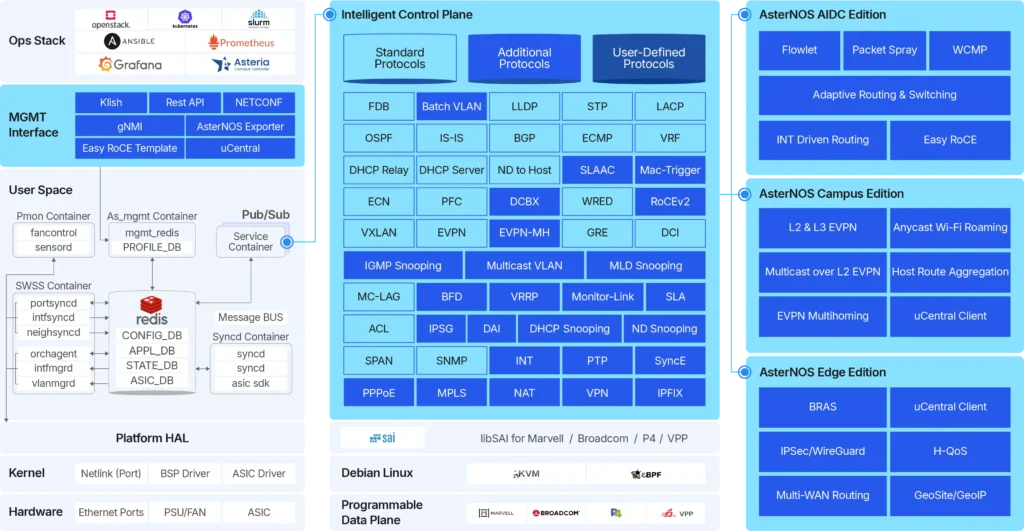
Unlike traditional switches that rely on proprietary network operating systems, SONiC is built on Linux and SAI (Switch Abstraction Interface), providing a more flexible software foundation for open networking architectures. Building on SONiC’s open architecture, AsterNOS further delivers enterprise-oriented networking features, management capabilities, and technical support.
5.1 Basic Interface and Access Features
- Port Speed and PoE Management: Supports auto-negotiation and configuration for 10M/100M/1G/2.5G/10G/25G interfaces. Provides PoE/PoE+/PoE++ power management, Delayed Power Supply, PD Alive detection, and status diagnostics. Version V6.1 further improves PoE initialization logging.
- Layer 2 Access and Isolation: Supports 4K VLANs, Voice VLAN, Flexible and Basic QinQ, VLAN Mapping, Port Isolation, and LACP link aggregation.
5.2 Security and Network Access Control
- 802.1X and Access Authentication: Supports MAC-based and port-based 802.1X authentication, Portal authentication, Guest VLAN, Escape Mode, and dynamic authorization.
- Access Security: Supports DHCP Snooping (IPv4/IPv6), Dynamic ARP Inspection (DAI), IP Source Guard (IPSG), ND Detection, RA Guard, SAVI, storm suppression, and Port Security.
5.3 Layer 3 Forwarding and Network Virtualization
- Layer 3 Routing: Supports VRF isolation, dual-stack IPv4/IPv6, static routing, OSPFv2/v3, BGP/MP-BGP, and Policy-Based Routing (PBR).
- Key Differences Between V5 and V6:
- V5.2: Focuses on data center and campus interconnection through MC-LAG + VXLAN hybrid deployments. Supports EVPN Route Types 1/2/3/4/5, with distributed and centralized gateway architectures.
- V6.1: Retains VXLAN/EVPN capabilities while introducing MPLS LDP, L3VPN, VPWS, VPLS, and SRv6 (SRv6 BE / TE / SID Type). These enhancements extend campus networking capabilities toward cloud-network convergence and end-to-end network slicing.
5.4 Precision Timing and High Availability
- PTP / SyncE: Supports standards including IEEE 1588v2, SMPTE 2059-2, and AES67. Selected 2.5G platforms, such as the CX206Y-24GT/24MT, support GNSS-assisted timing in both V5.2 and V6.1. V6.1 introduces compensation for GNSS antenna delay and physical port latency, as well as dynamic PTP configuration changes without restarting the PTP instance.
- High Availability: V5 supports cross-device link aggregation through MC-LAG and VRRP. V6.1 adds hardware-accelerated BFD (HW BFD for OSPF/BGP/ISIS/Static) and Monitor Link integration.
Software Version Recommendations
1. For Standard Enterprise Campus Access (2.5G Downlinks for Wi-Fi 6/7 APs and Office PCs)
- Recommended version: V5.2R018. This mature release supports MC-LAG, comprehensive Layer 2 security features, and a wide range of 802.1X / Portal authentication capabilities, meeting the requirements of most Layer 2 and Layer 3 enterprise campus networks.
2. For Next-Generation Smart Campuses or Deployments Requiring Advanced Routing and Monitoring Integration
- Recommended version: V6.1R006P002. This release upgrades the underlying software stack to Linux 6.1 + FRR 10 and natively integrates Prometheus Exporter for network monitoring. It also provides native support for multi-rate Multi-Gigabit hardware on the CX204Y/206Y series (24MT), together with a broader evolution path for SRv6, MPLS, and network automation interfaces such as NETCONF/YANG and gNMI.
6. 2.5G POE Switch Selection:
Different enterprise networks require different 2.5G switch configurations. If you need compact and flexible high-speed access, consider AC5Y. If you require high-density 24-port or 48-port 2.5G connectivity, AC5X is a suitable option. If your network requires high-density 2.5G access, a higher PoE power budget, and high-speed 25G / 100G uplinks, AC5P deserves particular consideration.
| Platform | Chipset Configuration | Key Port Configuration | Primary Positioning |
|---|---|---|---|
| AC5Y | DX2556 | 8×2.5G + 2×10G | Compact 2.5G access |
| AC5Y | DX2558 | 8×2.5G + 24×1G + 4×10G | Mixed-speed access |
| AC5X | Marvell AlleyCat 5X | 24/48×2.5G | High-density enterprise access |
| AC5P | Marvell AlleyCat 5P | 48×2.5G + 25G/100G uplinks | High-density access and high-speed aggregation |
Asterfusion’s 2.5G switch portfolio combines different chipset platforms, port densities, PoE power capabilities, uplink interfaces, and Enterprise SONiC software features to provide enterprises with flexible network upgrade options. Whether you are upgrading your Wi-Fi 6 / Wi-Fi 7 access network, building an enterprise campus network, or planning a high-density PoE deployment, you can choose the Asterfusion 2.5G switch platform that best matches your requirements.
| ASIC Family | Model / Variant | Port Configuration (Downlink + Uplink) | Positioning & Target Use Cases | Product Link |
| AC5Y | CX102S-8MT-M-S | 8× 2.5G RJ45 + 2× 10G SFP+ | Compact/desktop access; non-PoE lightweight branch office and edge node deployments | View Product |
| AC5Y | CX102S-8MT-M-SWP | 8× 2.5G RJ45 (PoE++) + 2× 10G SFP+ | High-power desktop access; ideal for powering low-density Wi-Fi 6/7 APs and IP cameras (150W budget) | View Product |
| AC5Y | 8×2.5G + 24×1G (Non-PoE) | 8× 2.5G RJ45 + 24× 1G RJ45 + 4× 10G SFP+ | Hybrid transition access; co-existence of standard 1G workstations and select 2.5G APs (non-PoE) | View Product |
| AC5Y | 8×2.5G + 24×1G (PoE 370W) | 8× 2.5G RJ45 + 24× 1G RJ45 (PoE+) + 4× 10G SFP+ | Standard PoE hybrid access; balances desktop terminals, medium-density APs, and VoIP phones (370W budget) | View Product |
| AC5Y | 8×2.5G + 24×1G (PoE 740W) | 8× 2.5G RJ45 + 24× 1G RJ45 (PoE+) + 4× 10G SFP+ | High-budget PoE hybrid access; supports full-load PoE power delivery across all copper ports (740W budget) | View Product |
| AC5X | CX204Y-24MT-M-S | 24× 2.5G RJ45 + 4× 25G SFP28 | Standard 24-port multi-gigabit access with 4×25G uplinks; high-speed corporate non-PoE desktop aggregation | View Product |
| AC5X | CX204Y-24MT-M-SWP4 | 24× 2.5G RJ45 (PoE+) + 4× 25G SFP28 | Standard 24-port multi-gigabit PoE access with 4×25G uplinks; mainstream enterprise Wi-Fi 6/7 campus networks | View Product |
| AC5X | CX206Y-24MT-M-H | 24× 2.5G RJ45 + 6× 25G SFP28 | High-uplink 24-port access with 6×25G uplinks; high-bandwidth aggregation and non-blocking stacking | View Product |
| AC5X | CX206Y-24MT-M-HWP4 | 24× 2.5G RJ45 (PoE+) + 6× 25G SFP28 | High-uplink 24-port PoE access with 6×25G uplinks; dense AP deployments requiring uplink redundancy | View Product |
| AC5X | CX206Y-48MT-M-H | 48× 2.5G RJ45 + 6× 25G SFP28 | High-density 48-port native 2.5G access with 6×25G uplinks; medium-to-large non-PoE multi-gig office desks | View Product |
| AC5X | CX206Y-48MT-M-HWP8 | 48× 2.5G RJ45 (PoE+) + 6× 25G SFP28 | High-density 48-port native 2.5G PoE access with 6×25G uplinks; full-floor high-density Wi-Fi 6/7 AP power supply | View Product |
| AC5P | CX204P-4Y48MT-M-H | 48× 2.5G RJ45 + 4× 25G SFP28 + 4× 100G QSFP28 | Flagship copper-fiber hybrid access with 100G uplinks; ultra-large campus & data center edge aggregation | View Product |
| AC5P | CX204P-4Y48MT-M-HWP | 48× 2.5G RJ45 (PoE++) + 4× 25G SFP28 + 4× 100G QSFP28 | Flagship copper-fiber hybrid high-budget PoE++ access with 100G uplinks; mission-critical Wi-Fi 7 & smart buildings | View Product |
Not sure which Asterfusion 2.5G switch is right for your network? Contact us to explore product specifications, technical documentation, and tailored network solutions.


