Table of Contents
Introduction
With the rise of generative AI, the distinction between AI Data Centers and Traditional Data Centers marks a profound transformation from CPU-centric architectures to GPU-powered systems. The existing network infrastructure is increasingly unable to meet the stringent demands of large-scale model training, which requires microsecond-level latency and zero packet loss.
Asterfusion, with its exceptional product lineup tailored for AI, such as the CX864E-N, redefines the next-generation intelligent computing network foundation. Offering unmatched performance with Port-to-port latency under 560ns, high-precision synchronization capabilities using PTP and SyncE, and Open AsterNOS built on SONiC, Asterfusion ensures seamless integration. The solution not only perfectly supports heterogeneous GPUs and SmartNICs but also reduces the deployment threshold for high-performance networks through RoCEv2, lossless networking, and its proprietary EasyRoCE management tools.

This article will explain the essential differences between AI Data Centers and traditional Data Centers, and detail how Asterfusion leverages these core technologies to build efficient AI training and AI inference networks, unleashing outstanding performance in AI networks.
What is AI Data Center
An AI data center, in simple terms, is designed specifically for large-scale training. This is crucial. Unlike traditional environments, the core here is the GPU. With thousands of processes running concurrently, the architecture has completely changed.
The power density in the racks is extremely high. Liquid or hybrid cooling has become a necessity to maintain temperature. Cooling is critical.
The network is now the key performance factor, no longer just a background element. Latency must be low, bandwidth needs to be large, and packet loss is unacceptable. Data exchange is frequent.
High-performance computing is the foundation. Accelerator cards handle matrix computations, speeding up training. The storage capacity is vast, with NVMe flash paired with distributed storage for strong throughput, all dealing with massive amounts of data.
Networking starts at 400G, even 800G. The structure is very flat, such as a non-blocking Leaf-Spine architecture. To stabilize thermal balance, power management must be intelligent. Efficiency is a top priority.
The layout is modular, allowing for fast expansion and strong adaptability. Fiber density has increased several times, with compute and storage nodes densely packed, all connected by high-speed links.
What is Traditional Data Center
Compared to AI data centers, traditional data centers are primarily data storage facilities. In the past, websites and email services were all handled by traditional data centers. They offer great stability, and their core functions haven’t changed. Servers run programs, storage holds data, and networks ensure connectivity, along with power and cooling systems designed to maintain uptime and avoid failures.
Task processing is fairly straightforward, typically involving handling requests or running databases. There is little demand for burst processing, and the focus is on stability. Office software works smoothly, efficiency is adequate—essentially, it’s steady but unremarkable.
In terms of hardware, it mainly involves CPU servers, mounted in standard racks with air cooling. The power consumption is stable, and planning is straightforward.
However, these devices are not suitable for AI networks. The computational power falls short, making it difficult to run tasks efficiently.
Key Differences between AI Data Centers and Traditional Data Centers
We’ve explained what an AI data center is and what traditional data centers focus on. Now, let’s introduce the differences between the two in the following aspects:
Computational Density and Switch Deployment Comparison
Traditional data centers have a power consumption of 5-15kW per rack and connect general-purpose servers on the access side. They usually carry a variety of mixed workloads, with switches deployed in a distributed manner.
AI data centers, on the other hand, have a power consumption of 30-100kW per rack, primarily consisting of GPU/TPU heterogeneous computing clusters. These are typically organized into micro-modules with 20-40 racks, with highly integrated computing nodes.
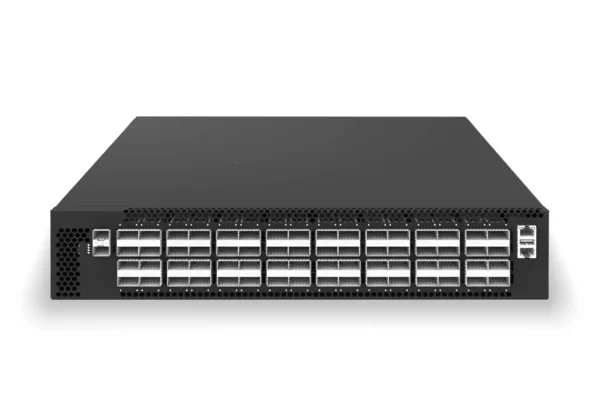
The Asterfusion AI 800G switch, based on the 51.2T Marvell Teralynx chip, provides 64×800G OSFP interfaces, supporting high-density AI training/inference clusters. The switch is a 2U form factor and can be deployed in standard racks, forming a unified solution for computing, storage, and networking.
Cooling Architecture and Switch Environment Compatibility Comparison
Traditional data centers typically use air cooling and row/column-level AC units, with hot and cold aisle containment. The room temperature is designed between 18-27°C, and aisle width is usually ≥1.2m.
For AI data centers with 30-100kW power and liquid cooling as the primary method, the Asterfusion 800G AI switch has been optimized for heat dissipation and structural design, making it compatible with liquid-cooled racks and top/mid-level cable routing. This facilitates the construction of an integrated “compute-storage-network” architecture.
Power Supply System and Switch Redundancy Design Comparison
Traditional data centers use N+1 power redundancy with a “Utility power-UPS-distribution cabinet” architecture, providing conventional power outage resilience.
AI data centers require 2N/3N power redundancy, meeting Uptime Institute Tier 3+ standards, with independent high-power distribution rooms and micro-module UPS units, designed to handle instantaneous high-power fluctuations.
The Asterfusion AI 800G switch is equipped with dual power supplies and supports 200V~320V HVDC (high voltage direct current). It ensures zero packet loss forwarding during power outages, ensuring uninterrupted AI training.
Network Topology and Switch Core Capability Comparison
(1) Basic Forwarding Capability
Traditional data centers use a three-layer architecture with multi-hop forwarding paths and millisecond-level latency.
Asterfusion switches support OSPF/BGP protocols, with port speeds of 25G/200G/400G available to support general services like file sharing and office systems, stably handling mixed business traffic.
AI data centers use lossless fat-tree topology, compliant with IEEE 802.1Qbb protocol, with end-to-end latency controlled within 10μs.
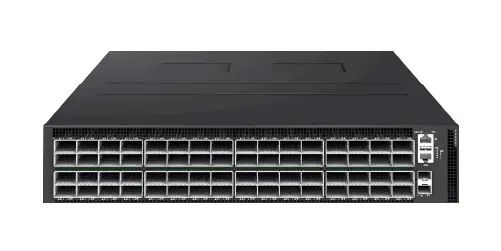
The Asterfusion AI 800G switch has a port-to-port latency as low as 560ns, supporting ECMP (Equal Cost Multi-Path) routing. It is designed specifically for GPU clusters and large model training, with no bottlenecks in computational interconnects.
(2) Lossless Transmission Capability
Traditional data center switches do not offer lossless features and allow minor packet loss, relying on TCP retransmission.
AI data centers require zero packet loss transmission and support PFC (Priority Flow Control) + ECN (Explicit Congestion Notification) dual-layer congestion control, compliant with RoCE v2 (RDMA over Converged Ethernet) protocol.
The Asterfusion AI 800G switch is equipped with intelligent lossless algorithms and over 200MB ultra-large buffer memory, significantly alleviating congestion in computational interconnects. This enhances network utilization and stability. In tests, the Token Generation Rate (TGR) when using the Asterfusion RoCE switch consistently outperformed InfiniBand during inference on the DeepSeek-R1 671B model. When the number of concurrent requests reached 100, the TGR was 27.5% higher than that of InfiniBand.
(3) High-Density Expansion Capability
Traditional data centers often use three-layer or Spine-Leaf architectures with rack-mounted switches, decoupled from servers/storage. Capacity is expanded by adding more switches or uplink bandwidth.
AI data centers typically adopt Spine-Leaf architecture but prefer deploying high-density Ethernet or InfiniBand switches at the top of the racks or in adjacent racks within the cluster or Pod. These switches are connected via 400G/800G high-speed links for lateral expansion, achieving multi-Tbps interconnect capabilities. Inside the racks/servers, GPU-GPU bandwidth is enhanced via dedicated interconnect technologies like NVLink/NVSwitch.
The Asterfusion AI 800G switch, based on a 51.2T chip, provides 64×800G OSFP ports and can connect over a hundred 400G links through breakout cables, supporting high-density 400G/800G GPU NIC interconnects. It is designed for large-scale AI clusters in Pod-level deployments.
(4) Intelligent O&M Capability
Traditional data centers primarily use CLI (Command Line Interface) management with basic SNMP monitoring, relying on manual troubleshooting.
AI data centers require standard management interfaces and visualization platforms to monitor critical network performance indicators like port traffic, latency, and packet loss in real time, with alarms.
The Asterfusion AI 800G switch is designed for such scenarios, supporting automated management through SNMP, NETCONF/YANG, and other standard interfaces. It integrates with observability platforms to monitor traffic, latency, and packet loss in real time, aiding rapid deployment of large-scale clusters and improving troubleshooting efficiency.
(5) Security Protection Capability
Many traditional data centers implement logical partitioning according to the Level 2.0 security standards, using VLANs, VRFs, and basic ACLs to achieve access control, meeting the security needs for general services like file sharing and office systems.
AI data centers, which carry sensitive training data for large models and GPU clusters, need to meet Level 3 or higher security requirements. This includes stricter network segmentation, link encryption, and fine-grained access control.
The Asterfusion AI 800G switch is designed for such environments, supporting fine-grained traffic control based on ACLs and combining micro-segmentation strategies to provide better data isolation and privacy protection for multi-tenant, multi-project large model training environments.
(6) Energy Efficiency Adaptability
Traditional data center switches typically use air cooling and high-efficiency power designs, operating stably in a 0-40°C conventional environment. They balance performance and energy consumption, adapting to traditional room cooling and power conditions.
AI data centers, with high power per rack and liquid cooling as the primary method, have high computational power that generates significant heat from GPU servers. These components are liquid-cooled via cold plates, and future immersion cooling techniques will further improve heat dissipation efficiency.
The Asterfusion AI 800G switch, under high bandwidth conditions, optimizes both energy efficiency and cooling design. It uses large-scale 3D vapor chamber heat dissipation modules and efficient air cooling systems, maintaining stable temperatures even under full load at 2180W. It achieves energy efficiency improvements, requiring only about 60% fan speed, reducing overall energy consumption and aligning with the green, low-carbon goals of AI data center construction.
Building Efficient AI Data Centers with Asterfusion AI Switches
AI Training Network
Asterfusion AI Data Center Switches, such as the CX864E-N device, are ideal for AI Training networks for the following reasons:
- Scalability
- High Bandwidth and High-Density Devices: Asterfusion provides high-density switches supporting 800G (based on the 51.2T switching chip). When designing a network for a 256K GPU-scale deployment, high-density ports significantly reduce the number of switch layers and devices, simplifying network topology.
- Multi-Layer Clos Architecture: With a standardized Clos architecture, Asterfusion supports smooth, linear scaling from tens of thousands of nodes to hundreds of thousands of nodes. The solution supports 200G/400G/800G mixed-rate networking to meet the access needs of GPUs across different generations.
- Ultra-Low Latency and Performance Optimization
- 500ns-Level Switching Latency: The CX-N series switches provide cut-through switching latency as low as 500ns, significantly reducing wait times caused by frequent synchronization during AI training.
- Rail-Optimized Design: For communication libraries like NCCL, Asterfusion uses a “rail-optimized” networking design. This approach ensures that different GPUs within the same server logically belong to the same switching plane, reducing cross-plane traffic (East-West Traffic) and long-tail latency, improving bandwidth utilization for All-Reduce operations.
- Breakthrough in Lossless Ethernet Technology & RoCEv2
- Adaptive Routing and Load Balancing: Asterfusion integrates the following technologies to address traditional Ethernet congestion issues:
- ARS (Adaptive Routing Switching): Dynamically adjusts paths based on Flowlet technology to avoid link congestion.
- ALB (Adaptive Load Balancing): Works with INT (In-band Network Telemetry) technology to enable real-time traffic optimization.
- EasyRoCE Toolkit: Solves the complex configuration issues of RoCE networks (RDMA over Converged Ethernet), providing automatic synchronization and visual monitoring, ensuring zero packet loss even in large-scale environments.
- Adaptive Routing and Load Balancing: Asterfusion integrates the following technologies to address traditional Ethernet congestion issues:
- Open Networking and Software Defined
- Enterprise-Grade SONiC (AsterNOS): Running on an open-source SONiC-based network OS, Asterfusion’s fully decoupled architecture avoids vendor lock-in, allowing enterprises to deeply customize and automate integration with their AI scheduling platforms (AIOS).
- Flexible Containerized Architecture: Supports third-party application extensions, making it easy to deploy telemetry or security plugins directly on the network side.
- High Cost-Performance and Energy Efficiency
- InfiniBand Replacement: In real-world training scenarios like Llama2, Asterfusion’s RoCE Ethernet solution provides performance equivalent to expensive InfiniBand, and in some configurations, outperforms it due to superior routing strategies.
- Lower TCO: Leveraging a standard Ethernet ecosystem significantly reduces both construction and operational costs.
For more details, refer to: How Asterfusion Designs a 256K-GPU Ultra-Ethernet AI Training Network

AI Inference Network
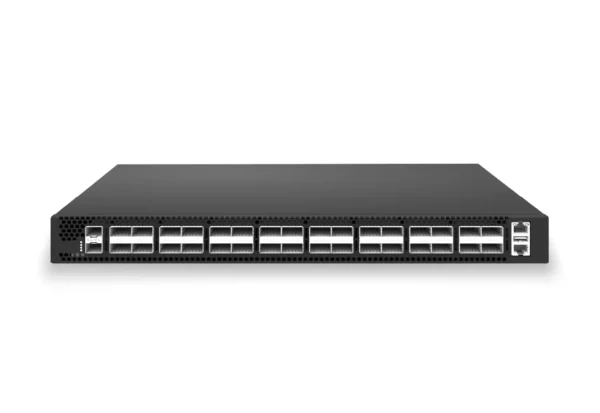
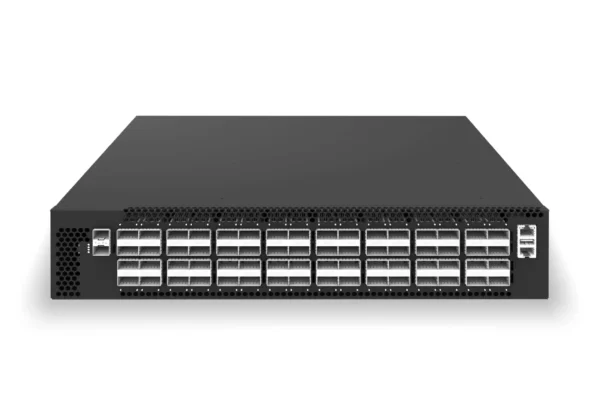
Based on our past customer practices and validations, it has been proven that devices like the CX532P-N, CX564P-N, paired with the ToR switch CX308P-48Y-N-V2, are well-suited for building AI inference networks.
- Exceptional Performance (Token Generation Rate and Latency) : The core metrics for AI inference are first-word latency (TTFT) and Token generation rate (TGR). Asterfusion’s solution performs excellently in real-world tests:
- Deep Optimization for MoE Architecture: Modern large models often adopt the MoE (Mixture of Experts) architecture, which generates massive All-to-All communications during inference.
- Non-blocking Forwarding: Asterfusion solves link congestion in MoE architecture with INT-driven adaptive routing and Packet Spray technologies.
- Precise Scheduling: It intelligently identifies the traffic characteristics of Prefill (pre-fill) and Decode (decoding) stages and applies differentiated QoS priority handling.
- High Cost-Effectiveness (Low TCO): Inference clusters are typically large-scale and cost-sensitive, and Asterfusion achieves “high-performance alternatives” using Ethernet:
- Significant Cost Reduction: Compared to expensive private InfiniBand networks, Asterfusion’s solution reduces construction costs by over 70%.
- Lower Operational Threshold: Operating staff do not need specialized training in InfiniBand technology, and existing automation tools like K8s and Prometheus can be reused.
- High Reliability and Multi-Tenant Isolation: Inference networks often need to carry requests from different customers:
- Multi-Tenant Isolation: By using VXLAN EVPN architecture, Asterfusion achieves logical isolation in the physical network, ensuring security and independence between different AI workloads.
- Linear Scalability: The solution supports ultra-large Spine-Leaf routing and can easily scale to 1000+ nodes, meeting the horizontal scalability needs of inference compute.
- User-Friendly EasyRoCE Technology Stack: Asterfusion provides the EasyRoCE toolkit to address the pain points of traditional RoCE network configuration and troubleshooting:
- Automated Configuration: Automatically synchronizes network parameters to ensure zero packet loss in RDMA traffic over Ethernet.
- End-to-End Monitoring: Full-process coverage from planning to operation, reducing deployment complexity for large-scale AI compute networks.
For more details, refer to Building a Future-Proof AI Inference Network

Conclusion
Asterfusion’s full range of AI switches (25G/100G/200G/400G/800G, and future 1.6T models) empowers the construction of next-generation AI data centers. From computing interconnects, heat dissipation adaptation, and power redundancy to intelligent operation, Asterfusion’s solutions comprehensively meet the core requirements for high-density, high-speed, lossless networking.

32-Port 400G QSFP-DD Data Center Switch for AI/ML Enterprise SONiC Ready
The Asterfusion CX732-N is a 32 x 400G QSFP-DD interfaces data center switch designed for the super spine layer in the next-generation cloud data center CLOS network. It offers low latency and boasts a line-rate L2/L3 up to 12.8Tbps switching performance by powerful Marvell Teralynx chip. This switch supports ROCEv2 and EVPN Multi-homing, with Enterprise SONiC NOS pre-installed. With its cost-effective nature,it stands out as the most affordable and efficient 400G open network switch for data center fabric.
With 64-port 800G configurations, 560ns port-to-port latency, and the EasyRoCE one-click deployment technology stack, Asterfusion achieves exceptional performance in real-world scenarios, with a 27.5% improvement in Token Generation Rate and a 20.4% reduction in single-token inference latency.
Supporting a 256K GPU cluster, Asterfusion ensures rail optimization and adaptive routing, providing accurate scheduling for both MoE inference scenarios and Prefill/Decode scheduling. Through hardware breakthroughs and software optimizations, Asterfusion builds a stable foundation for highly efficient AI networks.
With liquid-cooled data center deployments, power redundancy, security, and comprehensive technology, Asterfusion offers a high-reliability, low TCO solution to accelerate compute scaling and drive industry adoption.

Contact US !
- To request a proposal, send an E-Mail to bd@cloudswit.ch
- To receive timely and relevant information from Asterfusion, sign up at AsterNOS Community Portal
- To submit a case, visit Support Portal
- To find user manuals for a specific command or scenario, access AsterNOS Documentation
- To find a product or product family, visit Asterfusion-cloudswit.ch


