Table of Contents
Picking up from our previous discussion, we explored what a COM Express Type 7 module is, why it is needed, and how it works. We also introduced our ARM-based COM Express Type 7 module. For more details:What is a COM Express Type 7 Module? Why Do We Need It?
Where exactly can the Asterfusion CME102 be deployed? As a masterpiece that perfectly fuses the server-class computing power of the Marvell® OCTEON™ 10 DPU with the standard modular architecture of COM Express®, the CME102’s primary battlegrounds span all key network nodes—from enterprise data centers to the rugged polar edge.
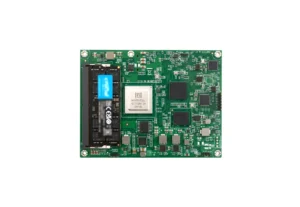
1. White-Box Network Switches: Highly Reliable Control Plane CPU
In modern open networking architectures, the CME102 and high-speed switching ASICs (such as Broadcom or Marvell switching chips) form a classic “brain and muscle” collaborative model.
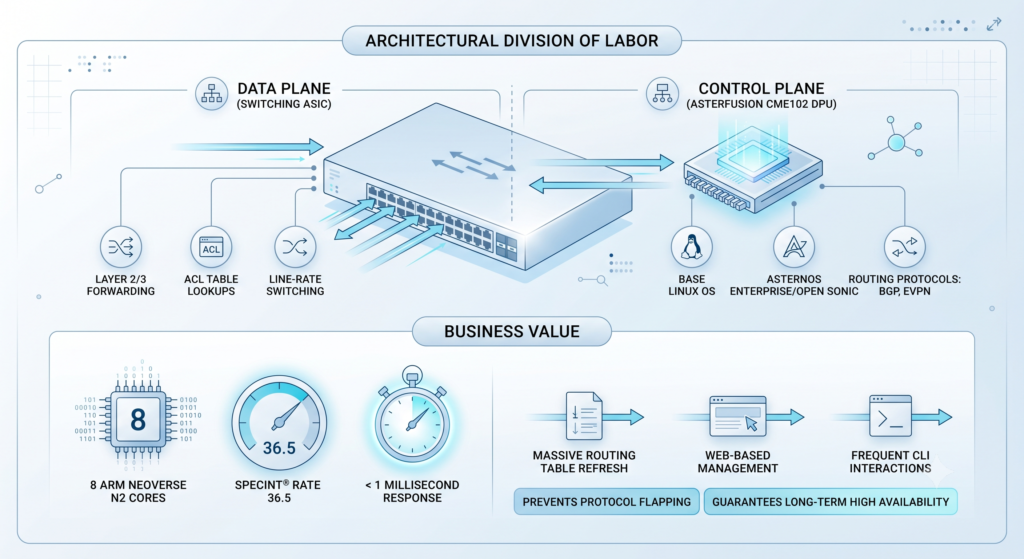
- Architectural Division of Labor: The switching ASIC focuses on Layer 2/3 high-speed forwarding, ACL table lookups, and line-rate switching on the data plane. Meanwhile, the CME102 acts as an independent control plane core, responsible for running the base Linux OS, for example : AsterNOS Enterprise/ SONiC network operating system, and complex routing protocol stacks like BGP and EVPN.
- Business Value: Powered by 8 Arm Neoverse N2 cores delivering exceptional single-core performance (SPECint® rate 36.5), it ensures that the control plane response remains at the millisecond level—even during massive routing table dynamic refreshes, frequent CLI interactions, or heavy Web-based centralized management. This effectively prevents protocol flapping caused by computing bottlenecks, guaranteeing long-term high availability of the equipment.
2. Next-Generation Firewalls & Security Gateways (NGFW / UTM / Security Gateway): The Home Turf for Hardware Offloading at Network Boundaries
For boundary security appliances that require both stateful inspection and deep security defense, the CME102 is the ultimate weapon to break traditional performance deadlocks.
- Traditional Bottlenecks: Legacy architectures rely on general-purpose CPUs (like Intel Xeon) to run software protocol stacks. When facing massive concurrent NAT translations, multi-protocol service access, and DPI (Deep Packet Inspection), the CPU can easily become instantly overloaded, causing latency to skyrocket. Once full security inspection profiles are enabled, the overall throughput typically collapses by over 70%, trapping the system in a deadlock where compute and forwarding throttle each other.
- The CME102 Solution: Leveraging the strict control-and-forwarding separation design of the Marvell OCTEON 10 CN102, it implements hard-core heterogeneous division of labor inside a single SoC:
- Control Plane (Background): 8 server-class Neoverse N2 cores focus on running management interfaces (Web/CLI), configuring security policies, and calculating routing protocols.Data Plane (Foreground): The most compute-heavy network packet processing (Hardware VPP) and stateful security flow processing are fully offloaded to the on-chip dedicated hardware acceleration engines (Hardware Engines).
-
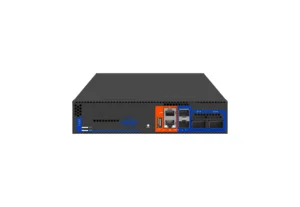 8 Core Arm Neoverse N2 Open Intelligent Gateway Based on Marvell OCTEON 10 CN103
 -
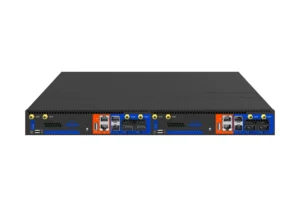 2 x 8 Core Arm Neoverse N2 Open Smart Gateway/Router Based on Marvell OCTEON 10 CN103
 -
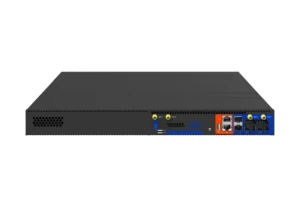 8 Core Arm Neoverse N2 Open Intelligent Gateway/Router Based on Marvell OCTEON 10 CN103
 -
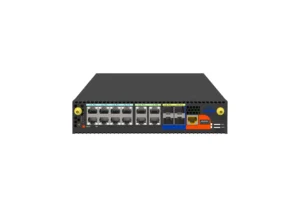 8 Core Arm Neoverse N2 Open Intelligent Gateway Based on Marvell OCTEON 10 CN102
3. Boundary Routers & SD-WAN Gateways: Commercial Cryptography-Grade Inline IPsec Tunnel Encryption Nodes
In scenarios involving multi-branch interconnection, hybrid cloud access, and cross-border networking, data transmission security and real-time performance are paramount.
- Application Edge: Traditional SD-WAN gateways struggle when handling a vast number of IPsec VPN tunnels, as software encryption aggressively consumes CPU cycles. The CME102 integrates a commercial cryptography-grade, dedicated Inline IPsec hardware encryption/decryption engine.
- Business Value: Whether dealing with complex key negotiations or heavy data stream encryption under high bandwidth, tasks are instantly offloaded via the hardware acceleration engine. This enables edge routers and SD-WAN appliances to maintain full line-rate forwarding with zero packet loss even with tunnel encryption maxed out, serving as a robust foundation for building high-performance, ultra-secure, and regulatory-compliant network pipelines.
4. Distributed Storage Systems & Flash Arrays (NAS / SAN / All-Flash Storage): Standard Distributed Storage Control Brain
In modern distributed storage (such as Ceph, ZFS) or All-Flash Storage arrays, high-performance network throughput and metadata management similarly demand a powerful yet low-power computing heart.
- Architectural Division of Labor: The CME102 is not designed to replace flash master controllers; instead, it acts as the master control brain of the storage server (Storage OS CPU), responsible for running Linux, Ceph service processes, RAID algorithms, and granular data management services.
- Business Value: Paired with high-bandwidth DDR5 ECC memory and native on-chip high-speed network channels, it interfaces seamlessly with NVMe SSD arrays. It delivers abundant protocol stack processing capabilities and high-speed data flow routing at a minimal power consumption cost, completely eliminating network I/O bottlenecks in storage performance.
5. 5G Small Cells, vRAN, & MEC (Edge Computing): Ultra-High Energy Efficiency Micro-Server Core
In 5G fixed-mobile convergence and edge computing scenarios, environmental factors impose strict physical constraints on equipment size, power consumption, and heat dissipation.
- Application Edge: Utilizing the standard COM Express® Type 7 modular design, the CME102 features an incredibly high density of high-speed I/O (integrating 4x 10G network ports and rich PCIe lanes on-chip). This allows equipment manufacturers to rapidly build micro-server hardware via a drop-in, plug-and-play approach.
- Business Value: Benefiting from the generational dividends of the advanced 5nm process, its thermal design power (TDP) is locked tight under the 33W threshold, enabling excellent fanless-capable design. In scenarios like BBU splitting, lightweight User Plane Function (UPF) localization, or MEC edge nodes, it provides robust containerized application (Kubernetes) scheduling and traffic distribution capabilities within a highly constrained power envelope.
6.AI Edge Boxes & Industrial Controllers : Highly Reliable Compute Base for Harsh Operating Conditions
In typical industrial and outdoor settings—such as smart factories, transportation, and roadside deployments—equipment must withstand harsh conditions including dust, high temperatures, and high humidity.
- Application Edge: Traditional x86 solutions, with power consumption easily reaching 50W–70W+, force devices to rely on mechanical fans for active cooling. However, in industrial and outdoor settings, fans are vulnerable points of failure; if a fan breaks, the entire device quickly overheats and fails.
- Business Value: Thanks to its ultra-low 33W power consumption and fanless operation, the CME102 allows devices to be completely sealed inside fully enclosed industrial metal enclosures. Equipment vendors can leverage this to develop long-lifespan, dust-proof, and moisture-proof high-reliability AI Edge Boxes or industrial controllers that smoothly execute edge data collection, traffic filtering, and lightweight AI inference algorithms.
Asterfusion ARM COM Express Type 7 CME102’s Application & Function Mapping
| Device / Scenario | Role & Function of CME102 |
| Switches | Control Plane CPU; runs network OS and routing protocols. |
| Routers | Data plane acceleration; runs Routing and VPP control. |
| Gateway | Gateway services control; offloads intensive NAT and multi-protocol access. |
| Firewalls / NGFW / UTM | Security policy enforcement, DPI control, and VPN tunnel management. |
| SD-WAN | Edge computing node; offloads high-throughput Inline IPsec encryption. |
| Storage Devices | Host controller; runs Storage OS (Ceph/ZFS) and manages data services. |
| Edge Servers | Low-power compute core; powers localized containerized (K8s) workloads. |
| 5G Equipment | Core processor for vRAN, UPF, and MEC edge applications. |
| Industrial Devices | Ruggedized master control paired with edge AI computing algorithms. |
| AI Edge Boxes | Dedicated compute engine for real-time edge inference and video analytics. |
Now that we have a clear blueprint of the CME102’s hardware highlights and its versatile deployment across next-generation open networking, a critical, elephants-in-the-room question inevitably surfaces for many system architects: “Is ARM’s raw performance inherently weaker than x86?” It is a valid hesitation born out of years of x86 dominance in the server market.
However, when it comes to dedicated networking workloads, looking only at generic CPU benchmarks is a trap. To dismantle this misconception and guide your upcoming hardware evaluation, let’s dive into a head-to-head architectural showdown:
ARM COM Express Type 7 vs x86 COM Express Type 7: Which to Choose?
ARM vs x86 COM Express Type 7: 4 Key Differences on Which to Choose?
Intel Xeon D Alternative: Asterfusion ARM COM Express Type 7 DPU
Intel Xeon D Alternative: Asterfusion COM Express Type 7 DPU Powered by Marvell Octeon CN102


