Table of Contents
In today’s networks, precise time synchronization is no longer just a “nice-to-have” — it’s the lifeblood. It directly determines whether data arrives accurately, keeps latency ultra-low, and reliably powers demanding applications like live streaming, on-demand video platforms (Netflix, iQiyi, YouTube, etc.), 5G, industrial automation, Time-Sensitive Networking (TSN), smart grids, and high-frequency financial trading. The three most widely adopted and mature synchronization technologies in the industry right now are:
- PTP (Precision Time Protocol, IEEE 1588)
- SyncE (Synchronous Ethernet)
- GNSS (Global Navigation Satellite System — GPS, BeiDou, Galileo, GLONASS, etc.)
Asterfusion’s switches natively support PTP, SyncE, and GNSS all in our SONiC based switches , delivering frequency, phase, and absolute time synchronization at nanosecond accuracy from a single device. This empowers customers to easily reach top-tier network precision, unlock true service differentiation, and deliver extreme user experiences. Next, let’s break down what these three technologies actually are, how they differ, how to choose the right one (or the right mix) for your scenario, and which combinations work best in the real world.
What is PTP ? – High-Precision Distributed Clocks for Time-sensitive Networks
PTP (Precision Time Protocol, IEEE 1588) is a protocol that achieves frequency, phase, and time synchronization across a network using data packets. It employs a master-slave clock architecture (Grandmaster, Boundary, Slave) and relies on dedicated synchronization messages in combination with hardware timestamping to maintain network-wide consistency at the nanosecond level—with actual precision depending on the device’s timestamping capability.
PTP can operate over Layer 2 or Layer 3 networks and supports different profiles based on the application scenario, such as G.8275.1 (full timing support) and G.8275.2 (partial timing support).
Because it can be flexibly deployed over existing networks without requiring all links to be upgraded—particularly advantageous in PTS mode—PTP has become a core synchronization technology for scenarios that demand strict time alignment, including streaming and live broadcast, 5G, O-RAN, TSN, power systems, data centers, and financial trading.

What Is SyncE?- A Physical-Layer Clock Designed for Frequency Synchronization
SyncE (Synchronous Ethernet, ITU-T G.8262/G.8264) is a technology that provides frequency synchronization at the Ethernet physical layer (Layer 1). While its overall purpose is similar to PTP, its focus is fundamentally different: PTP delivers time synchronization, whereas SyncE delivers frequency synchronization.
SyncE derives and distributes a highly stable bit clock from the line signal and uses the ESMC channel to carry QL (Quality Level) information to ensure synchronization quality across the network. Because synchronization information is transmitted at the physical layer, SyncE is immune to network traffic load, congestion, or packet jitter, offering an extremely stable frequency source. However, it only addresses frequency alignment and does not provide phase or time synchronization.
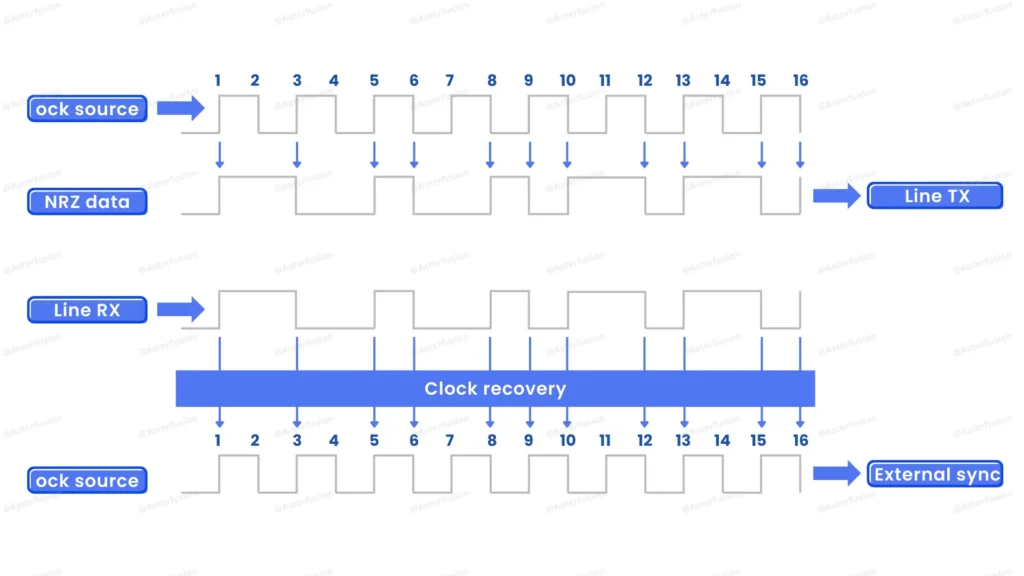
For this reason, SyncE is commonly used in transmission networks that demand exceptional frequency stability, such as traditional telecom transport networks. In many modern synchronization architectures, a typical approach is to use SyncE as the base frequency source and rely on PTP to provide phase and time alignment. This “frequency + time” combination is now widely adopted in carrier-grade networks.
What Is GNSS? -The Network’s Source of Absolute Time
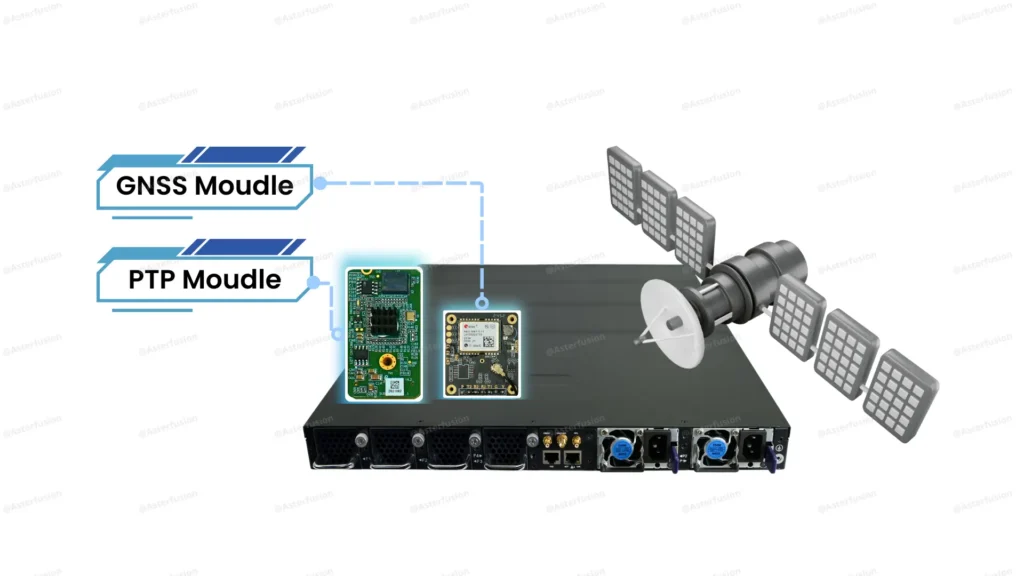
GNSS refers to Global Navigation Satellite Systems such as GPS, GLONASS, or Galileo. These systems deliver absolute time, frequency, and phase references via satellite signals. GNSS is commonly used as a high-precision external clock source and typically serves as the Primary Reference Clock (PRC) for the entire network. You can think of it as the network’s “master clock.”
GNSS can achieve microsecond-level accuracy, but it depends on clear satellite visibility and is vulnerable to interference, spoofing, and weather conditions. In addition, its signal attenuates over long transmission distances.
How Should I Choose from PTP, SyncE and GNSS?
| Aspect | PTP (Precision Time Protocol) | SyncE (Synchronous Ethernet) | GNSS (Global Navigation Satellite System) |
| Sync Type | Frequency, phase, and time | Frequency only | Absolute time, phase, and frequency |
| Operating Layer | L2 / L3 (packet-based) | Layer 1 (physical layer) | External satellite signals |
| Accuracy | Sub-microsecond to nanosecond (depends on HW timestamping) | Very stable frequency (no phase/time) | Microsecond-level (depends on receiver) |
| Network Dependency | Affected by delay, jitter, congestion (mitigated by TC/BC) | Not affected by traffic (pure L1) | Not dependent on network, but requires sky view |
| Transmission Distance | Unlimited across networks | Requires hop-by-hop SyncE support | Global coverage (satellite-based) |
| Robustness | High with redundant paths | Very high (physical layer) | Vulnerable to jamming/spoofing, weather effects |
| Hardware Support Needed? | Yes – hardware timestamping in switches (BC/TC/GM mode) | Yes – SyncE-capable PHY & ESMC support | Yes – GNSS receiver/module, antenna, 1PPS/ToD |
| Typical Applications | Media studios, video streamingsynchronization,5G/4G mobile backhaul, O-RAN, financial trading, live broadcast production, | Telecom transport networks, mobile backhaul, stable frequency distribution | Primary reference clock (PRC), data centers, telecom timing rooms |
| Strengths | Full time/phase sync, flexible deployment, high precision | Ultra-stable frequency, immune to network load | Highest accuracy absolute time, UTC traceable |
| Limitations | Sensitive to network behavior without proper design | No phase/time sync; needs end-to-end support | Satellite visibility issues; susceptible to interference |
| Asterfusion Model Support | CX-M | CX102S-8GT / CX102S-16GT / CX102S-8MT / /CX204Y-24GT / CX206Y-48GT / CX206P-48S / CX306P-48Y-M/CX202P-24Y/ CX204P-16Y / CX-N series / ET2500/ ET3608 | CX306P-48Y-M-H |
Here’s a straightforward way to pick the right technology (or combination) based on what your application actually needs:
- You need precise phase and absolute time alignment → Choose PTP (IEEE 1588) If your application cannot tolerate even tiny time offsets (phase or ToD), PTP is the answer. It delivers sub-microsecond down to nanosecond-level synchronization purely over existing L2/L3 packet networks using hardware-timestamped messages. Perfect scenarios:
- 4G/5G backhaul & midhaul/fronthaul (especially TDD air-interface timing)
- O-RAN radio units (O-RU) synchronization
- Time-Sensitive Networking (TSN) and industrial automation
- Power utility substations (IEC 61850)
- Live broadcasting & streaming production (multi-camera sync, seamless playout/switching)
- Financial trading timestamping (MiFID II, SEC rules) Bottom line: whenever devices must share an exact notion of “what time is it right now” and “exactly when did this event happen,” PTP is the go-to solution.
- You only need rock-solid frequency synchronization (no phase or ToD required) → Choose SyncE SyncE distributes frequency at the physical layer (Layer 1). It is completely immune to packet delay, jitter, or network congestion. Ideal for:
- Legacy transport networks (SDH/PDH replacement)
- High-stability optical networks
- Providing a clean frequency foundation before layering PTP on top If your only goal is “make sure every node runs at exactly the same clock rate,” SyncE is simpler, more robust, and often cheaper.
- You need an ultimate source of UTC time for the entire network → Choose GNSS GNSS (GPS, BeiDou, Galileo, GLONASS) provides the authoritative Coordinated Universal Time (UTC) reference and 1PPS signals. Typical roles:
- Primary Reference Clock (PRC/PRTC) in telco core sites and large data centers
- Feeding the Grandmaster for PTP and/or SyncE Drawbacks: requires roof antennas, vulnerable to jamming/spoofing/weather, so it should never be your only source. Treat GNSS as the “root of trust” for UTC, not the sole sync mechanism.
Recommended Real-World Combinations
For the most demanding applications (especially mobile backhaul/fronthaul and O-RAN): SyncE for frequency + PTP for phase & time This combo routinely achieves end-to-end accuracy of ≤10–30 ns and is the de-facto standard for modern 5G networks. In short:
- Phase/time critical → PTP (add GNSS as root)
- Frequency only → SyncE
- Need both extreme accuracy and resilience → SyncE + PTP + GNSS backup
Pick according to your precision requirements, and you’ll never go wrong.
Asterfusion PTP-Based SONiC Network Switches: High-Precision Synchronization for Modern Enterprises
Asterfusion Enterprise SONiC provides a comprehensive and flexible implementation of PTP (Precision Time Protocol), supporting all key clock roles, including Grandmaster (GM), Boundary Clock (BC), Transparent Clock (TC), and Ordinary Clock (OC). This ensures seamless adaptation to any network architecture. AsterNOS supports both one-step and two-step timestamping, as well as End-to-End (E2E) and Peer-to-Peer (P2P) delay measurement modes, offering deployment flexibility for networks with varying precision requirements.
Our solution fully complies with mainstream PTP profiles such as IEEE 1588v2, ITU-T G.8275.1, and SMPTE ST2059-2, and supports multiple concurrent PTP instances, effectively avoiding PTP domain conflicts. This makes it ideal for broadcast media, 5G communications, and industrial IoT environments where multiple services coexist.
Performance Highlights
- Synchronization accuracy: better than ±20 ns, suitable for applications extremely sensitive to latency such as video production, PMU (Phasor Measurement Unit), and mobile wireless access.
- Each device supports up to 48 concurrent slave clocks, enabling scalable, high-performance, and cost-effective clock distribution in large clustered networks.
For more: How to Deploy PTP Network Switches with SONiC for Nanosecond-Perfect Timing
Product | PTP Time Synchronization ITU Classification | Description |
Class A | • Support different access rates and enabling flexible deployment across diverse application scenarios • Optional PTP module supports SyncE | |
Class C |
In 5G and future telecom networks, ITU standards G.8273.2/3 define Class A/B/C clocks with Time Errors of ≤50/20/10 ns to meet varying synchronization accuracy needs. →For More
Asterfusion Supported Switch Models with SyncE
Our switches support both IEEE 1588v2 and SyncE in 5G / O-RAN scenarios, serving as the core component of a Grandmaster + Carrier Ethernet Switch. SyncE provides frequency synchronization at the physical layer (Layer 1), independent of network congestion, complementing PTP phase/time synchronization.
- Ease of Configuration: SONiC’s open architecture and AsterNOS programmability make SyncE setup straightforward, including ESMC message channels and QL level exchange. Hardware supports per-hop frequency regeneration, combined with GNSS as the Primary Reference Clock (PRC) for UTC traceability.
SynE Example Models: CX102S-8GT / CX102S-16GT / CX102S-8MT /CX204Y-24GT / CX206Y-48GT / CX206P-48S / CX306P-48Y-M/CX202P-24Y/ CX204P-16Y / CX-N series / ET2500/ ET3608
Asterfusion PTP+SynE Hybrid Models:
Hybrid Mode: Combining PTP + SyncE ensures full synchronization (frequency + phase) with ≤20 ns error. It provides frequency + phase + time synchronization, ideal for precision-synchronized networks in 5G, O-RAN, industrial IoT, financial trading, media production, and similar latency- and timing-sensitive applications.
Example Models: CX102S-8GT / CX102S-16GT / CX102S-8MT /CX204Y-24GT / CX206Y-48GT / CX206P-48S / CX306P-48Y-M/CX202P-24Y/ CX204P-16Y
Asterfusion GNSS-Enabled Switches – CX306P-48Y-M-H
The CX306P-48Y-M-H platform provides hybrid support for pluggable GNSS and PTP modules.

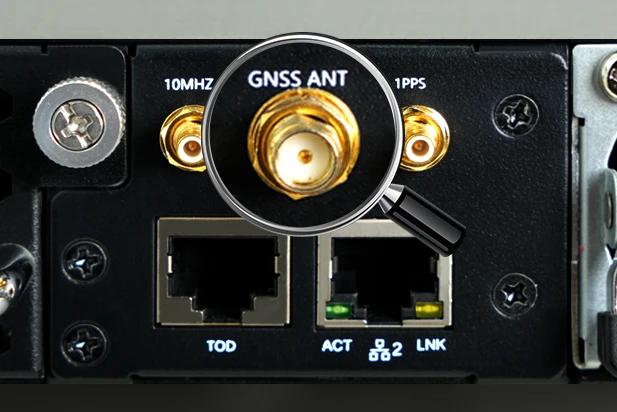
As shown on the rear panel, it features a GNSS antenna SMA connector for connecting an external GNSS antenna. The platform supports simultaneous reception of GPS/QZSS, GLONASS, BeiDou, and Galileo signals.
The platform also integrates a dedicated PTP (IEEE 1588v2) module for generating and distributing high-precision time signals across the network.
During operation, the antenna receives satellite signals, which are processed by internal circuitry and fed into the GNSS module to obtain UTC time synchronized with satellites, serving as the system reference clock. The PTP module then processes this reference time and delivers it to the ASIC, enabling time distribution over the network with approximately 20 ns accuracy.
Currently, our time synchronization solution has been deployed in the media industry and is also well suited for 5G O-RAN fronthaul, financial timestamping, and other latency- and precision-critical scenarios. For more: https://cloudswit.ch/blogs/gnss-switch-with-ptp-for-switching-and-routing/
Upgrade to Asterfusion switches and embrace a zero-latency synchronized future! Contact us now for a SONiC PTP / SyncE / GNSS deployment demo or a customized quote.


